BOEING: A DANGER TO ALL?

As I imagine you know, there have been several problems with Boeing aircraft in the last six years. This has led to serious concerns about Boeing’s commitment to safety and quality in its manufacturing. There’s quite a bit of evidence that it’s been cutting corners to maximize profits. Among other things, several whistleblowers have come forward with solid evidence of Boeing management’s lack of concern about safety and quality. What you may not know is that two of those whistleblowers have died in the last two months in unusual circumstances that have raised questions about how far Boeing would go to cover up its culpability for the accidents with Boeing planes.

(Note: If you find my posts too long to read on occasion, please just skim the bolded portions. Thanks for reading my blog! Special Note: The new, more user-friendly website for my blog is here.)

You probably remember the Boeing 737 Max airliner crashes in 2018 and 2019 that killed 346 people and the January 2024 Alaska Airlines 737 Max door plug blow out while in flight that left a gaping opening in the plane’s fuselage. There have been other incidents with Boeing planes that you may not have heard about including a jammed rudder on a 737 Max that caused a near miss in Newark in March, an emergency landing of a San Francisco to Boston flight after a report of a wing coming apart, and a malfunctioning de-icing system. Boeing has also failed 33 of 89 Federal Aviation Administration (FAA) audits.

As a result of all this, Boeing is under intense scrutiny for its apparent lack of commitment to safety and willingness to cut corners to reduce costs and increase profits. Over the past 10 years, Boeing’s profits have allowed it to buyback $39 billion of its own stock and pay another $20 billion to its shareholders in dividends. Boeing spent $26.6 million on lobbying with 17 lobbying firms in 2021 and 2022. Since 2010, it’s spent over $200 million on lobbying. It’s also spent $30 million on campaign contributions since 2010. So, it’s not like Boeing is running on a shoe string and can’t afford to pay attention to quality and safety.

But there’s no way that Boeing would murder a prominent whistleblower or two, is there? This question was first raised in March 2024 when a Boeing whistleblower died of an apparent suicide that was a total shock and unbelievable to everyone who knew him. [1] Then, in early May, a second Boeing whistleblower died after a short and unusual illness. Meanwhile, serious and potentially very damaging  investigations of Boeing’s quality control and commitment to safety in building its aircraft are ongoing.

In the March case, John Barnett, who had worked at Boeing for 28 years when he retired in late 2016, was found dead of an apparent suicide. Friends and his lawyer find it impossible to believe that he committed suicide. Circumstances also make it incongruent. He had filed a whistleblower complaint against Boeing in 2017 asserting a lack of commitment to safety in the manufacturing of its 787 Dreamliner airplane. (What he saw was so bad that he now refuses to fly.) In March, the case was about to go to trial after seven years of work and there was every reason to believe his safety concerns would be substantiated. His lawyer stated, “He was in very good spirits and really looking forward to putting this phase of his life behind him. We didn’t see any indication that he would take his own life. … No one can believe it.” [2] A family friend told a Charleston, SC, TV station reporter that Barnett had said to her that if he died it wouldn’t be suicide. [3]

He spent the last seven years of his Boeing career supervising 10 to 12 quality assurance inspectors at the North Carolina plant where final assembly of the 787 Dreamliner aircraft was done. Boeing had relocated the plant to North Carolina to avoid unionization. However, skilled machinists were not readily available, so insufficiently skilled workers were hired instead. Therefore, quality problems were frequent.

Boeing management made it clear that they felt that quality assurance was unnecessary. Barnett described how his quality assurance team was taken off the job after finding 300 defects on a fuselage section. He also described how Boeing managers allowed the use of parts that had been identified as defective. In 2014, he was reprimanded for documenting violations in writing, which violated Boeing’s policy of non-documentation. (Note: In the National Transportation Safety Board (NTSB) investigation of the incident where a “door plug” blew out of an Alaska Airlines plane’s fuselage in flight, Boeing was accused of refusing to cooperate because it failed to produce requested documents. However, it stated it was cooperating but did not have the requested documents because it does not document the repairs and procedures about which the NTSB was asking.)

Barnett’s battles with Boeing management were so stressful that he retired early at 55 and filed a whistleblower complaint. What made Barnett a particularly effective whistleblower was that he had documentation of his concerns, totaling thousands of pages.

More recently, in early May, Joshua Dean, a 45-year-old former quality auditor at a Boeing supplier, Spirit AeroSystems in Wichita, KS, died after a short and unusual illness. He had filed a complaint with the FAA alleging “serious and gross misconduct by senior quality management of the [Boeing] 737 [Max] production line.” He was concerned about manufacturing defects in the construction of the planes. Dean was fired by the Boeing supplier last year and filed a complaint with the Labor Department alleging that his termination was retaliation for raising safety concerns. [4]

In April, another Boeing whistleblower, Sam Salehpour, testified before Congress that there was “no safety culture” at Boeing; that employees who raised safety concerns were “ignored, marginalized, threatened, sidelined and worse;” and that he feared “physical violence” after stating his concerns publicly.

I urge you to contact President Biden and urge him to order a thorough Department of Justice and FAA investigation into the quality and safety problems with Boeing’s aircraft and its culpability for them. Please tell him that any penalties need to be sufficient to deter such future behavior by Boeing (as well as by corporations in general). A slap on the wrist and penalties that can be considered a cost of doing business have not deterred corporate bad behavior in the past. You can email President Biden at http://www.whitehouse.gov/contact/submit-questions-and-comments or you can call the White House comment line at 202-456-1111 or the switchboard at 202-456-1414.

[1]      Tkacik, M., 3/14/24, “The strange death of a Boeing whistleblower,” The American Prospect (https://prospect.org/justice/2024-03-14-strange-death-boeing-whistleblower/)

[2]      Tkacik, M., 3/14/24, see above

[3]      Emerson, A., 3/14/24, “ ‘If anything happens, it’s not suicide’: Boeing whistleblower’s prediction before death,” ABC News 4, Charleston, SC (https://abcnews4.com/news/local/if-anything-happens-its-not-suicide-boeing-whistleblowers-prediction-before-death-south-carolina-abc-news-4-2024)

[4]      Rushe, D., 5/2/24, “Second Boeing whistleblower dies after short illness,” The Guardian (https://www.theguardian.com/business/article/2024/may/02/second-boeing-whistleblower-dies)

OUR DEMOCRACY’S CHALLENGES Part 3: GERRYMANDERING AND HOW TO STOP IT

Demonstrators protest during a Fair Maps rally outside the U.S. Supreme Court, in Washington, U.S., March 26, 2019. REUTERS/Brendan McDermid – RC16A5DDD500

Our democracy’s challenges are serious and longstanding. This post describes ways to stop the gerrymandering of U.S. House and state legislative districts and its subversion of democracy. This previous post presented an overview of the challenges to our democracy, including the undemocratic selection of the president via the Electoral College (as well as how to fix this). Another previous post described the lack of fair representation in Congress, including due to the gerrymandering of House district boundaries.

(Note: If you find my posts too long to read on occasion, please just skim the bolded portions. Thanks for reading my blog! Special Note: The new, more user-friendly website for my blog is here.)

In our democratic republic, where power is placed in the hands of elected representatives, fair representation requires that our elected officials accurately represent the population’s characteristics –politically, racially, gender wise, etc. Gerrymandering of some U.S. House districts and some state legislative districts (some of it quite extreme) means that representation is not fair and democracy is subverted.

Fair and competitive elections are necessary for a healthy democracy as they ensure that the will of the voters is reflected in their elected representatives. One outcome of gerrymandering is that very few elections are competitive as districts are drawn to predetermine the outcome. In 2022, only 30 out of the 435 U.S. House seats had a margin of victory of less than four-percentage points (i.e., 52% to 48% or closer). [1]

The boundaries of U.S. House and state legislative districts are redrawn every ten years based on data from the decennial Census. The drawing of boundaries is done by the states and historically by state legislators. Given growing partisanship and a Voting Rights Act seriously weakened by the Supreme Court, legislators in some states, aided by the enhanced capabilities of computers to process very detailed data and maps, have engaged in extreme and effective gerrymandering for partisan advantage. The best estimates are that in the 2022 elections, through gerrymandering, Republicans captured between 15 and 20 more seats in the U.S. House (out of 435) than would have been expected otherwise. This gave them a majority, and therefore control, in the House by just five seats. In the U.S. House, and at the state legislature level as well, it’s clear that gerrymandering can dramatically affect the partisan control of legislative chambers. (See this previous post for more details.)

One result of super-charged gerrymandering has been that redistricting maps are much more frequently challenged in court. When courts find districts illegal and require them to be redrawn, the once-in-ten-years change in districts can become a change in districts every two years for each election. [2] However, some of these court cases can drag on for years.

The most common way to combat gerrymandering is to remove the power to draw district maps from state legislators, who are inherently partisan, and instead have an independent commission draw them. Eight states (AK, AZ, CA, CO, ID, MI, MT, and WA) have done so through legislation or ballot initiatives. Common Cause is one organization that has mobilized and supported efforts to create independent redistricting commissions. Key elements of an effective and truly independent commission include:

  • Politicians are prohibited from participating in or influencing the process, and the commission has the ultimate power to establish district boundaries;
  • Commission members are non-partisan or some members with a balance of party affiliation are included;
  • Strong conflict of interest rules are in place for commission members; and
  • The process is public and open so regular citizens can have input, as well as monitor progress and decision-making.

Independent commissions have worked extremely well when they are well insulated from political influence. When they aren’t, the process can devolve into partisanship and gridlock. [3] Districts drawn by well-designed independent commissions result in fairer representation of a state’s population, more competitive elections, fewer court challenges (and fewer successful ones) of redistricting maps, and a more public, transparent, democratic map development process.

Having a clear, prioritized set of rules for making decisions on where to draw boundaries is also important and can be put in place whether an independent commission is used or not. For example, districts should: [4]

  • Meet all legal requirements, including one person, one vote;
  • Be geographically contiguous and reasonably compact;
  • Respect the integrity of communities of interest to the extent practicable, including providing racial and language minorities the opportunity to elect representatives; and
  • Respect existing municipal and other political boundaries to the extent possible.

At the federal level, the Freedom to Vote Act has been introduced in Congress with strong Democratic support. (It’s a slimmed down version of the For the People Act.) It would (among other things): [5]

  • Ban partisan gerrymandering,
  • Strengthen protections for minority populations, and
  • Make it easier and quicker for voters to get unfair districts struck down in court and replaced with fair districts.

I urge you to contact your state legislators and ask them to support an independent redistricting commission for developing maps for legislative and U.S. House districts.

I urge you to contact President Biden and your U.S. Representative and Senators to ask them to support the Freedom to Vote Act. You can email President Biden at http://www.whitehouse.gov/contact/submit-questions-and-comments or you can call the White House comment line at 202-456-1111 or the switchboard at 202-456-1414. You can find contact information for your U.S. Representative at http://www.house.gov/representatives/find/ and for your U.S. Senators at http://www.senate.gov/general/contact_information/senators_cfm.cfm.

[1]      Leaverton, C., 1/20/23, “Three takeaways on redistricting and competition in the 2022 midterms,” Brennan Center for Justice (https://www.brennancenter.org/our-work/analysis-opinion/three-takeaways-redistricting-and-competition-2022-midterms)

[2]      Dayen, D., 1/29/24, “America is not a democracy,” The American Prospect (https://prospect.org/politics/2024-01-29-america-is-not-democracy/)

[3]      Li, M., 9/19/22, “Anti-gerrymandering reforms had mixed results,” Brennan Center for Justice (https://www.brennancenter.org/our-work/analysis-opinion/anti-gerrymandering-reforms-had-mixed-results)

[4]      Rudensky, Y., & Lo, A, Jan. 2020, “Creating strong rules for drawing maps,” Brennan Center for Justice (https://www.brennancenter.org/our-work/policy-solutions/creating-strong-rules-drawing-maps) See also other resources at the Brennan Center on redistricting, fair representation, and gerrymandering.

[5]      Li, M., 10/13/21, “The Freedom to Vote Act is a big deal for redistricting,” Brennan Center for Justice (https://www.brennancenter.org/our-work/analysis-opinion/freedom-vote-act-big-deal-redistricting)

SHORT TAKES #8: CORPORATE BAD BEHAVIOR

Here are short takes on three important stories that have gotten little attention in the mainstream media. Each provides a quick summary of the story, a hint as to why it’s important, and a link to more information. They range from profitable corporations that pay their executives more than they pay in federal taxes to corporate profit enhancement through shrinkflation to over a billion dollars in fraud enabled by Walmart.

STORY #1: A recent study found that for the period from 2018 to 2022 thirty-five profitable U.S. corporations paid their five top executives more than they paid in federal taxes. They include Tesla, T-Mobile, Netflix, Ford, Darden Restaurants, and MetLife. An additional 29 corporations paid their executives more than they paid in taxes in at least two or those five years. [1] Over this 5-year period, these 64 corporations had profits of $657 billion, paid their executives over $15 billion, and paid only $18.4 billion in federal taxes, just 2.8% of their profits. For decades, corporate profits and executive pay have been rising dramatically, while the amount corporations pay in taxes has been steadily declining.

The effective U.S. corporate tax rate has fallen from roughly 50% in the 1950s to 17% in 2022. Dodging taxes whenever possible and lobbying to reduce taxes are easy ways for corporate executives to increase profits and returns to themselves and shareholders. The low taxes paid by big corporations mean that other taxpayers have to pay more or get less in public services. [2]

A Tax Excessive CEO Pay Act has been introduced in Congress and would increase taxes on corporations where CEO pay is over 50 times that of their typical employee. The Act would gradually increase a corporation’s tax rate if the ratio of its CEO’s pay to that of its median worker is over 50 with up to a five-percentage-point increase in the tax rate if the ratio is over 500. The typical CEO-to-worker pay ratio today is about 350. For example, at McDonald’s the ratio is 1,224 and under this legislation its taxes last year would have been increased by $92 million. [3] I urge you to contact your U.S. Representative and Senators to ask them to support the Tax Excessive CEO Pay Act. You can find contact information for your US Representative at http://www.house.gov/representatives/find/ and for your US Senators at http://www.senate.gov/general/contact_information/senators_cfm.cfm.

Exorbitant CEO pay and high corporate profits are key factors leading to the growing numbers and wealth of billionaires. Forbes magazine just released its updated worldwide billionaires list. The number of individuals with wealth of over $1 billion grew by 141 last year to 2,781. Together, they own combined wealth of over $14 trillion. Fourteen of them have wealth of over $100 billion. Many of them oppose fair taxation of themselves and their businesses, and many of them also oppose fair treatment of workers by opposing unionization and imposing low pay and poor working conditions. Elon Musk of Tesla and Jeff Bezos of Amazon are classic examples. [4]

STORY #2: As if price gouging under the guise of “inflation” hadn’t boosted profits enough, corporations have also been engaging in another form of profit maximization at consumers’ expense: shrinkflation. First, corporations increased prices using their monopolistic power, blaming it on Covid-related “inflation” – but they’re not dropping prices now even though all the rationales for this “inflation” have dissipated. Now, they’re shrinking the amount of food or goods, such as snacks and paper products, in packages without reducing prices. For example, paper towels and toilet paper are 34.9% more expensive than in January 2019 and almost a third of that increase is due to shrinkage in the amount of product in packages. As a result, corporate profits are skyrocketing. [5] [6]

The Biden administration is attacking the monopoly power that lets corporations engage in consumer price gouging. It’s suing meat processors for price fixing and it’s blocking the merger of two huge grocery store chains, Kroger and Albertson’s. Biden and members of Congress are promoting the Shrinkflation Protection Act and the Price Gouging Protection Act. Both bills would empower the Federal Trade Commission to protect consumers from these unfair and deceptive corporate practices. I encourage you to contact President Biden and your Members of Congress to let them know you support these bills.

STORY #3: Since 1999, Walmart has been expanding its business into financial services. However, over the last decade, its gift card and money transfer services have enabled over $1 billion in fraud. Walmart has pushed back against efforts to require improvements in its oversight and fraud prevention, has failed to perform necessary employee training, and has failed to live up to promises made to regulators and business partners to prevent fraud.

Walmart has a financial incentive not to crack down on this fraud because it earns fees on each transaction – every Walmart gift card used, every sale of another company’s gift card, and every money transfer. These activities produce hundreds of millions of dollars in annual profits. [7]

In 2017, for example, the New York and Pennsylvania attorneys general investigated Walmart for profiting off gift card fraud. As a result, Walmart promised to ban or restrict the purchase of other companies’ gift cards with Walmart gift cards, a favorite scheme of scammers. However, it let the practice continue until 2022, even though it knew millions of dollars of fraud were occurring. At least 28 people have been convicted in state or federal courts of stealing tens of millions of dollars through gift card transactions at Walmart stores.

Walmart has ignored repeated warnings that up to 75% of the money transfers at some of its stores were fraudulent. Its money transfer partner, MoneyGram, reported at one point that of all the partners it worked with nationally Walmart stores were all of its top 20 fraud locations. In one week in March 2017, there were 610 complaints of money transfer fraud at Walmart, far more than anywhere else. (CVS was second with 47 complaints.) In 2022, the Federal Trade Commission sued Walmart for ignoring fraud in its money transfer service while it made millions in fees. In public statements, Walmart touts its anti-fraud efforts while in private filings in court cases it claims it has “no responsibility to protect against the criminal conduct of third parties.”

Despite these problems, Walmart continues to expand its financial services.

[1]      Institute for Policy Studies and Americans for Tax Fairness, March 2024, “More for them, less of us,” (https://ips-dc.org/report-corporations-that-pay-their-executives-more-than-uncle-sam/)

[2]      Johnson, J., 3/13/24, “Report exposes US corporations that pay their execs more than they pay in taxes,” Common Dreams (https://www.commondreams.org/news/ceo-pay-taxes)

[3]      Johnson, J., 6/22/24, “Progressive lawmakers unveil bill to attack ‘disease’ of corporate greed,” Common Dreams (https://www.commondreams.org/news/sanders-corporate-tax)

[4]      Conley, J., 4/2/24, “Forbes billionaires list shows ‘utterly unconscionable’ wealth growth of world’s richest,” Common Dreams (https://www.commondreams.org/news/forbes-list-billionaires)

[5]      Reich, R., 3/30/24, “Record corporate profits from your thinning wallet,” Robert Reich’s daily blog (https://robertreich.substack.com/p/record-corporate-profits-coming-from)

[6]      McCloskey, E., 2/22/24, “You’re not imagining it,” Patriotic Millionaires (https://patrioticmillionaires.org/2024/02/22/youre-not-imagining-it/)

[7]      Silverman, C., & Elkind, P., 1/17/24, “How Walmart’s financial services became a fraud magnet,” ProPublica (https://www.propublica.org/article/walmart-financial-services-became-fraud-magnet-gift-cards-money-laundering)

OUR DEMOCRACY’S CHALLENGES ARE SERIOUS AND LONGSTANDING Part 2

Our democracy’s challenges are serious and longstanding. I presented an overview of the challenges, some history, and then focused on the selection of the president via the undemocratic Electoral College, including how to fix it, in a previous post. This post focuses on Congress. The Senate is a long way from the one person, one vote representation on which democracy is typically built. The extreme gerrymandering of some U.S. House districts (and of some state legislative seats) means that democracy is subverted there too. Finally, the Supreme Court has allowed elections to be held with gerrymandered districts.

(Note: If you find my posts too long to read on occasion, please just skim the bolded portions. Thanks for reading my blog! Special Note: The new, more user-friendly website for my blog is here.)

Like the process of selecting the president via the Electoral College, the process for electing members of Congress is also flawed and undemocratic. The Senate, while established in the Constitution at two seats per state, is blatantly unconstitutional under the “one person, one vote” standard established by the Supreme Court in the 1960s based on the Constitution’s Equal Protection Clause. Although Senators are elected now rather than appointed by state legislatures (due to the 17th amendment to the Constitution in 1913), Senate representation is clearly undemocratic based on a state-to-state comparison. [1] For example, a California Senator represents the state’s 39 million people, over 67 times the 581,000 people a Wyoming Senator represents.

All Representatives in the U.S. House do represent similar numbers of people, but in some states the districts are so gerrymandered that they do not reflect the population of the state politically or racially. In part because of partisan gerrymandering, very few House elections are competitive. In 2022, only 30 out of the 435 House seats had a margin of victory of less than four-percentage points (i.e., 52% to 48% or closer). [2]

Gerrymandering, which is the manipulation of the boundaries of an electoral district to predetermine the outcome based on party, race, incumbency, or other factors, has been happening for a long time. Gerrymandering has become more blatant and effective in the 21st century because computers and mapping software now allow more sophisticated mapping using more detailed data.

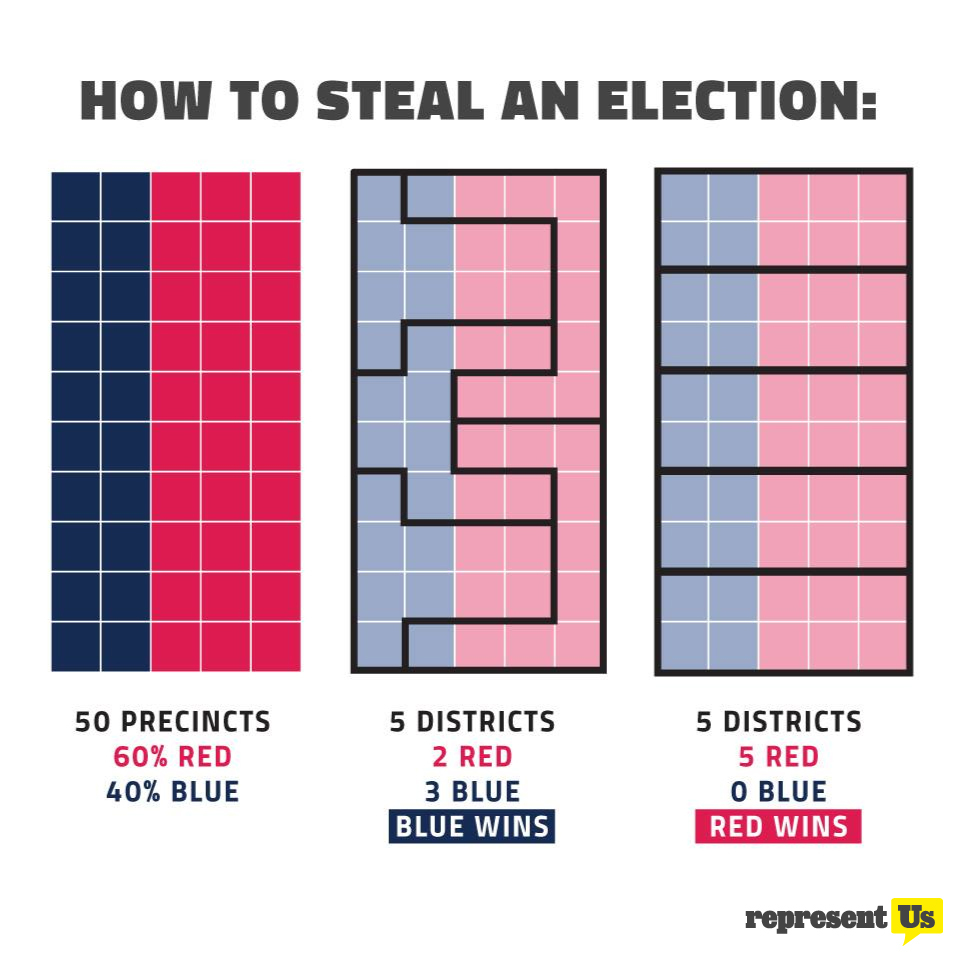
In the redrawing of U.S. House districts after the 2010 Census, independent analyses find that Republicans engaged in extreme partisan gerrymandering in seven states. Partisan gerrymandering is accomplished by packing as many supporters of the opposition party as possible into as few districts as possible. The opponents will win these seats overwhelmingly. Meanwhile, supporters of the favored party are spread more evenly across the other districts, so this party will comfortably win as many seats as possible. Partisan gerrymandering has also dramatically affected thousands of seats in state legislatures.

The best estimates are that, through gerrymandering, Republicans captured between 15 and 20 more seats in the House (out of 435) than would have been expected otherwise. After the 2022 elections, the Republicans controlled the House by a margin of just five votes (which has now shrunk to one vote due to resignations and a removal). For example, in South Carolina and Wisconsin the Republicans’ percentage of each state’s House seats is about 26-percentage points higher than the percentage of their vote in statewide races. (In SC: Republicans got roughly 60% of the vote in the Governor’s and Senator’s races but, due to gerrymandering, won 6 out of 7 House seats, 86%. In WI: Republicans got roughly 49% of the vote in the Governor’s and Senator’s races but, due to gerrymandering, won 6 out of 8 House seats, 75%.)

Extreme partisan gerrymandering means that officials get elected by a small handful of their constituents – those who vote for them in the primary election (where turnout is typically very low). Given that the party that will win the general election is in most cases pre-determined by gerrymandering or a district’s natural political characteristic, the winning candidate is selected by the small number of voters who are motivated enough to turn out and vote in the primary election. These are typically the party’s most committed and partisan voters. The result is that elected officials are in effect picking their voters, rather than most voters having any real choice about who their elected representative will be. (See this previous post for more details on gerrymandering and its undermining of democracy.)

The Supreme Court, prior to the 2022 elections, blocked the implementation of changes to House districts in at least seven states despite lower courts’ rulings that the districts were unconstitutionally gerrymandered. After the election, it confirmed that the districts were unconstitutional. This probably delivered at least seven seats to Republicans that otherwise would have gone to Democrats. (See this previous post for more detail on the Supreme Court’s rulings and their effects on the election.) The shift of five seats from Republicans to Democrats would have changed the control of the House, which would have made a dramatic difference in policy making in the House and for the country. It’s hard to believe that the Supreme Court’s actions and timing were anything but blatantly political.

Racial and partisan gerrymandering are closely linked because a large percentage of Blacks typically vote for Democrats. Racial gerrymandering is still very much present in the south. For example, in Alabama, there are seven congressional districts. Twenty-seven percent of the population is Black (and four percent is in other non-white categories), but by packing as many Black voters into one district as possible and splitting up the other Black voters among the other districts, there is only one Black-majority district in the state. The courts have ordered the creation of another Black-majority district but Alabama officials have been resistant. From a partisan perspective, Alabama Republicans got 67% of the vote in the Governor’s and U.S. Senator’s race but, because of gerrymandering, won 86% of the House seats (6 of 7), a 19-percentage point difference.

Similarly, in Louisiana, there are six congressional districts. A third of the population is Black, but, again, by packing as many Black voters into one district as possible and splitting up the other Black voters among the other districts, there is only one Black-majority district in the state. From a partisan perspective, Louisiana Republicans got 62% of the vote in the U.S. Senator’s race but, because of gerrymandering, have 83% of the House seats (5 of 6), a 21-percentage point difference.

My next post will present ways to reduce partisan and racial gerrymandering, which would make our elections for the U.S. House (and state legislatures) more democratic, i.e., more representative of a state’s and district’s population.

[1]      Dayen, D., 1/29/24, “America is not a democracy,” The American Prospect (https://prospect.org/politics/2024-01-29-america-is-not-democracy/)

[2]      Leaverton, C., 1/20/23, “Three takeaways on redistricting and competition in the 2022 midterms,” Brennan Center for Justice (https://www.brennancenter.org/our-work/analysis-opinion/three-takeaways-redistricting-and-competition-2022-midterms)