EXTREME CAPITALISM OF PRIVATE EQUITY FIRMS DOES GREAT HARM Part 1

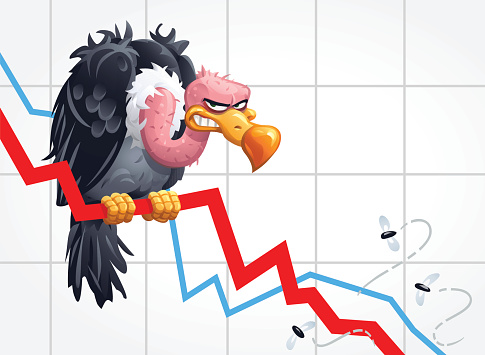
The extreme capitalism of private equity firms does great harm. These vulture capitalists use financial manipulation to extract big profits from companies without regard to their survival or the welfare of stakeholders. There’s a bill in Congress that will stop this.
Illustration of a vulture sitting on a falling graph. Concept for vulture capitalists, economic crisis, recession, bankruptcy and insolvency.

SUMMARY: The current brand of capitalism in the U.S. does lots of harm. Nowhere are the harms more evident than in the extreme capitalism of private equity (PE) firms. These vulture capitalists use financial manipulation to extract big profits from companies they buy without regard to the health or survival of the companies, or the welfare of their employees, customers, and communities. There’s a bill in Congress that will stop this vulture capitalism and all the damage it does.

(Note: If you find my posts too long to read on occasion, please just skim the bolded portions. Thanks for reading my blog! Special Note: The new, more user-friendly website for my blog is here.)

The current brand of capitalism in the U.S. does lots of harm. Even “routine” corporate activity results in lots of bad behavior, some of it illegal or corrupt, all of which harms employees, consumers, and the public. I’ve cited examples of this in many previous posts and, in my most recent post, I highlighted three examples and also shared why it’s important to be aware of this. The profit motive of capitalism and the greed of capitalists result in harmful business behaviors unless they’re well-regulated and the penalties and punishments for businesses and their executives are sufficient to truly discourage bad behavior or to put them out of business.

Nowhere are the harms of capitalism more evident than in the extreme capitalism of private equity (PE) firms. PE firms (i.e., “vulture capitalists”) use financial manipulation to extract profits from companies without regard to the health or survival of the companies, or the welfare of their employees, customers, and communities. Vulture capitalism fails to produce benefits for anyone other than the rich private equity financiers. They are not investing in the companies they buy; they are looking to maximize their short-term profits and have no qualms about the companies going bankrupt – in some cases that’s their plan. (See this previous post from 2018 describing the private equity business model and why it deserves to be called vulture capitalism.)

PE firms have purchased companies in many sectors of the economy from health care (over $500 billion between 2018 and 2023) to child care to pet care, from housing to private colleges, and from retail store chains to newspapers. Everywhere they’ve gone they’ve left destruction in their wake, including decimating local newspapers, bankrupting long-standing retail store chains, and causing deaths and injuries in health care.

In my next post, I’ll give a description of the PE business model and some specific recent examples of the harm it’s done, but, for now, here’s what can be done to stop this vulture capitalism. The Stop Wall Street Looting Act has been introduced in Congress by Senators Elizabeth Warren (D-MA), Tammy Baldwin (D-WI), Sherrod Brown (D-OH), (all three are up for re-election, by the way) and others, along with over half a dozen Representatives. First introduced in 2019, the Act would: [1]

  • Make the PE owners and investors responsible for the debts and liabilities of the companies they own rather than allowing them to continue to avoid responsibility and liability by claiming to be an independent entity.
  • Change bankruptcy laws so that when PE-owned companies go bankrupt (as they often do) workers’ pay and benefits, including pensions, would be given a higher priority, rather than being the last party to get paid if there’s any money left over (which there usually isn’t).
  • Ban practices that allow PE owners to extract short-term profits that undermine the financial viability of a purchased company. For example, if a PE-owned company files for bankruptcy, the PE owners and investors could be forced to pay back the fees, dividends, and other payments they had received over the last 3 – 5 years.
  • Prohibit PE-owned firms that receive federal or state funds (as all health care providers do and as 611 PE-owned companies that received $5.3 billion in Covid relief funds did) from acquiring other companies or making payments to the PE owners or investors for two years.
  • Ban PE-owned health care companies from receiving federal money from Medicare or Medicaid if they sell property to or receive property-based loans from a real estate investment trust (REIT). REIT transactions are a standard, financial manipulation practice for PE-owned hospitals and were a key factor in Steward Health’s rapid expansion and then bankruptcy.
  • Subject PE firms to greater oversight and disclosure requirements. Cerberus Capital Management, the PE firm behind the Steward health care bankruptcy and debacle, would not have been able to withhold financial information from health care oversight agencies and from Congress – as it continues to do today.

I urge you to contact your U.S. Representative and Senators to ask them to support the Stop Wall Street Looting Act. Private equity’s model of vulture capitalism needs to be reined in before more patients, customers, employees, and communities are harmed. You can find contact information for your US Representative at  http://www.house.gov/representatives/find/ and for your US Senators at http://www.senate.gov/general/contact_information/senators_cfm.cfm.

The PE industry and its allies will, of course, strenuously oppose this legislation, as they have since it was first introduced in Congress in 2019. For example, during the 2021-2022 election cycle, the PE industry donated almost $350 million to federal election candidates and committees.

If you need any convincing of the need to stop the vulture capitalism of the PE model of business financial manipulation, my next post will present some recent examples of PE ownership and the detrimental effects it’s had. It will also share an overview of the PE model.

[1]      Office of Senator Warren, 10/10/24, “Warren, lawmakers renew legislative push to stop private equity looting,” Press release (U.S. Senator Elizabeth Warren | Warren, Lawmakers Renew L…) and (Stop Wall Street Looting Act One Pager)
SHORT TAKES #16: MORE CORPORATE BAD BEHAVIOR

Here are summaries of three important stories that have gotten little attention in the mainstream media. These stories include corporations engaging in fraud and bribery, blocking competition to rip off businesses and consumers, and running unsafe prisons.

I share these stories of corporate bad behavior – and there are many more than I have time and space to share – for multiple reasons, including:

  • To puncture the prevalent myth that the private sector does no wrong and that it is efficient and effective in meeting needs and solving problems.
  • To demonstrate that the profit motive, coupled with the greed of corporate executives and investors, is so powerful that for many individuals it will corrupt their behavior in ways both small and large (e.g., de la Torre of Steward Health, Kenneth Lay and Jeffrey Skilling of Enron, and many others).
  • To make it clear that the private sector needs regulation to protect consumers, workers, and the public.
  • To show that the public shouldn’t trust what corporations say because they have a huge financial interest in hiding harms they may be causing (e.g., tobacco, global warming, toxicity of pesticides and other chemicals, etc.).
  • To document that the current punishments and penalties are too little to change corporate executives’ behavior. Often, the punishments and penalties are simply considered a cost of doing business.
  • To demonstrate that privatization of public functions and public goods (e.g., health care, drinking water systems, etc.) is not a wise idea.
  • To document that corporations are relentless over time and across multiple strategies (campaign spending, lobbying, the revolving door of personnel in and out of government regulatory positions, etc.) in their efforts to bend policy (taxes, regulation, punishments, etc.) and enforcement to their benefit. They are immortal, after all, and can and do outwait and out persevere most individuals and government agencies who try to rein in their power and misbehavior.

If you want to get a sense of the overall scale of corporate bad behavior visit this Violation Tracker database compiled by Good Jobs First.

STORY #1: RTX Corporation, formerly Raytheon, has agreed to pay $950 million in penalties for defrauding the government and paying foreign bribes. RTX entered into three-year deferred prosecution agreements (DPAs) with federal authorities in MA and NY. These mean the corporation won’t be prosecuted if it exhibits good conduct (i.e., complies with anticorruption and antifraud laws) for the next three years. [1] It also means the corporation doesn’t have to plead guilty and that its records and executives are not the subject of depositions and court testimony, which keeps the detailed information on the violations and investigations from being made public.

RTX inflated its revenue from government contracts by at least $111 million by lying about labor and materials costs, as well as double-billing. RTX paid bribes to a high-ranking Qatari military official to get lucrative contracts with the Qatari military. This violated the Foreign Corrupt Practices Act and the Arms Export Control Act.

RTX and its subsidiaries are repeat violators. Most recently, in August the corporation agreed to a $200 million penalty for more than two dozen violations of the Arms Export Control Act and International Traffic in Arms Regulations. The violations included the corporation providing classified military aircraft data to China and employees taking classified information on company laptops into Russia, Iran, and Lebanon.

Here’s Good Jobs First’s documentation of the violations of RTX and its subsidiaries since 2000. Prior to this latest $950 million settlement, there were 133 violations that resulted in penalties totaling $550 million.

STORY #2: The U.S. Justice Department has filed an antitrust lawsuit against Visa for stifling competition in the debit card business. The suit alleges that Visa penalizes banks and businesses that don’t use Visa’s payment processing system to process debit transactions. Visa’s processing system handles 60% of debit transactions in the U.S. and charges over $7 billion in fees. The suit alleges that Visa uses its dominance to stifle competition and extract billions of dollars in excessive fees from businesses and consumers. [2]

The Justice Department’s complaint relies heavily on Visa’s own statements of corporate strategy. For example, Visa’s stated strategy is to “partner with emerging players before they become disruptors.” As a result, it offers big incentives (up to hundreds of millions of dollars annually) to financial system innovators like Apple Pay and PayPal for NOT competing and NOT disrupting Visa’s dominance. [3]

Visa and its allies have spent over $80 million lobbying against the Credit Card Competition Act, which would save consumers and businesses an estimated $15 billion annually.

STORY #3: The U.S. Justice Department has announced an investigation into reports of recurring and sometimes deadly violence at the privately run Trousdale Prison in Tennessee; reports which have been endemic since it was opened in 2016 by CoreCivic. CoreCivic is the largest private prison corporation in the U.S. with a value of over $1.4 billion. It has four prisons and two jails in TN and, since 2016, has spent more than $4.4 million on nearly 80 settlements over 22 deaths of inmates and dozens of other mistreatment complaints. TN has fined CoreCivic $38 million since 2016 for contract violations and the state comptroller has released scathing audit reports three times. But CoreCivic is active with its political spending and state leaders downplay the problems and renew the state’s contracts with it. [4]

There have been over 300 deaths at the four CoreCivic prisons in TN since 2016; some due to natural causes, but some due to violence and some appear to be due to medical neglect. Inmate complaints allege murders, brutal beatings, physical and sexual assaults, medical neglect, and cruelty. In its settlements, CoreCivic does not admit guilt and typically requires the other parties to a settlement to agree to refrain from talking about their complaint or the settlement.

Severe staffing shortages and unchecked flows of contraband contribute to the problems at the CoreCivic facilities. Even the prison guards report that they feel unsafe because of the understaffing.

[1]      Offenhartz, J., & Sisak, M. R., 10/17/24, “RTX to pay $950m to resolve fraud allegations,” The Boston Globe from the Associated Press

[2]      Associated Press, 9/25/24, “Business Talking Points – Financial,” The Boston Globe

[3]      Kuttner, R., 9/25/24, “The Justice Department challenges Visa’s predatory power,” The American Prospect (https://prospect.org/blogs-and-newsletters/tap/2024-09-25-justice-department-challenges-visas-predatory-power/)

[4]      Mattise, J., Loller, T., & Hall, K. M., 10/14/24, “Tenn. prison operator under US scrutiny,” The Boston Globe from the Associated Press

CORPORATIONS ARE NOT PAYING THEIR FAIR SHARE IN TAXES

Large, profitable corporations are NOT paying their fair share in federal income tax. President Trump and the Republicans passed a huge tax cut for corporations in 2017 that exacerbated this problem. It cut the stated corporate tax rate from 35% to 21% (a 40% cut) and created new loopholes that let them reduce what they actually pay.

President Biden and Democrats in Congress are working to get big corporations to pay their fair share of taxes. The 2022 Inflation Reduction Act established a 15% minimum corporate tax and funded expanded tax enforcement. In addition, in 2021, the Biden administration negotiated a global minimum tax treaty with other nations but its approval has been blocked in Congress. [1] More on this later.

A study of the effects of the 2017 Tax Cut and Jobs Act found that the 342 large corporations that were profitable in every year from 2018 to 2022 – so it would be reasonable to expect that they would be paying significant taxes – actually paid just 14.1% of their profits in taxes (i.e., their “effective” tax rate). [2] This is only two-thirds of the tax rate stated in the law. In other words, these 342 corporations, as a group, paid an average of $55 billion less per year in taxes than the stated tax rate would require. [3] So, while big, profitable corporations were paying 14.1% of their profits in taxes, the average household was paying 13.6% of its income in federal income taxes in 2020. [4]

Moreover, 23 of these 342 profitable corporations paid NOTHING in federal taxes for the whole five-year period, despite being profitable in every one of those years! Even with $131 billion in profits over this period, these 23 big corporations (as a group) received tax refunds totaling almost $4 billion.

Another 109 of the 342 profitable corporations paid no federal tax in at least one year of the 2018 – 2022 period. In the years when they paid no tax, they, as a group, had $258 billion in profits but received over $14 billion in tax refunds.

Fifty-five of the 342 profitable corporations had effective tax rates of under 5% for the five-year period, including:

  • Bank of America:         $139 billion in profits             $5.3 billion in taxes          8% rate
  • AT&T:                              $  96 billion in profits             $2.5 billion in taxes          6% rate
  • Citigroup:                      $  35 billion in profits             $1.5 billion in taxes          3% rate
  • General Motors:          $  33 billion in profits             $0.4 billion in taxes          3% rate
  • Nike:                              $  19 billion in profits             $1.0 billion in taxes          9% rate
  • T-Mobile:                       $  18 billion in profits             $-0.0 billion in taxes         -0.4% rate
  • FedEx:                            $  16 billion in profits             $0.7 billion in taxes          6% rate
  • Net Flix:                         $  15 billion in profits             $0.2 billion in taxes          6% rate
  • Molson Coors:             $    7 billion in profits              $0.3 billion in taxes          8% rate
  • Voya Financial:             $    4 billion in profits             $-0.3 billion in taxes         -8.0% rate
  • Darden Restaurants:  $    4 billion in profits             $0.0 billion in taxes          8% rate
  • Office Depot:                $    7 billion in profits             $-0.0 billion in taxes         -4.6% rate

Also notable was that in an analysis by industry, the oil, gas, and pipeline industry had the second lowest effective tax rate of just 2.0%. Our tax policy has a long way to go if we want to use it to incentivize movement away from fossil fuels!

Here are some key statistics that make the case that corporations are not paying their fair share of taxes currently: [5]

  • The overall tax rate actually paid by corporations has fallen steadily from over 50% in the early 1950s to well under 20% today. (This is the cumulative effective tax rate for federal, state, and local taxes.)
  • In the 1950s, corporate taxes provided between 25% and 33% of federal revenue. For the past 40 years, corporate taxes have provided less than 15% of federal revenue.
  • As a share of the U.S. economy (GDP), corporate profits have risen from 8% in 1980 to 12% in 2022, a 50% increase. Meanwhile, corporate taxes have fallen from roughly 3% to 2% of GDP.

President Biden and Democrats are working to get big corporations to pay their fair share of taxes. The 2022 Inflation Reduction Act, passed by Democrats in Congress and signed by President Biden, established a 15% minimum corporate tax. More than half of the 342 corporations in the study cited above would have paid more in taxes with a 15% minimum tax rate. It’s estimated that it will generate over $200 billion in revenue over ten years from billion-dollar corporations. The Inflation Reduction Act also increased funding for enforcement of tax laws, which will reduce tax dodging by big corporations. [6]

In 2021, the Biden administration negotiated a global minimum tax treaty with other nations, but Congress has blocked approval of it. It would require multinational corporations to pay at least 15% of their profits in taxes. This would prevent corporations from avoiding taxes by shifting profits on paper to low tax countries. [7]

Note that Trump and the Republicans are stating in the presidential campaign that they will make the 2017 tax cuts permanent (they expire in 2025) and add on even more tax cuts. Among other things, they want to further cut the corporate tax rate from 21% to 15%. This would give the 100 largest, U.S. corporations, as a group, an estimated $50 billion a year in additional profits.

[1]      Johnson, J., 9/27/24, “Dems name and shame companies paying executives more than they pay in federal taxes,” Common Dreams (https://www.commondreams.org/news/executive-pay-federal-taxes)

[2]      Gardner, M., Wamhoff, S., & Marasini, S., Feb. 2024, “Corporate tax avoidance in the first five years of the Trump tax law,” Institute on Taxation and Economic Policy (https://itep.org/corporate-tax-avoidance-trump-tax-law/)

[3]      Johnson, J., 2/29/24, “Corporate tax avoidance rampant during first five years of Trump-GOP law: Study,” Common Dreams (https://www.commondreams.org/news/trump-corporate-tax-avoidance)

[4]      Anderson, S., Tashman, Z., & Rice, W., March 2024, “More for them, less for us,” Institute for Policy Studies and Americans for Tax Fairness (https://ips-dc.org/report-corporations-that-pay-their-executives-more-than-uncle-sam/)

[5]      Anderson, S., Tashman, Z., & Rice, W., March 2024, see above

[6]      Johnson, J., 9/27/24, see above

[7]      Johnson, J., 2/29/24, see above

SHORT TAKES #15: IMPORTANT JOURNALISM FROM READER-SUPPORTED, NON-PROFIT OUTLETS

Non-profit, investigative journalism reporting on 1) suits against OpenAI and ChatGPT for copyright infringement, 2) the effects of Trump’s plan to deport 11 million undocumented immigrants, and 3) efforts to discredit opponents of dangerous pesticides with an assist from U.S. government funds.

Here are summaries of three important stories that have gotten little attention in the mainstream media. These are all stories from or about reader-supported, non-profit journalism outlets. I encourage you to support their critically important work. It’s work the mainstream, for-profit, corporate media will never do, and often won’t even report on. This post summarizes stories from Mother Jones, Lighthouse Reports with The Guardian, and Common Dreams that range from 1) suing AI entities for using articles from Mother Jones and other sources without permission, compensation, or acknowledgement, 2) projecting the impact of Trump’s campaign promise to deport the estimated 11 million undocumented immigrants in the U.S., and 3) investigating the pesticide industry’s attacks on its critics including the use of some U.S. government funding to do so.

STORY #1: Mother Jones, the progressive, investigative, policy-oriented magazine, is suing OpenAI and its biggest shareholder, Microsoft. OpenAI is the creator of ChatGPT and other artificial intelligence (AI) tools. It has used nearly 17,500 Mother Jones’s articles, and continues to use new ones, to inform and train ChatGPT. The articles are part of ChatGPT’s database of knowledge that it will spew out in response to queries. However, OpenAI has done so without permission or compensation, despite having used the articles to create an extremely valuable product and business. [1]

Furthermore, early versions of ChatGPT listed the sources of its information. It now provides no attribution for the sources or authors of the information it disgorges. On top of the copyright violation and plagiarism issues, users of ChatGPT have no idea where the information produced is coming from and, therefore, whether the source is trustworthy. They don’t even have the information they would need to research the source to determine its trustworthiness.

Mother Jones’s suit is a David versus Goliath battle, as its annual budget is less than 1% of OpenAI’s CEO and co-founder Sam Altman’s net worth. However, the New York Times and eight other newspapers are also suing OpenAI and Microsoft due to use of millions of their articles without permission or compensation.

This is an existential threat to Mother Jones and other journalism because soon AI tools like ChatGPT will digest the news and other information for much of the public. In the future, many people won’t read articles in newspapers or magazines either in-print or on websites. However, AI tools and companies don’t investigate, dig up or verify stories, or even fact check, they just regurgitate what they have processed from unacknowledged sources. The companies that do all the hard work of investigating and reporting will become invisible and their primary sources of revenue will disappear. This will be a repeat of the Internet’s threat to newspapers on steroids.

STORY #2: The most recent issue of Mother Jones magazine (Sept.-Oct. 2024) took a deep dive into what would happen if Trump were elected president and carried through on his promise to deport the estimated 11 million undocumented immigrants in the U.S. Economists estimate that this would lead to a dire shortage of low-wage workers, triggering a recession while also igniting inflation. [2]

It’s estimated that state and local governments would lose roughly $37 billion in tax revenue, including California losing $8.5 billion and Texas about $5 billion. The federal government would lose approximately $59 billion in taxes, including almost $26 billion in Social Security taxes paid by undocumented immigrants even though they aren’t eligible to receive Social Security benefits.

Half of farm workers would disappear and the prices of hand-picked crops would increase by an estimated 21%. Milk might well double in price. One-quarter of the workers in meat processing facilities are undocumented so meat prices would likely skyrocket. The construction industry relies on about 1.4 million undocumented workers, about 1/5th of its workforce. If they were all deported, the construction of homes (among other things) would slow dramatically and their prices would increase by 10 – 15%. Roughly 350,000 undocumented immigrants work in health care, 160,000 as housekeepers and cleaners, and about 142,000 as child care providers, personal care aides, or home health care aides. The impact of the loss of all those workers would be catastrophic.

STORY #3: Investigative reporting by non-profit Lighthouse Reports and its partners [3] has revealed a concerted campaign by the agrochemical industry (and Syngenta corporation in particular), with some funding from the U.S. government, to discredit evidence and advocates opposing the use of the pesticide paraquat (as well as other industry products). Paraquat is a very toxic pesticide and has been banned in the European Union, the United Kingdom, China, and dozens of other countries, but it’s still used in the U.S. and Africa. Paraquat has been linked to Parkinson’s disease which is the basis of thousands of lawsuits against Syngenta (a subsidiary of Sinochem, a Chinese state-owned enterprise). The New Lede and The Guardian have previously reported that decades ago Syngenta’s internal research found that paraquat had adverse effects on brain tissue but it withheld this information and instead worked to discredit such findings.

The U.S. Department of Agriculture (USDA) and U.S. Agency for International Development (USAID) have for decades promoted U.S. agrochemical products, including pesticides and genetically-modified organism (GMO) crops, worldwide. USAID contracted with the International Food Policy Research Institute (IFPRI) to manage a U.S. government initiative to promote GMO crops in Asia and Africa. IFPRI, in turn, paid v-Fluence, a U.S.-based public relations firm, more than $400,000 from 2013 to 2019 for assistance in countering critics of the use of GMO crops and pesticides like paraquat. [4]

[1]      Bauerlein, M., Sept.-Oct. 2024, “Why we’re suing OpenAI,” Mother Jones (Press release: https://www.motherjones.com/press-releases/cir-sues-openai/)

[2]      Dias, I., Sept.-Oct. 2024, “How Trump’s ‘mass deportation’ plan would ruin America,” Mother Jones (https://www.motherjones.com/politics/2024/08/trump-mass-deportation-plan-immigration-border-patrol-ice-dhs-migrants-undocumented/)

[3]      Gillam, C., Gibbs, M., & DeBre, E., 9/27/24, “Revealed: The US government-funded ‘private social network’ attacking pesticide critics,” The Guardian (https://www.theguardian.com/us-news/2024/sep/26/government-funded-social-network-attacking-pesticide-critics) In addition to The Guardian and Lighthouse Reports, the consortium producing the report included Le Monde (France), The New Lede (US), Australian Broadcasting Corp., Africa Uncensored (Kenya), The Continent (South Africa), The Wire News (India), and The New Humanitarian (Switzerland).

[4]      Queally, J., 9/27/24, “‘Appalling’: US funded secret industry network targeting pesticide critics,” Common Dreams (https://www.commondreams.org/news/pesticide-industry-critics)