OUR CORRUPT CAMPAIGN FINANCING SYSTEM part 2

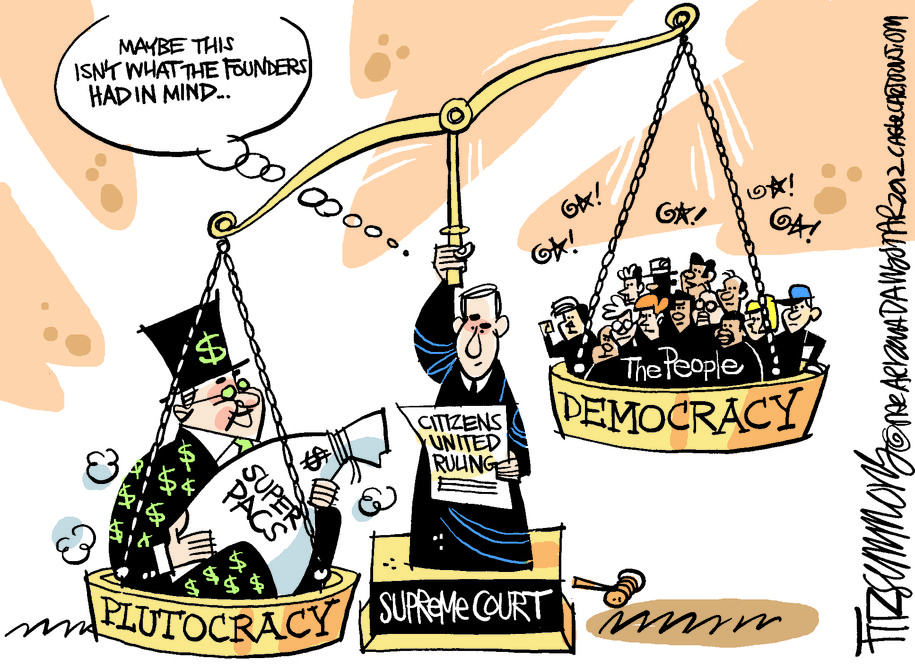
U.S. political campaigns are awash in money and it’s corrupting our government. The big spenders, wealthy individuals and corporations, are looking for something in return. They generally get rewarded with policies and actions that provide a high return on their investments.

(Note: If you find a post too long to read, please just skim the bolded portions. Thanks for reading my blog!)

My previous two posts have focused on how billionaires are buying our elected officials (here) and how super PACs (political action committees) are the vehicle they are using to do so (here). They also highlighted how big donors are using non-profit organizations that don’t have to report donors in order to hide their identities (i.e., “dark money”) and how super PACs are violating the law by coordinating with candidates’ campaigns. Unfortunately, the Federal Elections Commission (FEC) is failing to enforce campaign finance laws.

An example of how big money donors and our political parties are flouting campaign finance laws is the growing and now extensive use of joint fundraising committees. These joint fundraising committees allow big donors to skirt campaign contribution limits and write one huge check, typically for tens of thousands of dollars, for candidates’ campaign committees and political party PACs. The entities in the joint committee then supposedly split up the money so that no contribution limits are violated. Some of the joint fundraising committees directly pay for advertising but frame it as a fundraising solicitation to evade restrictions on their activities. These joint committees have also figured out how to game the system to get the lower advertising rates supposedly given only to candidates’ committees. (Note: Advertising rates for super PACs and other non-candidate entities can be up to 20 times higher than those for candidates’ committees.) [1]

These big donors are special interests, and they view their campaign spending as an investment. They expect a return on their investment, and generally they get paid back many, many times over. You may remember that in 2017 wealthy Republican donors were telling Trump and the Republicans that if they didn’t get a big tax cut their support of Republicans in the 2018 congressional elections would be curtailed. So, the Republicans in Congress and Trump, in December 2017, enacted the Tax Cuts and Jobs Act, which gave huge tax cuts to wealthy individuals and corporations.

As campaign spending is increasingly dominated by outside money, which is increasingly from super PACs and done with dark money, the result is a political environment of hidden influence by wealthy individuals and corporations. This undermines an essential principle of democracy: that voters deserve to know who is trying to influence their vote.

An example of huge spending by a special interest, using, of course, a super PAC, is the cryptocurrency industry. It was one of the largest and most successful special interest spenders in the 2024 elections. It spent roughly $245 million via a super PAC called Fairshake. The majority of its money went to Republicans. It won every one of the 49 races it spent money on except for Sen. Elizabeth Warren’s (D-MA) winning re-election campaign. However, none of Fairshake’s advertisements even mentioned cryptocurrency; it clearly wanted to influence elections without revealing its true interests.

Fairshake’s 48 victorious campaigns may understate its influence, as its spending in primaries instilled fear in numerous Democratic candidates who avoided criticizing the crypto-industry or stated support for it. Cryptocurrency industry donors were responsible for almost half of all corporate donations to all super PACs. Fairshake already has $78 million on hand for the 2026 congressional elections. Based on all of this, the crypto industry will almost certainly be rewarded with weak regulation by Congress and the Trump administration.

Another example of special interest spending with a very specific outcome in mind is the American Israel Affairs Committee’s super PAC (AIPAC). It spent roughly $100 million in the 2024 elections, primarily in primaries to beat Democratic candidates who weren’t unquestioning supporters of Israel in the face of the horrific Gaza War. It spent $14 million in one Democratic primary to beat incumbent Jamaal Bowman (D-NY), a record for outside spending in a House race. It also spent heavily in incumbent Cori Bush’s (D-MO) primary, which she ended up losing. The primary funders of AIPAC are Republican mega-donors, many of whom each gave hundreds of thousands of dollars to it. [2]

As another example, two multi-national, multi-hundred-billion-dollar investment management firms, Blackstone Group and Citadel, each gave $22 million to the Republican Senate Leadership super PAC for the 2022 congressional elections. They want, and so far have gotten, lax regulation of their financial activities and favorable tax treatment for their incomes. For example, the “carried interest” provision of U.S. tax laws allows the firms’ managers to treat their income as capital gains, which lets them pay an income tax rate on their huge incomes at less than half the rate they’d pay on regular income (i.e., non-capital gains income).

The fossil fuel industry is also reaping rewards for its spending of about $75 million in support of Trump’s campaign. Although Trump, in a public statement, told fossil fuel industry executives that if they invested $1 billion in his campaign that he would reward them, $75 million appear to have done the trick. Trump, in his first days in office, has signed executive orders, some of them likely written by fossil fuel industry lobbyists, revoking climate change reduction rules. These executive orders allow increased oil and gas drilling off the U.S. coast and on federal lands, allow the building of new liquified natural gas (LNG) export terminals, and withdraw the U.S. from international climate change reduction efforts. [3]

My next post will discuss some more general effects of all this special interest spending on election campaigns and what can be done about this obscene and corrupting spending.


[1]      Goldstein, L., 12/10/24, “The money game,” The American Prospect (The Money Game – The American Prospect)

[2]      Johnson, J., 8/28/24, “‘Very bad sign for democracy’: AIPAC has spent over $100 million on 2024 elections,” Common Dreams (‘Very Bad Sign for Democracy’: AIPAC Has Spent Over $100 Million on 2024 Elections | Common Dreams)

[3]      Johnson, J., 1/17/25, “Trump readies ‘day one climate destruction package’ after raking in big oil cash,” Common Dreams (Trump Readies ‘Day One Climate Destruction Package’ After Raking in Big Oil Cash | Common Dreams)
OUR CORRUPT CAMPAIGN FINANCING SYSTEM

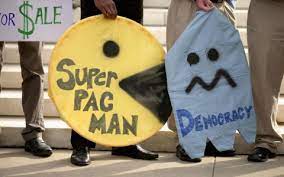
U.S. political campaigns are awash in money with increasing portions of it coming from super PACs and “dark money” non-profits. The unlimited political spending by super PACs, allowed by the Supreme Court’s Citizens United decision, is not independent of candidates’ campaigns nor are its donors fully disclosed. These were the Supreme Court’s stated requirements to ensure that candidates weren’t corrupted by the unlimited spending. Knowledgeable observers knew these requirements and the avoidance of corruption were a joke from day one.

(Note: If you find a post too long to read, please just skim the bolded portions. Thanks for reading my blog!)

Sixteen billion dollars were spent on the 2024 U.S. federal election campaigns. (See this previous post for more details.) Three types of spending occur in our federal elections:

  • Candidates’ political committees
  • Political action committees (PACs)
  • Super PACs

Candidates’ committees can accept up to $3,300 from an individual per election. (A primary and general election count as two elections.) A candidate’s committee can receive up to $5,000 per election from a PAC or party committee. A candidate’s committee may not accept any money from a super PAC. (Note: All money spent on a campaign that is not spent by a candidate’s committee is referred to as “outside money.”) [1]

PACs can accept contributions from individuals (not organizations) of up to $5,000 per year. PACs can contribute up to $5,000 per election to a candidate’s committee and up to $15,000 per election to a political party committee.

Super PACs (which came into existence after the Supreme Court’s 2010 Citizens United decision) can accept contributions of unlimited size from any entity, i.e., an individual or an organization, including a corporation or other business entity. They are not allowed to contribute to candidates’ committees or to political party committees. Their expenditures are supposed to be independent of candidates and parties. This requirement for independence was central to the Supreme Court’s Citizens United decision. The five justices supporting the unlimited contributions and spending wrote in their decision that disclosed, independent spending could not corrupt candidates or our government. Therefore, allowing unlimited, independent spending in campaigns, including by corporations, was constitutionally protected free speech.

To maintain independence, super PACs are prohibited (supposedly) from coordinating with candidates’ campaigns. However, this independence began eroding the day after the Court’s decision. That erosion grew dramatically in 2024. Knowledgeable observers knew from day one that this assertion of independence and lack of corruptive influence was a smoke screen for the justices who wanted to allow wealthy individuals and corporations to dominate our elections and government. The Federal Election Commission (FEC) has not enforced the law on independence. It has never fined or otherwise penalized a super PAC, even when coordination was blatant, as knowledgeable observers knew it wouldn’t.

For example, campaigns put “red boxes” in the media sections of their websites with messaging and targeting information. The super PACs use this information to ensure their messaging and targeting is aligned with the candidate’s campaign strategy. [2]

One of the most blatant violations of super PAC independence in 2024, was that super PACs actually ran extensive door knocking and other voter outreach efforts. Elon Musk’s super PAC’s activities in Pennsylvania were the most notable example. This kind of voter outreach requires sophisticated voter lists and street maps that candidates’ campaigns typically have and that PACs typically don’t have. Moreover, a failure to coordinate such activities with campaigns would create substantial redundancy and inefficiency. Nonetheless, an FEC ruling in 2024 essentially legalized such activities.

Furthermore, wealthy donors have found a way to avoid disclosure of their identities by funneling their money through non-profit 501(c)(4) organizations. (See this previous post for more details on 501(c)(4)s.) This “dark money,” as it is referred to, was about half of the $4.5 billion in outside spending in the 2024 federal elections.

My next post will present more examples of the corruption of the campaign finance system, discuss the effects of all this special interest spending, and give some options for what can be done about this obscene spending on our elections.


[1]      Ghosh, S., 9/15/22, “PACs, super PACs and more: Your guide to key election spending vehicles,” Campaign Legal Center (PACs, Super PACs and More: Your Guide to Key Election Spending Vehicles | Campaign Legal Center)

[2]      Goldstein, L., 12/10/24, “The money game,” The American Prospect (The Money Game – The American Prospect)

BILLIONAIRES ARE BUYING OUR ELECTED OFFICIALS AND USING DARK MONEY TO HIDE

U.S. elections are awash in money and billionaires are the dominant spenders. Wealthy interests have been allowed by the Supreme Court to engage in unlimited political spending, and they have found ways to avoid disclosing that they are the sources of the funding. Democrats made a huge political mistake years ago in not regulating campaign spending.

(Note: If you find my posts too long to read on occasion, please just skim the bolded portions. Thanks for reading my blog! Special Note: The new, more user-friendly website for my blog is here.)

Elections in the U.S. are awash in money. The Supreme Court’s 2010 Citizens United decision (and related ones) allowed unlimited spending by wealthy individuals and corporations. Supposedly, the donors and spending would be disclosed, as well as independent of candidates’ campaigns. This would, according to the supportive Supreme Court justices, ensure that there was no corruption. Most observers knew from day one that the independence of such spending and the prevention of corruption were not realistic. Time has proven this sentiment to be correct.

Wealthy interests have found or manufactured loopholes to get around disclosure and independence requirements. Furthermore, the lack of enforcement from the Federal Elections Commission (FEC) and the Internal Revenue Service (IRS) has eviscerated disclosure and independence laws.

Sixteen billion dollars were spent on the 2024 federal elections for president and Congress. Roughly $5.5 billion was spent on the presidential race and over $10 billion on congressional races. The record of over $18 billion from 2020 still stands. However, both the 2024 and 2020 amounts are roughly double what was spent in prior presidential election years before wealthy interests had figured out how to fully take advantage of the Citizens United decision. [1]

To win a seat in the U.S. House now costs on average about $3 million and about $30 million for a seat in the Senate. Incumbents win well over 90% of the time. Business interests’ campaign spending on behalf of incumbents is roughly 50 times what they spend for challengers. Business interests spend about 16 times what labor interests spend, despite the fact that labor represents millions of every day workers (and to some extent all workers) while business interests represent lifeless but immortal legal entities (e.g., corporations) and the self-interest of a small number of wealthy executives and investors. 

Campaign donations by small donors ($200 or less) are overwhelmed in most races by big donors. Of the 535 members of Congress, only 16 got over 50% of their donations from small donors. Over 40%, 230 of them, got less than 5% (1/20th) of their donations from small donors. Over 80%, 432 of them, got less than 20% (one fifth) of their donations from small donors.

The dominant campaign spenders today are the billionaires. Just 150 billionaire families spent $2 billion on federal elections in 2024. More than one-sixth (over 16%) of spending in the presidential race came from billionaires. Over 70% of billionaires’ money went to Republicans. Although determining exact figures is probably impossible, Elon Musk spent roughly $250 million in support of Trump’s campaign and additional tens of millions supporting other Republicans. Timothy Mellon spent $197 million on Republican campaigns. In the list of the top ten campaign spenders, only two supported Democrats, Michael Bloomberg and Dustin Moskovitz (Facebook co-founder). Their combined spending of less than $100 million pales in comparison to the money spent by wealthy individuals supporting Republicans. [2]

Much of this spending, including Musk’s $250 million, is spent through super PACs. Super PACs can accept unlimited contributions, but they must be reported to the FEC. However, wealthy donors who want to hide their identities have found a way to avoid this disclosure. A non-profit organization is created under section 501(c)(4) of the IRS code, which does not have to disclose donors. However, it can make unlimited contributions to super PACs, as well as engage in lobbying or issue advocacy for the public good (independent of candidates’ campaigns of course). Political activity is not supposed to be their primary activity, but IRS enforcement of this has been largely non-existent. Therefore, wealthy interests and super PACs are using 501(c)(4)s extensively. Most super PACs have an affiliated 501(c)(4) organization to facilitate secrecy for any donors who would like it. Hence, money flowing through 501(c)(4)s is referred to as “dark money.”

In the 2024 election cycle, about half of the $4.5 billion in election spending outside of candidates’ own campaigns was so-called “dark money,” i.e., funneled through 501(c)(4)s to hide the identity of the donors.

Democrats have historically raised more money for campaigns than Republicans, including through super PACs and dark money. It is projected that Democratic candidates got more dark money funding in the 2024 elections than Republicans. In 2020, Democratic candidates got about $500 million of dark money while Republicans got about $200 million.

Republicans have now caught up and, by aggressively innovating, ignoring the law, and pressuring the FEC and IRS to be lax in their enforcement activities, are poised to take the lead in campaign fundraising. With the majority of wealthy interests favoring Republicans, along with laws that allow unlimited spending, Republicans and the overwhelming wealth of their supporters are likely to be more dominant and powerful than ever in the coming years.

To reap big contributions from wealthy individuals and corporations, Democrats have catered to the wishes of these interests to the detriment of workers and everyday Americans. This has undermined Democrats’ electoral success. As the Democratic National Committee (DNC) selects new officers, it has tried to keep its membership list secret. Apparently, this was to limit grassroots advocacy and to hide the number of big money people on the list. In addition, the dominant funders of the DNC are corporations and venture capital companies. [3] This underscores the DNC’s focus on big money as opposed to workers and everyday Americans. [4] This is a major reason the Democrats did not perform better in the recent elections.

Democrats made a huge political mistake in not reforming campaign finance laws when they had chances to do so years ago. Democratic party leaders were too enamored with big contributions from the wealthy to see the writing on the wall over the long-term. President Clinton was a primary culprit in this big mistake.

Future posts will go into more detail on how our campaign finance system has become so corrupted, what the effects of this are, and what can be done about it.


[1]      Open Secrets, retrieved from the Internet 1/10/25, “Elections overview,” (Elections Overview • OpenSecrets)

[2]      Goldstein, L., 12/10/24, “The money game,” The American Prospect (The Money Game – The American Prospect)

[3]      Johnson, J., 1/10/25, “Progressive magazine published previously secret DNC membership list,” Common Dreams (Progressive Magazine Publishes Previously Secret DNC Membership List | Common Dreams)

[4]      Sifry, M. L., 1/10/25, “Opening the DNC’s black box,” The American Prospect (Opening the DNC’s Black Box – The American Prospect)

THE CORRUPTION OF AARP

Greed corrupts some non-profits and their executives, just as it does for-profit corporations and their executives. AARP is an example of a corrupt non-profit. It promotes inferior health insurance products from UnitedHealth, a huge, corrupt health services corporation, because it gets nearly $1 billion in kickbacks from UnitedHealth. AARP’s supposed advocacy for seniors is corrupted by its desire for for-profit health care whose providers will give it kickbacks.

(Note: If you find my posts too long to read on occasion, please just skim the bolded portions. Thanks for reading my blog! Special Note: The new, more user-friendly website for my blog is here.)

Many of my posts have written about how greed and the profit motive corrupt the behavior of corporations and their executives. Unfortunately, greed also leads to corruption of ostensibly non-profit organizations and their executives as well.

One example of corruption of a non-profit is AARP (formerly the American Association of Retired Persons). AARP is making a big push for new members now because it is raising its membership dues in mid-January. If you’ve gotten a solicitation to join, as I have, I encourage you to read the following before you decide to join (or renew).

AARP, with roughly 38 million members, claims to be an advocacy group for seniors (which it defines as over 50) but it’s largely a marketing scheme for health insurance. For 27 years, AARP has exclusively steered its members to UnitedHealth. It recommends UnitedHealth (and only UnitedHealth) to its members for Medicare Advantage plans, Medicare supplement plans, and Medicare drug plans.

UnitedHealth, a huge, for-profit provider of a wide range of health care services, has a horrible track record. [1] It denies claims for health care services at twice the rate (32%) of the industry average. It has been sued many times. Recently, it was sued based on claims that it knowingly uses an artificial intelligence algorithm that denies claims with a 90% error rate because it also knows that only about 0.2% of policy holders will appeal a denial of coverage. In 2023, the families of two deceased patients sued it for denying coverage for nursing home stays prescribed by their doctors. [2] It has been sued multiple times by its own members over its conflict of interest in promoting inferior insurance products, which often cost more and provide worse service than competitors. Its online discussion forum has numerous complaints about UnitedHealth’s denial of health care claims and numerous comments wondering why AARP recommends such a poor service provider.

UnitedHealth has also been charged with corrupt business practices multiple times. For example, its pharmacy benefit management subsidiary, Optum RX, is being sued by the Federal Trade Commission for anticompetitive and unfair market practices. Optum RX is charged with artificially inflating the prices consumers pay for drugs to get kickbacks from drug manufacturers. (See this previous post for more details.) (Note: A provision in the Congressional budget bill that was scuttled by Elon Musk and later by Trump would have stopped the kickbacks from drug makers to pharmacy benefit managers. The subsequent and final version of the bill, which was passed to avert a government shutdown, did not contain this provision.)

UnitedHealth is not only huge, it’s quite profitable. It had revenue of $372 billion and profits of $23 billion in 2023, making it the eighth largest corporation in the world. Its CEO received compensation of $23.5 million in 2023. UnitedHealth’s size and vertical integration create opportunities for monopolistic behavior, incentives for putting profits before patient outcomes, as well as opportunities and incentives for illegal behavior. (See previous posts here and here for more details.)

So, why does AARP recommend UnitedHealth and why has it done so exclusively for 27 years? Because it has an incredibly lucrative kickback deal with UnitedHealth that provides most of its revenue. UnitedHealth kicks back to AARP 4.95% of premiums paid by AARP members. In 2023, AARP had revenue of over $900 million from kickbacks on health insurance,  three times its revenue of $290 million from membership dues. [3]

Furthermore, AARP’s supposed advocacy for seniors has been distorted by its kickbacks from UnitedHealth. It has lobbied heavily for allowing inefficient, for-profit providers to participate in Medicare because this gives AARP opportunities for kickbacks. Independent sources have documented time and again how UnitedHealth in particular, and for-profit health care providers in general, provide poorer service at higher cost than traditional, public Medicare. Moreover, the profit motive leads to a wide range of corrupt and illegal behavior by UnitedHealth and other for-profit health care providers. (See this previous post for more details.)

To add insult to injury, because of its (supposed) non-profit status, AARP paid only about $3 million in income tax on its commercial (i.e., non-membership) income, a rate of less than 0.3%.

I encourage you not to join AARP if you haven’t and to  drop your membership if you have one. There are other groups that advocate for seniors with what’s best for seniors as their true and only motivation. These groups are much smaller than the billion-dollar-a-year AARP and therefore often struggle to get noticed. Two such groups are the National Committee to Preserve Social Security and Medicare and Social Security Works. I urge you to check them out and consider supporting their work.

[1]      If UnitedHealth sounds surprisingly familiar, it may be because it was the CEO of a UnitedHealth subsidiary that was shot and killed in New York City recently.

[2]      Cox Richardson, H., 12/5/24, “Letters from an American,” (https://heathercoxrichardson.substack.com/p/december-5-2024)

[3]      Kuttner, R., 12/11/24, “How AARP shills for UnitedHealthcare,” The American Prospect (https://prospect.org/blogs-and-newsletters/tap/2024-12-11-how-aarp-shills-for-unitedhealthcare/)