SHORT TAKES #16: MORE CORPORATE BAD BEHAVIOR

Here are summaries of three important stories that have gotten little attention in the mainstream media. These stories include corporations engaging in fraud and bribery, blocking competition to rip off businesses and consumers, and running unsafe prisons.

I share these stories of corporate bad behavior – and there are many more than I have time and space to share – for multiple reasons, including:

  • To puncture the prevalent myth that the private sector does no wrong and that it is efficient and effective in meeting needs and solving problems.
  • To demonstrate that the profit motive, coupled with the greed of corporate executives and investors, is so powerful that for many individuals it will corrupt their behavior in ways both small and large (e.g., de la Torre of Steward Health, Kenneth Lay and Jeffrey Skilling of Enron, and many others).
  • To make it clear that the private sector needs regulation to protect consumers, workers, and the public.
  • To show that the public shouldn’t trust what corporations say because they have a huge financial interest in hiding harms they may be causing (e.g., tobacco, global warming, toxicity of pesticides and other chemicals, etc.).
  • To document that the current punishments and penalties are too little to change corporate executives’ behavior. Often, the punishments and penalties are simply considered a cost of doing business.
  • To demonstrate that privatization of public functions and public goods (e.g., health care, drinking water systems, etc.) is not a wise idea.
  • To document that corporations are relentless over time and across multiple strategies (campaign spending, lobbying, the revolving door of personnel in and out of government regulatory positions, etc.) in their efforts to bend policy (taxes, regulation, punishments, etc.) and enforcement to their benefit. They are immortal, after all, and can and do outwait and out persevere most individuals and government agencies who try to rein in their power and misbehavior.

If you want to get a sense of the overall scale of corporate bad behavior visit this Violation Tracker database compiled by Good Jobs First.

STORY #1: RTX Corporation, formerly Raytheon, has agreed to pay $950 million in penalties for defrauding the government and paying foreign bribes. RTX entered into three-year deferred prosecution agreements (DPAs) with federal authorities in MA and NY. These mean the corporation won’t be prosecuted if it exhibits good conduct (i.e., complies with anticorruption and antifraud laws) for the next three years. [1] It also means the corporation doesn’t have to plead guilty and that its records and executives are not the subject of depositions and court testimony, which keeps the detailed information on the violations and investigations from being made public.

RTX inflated its revenue from government contracts by at least $111 million by lying about labor and materials costs, as well as double-billing. RTX paid bribes to a high-ranking Qatari military official to get lucrative contracts with the Qatari military. This violated the Foreign Corrupt Practices Act and the Arms Export Control Act.

RTX and its subsidiaries are repeat violators. Most recently, in August the corporation agreed to a $200 million penalty for more than two dozen violations of the Arms Export Control Act and International Traffic in Arms Regulations. The violations included the corporation providing classified military aircraft data to China and employees taking classified information on company laptops into Russia, Iran, and Lebanon.

Here’s Good Jobs First’s documentation of the violations of RTX and its subsidiaries since 2000. Prior to this latest $950 million settlement, there were 133 violations that resulted in penalties totaling $550 million.

STORY #2: The U.S. Justice Department has filed an antitrust lawsuit against Visa for stifling competition in the debit card business. The suit alleges that Visa penalizes banks and businesses that don’t use Visa’s payment processing system to process debit transactions. Visa’s processing system handles 60% of debit transactions in the U.S. and charges over $7 billion in fees. The suit alleges that Visa uses its dominance to stifle competition and extract billions of dollars in excessive fees from businesses and consumers. [2]

The Justice Department’s complaint relies heavily on Visa’s own statements of corporate strategy. For example, Visa’s stated strategy is to “partner with emerging players before they become disruptors.” As a result, it offers big incentives (up to hundreds of millions of dollars annually) to financial system innovators like Apple Pay and PayPal for NOT competing and NOT disrupting Visa’s dominance. [3]

Visa and its allies have spent over $80 million lobbying against the Credit Card Competition Act, which would save consumers and businesses an estimated $15 billion annually.

STORY #3: The U.S. Justice Department has announced an investigation into reports of recurring and sometimes deadly violence at the privately run Trousdale Prison in Tennessee; reports which have been endemic since it was opened in 2016 by CoreCivic. CoreCivic is the largest private prison corporation in the U.S. with a value of over $1.4 billion. It has four prisons and two jails in TN and, since 2016, has spent more than $4.4 million on nearly 80 settlements over 22 deaths of inmates and dozens of other mistreatment complaints. TN has fined CoreCivic $38 million since 2016 for contract violations and the state comptroller has released scathing audit reports three times. But CoreCivic is active with its political spending and state leaders downplay the problems and renew the state’s contracts with it. [4]

There have been over 300 deaths at the four CoreCivic prisons in TN since 2016; some due to natural causes, but some due to violence and some appear to be due to medical neglect. Inmate complaints allege murders, brutal beatings, physical and sexual assaults, medical neglect, and cruelty. In its settlements, CoreCivic does not admit guilt and typically requires the other parties to a settlement to agree to refrain from talking about their complaint or the settlement.

Severe staffing shortages and unchecked flows of contraband contribute to the problems at the CoreCivic facilities. Even the prison guards report that they feel unsafe because of the understaffing.

[1]      Offenhartz, J., & Sisak, M. R., 10/17/24, “RTX to pay $950m to resolve fraud allegations,” The Boston Globe from the Associated Press

[2]      Associated Press, 9/25/24, “Business Talking Points – Financial,” The Boston Globe

[3]      Kuttner, R., 9/25/24, “The Justice Department challenges Visa’s predatory power,” The American Prospect (https://prospect.org/blogs-and-newsletters/tap/2024-09-25-justice-department-challenges-visas-predatory-power/)

[4]      Mattise, J., Loller, T., & Hall, K. M., 10/14/24, “Tenn. prison operator under US scrutiny,” The Boston Globe from the Associated Press

CORPORATIONS ARE NOT PAYING THEIR FAIR SHARE IN TAXES

Large, profitable corporations are NOT paying their fair share in federal income tax. President Trump and the Republicans passed a huge tax cut for corporations in 2017 that exacerbated this problem. It cut the stated corporate tax rate from 35% to 21% (a 40% cut) and created new loopholes that let them reduce what they actually pay.

President Biden and Democrats in Congress are working to get big corporations to pay their fair share of taxes. The 2022 Inflation Reduction Act established a 15% minimum corporate tax and funded expanded tax enforcement. In addition, in 2021, the Biden administration negotiated a global minimum tax treaty with other nations but its approval has been blocked in Congress. [1] More on this later.

A study of the effects of the 2017 Tax Cut and Jobs Act found that the 342 large corporations that were profitable in every year from 2018 to 2022 – so it would be reasonable to expect that they would be paying significant taxes – actually paid just 14.1% of their profits in taxes (i.e., their “effective” tax rate). [2] This is only two-thirds of the tax rate stated in the law. In other words, these 342 corporations, as a group, paid an average of $55 billion less per year in taxes than the stated tax rate would require. [3] So, while big, profitable corporations were paying 14.1% of their profits in taxes, the average household was paying 13.6% of its income in federal income taxes in 2020. [4]

Moreover, 23 of these 342 profitable corporations paid NOTHING in federal taxes for the whole five-year period, despite being profitable in every one of those years! Even with $131 billion in profits over this period, these 23 big corporations (as a group) received tax refunds totaling almost $4 billion.

Another 109 of the 342 profitable corporations paid no federal tax in at least one year of the 2018 – 2022 period. In the years when they paid no tax, they, as a group, had $258 billion in profits but received over $14 billion in tax refunds.

Fifty-five of the 342 profitable corporations had effective tax rates of under 5% for the five-year period, including:

  • Bank of America:         $139 billion in profits             $5.3 billion in taxes          8% rate
  • AT&T:                              $  96 billion in profits             $2.5 billion in taxes          6% rate
  • Citigroup:                      $  35 billion in profits             $1.5 billion in taxes          3% rate
  • General Motors:          $  33 billion in profits             $0.4 billion in taxes          3% rate
  • Nike:                              $  19 billion in profits             $1.0 billion in taxes          9% rate
  • T-Mobile:                       $  18 billion in profits             $-0.0 billion in taxes         -0.4% rate
  • FedEx:                            $  16 billion in profits             $0.7 billion in taxes          6% rate
  • Net Flix:                         $  15 billion in profits             $0.2 billion in taxes          6% rate
  • Molson Coors:             $    7 billion in profits              $0.3 billion in taxes          8% rate
  • Voya Financial:             $    4 billion in profits             $-0.3 billion in taxes         -8.0% rate
  • Darden Restaurants:  $    4 billion in profits             $0.0 billion in taxes          8% rate
  • Office Depot:                $    7 billion in profits             $-0.0 billion in taxes         -4.6% rate

Also notable was that in an analysis by industry, the oil, gas, and pipeline industry had the second lowest effective tax rate of just 2.0%. Our tax policy has a long way to go if we want to use it to incentivize movement away from fossil fuels!

Here are some key statistics that make the case that corporations are not paying their fair share of taxes currently: [5]

  • The overall tax rate actually paid by corporations has fallen steadily from over 50% in the early 1950s to well under 20% today. (This is the cumulative effective tax rate for federal, state, and local taxes.)
  • In the 1950s, corporate taxes provided between 25% and 33% of federal revenue. For the past 40 years, corporate taxes have provided less than 15% of federal revenue.
  • As a share of the U.S. economy (GDP), corporate profits have risen from 8% in 1980 to 12% in 2022, a 50% increase. Meanwhile, corporate taxes have fallen from roughly 3% to 2% of GDP.

President Biden and Democrats are working to get big corporations to pay their fair share of taxes. The 2022 Inflation Reduction Act, passed by Democrats in Congress and signed by President Biden, established a 15% minimum corporate tax. More than half of the 342 corporations in the study cited above would have paid more in taxes with a 15% minimum tax rate. It’s estimated that it will generate over $200 billion in revenue over ten years from billion-dollar corporations. The Inflation Reduction Act also increased funding for enforcement of tax laws, which will reduce tax dodging by big corporations. [6]

In 2021, the Biden administration negotiated a global minimum tax treaty with other nations, but Congress has blocked approval of it. It would require multinational corporations to pay at least 15% of their profits in taxes. This would prevent corporations from avoiding taxes by shifting profits on paper to low tax countries. [7]

Note that Trump and the Republicans are stating in the presidential campaign that they will make the 2017 tax cuts permanent (they expire in 2025) and add on even more tax cuts. Among other things, they want to further cut the corporate tax rate from 21% to 15%. This would give the 100 largest, U.S. corporations, as a group, an estimated $50 billion a year in additional profits.

[1]      Johnson, J., 9/27/24, “Dems name and shame companies paying executives more than they pay in federal taxes,” Common Dreams (https://www.commondreams.org/news/executive-pay-federal-taxes)

[2]      Gardner, M., Wamhoff, S., & Marasini, S., Feb. 2024, “Corporate tax avoidance in the first five years of the Trump tax law,” Institute on Taxation and Economic Policy (https://itep.org/corporate-tax-avoidance-trump-tax-law/)

[3]      Johnson, J., 2/29/24, “Corporate tax avoidance rampant during first five years of Trump-GOP law: Study,” Common Dreams (https://www.commondreams.org/news/trump-corporate-tax-avoidance)

[4]      Anderson, S., Tashman, Z., & Rice, W., March 2024, “More for them, less for us,” Institute for Policy Studies and Americans for Tax Fairness (https://ips-dc.org/report-corporations-that-pay-their-executives-more-than-uncle-sam/)

[5]      Anderson, S., Tashman, Z., & Rice, W., March 2024, see above

[6]      Johnson, J., 9/27/24, see above

[7]      Johnson, J., 2/29/24, see above

SHORT TAKES #15: IMPORTANT JOURNALISM FROM READER-SUPPORTED, NON-PROFIT OUTLETS

Non-profit, investigative journalism reporting on 1) suits against OpenAI and ChatGPT for copyright infringement, 2) the effects of Trump’s plan to deport 11 million undocumented immigrants, and 3) efforts to discredit opponents of dangerous pesticides with an assist from U.S. government funds.

Here are summaries of three important stories that have gotten little attention in the mainstream media. These are all stories from or about reader-supported, non-profit journalism outlets. I encourage you to support their critically important work. It’s work the mainstream, for-profit, corporate media will never do, and often won’t even report on. This post summarizes stories from Mother Jones, Lighthouse Reports with The Guardian, and Common Dreams that range from 1) suing AI entities for using articles from Mother Jones and other sources without permission, compensation, or acknowledgement, 2) projecting the impact of Trump’s campaign promise to deport the estimated 11 million undocumented immigrants in the U.S., and 3) investigating the pesticide industry’s attacks on its critics including the use of some U.S. government funding to do so.

STORY #1: Mother Jones, the progressive, investigative, policy-oriented magazine, is suing OpenAI and its biggest shareholder, Microsoft. OpenAI is the creator of ChatGPT and other artificial intelligence (AI) tools. It has used nearly 17,500 Mother Jones’s articles, and continues to use new ones, to inform and train ChatGPT. The articles are part of ChatGPT’s database of knowledge that it will spew out in response to queries. However, OpenAI has done so without permission or compensation, despite having used the articles to create an extremely valuable product and business. [1]

Furthermore, early versions of ChatGPT listed the sources of its information. It now provides no attribution for the sources or authors of the information it disgorges. On top of the copyright violation and plagiarism issues, users of ChatGPT have no idea where the information produced is coming from and, therefore, whether the source is trustworthy. They don’t even have the information they would need to research the source to determine its trustworthiness.

Mother Jones’s suit is a David versus Goliath battle, as its annual budget is less than 1% of OpenAI’s CEO and co-founder Sam Altman’s net worth. However, the New York Times and eight other newspapers are also suing OpenAI and Microsoft due to use of millions of their articles without permission or compensation.

This is an existential threat to Mother Jones and other journalism because soon AI tools like ChatGPT will digest the news and other information for much of the public. In the future, many people won’t read articles in newspapers or magazines either in-print or on websites. However, AI tools and companies don’t investigate, dig up or verify stories, or even fact check, they just regurgitate what they have processed from unacknowledged sources. The companies that do all the hard work of investigating and reporting will become invisible and their primary sources of revenue will disappear. This will be a repeat of the Internet’s threat to newspapers on steroids.

STORY #2: The most recent issue of Mother Jones magazine (Sept.-Oct. 2024) took a deep dive into what would happen if Trump were elected president and carried through on his promise to deport the estimated 11 million undocumented immigrants in the U.S. Economists estimate that this would lead to a dire shortage of low-wage workers, triggering a recession while also igniting inflation. [2]

It’s estimated that state and local governments would lose roughly $37 billion in tax revenue, including California losing $8.5 billion and Texas about $5 billion. The federal government would lose approximately $59 billion in taxes, including almost $26 billion in Social Security taxes paid by undocumented immigrants even though they aren’t eligible to receive Social Security benefits.

Half of farm workers would disappear and the prices of hand-picked crops would increase by an estimated 21%. Milk might well double in price. One-quarter of the workers in meat processing facilities are undocumented so meat prices would likely skyrocket. The construction industry relies on about 1.4 million undocumented workers, about 1/5th of its workforce. If they were all deported, the construction of homes (among other things) would slow dramatically and their prices would increase by 10 – 15%. Roughly 350,000 undocumented immigrants work in health care, 160,000 as housekeepers and cleaners, and about 142,000 as child care providers, personal care aides, or home health care aides. The impact of the loss of all those workers would be catastrophic.

STORY #3: Investigative reporting by non-profit Lighthouse Reports and its partners [3] has revealed a concerted campaign by the agrochemical industry (and Syngenta corporation in particular), with some funding from the U.S. government, to discredit evidence and advocates opposing the use of the pesticide paraquat (as well as other industry products). Paraquat is a very toxic pesticide and has been banned in the European Union, the United Kingdom, China, and dozens of other countries, but it’s still used in the U.S. and Africa. Paraquat has been linked to Parkinson’s disease which is the basis of thousands of lawsuits against Syngenta (a subsidiary of Sinochem, a Chinese state-owned enterprise). The New Lede and The Guardian have previously reported that decades ago Syngenta’s internal research found that paraquat had adverse effects on brain tissue but it withheld this information and instead worked to discredit such findings.

The U.S. Department of Agriculture (USDA) and U.S. Agency for International Development (USAID) have for decades promoted U.S. agrochemical products, including pesticides and genetically-modified organism (GMO) crops, worldwide. USAID contracted with the International Food Policy Research Institute (IFPRI) to manage a U.S. government initiative to promote GMO crops in Asia and Africa. IFPRI, in turn, paid v-Fluence, a U.S.-based public relations firm, more than $400,000 from 2013 to 2019 for assistance in countering critics of the use of GMO crops and pesticides like paraquat. [4]

[1]      Bauerlein, M., Sept.-Oct. 2024, “Why we’re suing OpenAI,” Mother Jones (Press release: https://www.motherjones.com/press-releases/cir-sues-openai/)

[2]      Dias, I., Sept.-Oct. 2024, “How Trump’s ‘mass deportation’ plan would ruin America,” Mother Jones (https://www.motherjones.com/politics/2024/08/trump-mass-deportation-plan-immigration-border-patrol-ice-dhs-migrants-undocumented/)

[3]      Gillam, C., Gibbs, M., & DeBre, E., 9/27/24, “Revealed: The US government-funded ‘private social network’ attacking pesticide critics,” The Guardian (https://www.theguardian.com/us-news/2024/sep/26/government-funded-social-network-attacking-pesticide-critics) In addition to The Guardian and Lighthouse Reports, the consortium producing the report included Le Monde (France), The New Lede (US), Australian Broadcasting Corp., Africa Uncensored (Kenya), The Continent (South Africa), The Wire News (India), and The New Humanitarian (Switzerland).

[4]      Queally, J., 9/27/24, “‘Appalling’: US funded secret industry network targeting pesticide critics,” Common Dreams (https://www.commondreams.org/news/pesticide-industry-critics)

CORRUPT MANAGEMENT OF PRESCRIPTION DRUG INSURANCE

The Federal Trade Commission is suing the three dominant prescription drug insurance managers for practices that it alleges have spiked the price of insulin in the U.S. The suit claims these drug insurance managers have been “engaging in anticompetitive and unfair rebating practices that have artificially inflated the list price of insulin drugs and impaired patients’ access to lower” cost alternatives. Drug insurance management was originally a cost-control effort that morphed into a profit center by getting rebates (i.e., kickbacks) from drug makers.

(Note: If you find my posts too long to read on occasion, please just skim the bolded portions. Thanks for reading my blog! Special Note: The new, more user-friendly website for my blog is here.)

The Federal Trade Commission (FTC) is suing the three largest pharmacy benefit managers (PBMs) for practices that it alleges have spiked the price of insulin in the U.S. to over 12 times what it was 20 years ago. PBMs are middlemen that manage the costs of prescription drug coverage for health insurers. They determine which drugs an insurance plan will pay for, what the co-pay for patients will be, and how much pharmaceutical manufacturers will be paid for their drugs. [1]

The FTC is suing Caremark Rx, Express Scripts, and Optum Rx, which process 80% of all prescription drug purchases in the U.S., for “engaging in anticompetitive and unfair rebating practices that have artificially inflated the list price of insulin drugs and impaired patients’ access to lower” cost alternatives. Each of these PBMs has roughly $100 billion in annual revenue and is tied to a large insurance corporation: Caremark Rx to CVS, Express Scripts to Cigna, and Optum Rx to UnitedHealth.

The FTC’s suit does not come as a surprise. Last year, numerous local governments sued these three PBMs and the three large insulin manufacturers alleging they had conspired to increase the price of insulin. [2]

PBMs were originally created by insurance corporations to manage the growing costs of prescription drugs. The initial intent was to save insurance corporations and patients money by negotiating lower prices with the drug makers and incentivizing patients to use lower cost drugs, particularly generic drugs as opposed to brand name drugs. A key part of these efforts was the creation of lists of drugs the PBM and insurer would pay for along with a tiered set of co-pays for patients to incentivize the use of lower cost drugs. These lists are known as “formularies.” [3]

The PBMs discovered they could turn this cost-control effort into a profit center by getting rebates (i.e., kickbacks) from the pharmaceutical manufacturers by paying them well for their drugs and incentivizing patients to use those drugs.

This created all sorts of perverse incentives. The PBMs could increase their profits by steering patients to brand name drugs with higher prices and co-pays (as opposed to cheaper generic drugs) because the PBMs got bigger rebates on the higher priced drugs. The PBMs could also increase their profits and rebates by paying the drug makers inflated prices for their drugs, because that allowed the drug makers to give them bigger rebates (also sometimes referred to as discounts). However, this drove up the “list prices” of these drugs so that people without health insurance (or with health insurers other than those linked to these PBMs) paid more.

The FTC suit focuses on insulin, although the illegal practices it charges the PBMs with apply to all prescription drugs. In the case of insulin, the PBMs’ formularies (i.e., list of approved drugs) include only certain types or brands of insulin. These are typically NOT the lowest price insulin products but the ones that give the PBMs the highest rebates and profits. Their collusion with the insulin product makers to maximize their rebates and profits, drives up the price of these insulin products for all users. The FTC has warned drug manufacturers that their complicity in the PBMs’ practices raises serious concerns and that they may be named as defendants in future FTC actions.

As background, insulin was invented in the 1920s and the inventors refused to patent it to make it as readily and cheaply available as possible. Today, three pharmaceutical corporations control the market for insulin: Eli Lilly, Novo Nordisk, and Sanofi. They’ve used their market power to unjustifiably increase the price of insulin. For example, Eli Lilly’s leading insulin product, Humalog, costs 13 times more now, $274 a dose, than it did in 1999 when it was $21.

Two interesting notes: First, Express Scripts has sued the FTC for defamation over the findings of its study of the PBMs’ behaviors. These findings were a precursor to the FTC’s lawsuit. Second, the FTC is also looking at the PBMs’ practices that favor certain, often affiliated pharmacy chains (such as CVS in the case of Caremark) and harm other pharmacies, particularly independent (i.e., non-chain) pharmacies. These, probably illegal, practices reduce competition in the pharmacy business.

As noted, these practices of the PBMs and the pharmaceutical corporations are by no means limited to insulin. The City of Baltimore is suing drug maker Biogen alleging illegal collusion with the three big PBMs to block competition for its brand name multiple sclerosis (MS) drug, Tecfidera. Biogen has regularly increased the price of the drug from $52,500 for a year’s supply in 2013 to $90,000 in 2019, so the drug now provides almost half of Biogen’s revenue. [4] Biogen’s patent on the drug was expiring and it was desperate to maintain the revenue stream and its profits. The suit alleges that Biogen paid the three PBMs to structure their drug formularies to promote the use of its drug rather than lower-cost generic drugs. Biogen calls the payments “rebates” or “fees,” but, in reality, they are good, old-fashioned kickbacks.

Kentucky is suing Express Scripts alleging that it colluded with opioid makers to increase opioid sales through deceptive marketing and other strategies. The result was a deadly, on-going opioid addiction crisis that was linked to roughly 75,000 deaths nationwide in the last year. [5]

There are bills in Congress and in state legislatures that would tackle various elements of PBMs’ corrupt practices. I’ll keep you posted if any of the bills in Congress look like they may move forward. In the meantime, you might want to raise this issue with your state representative or senator, or your state’s public health agency, to learn if they are taking steps to stop the anti-competitive practices of PBMs.

[1]      Dayen, D., 9/20/24, “FTC sues PBMs for jacking up insulin prices,” The American Prospect (https://prospect.org/health/2024-09-20-ftc-sues-pbms-jacking-up-insulin-prices/)

[2]      Silverman, E. 9/26/24, “Baltimore sues Biogen, accusing it of blocking generic MS drugs,” The Boston Globe from Stat News

[3]      Editorial, 7/30/24, “Reining in pharmacy benefit managers,” The Boston Globe

[4]      Silverman, E. 9/26/24, see above

[5]      Schreiner, B., 9/28/24, “Kentucky sues Express Scripts,” The Boston Globe from the Associated Press

SHORT TAKES #14: MORE EXAMPLES OF CORPORATE BAD BEHAVIOR

Here are short takes on three important stories that have gotten little attention in the mainstream media. Each provides a quick summary of the story, a hint as to why it’s important, and a link to more information. They range from irresponsible and dangerous behavior by the owners and operators of a cargo ship to corrupt behavior by a student loan servicer to illegal behavior by Apple and Goggle in Europe.

STORY #1: The cargo ship that crashed into and collapsed the bridge in Baltimore (killing six people who were working on the bridge) has asked a court to limit its liability to $44 million! The U.S. Justice Department, the U.S. attorney in Maryland, the State of Maryland, the City of Baltimore, business owners in the area, and the families of those who died are all opposing this effort. More realistically and fairly, the liability for this incident could be billions of dollars. [1]

Justice Department lawyers have asserted in court documents that the owners and operators of the ship prioritized profits over safety and knowingly allowed a dangerous, unseaworthy ship to set sail. Their court filing identified mechanical problems on the ship and described the owners’ “Band-Aid approach” to fixing some of them. It described the crew as “ill-prepared” and the owners as “cutting corners in ways that risked lives and infrastructure so that they could save time and money.”

Due to the “negligence” and “egregious facts” of the case, the Justice Department is seeking $100 million in economic damages and unspecified punitive damages. The economic damages could escalate as the cost of rebuilding the bridge is factored in and, along with the claims of other entities, including the families of those who died, the liability is likely to be in the billions. Unfortunately, the litigation to settle all this will likely drag on for years.

The FBI has opened an investigation into whether the ship’s owners’ and crew’s actions, in allowing the ship to sail with known problems, rise to the level of a crime. No criminal charges have yet been filed.

STORY #2: Navient Corp. has been banned from servicing federal student loans and will pay $100 million to harmed borrowers, as well as a $20 million penalty. This settlement with the Consumer Financial Protection Bureau (CFPB) comes after an investigation found that Navient had denied borrowers access to more affordable, income-based repayment plans, while channeling them into more expensive (and profitable) repayment plans. [2]

Navient is a repeat offender. In 2022, it paid $1.85 billion and canceled 66,000 student loans in a settlement with 39 states over its use of predatory lending practices. It has failed to report borrower complaints as is required by the U.S. Department of Education and has ranked dead last in borrower satisfaction according to surveys by the department. It has made it difficult for students who attended fraudulent for-profit schools to get debt relief.

Navient still services non-federal student loans for more than 12 million borrowers totaling nearly $300 billion in debt. If you or someone you know has a loan serviced by Navient, keep a close eye on the payment plan and options.

STORY #3: The European Union’s top court has ruled that Apple must pay over $14 billion in back taxes to Ireland. It concluded that two Apple subsidiaries got illegal, selective tax breaks from Ireland between 1991 and 2014 and that these tax breaks were illegal state aid that harmed competition. Apple’s taxes in Ireland, the base of its European operations since 1980, have been as low as 0.005% of profits. Ireland hosts the headquarters of many multinational corporations because of its special tax breaks. [3]

The current system for taxing multinational corporations is complex and unfair. Coordination and reform of tax policies across countries is badly needed. The United Nations is working to establish a global tax standard that fairly taxes a multinational corporation’s economic activity and appropriately distributes taxes among the countries where the corporation does business.

The European Union court also ruled that Google had illegally used its search engine dominance to favor its own shopping service. Google was fined $2.65 billion.

[1]      Mettler, K., 9/19/24, “US: Ship that hit bridge deficient,” The Boston Globe from the Washington Post

[2]      Bloomberg, 9/13/24, “Navient banned from servicing federal student loans, to pay $120 million,” Business Talking Points, The Boston Globe

[3]      Carver, E., 9/10/24, “ ‘Long-overdue justice: EU court rules Ireland let Apple avoid $14.4 billion in taxes,” Common Dreams (https://www.commondreams.org/news/ireland-apple-tax)

HOW EXECUTIVES USE CORPORATE PROFITS

Executives at large, low-wage corporations are using profits and cash for exorbitant CEO compensation and stock buybacks, rather than increasing workers’ pay, contributing to workers’ retirement accounts, or investing in their corporations’ futures.

(Note: If you find my posts too long to read on occasion, please just skim the bolded portions. Thanks for reading my blog! Special Note: The new, more user-friendly website for my blog is here.)

The 30th annual report on how executives at large, low-wage corporations use the company’s profits has just been issued. It examines the 100 big U.S. corporations with the lowest median worker pay out of the 500 largest corporations in the U.S. (aka, the S&P 500). (Median pay is the middle of the distribution of the pay of all the workers at the corporation.) The corporations are referred to in the report as the “Low-Wage 100.” Note that women and people of color make up a disproportionately large share of the workers at these low-wage corporations. [1]

The report documents how profits were used among the following categories of spending:

  • Chief Executive Officer (CEO) pay ($14.7 million on average or 538 times the average of median worker’s pay),
  • Workers’ median pay ($34,522 or $17 per hour on average for a full-time worker),
  • Buying back the corporation’s own stock (over $1 billion per year per company on average for a total of $522 billion from 2019 – 2023),
  • Contributing to workers’ retirement savings, and
  • Investing in the future of the corporation.

For example, Ross Stores had the lowest median worker wage at $8,618 and a CEO making 2,100 times worker pay ($18.1 million in 2023), the highest ratio of CEO pay to worker pay among the Low-Wage 100. Nike’s CEO had the highest compensation among the Low-Wage 100 in 2023 at $32.8 million. This was 975 times the median worker’s pay at Nike.

From 2019 to 2023, 93 of the Low-Wage 100 corporations bought back their own stock. These buybacks artificially inflate the corporation’s stock price. This uses the corporation’s profits and cash to reward shareholders, including executives (who typically get a big chunk of their compensation in stock options), rather than compensating workers or investing in the business. For example, from 2019 to 2023, Lowe’s spent the most among the Low-Wage 100 on stock buybacks at $42.6 billion. This money could instead have been used to give an annual bonus for each of these five years of almost $30,000 to each of Lowe’s 285,000 workers, whose median pay is $32,626. Home Depot was second in buyback spending at $37.2 billion, which could have given its 463,100 workers five bonuses of $16,071 each year to augment their median pay of $35,131. Walmart spent $30.8 billion on buybacks, which could have given its 2.1 million workers five annual bonuses of almost $3,000 each to augment their median pay of just $27,642.

Another perspective on the stock buyback versus worker tradeoff is to compare the amount these corporations spent on buybacks versus contributions to workers’ retirement plans. Autozone had the largest imbalance, spending 92 times as much on buybacks as it contributed to workers’ retirement savings. Chipotle was second, spending 48 times as much on buybacks as on workers’ retirement benefits.

Another alternative to using profits and cash for stock buybacks would be to use them for internal capital investments that could, for example, improve efficiency, expand capacity, or upgrade equipment and technology. One might think that executives would prioritize such investments in the longer-term success of their corporations. However, from 2019 to 2023, 47 of the Low-Wage 100 spent more on buybacks than capital investments. Lowe’s led the way spending $33.6 billion more on buybacks than capital investments. Surprisingly, even hi-tech corporations like semiconductor maker Analog Devices spent $6.2 billion more on buybacks than capital investments and Johnson Controls, a maker of smart building technologies, spent $8.8 billion more on buybacks than investments.

Here are some highlights from the report (see the report for a list of all 100 corporations and related statistics):

Corporation

CEO pay

Median worker pay

CEO pay as multiple of worker pay

Stock buybacks

Investments in business

Bath & Body

$11.7 million

$  9,834

1,189

$  3.4 billion

$  1.6 billion

Coca-Cola

$24.7 million

$13,752

1,799

$  5.0 billion

$  7.9 billion

Hilton

$26.6 million

$48,435

549

$  5.8 billion

$  0.7 billion

Lululemon

$16.5 million

$19,518

845

$  2.1 billion

$  2.2 billion

McDonald’s

$19.2 million

$15,802

1,212

$13.7 billion

$10.3 billion

Nike

$32.8 million

$33,646

975

$17.5 billion

$  4.6 billion

Starbucks

$14.6 million

$14,209

1,028

$16.9 billion

$  8.9 billion

Target

$19.2 million

$26,696

719

$12.5 billion

$19.6 billion

TJX Cos.

$22.2 million

$14,857

1,496

$  8.7 billion

$  6.0 billion

Yum! Brands

$21.2 million

$17,628

1,205

$  3.9 billion

$  1.2 billion


There are policies that would incentivize corporations and their executives to cut exorbitant CEO pay, to reduce stock buybacks (which used to be illegal manipulation of stock prices [see this previous post for more detail]), and to invest in workers and the future of their businesses. For example:

  • Higher tax rates on corporations with large gaps between CEO and worker pay,
  • Limits on the inclusion of extremely high compensation as a business expense and cost that reduces profits and, therefore, taxes owed,
  • Allowing recoupment of executive compensation from previous years when a corporation files for bankruptcy or gets a bailout,
  • Increasing taxes and/or restrictions on stock buybacks,
  • Closing tax loopholes, such as for “carried interest” income of investment managers and unlimited tax-deferred retirement contributions, and
  • Putting restrictions on CEO-worker pay gaps and stock buybacks in federal government contracts.

I urge you to contact President Biden and your U.S. Representative and Senators to ask them to reduce exorbitant CEO pay and stock buybacks, while encouraging investments in workers and a business’s future. You can email President Biden at http://www.whitehouse.gov/contact/submit-questions-and-comments or you can call the White House comment line at 202-456-1111 or the switchboard at 202-456-1414. You can find contact information for your US Representative at http://www.house.gov/representatives/find/ and for your US Senators at http://www.senate.gov/general/contact_information/senators_cfm.cfm.

[1]      Anderson, S., 8/29/24, “Executive excess 2024: The ‘Low-Wage 100’ large corporations are enriching CEOs at the expense of workers and long-term investment,” Institute for Policy Studies (https://ips-dc.org/report-executive-excess-2024/) This post is a summary of this report.

SHORT TAKES #13: STOPPING CORPORATE CORRUPTION: GUNS AND MONEY

Short takes on two important stories: Updates on 1) holding gun manufacturers accountable for illegal gun sales and 2) efforts to stop multi-billion-dollar, international, corrupt money laundering via the U.S. financial system.

Here are short takes on two important stories that have gotten little attention in the mainstream media. Each provides a quick summary of the story, a hint as to why it’s important, and a link to more information. The first is an update on an effort to hold gun manufacturers accountable for illegal gun sales. The second is an update on efforts to stop international, corrupt money laundering via the U.S. financial system, which is a multi-billion-dollar issue.

STORY #1: You may remember that earlier this year the Indiana legislature passed a bill that retroactively banned Gary Indiana’s 1999 lawsuit against gun manufacturers for illegal gun sales. Good news! In August, an Indiana Superior Court judge ruled that the retroactive ban was unconstitutional!

The judge ruled that banning lawsuits by cities against gun manufacturers was legal. However, he ruled that the retroactive ban on Gary Indiana’s suit would “violate years of vested rights and constitutional guarantees” and that the city’s rights should be protected and upheld. The gun manufacturers have announced they will appeal, but for now the suit will go forward. The discovery phase of the trial was nearing completion earlier this year before the legislature attempted to block the suit. The gun manufacturers want to stop the suit from moving forward now so the thousands of documents they have had to share as part of the suit’s pre-trial discovery process won’t be made public. The documents will presumably reveal embarrassing, if not illegal, decisions, actions, and polices of the gun makers. [1]

STORY #2: The U.S. financial system is probably the largest vehicle for money laundering in the world. Hundreds of billions of dollars flow through the U.S. financial system each year from terrorists, international criminals and gangs, corrupt government and business officials, and drug and human traffickers. [2]

A major step to crack down on money laundering and the corruption it enables was taken recently by the U.S. Treasury Department’s Financial Crimes Enforcement Network (FinCEN). New regulations were issued that will stop money laundering via residential real estate and private investment firms, such as private equity firms and hedge funds. [3]

Currently, money is laundered through cash purchases of expensive residential real estate and large cash investments with private investment firms. These transactions receive little, if any scrutiny. The new regulations will require reporting and scrutiny of these large cash transactions. For example, since the collapse of the Soviet Union in 1991, Russian oligarchs have moved billions of dollars of their ill-gotten wealth into the U.S., where they knew it could be laundered through the U.S.’s deregulated financial system and would be protected by the U.S. legal system.

After the September 11, 2001, terrorist attacks on the World Trade Centers in New York, the U.S. did crack down on money laundering and funding for terrorists by requiring financial institutions to report and scrutinize large cash transactions. However, most real estate transactions and investments in private, largely unregulated, investment firms were exempted.

In 2011, then-FBI Director Mueller noted that organized crime had changed with globalization and technology. It had become a multi-national, multi-billion-dollar enterprise involving cooperation among criminals, corrupt government officials, and corrupt business leaders. It was a significant national security threat and engaged in widely diverse activities including computer hacking, copyright infringement, human trafficking, health care fraud, and manipulation of prices for commodities such as oil, natural gas, and precious metals. The perpetrators also work to corrupt officials at the highest levels of governments and businesses to aid and abet their illegal activities.

In 2021, President Biden declared that the fight against such criminal and corrupt activity was a core national security priority. As a first step, Congress passed and Biden signed the Corporate Transparency Act. It requires shell companies (i.e., business entities that have no real business activities and are used as passthroughs for financial transactions) to provide detailed identification of all persons who own 25% of more of the company or exercise substantial control of it. The Act also increases penalties for money laundering and enhances cooperation between U.S. and foreign financial and law enforcement authorities. (For more detail see this previous post.)

In 2023, the U.S. Treasury Department announced that money laundering by Russian entities, including the government, state-owned enterprises, organized crime, and oligarchs posed a significant threat to our national security and to the international financial system. This concern was an important factor driving the new anti-money laundering and anti-corruption regulations.

[1]      Coleman, V., 8/13/24, “Historic gun suit survives serious legal threat engineered by Indiana Republicans,” (https://www.propublica.org/article/gary-indiana-lawsuit-guns-gunmakers-gop-glock-smith-wesson)

[2]      Richardson, H. C., 8/29/24, “Letters from an American blog,” (https://heathercoxrichardson.substack.com/p/august-29-2024)

[3]      U.S. Treasury Department, 8/28/24, “FinCEN issues final rules to safeguard residential real estate, investment advisor sectors from illicit finance,” (https://www.fincen.gov/news/news-releases/fincen-issues-final-rules-safeguard-residential-real-estate-investment-adviser)

TRUMP’S APPARENT WITNESS TAMPERING AND ILLEGAL FUNDING OF HIS LEGAL EXPENSES

Witnesses in multiple Trump cases have gotten financial benefits or promises of pardons, which appears to be illegal witness tampering. Five campaign entities have funded Trump’s legal expenses; some of this appears to be illegal.

Witnesses in multiple civil and criminal cases involving former president Trump have gotten financial benefits or promises of pardons at key points in time during the cases’ proceedings. Witness tampering is a crime. Five campaign entities have shared the funding of Trump’s legal expenses, estimated to be over $100 million as-of early 2024. Some of their spending and transfers of funds appear to be illegal.

(Note: If you find my posts too long to read on occasion, please just skim the bolded portions. Thanks for reading my blog! Special Note: The new, more user-friendly website for my blog is here.)

Trump, his campaign committee, and three Political Action Committees (PACs) organized to support his campaign all appear to have violated the law in activities related to the criminal and civil cases where Trump is a defendant.

First, at least a dozen witnesses in Trump’s civil or criminal cases have received significant financial benefits either from the Trump campaign (such as large pay raises, increased consulting fees, severance pay, or new jobs for themselves or family members), from Trump’s social media company, or other Trump businesses (such as positions, shares, or severance pay). These benefits often were provided right around the time of their actual or potential testimony. Trump has also made, both explicitly and implicitly, promises of pardons for witnesses. If any of these actions were intended to influence a person’s testimony or their willingness to testify, that would be a crime. [1]

Cases of witness tampering are difficult to prove in court because prosecutors must show that benefits or punishments were intended to influence testimony. However, both a former Trump campaign manager and a former campaign adviser were convicted of witness tampering in 2018 and 2019. Trump pardoned both men in the final days of his presidency, but notably did not pardon a co-defendant who had cooperated with prosecutors.

Apparent attempts to influence witnesses have been a recurring theme in civil and criminal cases involving Trump. In 2023, Trump publicly encouraged a witness not to testify in the Georgia election interference case. During the congressional January 6 hearings, White House staffer Cassidy Hutchinson reported multiple efforts to influence her testimony. Trump aides Boris Epshteyn and Susie Wiles, both potential witnesses in Trump cases, saw their consulting companies receive large increases in payments from the Trump campaign while their testimony was being sought by prosecutors. In the same time period, Wiles’ daughter got a $222,000 a year job at the Trump campaign. Allen Weisselberg, former chief financial officer of the Trump Organization businesses, got a $2 million severance package in January 2023, four months after the New York State Attorney General sued Trump for financial fraud. The severance agreement prohibits him from voluntarily cooperating with investigators.

Dan Scavino, a longtime Trump communications staffer, had the power to post to Trump’s social media accounts and was with Trump on January 6. In August 2021, a month after the congressional January 6 hearings began, Scavino got a $240,000 a year consulting job from Trump’s social media company. He refused to testify or turn over documents to the committee and was held in contempt of Congress. In September 2022, he was subpoenaed by the federal grand jury investigating election interference. After this subpoena but before his testimony in May 2023, he was given a seat on the board of Trump’s social media company. Securities and Exchange Commission (SEC) reports from the company show that he was given a $600,000 bonus and $4 million in shares, although it isn’t specific about when these benefits were granted. And the list of apparent witness tampering goes on and on.

Second, five campaign entities have shared the funding of Trump’s legal expenses, estimated to be over $100 million as-of early 2024. The five entities are: [2]

  • Trump’s 2020 presidential campaign committee,
  • The Make America Great Again (MAGA) PAC,
  • The Save America PAC, ostensibly a “leadership PAC” meant for supporting other candidates,
  • The MAGA Inc. PAC, a Trump-supporting Super PAC that can take unlimited contributions because it operates independently of the candidate and his campaign committee (supposedly), and
  • The Republican National Committee (RNC).

An important legal question is which of Trump’s legal expenses are (or should be) personal expenses versus appropriate campaign expenses. Campaign finance laws prohibit campaign committee funds from being used for personal expenses, but allow personal use of PAC funds. Trump has used donations to his campaign, his affiliated PACs, and the RNC to pay essentially all his lawyers’ bills in all of the two dozen cases he has faced since 2020. A lot of the spending falls into legal gray areas due to loopholes in campaign finance laws and weak enforcement, especially by the Federal Elections Commission (FEC). Further complicating the situation, several of his lawyers work both on cases that are personal (e.g., the civil and fraud cases involving his businesses) and on ones that are related to his role as President (e.g., the classified documents case).

Between election day in 2020 and the January 6, 2021, attack on the U.S. Capitol, Trump raised $255.4 million for an “election defense fund,” supposedly to stop the election from being stolen. This money was split between his campaign committee (and was later moved to his MAGA PAC) and his Save America PAC. The Save America PAC has paid roughly $70 million for Trump’s legal expenses, the bulk of those expenses to-date. Trump campaign staff set up a joint fundraising agreement between the Save America PAC and the RNC, which had the RNC prioritize sending money to the Save America PAC rather than to its own coffers.

The Save America PAC made a $60 million donation to the MAGA Inc. PAC but then got that money back through a series of unusual monthly payments. MAGA Inc. is a Super PAC that can receive unlimited donations and is required to operate independently of the Trump campaign. However, this unusual arrangement makes it appear that it is paying for Trump’s legal expense, although FEC disclosure requirements don’t make this explicitly clear. Furthermore, it is illegal for MAGA Inc. to donate more than $5,000 to the Save America PAC, so their arrangement appears to be illegal but there has been no enforcement action.

Federal elected officials and candidates are allowed to establish a personal legal defense fund to pay for any legal matter related to the individual’s reputation and fitness for office. These legal defense funds are subject to strict contribution and disclosure requirements. There is no evidence that Trump has set up a legal defense fund.

The three PACs are prohibited, at least in theory, from coordinating their spending with the Trump campaign committee and Trump, as well as with each other. However, the FEC, which has three Republican and three Democratic members, has repeatedly been deadlocked on key decisions and enforcement actions. As the Brennan Center for Justice reports, “In the 14 years since Citizens United, during which super PAC coordination with candidates … has been rampant, the FEC has almost never even investigated coordination restrictions, let alone sought to enforce them, despite the commission’s own nonpartisan staff recommending investigations dozens of times.” [3]

All of this highlights the need to reform campaign finance laws and strengthen FEC enforcement. Passing the Freedom to Vote Act in Congress would do a lot to address these issues.

I urge you to contact your U.S. Representative and Senators to ask them to push for passage of the Freedom to Vote Act. You can find contact information for your US Representative at  http://www.house.gov/representatives/find/ and for your US Senators at http://www.senate.gov/general/contact_information/senators_cfm.cfm.

[1]      Faturechi, R., Elliott, J., & Mierjeski, A., 6/3/24, “Multiple Trump witnesses have received significant financial benefits from his businesses, campaign,” ProPublica (https://www.propublica.org/article/donald-trump-criminal-cases-witnesses-financial-benefits)

[2]      Weiner, D. I., & Bacskai, O., 5/10/24, “Trump’s use of campaign funds to pay legal bills,” Brennan Center for Justice (https://www.brennancenter.org/our-work/research-reports/trumps-use-campaign-funds-pay-legal-bills)

[3]      Weiner, D. I., & Bacskai, O., 5/10/24, see above

SHORT TAKES #12: BIG BUSINESS RIP-OFFS: DRUGS AND PET CARE

Private equity firms are invading the pet care business and ripping off pet owners. The big pharmaceutical corporations are ripping off U.S. customers with high drug prices.

Here are short takes on three important stories that have gotten little attention in the mainstream media. Each provides a quick summary of the story, a hint as to why it’s important, and a link to more information. The first item describes the invasion of private equity firms into the pet care business. The other two describe U.S. drug pricing by the big pharmaceutical corporations.

STORY #1: Some private equity, vulture capitalism firms (see this previous post for why this terminology is appropriate) have targeted the pet care sector because they know that pet owners are willing to spend lots of money on their pets, especially when pets have medical or health issues. Over the past decade, private equity firms have spent billions buying up veterinary practices and now own almost 30% of them. The private equity firms make big and quick profits by increasing prices, reducing quality of care, and making working conditions onerous for veterinarians. (This mimics what private equity firms have done in the health care system for humans. See previous posts here and here.) Since 2014, prices for veterinary services have risen by 60%. At least one of the private equity firms is also buying up pet insurance companies. [1]

Veterinarians at private equity-owned practices have reported being overworked and pressured to sell pet owners expensive tests and procedures that may, in some cases, not be needed or appropriate. Some of the private equity managers tie veterinarians’ pay to the amount of revenue they generate.

I urge you to contact President Biden and ask him to direct the Federal Trade Commission (FTC) to take strong action to stop private equity acquisitions in the pet care industry and to rein in private equity firms and their practices in general. You can email President Biden at http://www.whitehouse.gov/contact/submit-questions-and-comments or you can call the White House comment line at 202-456-1111 or the switchboard at 202-456-1414.

I also urge you to contact your U.S. Representative and Senators to ask them to support the Stop Wall Street Looting Act, which would rein in the private equity industry’s vulture capitalism. You can find contact information for your US Representative at  http://www.house.gov/representatives/find/ and for your US Senators at http://www.senate.gov/general/contact_information/senators_cfm.cfm.

STORY #2: The huge pharmaceutical corporation, Novo Nordisk, has been spending millions on lobbying and campaign contributions seeking to increase coverage of its weight-loss drugs, Ozempic and Wegovy, by Medicare and Medicaid, as well as to block regulation of their prices. Both drugs have the same active ingredient, semaglutide. In 2017, Ozempic was approved for adults with Type 2 diabetes (aka late onset or adult diabetes) to aid in appetite and weight control. In 2021, Wegovy was approved for weight loss. (Interestingly, neither of these drugs has been approved for use by people with Type 1 diabetes, the chronic life-long version of diabetes (aka juvenile or insulin-dependent diabetes.) Medicare and Medicaid only cover Ozempic for Type 2 diabetes patients and Wegovy only for patients with cardiovascular risks. Novo Nordisk is lobbying for expanded coverage that would include other patients.

Novo Nordisk has been spending about $4 million per year on lobbying since 2017. In 2023, it spent over $5 million on lobbying, hiring 77 lobbyists from 13 firms, 54 of whom had come through the revolving door, i.e., had previously been in government jobs. [2]

Since the 2013-2014 election cycle, Novo Nordisk-affiliated entities have averaged over $600,000 in campaign contributions in each of the five two-year election cycles. In the current 2023-2024 election cycle, its political action committee (PAC), executives, and employees had already made $500,000 in campaign contributions by June 30. This adds up to more than $3.5 million over 12 years.

Novo Nordisk has also engaged in aggressive marketing to increase the use of the Ozempic and Wegovy, spending $471 million on marketing them in 2023 alone. Their marketing campaign has been very successful and it’s estimated that 15.5 million Americans (6% of the population) have now used one of these injectable weight-loss drugs. This has led to shortages for the diabetics who need them the most.

Novo Nordisk charges about $1,000 per month for Ozempic injections in the U.S. In Canada, this costs about $150 and in Germany around $60, because prices there are regulated.

STORY #3: On the issue of drug prices in general, a 2021 RAND Corporation study found that drug prices in the U.S. average 2.56 times the prices in 32 comparable nations. For name brand drugs, it’s 3.44 times as much. In August 2022, President Biden signed the Inflation Reduction Act that allows Medicare to negotiate drug prices. (Price negotiation had been prohibited by the Medicare drug benefit law signed by President G. W. Bush.) Every Republican in Congress voted against the Inflation Reduction Act and Vice President Kamala Harris cast the tie-breaking vote that allowed the bill to pass in the Senate and go to Biden to be signed into law.

Medicare recently announced agreements with pharmaceutical companies for negotiated prices on ten drugs. The new prices are from 38% to 79% less than the current list prices. These prices would have saved the government about $6 billion last year if they had been in effect. About 9 million people use these ten drugs and will save about $1.5 billion a year in out-of-pocket costs after the new prices go into effect on January 1, 2026. [3]

[1]      Perez, A., 8/7/24, “‘Life and death’ for pets: Elizabeth Warren targets firm buying veterinary offices,” Rolling Stone (https://www.rollingstone.com/politics/politics-news/elizabeth-warren-targets-private-equity-firm-veterinary-offices-1235075465/)

[2]      Cook, M., 7/25/24, “Ozempic-producer Novo Nordisk on track for record spending on lobbying in 2024,” Open Secrets (https://www.opensecrets.org/news/2024/07/ozempic-producer-novo-nordisk-on-track-for-record-spending-on-lobbying-in-2024/)

[3]      Richardson, H. C., 8/15/24, “Letters from an American blog,” https://heathercoxrichardson.substack.com/p/august-15-2024

CAMPAIGN FINANCE BAD NEWS AND GOOD NEWS

The huge amounts of money being spent on campaigns is a serious and growing problem, distorting who runs, who wins, and the policies they support. Increased giving by small donors is good news, but the bad news is that it’s overwhelmed by the giving of big donors. Nationalization of campaign fundraising and increasing donor opacity are also problems. Your involvement in giving to and volunteering on campaigns makes a difference. Matching small donations by constituents with public funds is a growing way to address problems with campaign financing.

(Note: If you find my posts too long to read on occasion, please just skim the bolded portions. Thanks for reading my blog! Special Note: The new, more user-friendly website for my blog is here.)

The huge amounts of money being spent on campaigns is a serious and growing problem. For example, Peter Thiel’s $15 million and additional money from his cronies basically bought J.D. Vance a U.S. Senate seat in 2022. Elon Musk pledged $45 million a month to Trump’s presidential campaign. (He may have subsequently rescinded the pledge.) Overall, as-of August 15, supposedly independent super PACs and groups had already spent a record amount – over $1 billion – in  2024 election campaigns. This is almost twice what they had spent at the same point in the last presidential election year of 2020, which was the record at the time. [1]

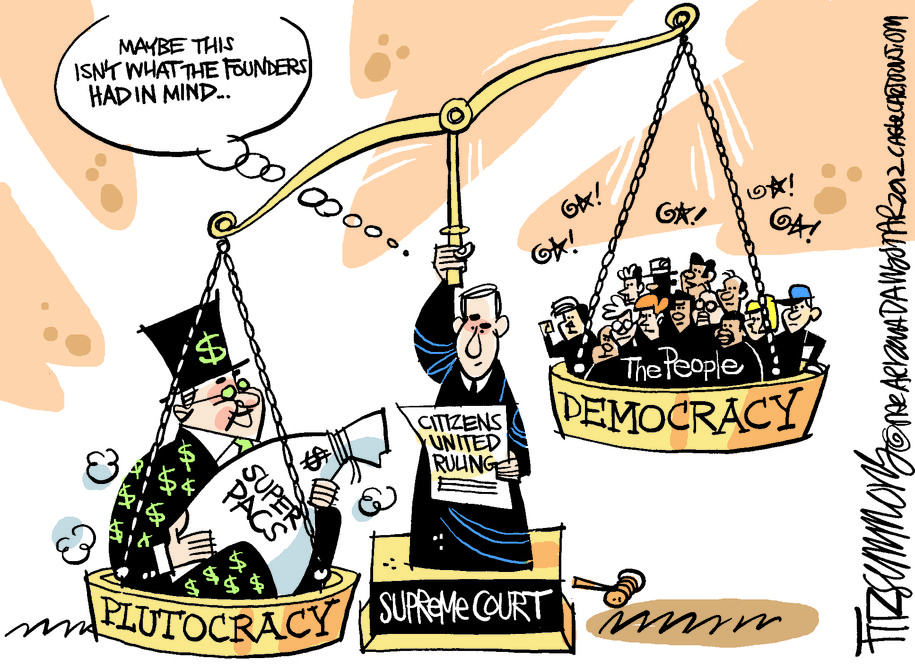
The good news is that giving by small donors has increased. The bad news is that giving by big donors has increased even more and outweighs the donations of the millions of small donors. In the 2022 congressional elections, the 100 biggest donors contributed more than $1.2 billion in total (yes, billion). That’s 60% more than the total donated by millions of small donors. This is in large part due to the Supreme Court’s 2010 Citizens United decision (and related decisions) that allowed unlimited donations by wealthy individuals and corporations, asserting that this is a free speech right. Prior to 2010, small donations significantly outweighed the 100 largest donors. [2]

Another troubling trend is the nationalization of campaign fundraising, which means that more and more campaign money is coming from outside a candidate’s district, i.e., NOT from the candidate’s constituents. In high profile congressional races, out-of-state contributions now constitute the vast majority of the money spent on campaigns. This is a result of the unlimited spending by super political action committees (PACs) and other outside groups that are ostensibly operating independently of the candidate’s campaign. Nationalized funding incentivizes candidates to take extreme positions and engage in outrageous behavior to garner national attention and donors.

A third troubling trend is that campaign money is becoming harder and harder to track, i.e., it is harder and harder to identify the original source of the money. So-called “dark money” groups, which are not required to disclose their donors, are spending more and more. Legal loopholes and lax enforcement (particularly by the Internal Revenue Service (IRS) and the Federal Election Commission (FEC)) are allowing non-profits and even charities (whose donations are tax deductible) to spend money on political campaigns. In addition, more and more money is being spent on on-line activities and promotions where disclosure laws haven’t caught up with the reality of today’s campaigns.

The prominent role of big money distorts not only who wins elections, but who runs, as well as what policies are supported by candidates and then enacted by those who win. People without access to wealth, disproportionately people of color and women, are less likely to run for office and to win. Big money also exacerbates the risk of corruption, both blatant and subtle.

To address these problems, requirements for campaign donor transparency need to be strengthened and enforced. Rules and regulations for super PACs and other politically active groups need to be tightened and better enforced. Ultimately, the Citizens United and other related Supreme Court decisions need to be overturned by a constitutional amendment.

In the meantime, matching small campaign donations from constituents with public funds is needed to enhance the importance of contributions from actual voters. This also makes non-traditional candidates (i.e., non-white and non-male) more competitive. New York City, and more recently New York State, along with other states and municipalities, have successfully implemented this campaign financing reform, and it’s been very effective.

I urge you to donate what you can to candidates you support. Small contributions do make a difference, particularly in lower-profile and local elections. They also let the candidate know that you are paying attention and want your voice heard. They give you additional visibility and influence with elected officials you supported when they were running for office. To further increase your visibility and influence, volunteer for candidates you care about, if you can. Knocking on doors, making phone calls, writing postcards, and other personal communications really make a difference in campaigns!

[1]      Cloutier, J., 8/15/24, “Outside spending in 2024 federal election tops $1 billion,” Open Secrets (https://www.opensecrets.org/news/2024/08/outside-spending-in-2024-federal-election-tops-1-billion)

[2]      Weiner, D. I., 7/24/24, “A changing campaign finance landscape,” Brennan Center for Justice (https://www.brennancenter.org/our-work/research-reports/changing-campaign-finance-landscape)

THE ACTIVISM OF THE EXTENSIVE, WELL-FUNDED RIGHT-WING NETWORK Part 2

The extensive, well-funded right-wing network in the U.S. is actively working to turn America into an oligarchy with an authoritarian president. They do not believe in democracy. However, a solid majority of the public does not support them. Those of us who believe in democracy, need to inform the public of the right-wing’s plans, and then get the public engaged and out to vote.

(Note: If you find my posts too long to read on occasion, please just skim the bolded portions. Thanks for reading my blog! Special Note: The new, more user-friendly website for my blog is here.)

J.D. Vance has now been upgraded from a newly minted (in 2022), billionaire-backed, U.S. Senator (see this previous post for background including Peter Thiel’s major role) to Republican vice-presidential nominee. Peter Thiel and other tech entrepreneurs and venture capitalists, including Elon Musk (of Tesla and Space X), lobbied hard for Trump to select Vance as his vice-presidential running mate. Musk reportedly pledged $45 million a month to Trump’s campaign if Vance was selected. (Musk has since walked back that pledge.) Having their handpicked guy as vice president would give these billionaires tremendous influence in the White House and throughout the federal government, which is what oligarchy is all about.

Peter Thiel and his cronies would look to Vance to push policies that would favor the companies they own, run, and invest in. They want to be unregulated and favored in tax policies and other laws. They see no need for government to regulate the economy so there is fair competition (as opposed to monopolistic power) and so workers and consumers are treated fairly and are kept safe. They have already gotten Trump to embrace many of their desired policies, including support for electric vehicles, cryptocurrency, artificial intelligence (AI), and the unregulated finance and acquisition strategies of the venture capital industry. [1]

Thiel’s embrace of oligarchy and authoritarianism was evident when he wrote in 2009, “I no longer believe that freedom and democracy are compatible.” (That begs the question of freedom for whom.) He also wrote that democracy and capitalism are no longer compatible, in part because women have been granted the right to vote. [2]

J.D. Vance is not only deeply indebted to Thiel and his other right-wing financial backers, he is also deeply embedded in promoting right-wing Christian nationalism. Vance wrote the foreword for Kevin Roberts’ new book, Dawn’s Early Light: Taking Back Washington to Save America. (Roberts is the President of the Heritage Foundation and led the development of Project 2025, the blueprint for a right-wing, authoritarian presidency.) In the foreword, Vance writes that he is part of the right-wing network working to create “a fundamentally Christian view of culture and economics.”

In March 2024, a specific example of the ability of billionaires to corrupt our political and economic systems was apparent when, after meeting with billionaire Jeff Yass, former president Trump reversed his position that the Chinese company TikTok should be banned in the U.S. Yass owns 15% of TikTok’s Chinese parent company, Byte Dance, and is also a big investor in Trump’s Truth Social online media company. [3] Yass is also this election cycle’s biggest donor to-date to non-candidate, Republican-affiliated Political Action Committees, having already given over $46 million. [4]

Robert Reich recently wrote that “Big money, especially from Big Tech, is the second-biggest threat to American democracy — after Donald Trump.” He noted that some billionaire donors to Democrats (in addition to those supporting Republicans) are pushing back against efforts to regulate the economy and, in particular, against enforcement of anti-trust laws and other anti-monopoly policies. Lina Khan, the Chair of the Federal Trade Commission in the Biden Administration, has been the strongest enforcer of anti-trust laws in 45 years and the billionaire businessmen on both sides of the political aisle don’t like this. Therefore, they have been calling on Biden, and now Kamala Harris, to remove her. [5]

The billionaires have money and the right-wing has a well-funded and impressive organizational network, but what they don’t have is the support of the public and voters. Those of us who want to preserve our democracy need to mobilize the public to get out to vote in record numbers to overwhelm the minority that are right-wingers and Trump cult members.

Supporters of democracy need to get out the word about who the right-wingers’ policies benefit and where they want to take our countryas they have laid it out in Project 2025’s 900 plus page blueprint. They want to implement an authoritarian presidency, an oligarchy of billionaires that control our economy and society, and policies that are aligned with right-wing Christian nationalism. They want an unregulated economy with big brother tech companies that know more about us than we know about ourselves and that use this information to relentlessly sell us products for the absolute maximum we are willing to pay – to maximize their profits and outrageous wealth. They want unregulated venture (i.e., vulture) capital firms to flourish along with cryptocurrency, which, among other things, is the financial vehicle of choice of terrorists, drug cartels, human traffickers, oligarchs laundering money, and everyday criminals.

The right-wing and their Project 2025 want to put wealthy oligarchs and authoritarians in power. They want Trump and Republican presidents to rule like the king the colonists rebelled against 250 years ago. They want a government that will benefit them and their cronies. That’s what the vast right-wing conspiracy has been all about for the last 45 years. It’s now out in the open and we need to push back hard against their 45 years of momentum.

Democracy is not a spectator sport and for too long too many citizens have been spectators – and in many cases not even watching closely at all. We, who believe in democracy, need to get them informed, engaged, and out to vote.

[1]      Dwoskin, E., & Zakrzewski, C., 7/29/24, “Powerful tech group anointed Vance,” The Boston Globe from the Washington Post

[2]      Richardson, H. C., 7/30/24, “Letters from an American blog,” (https://heathercoxrichardson.substack.com/p/july-30-2024)

[3]      Kuttner, R., 3/27/24, “The corrupt trifecta of Yass, Trump, and Netanyahu,” The American Prospect blog (https://prospect.org/blogs-and-newsletters/tap/2024-03-27-corrupt-trifecta-yass-trump-netanyahu/)

[4]      Open Secrets, retrieved 3/28/24, “2024 top donors to outside spending groups, “ (https://www.opensecrets.org/outside-spending/top_donors/2024)

[5]      Reich, R., 8/6/24, “Kamala’s surprise opportunity,” Robert Reich’s daily blog (https://robertreich.substack.com/p/how-kamala-should-respond-to-the)

THE ACTIVISM OF THE EXTENSIVE, WELL-FUNDED RIGHT-WING NETWORK

The extensive, well-funded right-wing network in the U.S. is working hard to influence our politics, policies, and laws. The Federalist Society has been a very effective piece of this activism, successfully promoting right-wing legal positions and right-wing lawyers for federal judgeships, including on the Supreme Court. The right-wing network is expanding its influence and support into other parts of our society and economy, notably the technology and venture capital sectors.

(Note: If you find my posts too long to read on occasion, please just skim the bolded portions. Thanks for reading my blog! Special Note: The new, more user-friendly website for my blog is here.)

An overview of the funding network that’s part of the vast right-wing conspiracy that Hillary Clinton called out in 1998 is provided in this previous post. It focuses on some current pieces of the extensive, wealthy right-wing funding network, including the recently uncovered, politically-active (probably illegally), charity Ziklag that’s working to embed right-wing Christianity in U.S. politics, policies, and laws.

The right-wing’s activism includes high-profile think tanks, such as the Heritage Foundation and the American Enterprise Institute. The Heritage Foundation is the lead organizer of the Project 2025 blueprint for the next Trump or Republican presidencies. Project 2025 has been getting a fair amount of attention lately because of its radical, revolutionary, authoritarian proposals and its concrete plans to implement them.

One of the most visible and successful pieces of right-wing activism has been the work of The Federalist Society, which promotes right-wing legal positions and right-wing lawyers for federal judgeships. It was founded in 1982 and its very influential leader, Leonard Leo, has worked there for over 25 years. It played the lead role in getting the six radical, reactionary justices onto the current Supreme Court. (See this previous post for why they should be called radical, reactionary justices, given that they are anything but conservative.) It has also led the way in the appointment of over 200 other right-wing federal judges, 28% of the federal judiciary.

Another Leonard Leo-run organization, the Marble Freedom Trust, recently received a $1.6 billion gift (yes, billion) from Chicago businessman Barre Seid. This has been described as the largest known donation to a political advocacy group ever.

ProPublica and an investigative journalism partner, Documented, have reported that over the last five years or so, Leo has also been playing a leading role with the Teneo Network. It’s a little-known network of young conservatives working to replicate the success of The Federalist Society in other realms of U.S. society. It recruits under 40 years old corporate leaders, athletes, scholars, and writers. [1]

The Teneo Network’s founders were Senator Josh Hawley (R-MO) and Evan Baehr, a tech entrepreneur. It’s striving to influence Wall Street, Silicon Valley, the media, and Hollywood, the way The Federalist Society has influenced the legal system. For example, it’s pushing back against investors and others who are advocating for good corporate environmental, social, and governance practices and policies.

As one example of the flow of money in the vast right-wing funding network, in 2021, the majority of Teneo’s funding, over $3 million, came from DonorsTrust, a funnel for laundering right-wing money and hiding the identities of donors. DonorsTrust, which had $1.5 billion in assets in 2021, had received $41 million from Leo’s group the Marble Freedom Trust (which had received the $1.6 billion gift from the Chicago businessman). Teneo has also received funding from the Charles Koch Foundation, Betsy DeVos’s family (Trump’s Secretary of Education), and other well-known wealthy, conservative donors.

Teneo’s members include Senator (and now Republican vice-presidential candidate) J.D. Vance (R-OH), Representative Elise Stefanik (R-NY), Nebraska’s Attorney General, Virginia’s Solicitor General, aides to FL Governor DeSantis, and the heads of the Republican Attorneys General Association, the Republican State Leadership Committee, and Turning Point USA (a right-wing group promoting student activism).

Teneo and right-wing activism in general have engaged and been supported by several venture capitalists and technology sector entrepreneurs. A key activist and supporter, who has been in both fields, is billionaire Peter Thiel. J.D. Vance worked at Thiel’s venture capital firm in 2016 – 2017. Thiel then and afterwards in other investment industry roles made Vance wealthy. When Vance decided to run for the U.S. Senate in 2021, Thiel backed him with $15 million for his campaign. Thiel also brought in other tech entrepreneurs, venture capitalists, and right-wingers to support Vance. In 2022, Vance won election to the Senate. There probably isn’t a clearer current example of a politician and political office having been bought by billionaires than J.D. Vance and his U.S. Senate seat. (By the way, back in 2010, Evan Baehr, co-founder of the Teneo Network, worked for Peter Thiel.)

More on J.D. Vance, Peter Thiel, and their promotion of a right-wing agenda, including Christian nationalism, in U.S. politics, policies, and laws in my next post. I’ll also identify what we can and must do to pushback.

[1]      Kroll, A., & Bernstein, A., (ProPublica), & Surgey, N., (Documented), 3/9/23, “Inside the ‘private and confidential’ conservative group that promises to ‘crush liberal dominance’,” ProPublica (https://www.propublica.org/article/leonard-leo-teneo-videos-documents)

THE EXTENSIVE AND WEALTHY RIGHT-WING FUNDING NETWORK

There was a vast right-wing conspiracy in 1998 when Hillary Clinton called it out for attacking her and President Clinton. It’s only grown bigger and better funded since then, although it’s not so much of a conspiracy any more as it’s largely out in the open. It is getting more extreme and investigative journalists recently uncovered a piece of it that’s explicitly pushing right-wing Christian nationalism into U.S. politics, policies, and laws.

(Note: If you find my posts too long to read on occasion, please just skim the bolded portions. Thanks for reading my blog! Special Note: The new, more user-friendly website for my blog is here.)

You may remember First Lady Hillary Clinton using the phrase “vast right-wing conspiracy” in 1998 to describe the source of the attacks on her and President Clinton. Although she didn’t originate the phrase, she put it into the mainstream of American dialogue. Although the assertion that there is a “vast right-wing conspiracy” is pooh-poohed and mocked by Republicans to this day, there was and is a lot of truth to it. When Hillary Clinton was asked in 2016, when she was running for President, if she still believed in the “vast right-wing conspiracy,” she answered in the affirmative and added that it was even better funded then than in 1998. She also noted that it was probably no longer correct to call it a conspiracy as it was much more out in the open.

Today, it’s very much out in the open and its funding has grown dramatically. However, many of its big funders do go out of their way to hide their identities or at least their connections to specific activities. They contribute to right-wing activities through dark money, not-for-profit groups that do not have to report their donors. They use networks of organizations (including shell corporations) and super Political Action Committees (PACs), and transfer funds among them, sometimes in multiple steps, to launder contributions and obscure donors. All of this was, of course, enabled by the Supreme Court’s 2010 Citizens United (and related) decisions that gave wealthy individuals and corporations the right, based on free speech claims, to spend unlimited sums of money for political purposes.

Perhaps the best known and largest piece of the right-wing funding network is the one establish by the billionaire Koch brothers. It funnels hundreds of millions of dollars through dozens of related entities every election cycle. A key entity is the Americans for Prosperity super PAC, founded in 2004, which has already spent over $70 million on 2024 campaigns. In addition to Koch contributions, it also receives large contributions from other wealthy Republican supporters such as the Walton family (owners of Walmart).

Paul Krugman in his 2005 book, The Great Unraveling, wrote about the network of wealthy individuals and foundations that fund the vast right-wing network. They fund a coordinated set of Republican and right-wing think tanks, advocacy groups, law firms, and media outlets (including Fox, founded in 1996, and talk radio). These organizations push their right-wing agenda, as well as attack Democrats and progressive policies. Krugman noted that this right-wing network of funders and organizations far surpasses in funding, size, coordination, and influence anything on the Democratic, left, or progressive political side. He also noted that those pushing the more extreme elements of the right-wing agenda were (and are) not conservatives but “radical, revolutionaries,” including members of President G. W. Bush’s administration. In hindsight, Krugman was clearly right, in that the goals and policies they were pushing were direct precursors of the undemocratic, authoritarian vision of the Trump / MAGA agenda today. (If you’re interested, the Trump / MAGA agenda has been written down in detail in Project 2025. I’ve previously posted about it here and here.)

Recently, ProPublica and an investigative journalism partner, Documented, uncovered a new piece of the vast, right-wing funding network. A charity (a 501(c)(3), non-profit, tax-exempt organization that does not have to reveal its donors) called Ziklag is planning to spend nearly $12 million to promote Christian nationalism in U.S. politics. It is funded by a network of very wealthy, radical, Christian donors, including the high-profile billionaire David Green, who founded and owns Hobby Lobby (a chain of arts and crafts stores). He has long been active in pushing his view of Christian-based policy, such as having the right to exclude abortion and morning-after pill coverage from the company’s health insurance for its 46,000 employees. He is a major financial supporter of evangelical organizations. Ziklag is also supported by the billionaire Uihlein family (owners of an office supply company and heir to the Schlitz brewing fortune) and the Wallers (owners of Jockey apparel). It claims to have 125 members and recruits new members who are conservative Christians with a net worth of over $25 million. [1]

Ziklag’s long-term goal is to embed its right-wing version of Christianity in all walks of American society. Its 2024 efforts are focused on using pastors and churches to turnout voters, motivating them around issues of “parents’ rights” (e.g., to ban books and content they don’t like from schools) and opposition to transgendered individuals and policies. It is also planning to use artificial intelligence software to drive challenges to hundreds of thousands of voters in swing states. In 2022, Ziklag gave $600,000 to the Conservative Partnership Institute which funds “election integrity” efforts led by Cleta Mitchell (one of the lawyers on Trump’s call to the Georgia Secretary of State in 2021 asking him to “find” enough votes to make Trump the election winner in Georgia). Ziklag is planning to give another $800,000 to these efforts for the 2024 election. Its stated goal is to remove 1 million supposedly ineligible voters from the voting rolls in swing states.

Although the $12 million Ziklag plans on spending is a tiny amount compared to the hundreds of millions of dollars flowing through the vast right-wing network of funders, it’s significant because it highlights the growing extremism of these efforts. It’s explicitly pushing right-wing Christian nationalism into U.S. politics, policies, and laws. It has given funding to the Alliance Defending Freedom, the right-wing Christian legal group that led the effort to overturn the right to an abortion (i.e., Roe v. Wade). It has also provided funding to Turning Point USA, a charity working to promote right-wing student activism, and many other right-wing advocacy groups. It claims to have organized a coalition that played a major role in getting Amy Coney Barrett confirmed to the Supreme Court in 2020.

As a charity, receiving donations that are tax deductible, Ziklag is prohibited by IRS regulations from engaging in political campaigns on behalf of (or in opposition to) any candidate. Therefore, many of Ziklag’s activities appear to be illegal. Unfortunately, the IRS has been lax in enforcing regulations prohibiting or limiting political activity by tax-exempt organizations, so some of them, like Ziklag, appear to be flagrantly violating the law.

[1]      Kroll, A., (ProPublica) & Surgey, N., (Documented), 7/13/24, “Inside Ziklag, the secret organization of wealthy Christians trying to sway the election and change the country,” (https://www.propublica.org/article/inside-ziklag-secret-christian-charity-2024-election)

SHORT TAKES #11: CORPORATIONS AND THE FEDERAL GOVERNMENT

Here are short takes on three important stories that have gotten little attention in the mainstream media. Each provides a quick summary of the story, a hint as to why it’s important, and a link to more information. These three highlight the relationships between corporations and the federal government.

STORY #1: In 2023, $2,974 of the average taxpayer’s federal taxes went to the Defense Department. Of that amount, $705 went to salaries for the troops, while 2 ½ times that, over $1,700, went to for-profit corporate defense contractors. Among others, $87 went to Boeing, whose V-22 Osprey military aircraft has crashed multiple times, most recently last November, killing eight service members. The $2,974 to Defense is more than two months of rent for the average renter with well over a month’s rent going to defense contractors. Another $112 from the average taxpayer went to support for foreign militaries.

For the sake of comparison, the federal government spent, from the average taxpayer, $516 for food assistance for low-income Americans, $346 for K-12 education, $110 for the Child Tax Credit which lifts poor children out of poverty, and $58 for diplomacy. These data come from the Institute for Policy Studies’ annual receipt for the American taxpayer.

STORY #2: To penalize the greed of large corporations that have made record profits by increasing prices, the Ending Corporate Greed Act has been introduced in Congress. It would put a 95% tax on the profits of large corporations (over $500 million in yearly revenue) that exceed their average profits in 2015 – 2019. The goal is to heavily tax the windfall profits large corporations have made in the pandemic and post-pandemic years by hiking prices on gas, food, rent, drugs, and other products. Large corporations have used the smoke screen of supply chain problems and other effects of the pandemic to create price “inflation” that did not reflect increased costs but was simply greed, using a catastrophe as a pretext for raising prices and profits. [1]

In 2023, corporate profits rose to record highs due to price gouging. If the 95% windfall profits tax had been in place in 2023, just ten large corporations would have had to pay $300 billion on their excess profits. For example, Amazon’s profits were $37.6 billion, a 444% increase from its average profits from 2015 to 2019. It would have paid $19 billion if a 95% windfall profits tax had been in place. Other notable increases in profits occurred at Marathon Petroleum (up 325%), Chevron (up 289%), Exxon Mobil (up 165%), Google (up 195%), and Microsoft (up 190%).

STORY #3: Large chemical corporations, such as ones that produce pesticides, routinely work to influence the Environmental Protection Agency (EPA). For example, the EPA recently proposed easing restrictions on the pesticide, acephate. The European Union banned this pesticide over 20 years ago. It’s a type of chemical called an organophosphate. These chemicals are linked to detrimental effects on children’s brains including autism, hyperactivity, and poorer cognitive performance. [2]

Several studies suggest that even at currently allowable levels acephate may be causing learning disabilities in children exposed to it while in utero or during their first years of life. In 2017, researchers found that children of Californians who, while pregnant, lived within 1 kilometer of where the pesticide was applied had lower IQ scores and worse verbal comprehension on average than children of people who lived further away. Two years later, another group of scientists reported that mothers who lived near areas where acephate was used during their pregnancies had children who were at increased risk for autism.

In 2021, the EPA effectively banned another organophosphate pesticide, chlorpyrifos, based in part on evidence linking it to detrimental effects on children’s brains. (Based on a lawsuit by a company that sells chlorpyrifos and several agricultural groups, a court blocked the ban. This allows the use of chlorpyrifos on some crops, including cherries, strawberries, and wheat.) While some health and farmworker groups are petitioning the EPA to ban all organophosphate pesticides, the EPA is arguing that it can adequately protect children by limiting the amounts farmers can use.

The U.S. regulation of pesticides (and other chemicals) is weaker than in other well-off countries because it’s particularly vulnerable to industry influence in multiple ways. The chemical corporations are responsible for paying for research to establish the safety of their chemicals (because the U.S. government doesn’t want to pay for the testing itself). This, of course, creates huge conflicts of interest. There’s a lot of evidence that the testing research is biased in favor of the corporations and the (supposed) safety of their chemicals.

Furthermore, the corporations are pushing the EPA to allow a new type of toxicity testing that is quicker and cheaper. Rather than relying on the traditional animal testing, the industry wants to do testing just on disembodied cells. This type of testing is not as sensitive and, therefore, tends to find more chemicals and higher levels of chemicals to be safe. Scientists have warned the EPA not to use these new tests to loosen regulations.

In addition to doing the testing, the corporations also work to influence the EPA through lobbying, campaign contributions to elected officials, and the revolving door for personnel. People move back and forth between the chemical corporations and the EPA division that regulates them. If an EPA employee wants to get a job with a chemical corporation when they leave the EPA, they have an incentive to act in ways that don’t alienate prospective future employers.

The EPA’s Office of Pesticide Programs has been criticized for allowing pesticides to be sold without required toxicity testing. In 2018, staff members celebrated having waived 1,000 legally required tests for pesticides! It was noted that this had saved the chemical corporations more than $6 million.

[1]      Johnson, J., 6/21/24, “Bowman, Sanders propose 95% tax on corporations exploiting inflation to jack up prices,” Common Dreams (https://www.commondreams.org/news/windfall-tax-inflation)

[2]      Lerner, S., 4/24/24, “10 times as much of this toxic pesticide could end up on your tomatoes and celery under a new EPA proposal,” ProPublica (https://www.propublica.org/article/epa-acephate-pesticide-adhd-autism-regulations)

THE SUPREME COURT’S THREATS TO OUR DEMOCRACY AND HOW TO FIGHT BACK

Based on the recent decisions by the Supreme Court’s six radical, reactionary justices, we should all be in the streets protesting. Their decisions undermine the Constitution and our system of government. For those of us who want to keep our democracy, we need to fight back and protest in whatever ways we can, starting with getting out to vote and voting for every office on your ballot in every election.

(If you find my posts too long to read on occasion, please just skim the bolded portions. Thanks for reading my blog! Note: The new, more user-friendly website for my blog is here.)

Based on the recent decisions by the Supreme Court’s six radical, reactionary justices, we should all be in the streets protesting. Their recent decisions undermine the Constitution and our system of government. Their presidential immunity decision violates the principle that everyone is subject to the rule of law (see this previous post for more details).

In addition, in late June, the Supreme Court’s six radical, reactionary justices, in their Loper Bright Enterprises v. Raimondo decision, overturned a 40-year-old Supreme Court precedent and over 200 years of precedent in practice. They ruled that the courts should not defer to the expertise of federal executive branch agencies on the details of the implementation of laws. [1]

The authority of executive branch agencies to make the detailed decisions necessary to implement laws had been the practice and core of our system of government for over 200 years. It was upheld and formalized by the Supreme Court in 1984 in a case that established the so-called “Chevron doctrine,” which said that the court system should defer to executive branch agencies’ expertise in interpreting and implementing laws. That decision reflected the Court’s belief and understanding from the Constitution that policy decisions should be responsive to the voters and their elected representatives, not made by unelected federal judges with lifetime appointments. Therefore, policy decisions should be in the hands of the president, the head of the executive branch and its agencies, and Congress, which writes the laws.

Based on the Court’s Loper Bright ruling, federal judges now have the power to determine the interpretation and implementation of laws. This means that agencies’ expertise and process in establishing rules and regulations can now be superseded by the courts. This takes crucial decision making out of the hands of experts and scientists at federal agencies and hands it to federal judges. Judges don’t have the expertise to make these decisions. The roughly 800 judges that make up the federal judicial system have widely varied philosophical and ideological views that mean there will be contradictory rulings that will create confusion and even chaos in the court system and in our economy and society. Furthermore, the workload of reviewing challenges to the thousands of decisions that executive branch agencies make in implementing laws is likely to bog down and maybe overwhelm the court system. Even Congress does not have the capacity to micromanage the implementation of the laws it passes, so it leaves this work to the fourteen executive branch agencies, their over 1 million employees, and their expertise. (The Department of Defense is the fifteenth executive branch agency and has over 3 million employees, but has less of a role in establishing rules and regulations that affect civilian society.)

The door is now open for court challenges to rules and regulations on, for example, public safety, public health, and environmental protection, such as protecting the public from pollution, unsafe and contaminated food, and unsafe working conditions. The approval of drugs and the regulation of drug prices are now susceptible to court challenges. The details of safety standards for aircraft construction and air travel, as well as the detailed regulations of financial instruments and institutions are now subject to court review. The federal requirements for services for children with special needs can now be challenged in the courts. And on and on and on. Some expert legal observers are worried that a likely plethora of challenges to rules and regulations could lead to legal and administrative chaos in the federal judiciary and regulatory agencies.

An important effect of these recent Supreme Court decisions by the six radical, reactionary justices is that more power has been arrogated to the court system and ultimately to the Supreme Court. In the Loper Bright case it’s power over rules and regulations and in the presidential immunity case, the courts will now decide which presidential acts are immune official acts, which aren’t, and what evidence can be used in a trial. Note that these rulings have created a strong president at the head of the executive branch but weak executive branch agencies. This is just another contradiction in the dramatic lack of coherence in the Court’s decisions.

The six radical, reactionary Supreme Court justices are not behaving as good-faith players in a constitutional democracy. They have overturned the balance of power among the three branches of government established by the Constitution, undermined its checks and balances, and made the courts (i.e., themselves) the supreme rulers and the ultimate arbiters of all legislative and executive branch decisions.

For those of us who want a democracy, with government of, by, and for the people, operating under the rule of law, rather than an authoritarian government overseen by an imperial president and an all-powerful cadre of six radical Supreme Court justices, we need to fight back and protest in whatever ways we can: [2]

  • Write letters to the editor, post on social media, call in to talk shows on the radio, etc.,
  • Talk with family, friends, colleagues, and neighbors,
  • Participate in local events and demonstrations,
  • Donate money to good organizations and candidates,
  • Volunteer in local government and local organizations,
  • Engage in local government and politics, perhaps even run for an elected position, and
  • Most of all, get out and vote and get everyone you know to do so as well.

On this last point, getting out to vote, I encourage you to vote for every office on your ballot in every election. In addition to federal offices, state and local elections and offices matter greatly. They affect your everyday life, your local schools, and the well-being of everyone in your local community. They also are the proving ground and pipeline for candidates for higher offices. I painfully note (as someone who was a proud independent until the days of President Reagan and who viewed local elections as non-partisan until 20 years ago) that the Republican Party, at least everywhere that I can see, has become the party of Trump and authoritarianism, of the wealthy, and of the large corporations. Therefore, I encourage you to scrutinize any Republican you might vote for very carefully, and, when in doubt, to vote for Democrats – all the way down the ballot to your local offices. (For more on the importance of “down ballot” races, see this blog post from Robert Hubbell.)

Democrats need to be in control of Congress and the presidency so the Supreme Court can be reformed. It clearly needs enforceable ethics rules. Perhaps most importantly, the Court needs to be expanded to counteract the two seats that were stolen by Republicans and have given the radical, reactionary justices control. There are other reforms that should be considered, such as term limits. See this previous post for some options for reforming the Supreme Court.

[1]      Turrentine, J., 6/28/24, “The Supreme Court ends Chevron deference – What now?” Natural Resources Defense Council (https://www.nrdc.org/stories/what-happens-if-supreme-court-ends-chevron-deference)

[2]      Pepper, D., 2023, “Saving democracy: A user’s manual for every American,” St. Helena Press, Cincinnati, Ohio.

THE SUPREME COURT IS A THREAT TO OUR DEMOCRACY

Abortion rights activists rally outside of the US Supreme Court after the overturning of Roe Vs. Wade, in Washington, DC, on June 24, 2022. (Photo by Mandel NGAN / AFP) (Photo by MANDEL NGAN/AFP via Getty Images)

Based on the Supreme Court’s decisions of the last few weeks, we should all be in the streets protesting and storming the Supreme Court. Its decisions undermine the Constitution and our system of government, while giving the president king-like status.

(Note: If you find my posts too long to read on occasion, please just skim the bolded portions. Thanks for reading my blog! Special Note: The new, more user-friendly website for my blog is here.)

Based on the Supreme Court’s decisions of the last few weeks, we should all be in the streets protesting and storming the Supreme Court. Their decisions undermine the Constitution and our system of government as it’s worked for over 200 years. I won’t go into the details of the decisions because you’ve probably read or heard about them. I’ll just state that this is a radical, reactionary Court – not a conservative one by any stretch of the imagination. (See this previous post for details.)

The six radical, reactionary justices on the Court totally disregard precedents both in content and procedure to make rulings that are political and ideological, not grounded in law or the Constitution. Their claim of being true to the original text and intent of the Constitution is a blatant lie – a smoke screen for making rulings out of thin air that suit their political purposes. This is judicial activism in the extreme, which conservatives used to decry (and still would if they were true conservatives).

Moreover, the six radical, activist justices stated in their congressional confirmation hearings that they would respect precedents; they would call balls and strikes but not change the rules of the game. It’s now clear they were lying and committing perjury.

With its recent decision on presidential immunity from criminal prosecution, the Court puts the president above the rule of law. The decision exempts the president from the rule of law for all official acts (and probably for many unofficial acts as well). This grants the president king-like status.

This is in blatant contradiction to what the Founding Fathers intended in the Constitution and made clear in their writings. The Constitution does mention immunity – for citizens, for witnesses to crimes, and for legislators in limited cases (for speech or debate in congressional chambers). Clearly, the writers of the Constitution thought carefully about immunity and did NOT grant it to the president. The supposed constitutional originalists on the Supreme Court invented presidential immunity out of thin air, presumably for political reasons.

Historian Heather Cox Richardson has a clear and concise interview (6 mins.) on the immunity issue and has written about it in her Letters from an American blog. Her blog post includes quotes from the confirmation hearings of Justices Roberts, Alito, and Kavanaugh where they stated that no one is above the law. Therefore, they have, very specifically, shown that their congressional testimony was a lie and that they committed perjury.

Retired lawyer Robert Hubbell states that the Court’s presidential immunity decision (and others) by the six radical justices shows that the “Supreme Court is lawless.” The immunity decision “overthrew the American Revolution and anointed the US president as a modern-day king.” He succinctly outlines what the decision does and gives examples of what a president can now do without fear of criminal prosecution, including accept a bribe in exchange for a pardon and direct the Justice Department to target political enemies. With this immunity in place, what President Nixon did during Watergate would presumably have been completely legal. [1]

Moreover, the Supreme Court’s decision leaves it to the courts (i.e., ultimately itself) to decide what are “official” (immune from prosecution) and “unofficial” presidential acts, and also to decide what evidence can be used in a prosecution. Therefore, the Court has arrogated substantial power to itself over the implementation of its presidential immunity ruling – a real power grab.

The hypocrisy of the six radical Supreme Court justices who claim to be constitutional “originalists” is laid bare by their decisions. For example, they have ruled:

  • For very strong presidential immunity, which is not only nowhere in the Constitution, but contradicts the Constitution and its writers. This ruling’s lack of a constitutional basis is made clear by provisions for other immunities that ARE in the Constitution and by the expressed sentiments of the writers of the Constitution that the president should NOT be above the law and have king-like powers.
  • Against banning an insurrectionist from the ballot, despite clear language in the Constitution that an insurrectionist cannot hold elected office without 2/3 approval from Congress.

My next post will discuss the Supreme Court’s decimation of the power of executive branch agencies to implement laws and protect workers, consumers, and residents through rules and regulations.

[1]      Hubbell, R., 7/2/24, “The Supreme Court is the biggest threat to democracy we face,” Today’s Edition Newsletter (https://roberthubbell.substack.com/p/the-supreme-court-is-the-biggest)  

MICROSOFT PUTS PROFITS BEFORE CYBERSECURITY Part 2

Recent investigative reporting by ProPublica showed that Microsoft has put making profits, through securing a place as an industry leader in cloud computing, ahead of keeping its customers safe from cyberattacks – with very harmful results. [1] Punishments for corporations and their executives need to be increased to deter this type of corrupt extreme capitalism.

(Note: If you find my posts too long to read on occasion, please just skim the bolded portions. Thanks for reading my blog! Special Note: The new, more user-friendly website for my blog is here.)

Microsoft failed for three years to address a known flaw in its software that allowed Russian hackers in the SolarWinds breach to gain access to the data and emails of its customers, including sensitive agencies of the federal government. Moreover, its president lied in testimony to Congress claiming first that Microsoft flaws had not contributed to the breaches and later that he and Microsoft had not been aware of the flaw. (See this previous post for more details.)

In 2016, when the flaw was discovered, Microsoft was in a major industry battle to be a leader in cloud computing services and was vying for a multi-billion-dollar Defense Department cloud computing contract. Admitting to a software vulnerability in a related product would have hurt Microsoft’s chances of winning the contract. The Microsoft employee who discovered and reported the flaw, Andrew Harris, was told the decision not to fix the software flaw was a business decision not a technical one.

As background, Microsoft’s new CEO in 2014, Satya Nadella, saw cloud computing as the future of the technology industry and staked Microsoft’s future on being a major player in this arena. Under pressure to catch up to industry-leader Amazon, Microsoft focused on new features and functionality for its cloud computing products to generate sales and profits and not on security fixes, which cost money and have no immediately visible benefit.

In 2024, Microsoft President Brad Smith was called back to testify before Congress again (see this previous post for information on his 2021 appearance) after a series of cyberattacks on the federal government linked to flaws in Microsoft products. For example, in 2023, Chinese hackers exploited a Microsoft security flaw to access the email accounts of senior government officials. In addition, ProPublica’s reporting on Microsoft’s culpability in the 2019 SolarWinds breach (see this previous post for more information) had been published the day of Smith’s testimony. ProPublica had contacted Microsoft two weeks before with detailed questions related to its investigation and a request for an interview with Smith. Nonetheless, Smith claimed in his testimony to be unaware of the role of a Microsoft software flaw in the SolarWinds breach. [2]

The Federal Cyber Safety Review Board, in reviewing the Microsoft-related security breaches, found that Microsoft’s “security culture was inadequate and requires an overhaul.”

Microsoft’s ignoring of cybersecurity issues to maximize profits has put its customers at risk. It has allowed Russian, Chinese, and other hackers to steal information and data from government agencies, businesses, and their customers.

Publicly traded corporations, like Microsoft, are beholden to profits, to the price of their stock, and to stockholders, not to customers or any sense of the public good. That’s the reality of the unregulated, extreme capitalism allowed by current U.S. laws. This and the extreme personal wealth accumulation it allows seem to have resulted in greed rising to new heights and ethics falling to new lows.

The frequency, pervasiveness, and repetitiveness of business scandals driven by putting profits first and foremost is astounding. If you want to see how pervasive corporate violations of the law are, look at the Violation Tracker database compiled by Good Jobs First.

An underlying theme of this corrupt corporate behavior is the loss of robust competition in the marketplace due to the emergence of a handful of huge, monopolistic corporations in many industries. This has occurred largely through mergers and acquisitions that have occurred due to little or no enforcement of antitrust laws since the 1980s (until very recently).

To stop corporate corruption and bad behavior, there must be more enforcement with greater penalties. Otherwise, corporations just treat the penalties they pay as a cost of doing business. The size of the penalties must be big enough that it significantly reduces a corporation’s profits and share price. This would impact stockholders, particularly big ones, including senior executives. The impact should be big enough to put senior executives’ jobs at-risk.

For substantial illegal behavior by their corporations, CEOs and other senior executives need to be held personally accountable with criminal charges, the ability to make them return compensation (especially bonuses for generating big profits), and the risk of being fired with no severance package.

The ultimate penalty would be to revoke the corporation’s charter to do business, forcing the liquidation of the corporation. This does not seem likely to happen, so when the illegal or corrupt behavior is serious enough or repetitive enough, the financial penalties must be big enough to potentially put the corporation into bankruptcy and out of business – if the goal is to truly stop corporate corruption and bad behavior. Furthermore, corporations with a track record of serious violations should be banned from doing business with the federal government.

I urge you to contact President Biden to ask him to have the Department of Justice and other agencies investigate and seriously punish Microsoft and its executives for allowing dangerous cybersecurity breaches. You can email President Biden at http://www.whitehouse.gov/contact/submit-questions-and-comments or you can call the White House comment line at 202-456-1111 or the switchboard at 202-456-1414.

I urge you to contact your U.S. Representative and Senators to ask them to pass laws that place serious penalties and punishments on corporations and their executives when they put profits before the safety and security of their customers and the public. You can find contact information for your U.S. Representative at  http://www.house.gov/representatives/find/ and for your US Senators at http://www.senate.gov/general/contact_information/senators_cfm.cfm.

[1]      ProPublica, 6/18/24, “Nine takeaways from our investigation into Microsoft’s cybersecurity failures” (https://www.propublica.org/article/microsoft-solarwinds-what-you-need-to-know-cybersecurity)

[2]     Dudley, R., with Burke, D., 6/13/24, “Microsoft president grilled by Congress over cybersecurity failures,” ProPublica (https://www.propublica.org/article/microsoft-solarwinds-cybersecurity-house-homeland-security-hearing)

MICROSOFT PUTS PROFITS BEFORE CYBERSECURITY

Recent investigative reporting by ProPublica brought to light another example of a corporation putting profit before the well-being of its customers. Microsoft put making profits, through securing a place as an industry leader in cloud computing, ahead of keeping its customers safe from cyberattacks – with very detrimental results.

(Note: If you find my posts too long to read on occasion, please just skim the bolded portions. Thanks for reading my blog! Special Note: The new, more user-friendly website for my blog is here.)

You may remember the “SolarWinds” cybersecurity breach by Russian hackers that was revealed in 2020. It was one of the largest cyberattacks on U.S. government agencies and private businesses ever. The hackers penetrated the SolarWinds corporation’s software in 2019 and used it to gain access to the computer systems of multiple companies and U.S. government agencies. They got sensitive data from the National Nuclear Security Administration, which oversees U.S. nuclear weapons. They accessed the National Institutes of Health (NIH) as it was working to contain the Covid virus and develop a vaccine for it. They gained access to the email accounts of senior officials at the Treasury Department.

In 2021, Microsoft President Brad Smith testified before Congress that although all the affected companies and government agencies used Microsoft software and cloud computing services, no Microsoft vulnerability or flaw had been exploited in the SolarWinds cybersecurity breach. He said the customers should have done more to protect themselves.

Recent investigative reporting by ProPublica has shown this to be a lie and, moreover, that Microsoft had been warned multiple times, years earlier, about a software flaw that was taken advantage of in the cyberattack. [1] In 2016, Microsoft engineer and cybersecurity expert, Andrew Harris, identified a flaw in a Microsoft software product. The flaw allowed a hacker who had gained access to an individual’s local computer at a Microsoft customer to steal the keys needed to access a broad range of programs and networks. These included Microsoft products that provided remote computing services and data storage to multiple customers, a service called “cloud computing.” Millions of users of these Microsoft products, including federal government agencies and employees, were vulnerable.

In 2016, Harris reported the flaw to Microsoft’s Security Response Center and to the product’s manager, who agreed it was a significant flaw but did not feel it was urgent to address it. Harris suggested a simple fix that would require users of the Microsoft product to logon a second time to access other programs and networks, including cloud computing systems. This was rejected because it would inconvenience customers and hurt marketing of the product, for which the single logon capability was a key selling point.

Harris personally contacted some sensitive Microsoft customers he worked with to inform them of the flaw and their vulnerability. For example, he worked with the New York Police Department to implement the fix he had recommended. [2]

In November 2017, a private cybersecurity firm, Cyber Ark, identified the same flaw. It reported it publicly after having notified Microsoft about it twice with no response. In 2018, another Microsoft engineer identified a related flaw that made the flaw Harris had identified even more serious.

In 2019, another private cybersecurity firm, Mandiant, after notifying Microsoft but getting no response, publicly demonstrated the use of the flaw to gain access to cloud computing services.

Nonetheless, in 2021, after the SolarWinds cyberattack had given Russian hackers access to Microsoft’s cloud computing services and customers’ data and emails, as noted above, Microsoft President Brad Smith testified (untruthfully) before Congress that no Microsoft vulnerability or flaw had been exploited in the SolarWinds cybersecurity breach.

Harris, frustrated by the failure of Microsoft to address the flaw he’d identified, left Microsoft in August 2020, before the SolarWinds cyberattack became publicly known. He publicly stated that Microsoft’s “decisions [were] not based on what’s best for Microsoft customers but on what’s best for Microsoft.”

Some context for Microsoft’s behavior, as well as steps that should be taken to stop the corporate practice of putting profits before all else, will be in my next post.

[1]      ProPublica, 6/18/24, “Nine takeaways from our investigation into Microsoft’s cybersecurity failures” (https://www.propublica.org/article/microsoft-solarwinds-what-you-need-to-know-cybersecurity)

[2]     Dudley, R., with Burke, D., 6/13/24, “Microsoft president grilled by Congress over cybersecurity failures,” ProPublica (https://www.propublica.org/article/microsoft-solarwinds-cybersecurity-house-homeland-security-hearing)

SHORT TAKES #10: ELECTIONS AND MONEY

Here are short takes on two important stories that have gotten little attention in the mainstream media. Each provides a quick summary of the story, a hint as to why it’s important, and a link to more information. They highlight the role of money in our elections and how the often overwhelming power and influence of the wealthy is only increasing.

STORY #1: U.S. federal elections are already awash in money that gives wealthy individuals and corporations inordinate influence in our elections and therefore in policy making. Very unfortunately, the Federal Elections Commission (FEC) is now making this even worse. For over ten years the FEC has been dysfunctional as hyper-partisanship among its three Democratic and three Republican members has caused gridlock. However, since her appointment in 2022, Democratic appointee Dara Lindenbaum has repeatedly voted with the three Republicans to further deregulate campaign spending. They are rolling back constraints on the spending and raising of money by candidates, political parties, and political action committees (PACs). [1]

For example, their decisions have:

  • Allowed candidates’ campaigns and PACs to coordinate door-to-door canvassing efforts. Previously, all coordination between them was banned because of the unlimited amounts of money PACs can receive and the potential for such large sums of money to corrupt elected officials. Although, the FEC has done a poor job of enforcing the prohibition on coordination, to officially allow it is a huge step in the wrong direction.
  • Permitted federal candidates to raise unlimited amounts of money for state-level ballot initiatives. Huge spending by corporations (hundreds of millions of dollars) in state ballot initiatives has skewed results of this supposedly ultimate democratic policy making avenue. Allowing federal candidates to raise unlimited amounts of money for these campaigns not only further undermines the supposed public interest democracy of ballot initiatives, it also presents serious opportunities for corruption of federal candidates.
  • Allowed wealthy campaign donors to put money into a trust which would then donate to campaigns, while keeping the original donor anonymous. More transparency not less is needed about the sources of campaign spending. Voters should know who is trying to influence their voting.
  • Ruled that mass text messages are not “public communications” thereby subjecting them to less regulation.
  • Allowed members of Congress to use money from their PACs for their personal benefit. This means that donors to these PACs can, in effect, put money into the pockets of members of Congress. If this isn’t ripe for corruption, nothing is.


STORY #2: As hyper-partisanship, influence by corporations and the wealthy, and other factors are blocking enactment of policies in state legislatures that have broad public support, voters are using ballot initiatives to attempt to enact such policies. These ballot initiatives, especially when they address hot-button issues like abortion, Medicaid expansion, marijuana legalization, and workers’ rights, are becoming very expensive. In 2022, across the country, spending on ballot initiatives exceeded $1 billion. In 2023, with fewer state elections and ballot initiatives in only eight states, spending exceeded $200 million. [2]

Much of the spending on ballot initiatives is in California because it is a huge state and it’s relatively easy to put a question on the ballot there. For example, in 2022, over $450 million was spent on two CA ballot initiatives on sports betting. In 2020, Uber, Lyft, DoorDash, InstaCart and others spent over $200 million on a successful CA ballot initiative to define their workers as independent contractors and not employees under labor laws and regulations. Those opposing the ballot initiative spent almost $20 million, a significant sum but less than one-tenth of what the proponents spent. [3]

The 2024 elections are almost certainly going to set records for ballot initiative spending with many issues in many states on the ballot in November. For example, at least 14 states have efforts underway to put an abortion rights question on the ballot. Spending on these ballot questions alone will certainly exceed $100 million.

[1]      Goldmacher, S., 6/11/24, “On elections, from deadlock to deregulation,” The Boston Globe from The New York Times

[2]      Serna, Jr., A., & Cloutier, J., 3/12/24, “Ballot measures shape debates on hot-button issues, drawing millions in outside spending,” Open Secrets (https://www.opensecrets.org/news/2024/03/ballot-measures-shape-debate-on-hot-button-issues-drawing-millions/)

[3]      Ballotpedia, retrieved from the Internet 6/12/24, “California Proposition 22, app-based drivers as contractors and labor policies initiative (2020),” (https://ballotpedia.org/California_Proposition_22,_App-Based_Drivers_as_Contractors_and_Labor_Policies_Initiative_(2020))

OUR DEMOCRACY’S CHALLENGES ARE SERIOUS AND LONGSTANDING Part 4

Our democracy’s challenges are serious and longstanding. This post describes states’ laws and practices on voter registration and voting that create barriers to some citizens’ ability to vote. In most cases, they are Republican efforts to keep Democratic leaning voters from voting.

(Note: If you find my posts too long to read on occasion, please just skim the bolded portions. Thanks for reading my blog! Special Note: The new, more user-friendly website for my blog is here.)

The one person, one vote standard is a cornerstone of democracy along with the assumption that every citizen can vote. Two violations of these standards are in the Constitution in the structure of the Senate and the Electoral College. (See this previous post for more details.) The Constitution gives control of elections to the states and state laws and practices create other violations of these standards. Gerrymandering is one way that states violate the spirit of these standards without directly violating them. (See this previous post for more details.)

Some states’ laws and practices on voter registration and voting create barriers to some citizens’ ability to vote. A true commitment to democracy would mean making it easy for every citizen to vote. However, historically, states erected a variety of barriers to voting by non-white citizens, particularly former slaves and Native Americans. The Voting Rights Act of 1965 addressed these barriers and did so quite effectively. However, since 2013, the radical, right-wing Supreme Court has effectively repealed the Voting Rights Act and suppression of voting by Blacks (and others) is now very much alive in some states. [1] Most recently, the Supreme Court has basically allowed racial gerrymandering if a state claims it’s partisan (not racial) gerrymandering, which the Supreme Court has ruled the courts have no jurisdiction over.

Republicans know that their policy positions are not popular with the majority of the voting public and, therefore, that they won’t win most elections. So, they try to obfuscate their policy positions, but even more effectively, they work to suppress voting by anyone who is not one of their fervent supporters.

Perhaps the most common barriers to voting are the ID requirements some states have put in place to register or to vote. Many states require a government issued ID such as a driver’s license. Low-income and minority citizens (who disproportionately vote for Democrats) are less likely to have a license and, therefore, this is more likely to be a barrier to voting for them. Some states bar the use of a student ID, but, as in Texas, allow the use of a firearm ID.

The number and location of polling places has long been a technique states use to make it easier for some voters to vote and harder for others. Voting on remote and rural Indian Reservations has often been made difficult by requiring a long trip to get to a polling location. Polling places in densely populated, low-income, neighborhoods, often with a high proportion of Blacks or Latinos, have sometimes been sparse and under-equipped leading to long wait times.

The expansion of voting by mail that occurred during the pandemic made voting easier for many people. However, some states have made it difficult to get a mail ballot or complex to submit a valid mail vote. Some have restricted the availability of drop boxes where mail ballots could be delivered, which was a particular issue given the slowing of mail delivery by President Trump’s appointees to run the postal service.

Many states have restricted voting by those convicted of a felony crime or those in prison. Some states have prohibited a convicted felon from ever voting again. These voting restrictions disproportionately affect Blacks and in some jurisdictions were clearly put in place with this in mind. There is a partisan effect, of course, because Blacks tend to disproportionately vote for Democrats. For example, in the 2000 presidential election, which Republican George W. Bush won by winning Florida by less than 600 votes, over 100,000 felons in Florida who had completed their jail sentences were barred from voting.

Purges of registered voters from the list of eligible voters is another technique that can be used to suppress voting. This is a strategy currently being used by Republicans in the run up to the 2024 elections. A common technique is to send a mailing to a voter that requires a response or the voter will be dropped from the voting rolls. Renters or others who have less stable housing, typically low-income and minority citizens and students, are less likely to get the mail and to respond, so they get purged and prevented from voting.

Another technique is to purge voters who have not voted in an election or two. This is done in Georgia, where in July 2017, Secretary of State Brian Kemp, who was running for Governor in the 2018 election, purged 560,000 voters. It was estimated that at least 107,000 of them were eligible to vote. Then in October 2018, the month before the election, he blocked 53,000 voter registrations, 70 – 80 percent of them for people of color, based on minor discrepancies such as a missing apostrophe or hyphen in a name. Kemp, a white, male, Republican, won the Governor’s race on November 6, 2018, by less than 55,000 votes over Stacey Abrams, a black, female, Democrat.

As you can probably surmise from this summary of barriers states are erecting to voting, these barriers (and others) are almost exclusively put in place by Republicans to disproportionately keep likely Democrats from voting.

One solution to much of this voter suppression is to establish national standards for voter registration and voting for national elections. A future post will discuss this and other solutions to the problems facing democracy here in the U.S.

[1]      Dayen, D., 1/29/24, “America is not a democracy,” The American Prospect (https://prospect.org/politics/2024-01-29-america-is-not-democracy/)

SHORT TAKES #9: CRIME AND PUNISHMENT, OR NOT

Here are short takes on two important stories that have gotten little attention in the mainstream media. Each provides a quick summary of the story, a hint as to why it’s important, and a link to more information. They describe two very different crimes and a little perspective on who gets punished and who doesn’t. It seems like our criminal justice system is sometimes more focused on protecting the wealthy and powerful than meting out justice.

STORY #1: A former Internal Revenue Service (IRS) contractor, Charles Littlejohn, who leaked the tax information of thousands of wealthy individuals (including President Trump) was just sentenced to five years in prison, six times the maximum under sentencing guidelines. Stealing tax information is a crime and he pleaded guilty, but the sentence is much longer and harsher than the sentencing guidelines call for or than sentences in other similar cases. He is appealing his sentence. When President Nixon’s tax return was leaked in the 1970s, the leaker was not even indicted. [1]

In some ways, Littlejohn performed a public service. The information he leaked revealed how little many of the very rich pay in U.S. income taxes. ProPublica published dozens of articles analyzing the data, showing, among other things, that for the first time in history U.S. billionaires had a lower effective tax rate than working-class Americans. In many countries, tax information is public information so the public and lawmakers know how the tax system is or isn’t working. The tax returns of presidents and presidential candidates have been made public for decades because they contain valuable information for the voting public. Trump broke this tradition and refused to release his tax returns. So, leaking his information also performed a public service. [2]

The judge stated in sentencing Littlejohn that deterrence was necessary and, shockingly, even compared him to some of the January 6th insurrectionists. However, deterrence is hardly necessary in this situation as IRS workers rarely leak information, in part because they are likely to be caught due to the IRS’s security systems that track who accesses every tax return. Unauthorized accessing of tax returns will cost someone their job and may well put them in jail. This is plenty of deterrence and a ten-month jail sentence, in alignment with sentencing guidelines, seems like plenty to underscore the deterrence of getting caught. Moreover, this harsh sentence makes it seem like the IRS is more focused on protecting the interests of wealthy taxpayers than exposing tax cheats and unfairness in our tax system.

Many wealthy tax evaders have been sentenced to more lenient sentences than Littlejohn, even though deterrence is truly necessary to reduce tax evasion. Tax evaders are many and are rarely caught and rarely punished, despite stealing millions of dollars from the government (and, in effect, from other taxpayers). So, deterrence is truly important in their cases.

STORY #2: In 2021 and 2022, Scott Sheffield, the CEO of a Texas oil and gas corporation, Pioneer Natural Resources (Pioneer), manipulated the price of oil and gas. This cost every American consumer an estimated $2,100. This is one piece of the “inflation” in the post-Covid period that clearly wasn’t inflation but reflected the greed and manipulative power of an American corporation and its CEO. Over those two years, Sheffield exchanged hundreds of communications with leaders of the Organization of Petroleum Exporting Countries (OPEC), which is led by Saudi Arabia, about reducing oil production to maintain high prices and high profits. It’s estimated that this scheme and collusion accounted for 27% of the increase in gas prices. Industry profits in this period hit a record high of $205 billion and, in 2021, Pioneer enjoyed its highest profits in ten years. [3]

Sheffield has significant influence in the federal government due to his $281,000 in campaign contributions to congressional and presidential campaigns since 2006. In addition, his known contributions to political action committees (PACs) are $200,000 and, since 2012, his corporation’s PAC and employees have contributed $1.2 million to campaigns.

This influence allowed him to spearhead the successful effort in 2014 to get the longstanding ban on the export of U.S. oil overturned. The ban had been in place for national security purposes and also had the effect of keeping oil and gas prices down in the U.S. In 2021, he personally and successfully lobbied President Trump to use his leverage with OPEC and the Saudis to constrain oil production, which increased prices and profits.

This scheme and collusion were uncovered by the Federal Trade Commission (FTC) while it was reviewing the recently completed merger between Pioneer and ExxonMobil. Because of Sheffield’s actions and as a condition of approving the merger, the FTC banned Sheffield from serving on the Board of the combined corporation. It could refer Sheffield to the Department of Justice for prosecution.

I urge you to contact President Biden and ask him to encourage the FTC to make a criminal referral of Sheffield. Corporate crime needs to be appropriately punished. Executives responsible for corporate crime need to be tried and, if convicted, given serious penalties, including jail time, to provide strong incentives to other executives and corporations to obey the law. Unfortunately, criminal charges for executives rarely happen.

You could also ask Biden to commute Littlejohn’s sentence if it isn’t reduced on appeal.

[1]      Avi-Yonah, R., 5/21/24, “A five-year prison sentence for a public hero,” The American Prospect (https://prospect.org/justice/2024-05-21-five-year-sentence-public-hero-charles-littlejohn/)

[2]      Eisinger, J., Ernsthausen, J., & Kiel, P. 6/8/21, “The secret IRS files: Trove of never-before-seen records reveal how the wealthiest avoid income tax,” ProPublica (https://www.propublica.org/article/the-secret-irs-files-trove-of-never-before-seen-records-reveal-how-the-wealthiest-avoid-income-tax)

[3]      Goldstein, L., 5/7/24, “The mega-donor who colluded with OPEC,” The American Prospect (https://prospect.org/power/2024-05-07-mega-donor-scott-sheffield-opec-exxonmobil/)

BOEING: A DANGER TO ALL?

As I imagine you know, there have been several problems with Boeing aircraft in the last six years. This has led to serious concerns about Boeing’s commitment to safety and quality in its manufacturing. There’s quite a bit of evidence that it’s been cutting corners to maximize profits. Among other things, several whistleblowers have come forward with solid evidence of Boeing management’s lack of concern about safety and quality. What you may not know is that two of those whistleblowers have died in the last two months in unusual circumstances that have raised questions about how far Boeing would go to cover up its culpability for the accidents with Boeing planes.

(Note: If you find my posts too long to read on occasion, please just skim the bolded portions. Thanks for reading my blog! Special Note: The new, more user-friendly website for my blog is here.)

You probably remember the Boeing 737 Max airliner crashes in 2018 and 2019 that killed 346 people and the January 2024 Alaska Airlines 737 Max door plug blow out while in flight that left a gaping opening in the plane’s fuselage. There have been other incidents with Boeing planes that you may not have heard about including a jammed rudder on a 737 Max that caused a near miss in Newark in March, an emergency landing of a San Francisco to Boston flight after a report of a wing coming apart, and a malfunctioning de-icing system. Boeing has also failed 33 of 89 Federal Aviation Administration (FAA) audits.

As a result of all this, Boeing is under intense scrutiny for its apparent lack of commitment to safety and willingness to cut corners to reduce costs and increase profits. Over the past 10 years, Boeing’s profits have allowed it to buyback $39 billion of its own stock and pay another $20 billion to its shareholders in dividends. Boeing spent $26.6 million on lobbying with 17 lobbying firms in 2021 and 2022. Since 2010, it’s spent over $200 million on lobbying. It’s also spent $30 million on campaign contributions since 2010. So, it’s not like Boeing is running on a shoe string and can’t afford to pay attention to quality and safety.

But there’s no way that Boeing would murder a prominent whistleblower or two, is there? This question was first raised in March 2024 when a Boeing whistleblower died of an apparent suicide that was a total shock and unbelievable to everyone who knew him. [1] Then, in early May, a second Boeing whistleblower died after a short and unusual illness. Meanwhile, serious and potentially very damaging  investigations of Boeing’s quality control and commitment to safety in building its aircraft are ongoing.

In the March case, John Barnett, who had worked at Boeing for 28 years when he retired in late 2016, was found dead of an apparent suicide. Friends and his lawyer find it impossible to believe that he committed suicide. Circumstances also make it incongruent. He had filed a whistleblower complaint against Boeing in 2017 asserting a lack of commitment to safety in the manufacturing of its 787 Dreamliner airplane. (What he saw was so bad that he now refuses to fly.) In March, the case was about to go to trial after seven years of work and there was every reason to believe his safety concerns would be substantiated. His lawyer stated, “He was in very good spirits and really looking forward to putting this phase of his life behind him. We didn’t see any indication that he would take his own life. … No one can believe it.” [2] A family friend told a Charleston, SC, TV station reporter that Barnett had said to her that if he died it wouldn’t be suicide. [3]

He spent the last seven years of his Boeing career supervising 10 to 12 quality assurance inspectors at the North Carolina plant where final assembly of the 787 Dreamliner aircraft was done. Boeing had relocated the plant to North Carolina to avoid unionization. However, skilled machinists were not readily available, so insufficiently skilled workers were hired instead. Therefore, quality problems were frequent.

Boeing management made it clear that they felt that quality assurance was unnecessary. Barnett described how his quality assurance team was taken off the job after finding 300 defects on a fuselage section. He also described how Boeing managers allowed the use of parts that had been identified as defective. In 2014, he was reprimanded for documenting violations in writing, which violated Boeing’s policy of non-documentation. (Note: In the National Transportation Safety Board (NTSB) investigation of the incident where a “door plug” blew out of an Alaska Airlines plane’s fuselage in flight, Boeing was accused of refusing to cooperate because it failed to produce requested documents. However, it stated it was cooperating but did not have the requested documents because it does not document the repairs and procedures about which the NTSB was asking.)

Barnett’s battles with Boeing management were so stressful that he retired early at 55 and filed a whistleblower complaint. What made Barnett a particularly effective whistleblower was that he had documentation of his concerns, totaling thousands of pages.

More recently, in early May, Joshua Dean, a 45-year-old former quality auditor at a Boeing supplier, Spirit AeroSystems in Wichita, KS, died after a short and unusual illness. He had filed a complaint with the FAA alleging “serious and gross misconduct by senior quality management of the [Boeing] 737 [Max] production line.” He was concerned about manufacturing defects in the construction of the planes. Dean was fired by the Boeing supplier last year and filed a complaint with the Labor Department alleging that his termination was retaliation for raising safety concerns. [4]

In April, another Boeing whistleblower, Sam Salehpour, testified before Congress that there was “no safety culture” at Boeing; that employees who raised safety concerns were “ignored, marginalized, threatened, sidelined and worse;” and that he feared “physical violence” after stating his concerns publicly.

I urge you to contact President Biden and urge him to order a thorough Department of Justice and FAA investigation into the quality and safety problems with Boeing’s aircraft and its culpability for them. Please tell him that any penalties need to be sufficient to deter such future behavior by Boeing (as well as by corporations in general). A slap on the wrist and penalties that can be considered a cost of doing business have not deterred corporate bad behavior in the past. You can email President Biden at http://www.whitehouse.gov/contact/submit-questions-and-comments or you can call the White House comment line at 202-456-1111 or the switchboard at 202-456-1414.

[1]      Tkacik, M., 3/14/24, “The strange death of a Boeing whistleblower,” The American Prospect (https://prospect.org/justice/2024-03-14-strange-death-boeing-whistleblower/)

[2]      Tkacik, M., 3/14/24, see above

[3]      Emerson, A., 3/14/24, “ ‘If anything happens, it’s not suicide’: Boeing whistleblower’s prediction before death,” ABC News 4, Charleston, SC (https://abcnews4.com/news/local/if-anything-happens-its-not-suicide-boeing-whistleblowers-prediction-before-death-south-carolina-abc-news-4-2024)

[4]      Rushe, D., 5/2/24, “Second Boeing whistleblower dies after short illness,” The Guardian (https://www.theguardian.com/business/article/2024/may/02/second-boeing-whistleblower-dies)

OUR DEMOCRACY’S CHALLENGES Part 3: GERRYMANDERING AND HOW TO STOP IT

Demonstrators protest during a Fair Maps rally outside the U.S. Supreme Court, in Washington, U.S., March 26, 2019. REUTERS/Brendan McDermid – RC16A5DDD500

Our democracy’s challenges are serious and longstanding. This post describes ways to stop the gerrymandering of U.S. House and state legislative districts and its subversion of democracy. This previous post presented an overview of the challenges to our democracy, including the undemocratic selection of the president via the Electoral College (as well as how to fix this). Another previous post described the lack of fair representation in Congress, including due to the gerrymandering of House district boundaries.

(Note: If you find my posts too long to read on occasion, please just skim the bolded portions. Thanks for reading my blog! Special Note: The new, more user-friendly website for my blog is here.)

In our democratic republic, where power is placed in the hands of elected representatives, fair representation requires that our elected officials accurately represent the population’s characteristics –politically, racially, gender wise, etc. Gerrymandering of some U.S. House districts and some state legislative districts (some of it quite extreme) means that representation is not fair and democracy is subverted.

Fair and competitive elections are necessary for a healthy democracy as they ensure that the will of the voters is reflected in their elected representatives. One outcome of gerrymandering is that very few elections are competitive as districts are drawn to predetermine the outcome. In 2022, only 30 out of the 435 U.S. House seats had a margin of victory of less than four-percentage points (i.e., 52% to 48% or closer). [1]

The boundaries of U.S. House and state legislative districts are redrawn every ten years based on data from the decennial Census. The drawing of boundaries is done by the states and historically by state legislators. Given growing partisanship and a Voting Rights Act seriously weakened by the Supreme Court, legislators in some states, aided by the enhanced capabilities of computers to process very detailed data and maps, have engaged in extreme and effective gerrymandering for partisan advantage. The best estimates are that in the 2022 elections, through gerrymandering, Republicans captured between 15 and 20 more seats in the U.S. House (out of 435) than would have been expected otherwise. This gave them a majority, and therefore control, in the House by just five seats. In the U.S. House, and at the state legislature level as well, it’s clear that gerrymandering can dramatically affect the partisan control of legislative chambers. (See this previous post for more details.)

One result of super-charged gerrymandering has been that redistricting maps are much more frequently challenged in court. When courts find districts illegal and require them to be redrawn, the once-in-ten-years change in districts can become a change in districts every two years for each election. [2] However, some of these court cases can drag on for years.

The most common way to combat gerrymandering is to remove the power to draw district maps from state legislators, who are inherently partisan, and instead have an independent commission draw them. Eight states (AK, AZ, CA, CO, ID, MI, MT, and WA) have done so through legislation or ballot initiatives. Common Cause is one organization that has mobilized and supported efforts to create independent redistricting commissions. Key elements of an effective and truly independent commission include:

  • Politicians are prohibited from participating in or influencing the process, and the commission has the ultimate power to establish district boundaries;
  • Commission members are non-partisan or some members with a balance of party affiliation are included;
  • Strong conflict of interest rules are in place for commission members; and
  • The process is public and open so regular citizens can have input, as well as monitor progress and decision-making.

Independent commissions have worked extremely well when they are well insulated from political influence. When they aren’t, the process can devolve into partisanship and gridlock. [3] Districts drawn by well-designed independent commissions result in fairer representation of a state’s population, more competitive elections, fewer court challenges (and fewer successful ones) of redistricting maps, and a more public, transparent, democratic map development process.

Having a clear, prioritized set of rules for making decisions on where to draw boundaries is also important and can be put in place whether an independent commission is used or not. For example, districts should: [4]

  • Meet all legal requirements, including one person, one vote;
  • Be geographically contiguous and reasonably compact;
  • Respect the integrity of communities of interest to the extent practicable, including providing racial and language minorities the opportunity to elect representatives; and
  • Respect existing municipal and other political boundaries to the extent possible.

At the federal level, the Freedom to Vote Act has been introduced in Congress with strong Democratic support. (It’s a slimmed down version of the For the People Act.) It would (among other things): [5]

  • Ban partisan gerrymandering,
  • Strengthen protections for minority populations, and
  • Make it easier and quicker for voters to get unfair districts struck down in court and replaced with fair districts.

I urge you to contact your state legislators and ask them to support an independent redistricting commission for developing maps for legislative and U.S. House districts.

I urge you to contact President Biden and your U.S. Representative and Senators to ask them to support the Freedom to Vote Act. You can email President Biden at http://www.whitehouse.gov/contact/submit-questions-and-comments or you can call the White House comment line at 202-456-1111 or the switchboard at 202-456-1414. You can find contact information for your U.S. Representative at http://www.house.gov/representatives/find/ and for your U.S. Senators at http://www.senate.gov/general/contact_information/senators_cfm.cfm.

[1]      Leaverton, C., 1/20/23, “Three takeaways on redistricting and competition in the 2022 midterms,” Brennan Center for Justice (https://www.brennancenter.org/our-work/analysis-opinion/three-takeaways-redistricting-and-competition-2022-midterms)

[2]      Dayen, D., 1/29/24, “America is not a democracy,” The American Prospect (https://prospect.org/politics/2024-01-29-america-is-not-democracy/)

[3]      Li, M., 9/19/22, “Anti-gerrymandering reforms had mixed results,” Brennan Center for Justice (https://www.brennancenter.org/our-work/analysis-opinion/anti-gerrymandering-reforms-had-mixed-results)

[4]      Rudensky, Y., & Lo, A, Jan. 2020, “Creating strong rules for drawing maps,” Brennan Center for Justice (https://www.brennancenter.org/our-work/policy-solutions/creating-strong-rules-drawing-maps) See also other resources at the Brennan Center on redistricting, fair representation, and gerrymandering.

[5]      Li, M., 10/13/21, “The Freedom to Vote Act is a big deal for redistricting,” Brennan Center for Justice (https://www.brennancenter.org/our-work/analysis-opinion/freedom-vote-act-big-deal-redistricting)

SHORT TAKES #8: CORPORATE BAD BEHAVIOR

Here are short takes on three important stories that have gotten little attention in the mainstream media. Each provides a quick summary of the story, a hint as to why it’s important, and a link to more information. They range from profitable corporations that pay their executives more than they pay in federal taxes to corporate profit enhancement through shrinkflation to over a billion dollars in fraud enabled by Walmart.

STORY #1: A recent study found that for the period from 2018 to 2022 thirty-five profitable U.S. corporations paid their five top executives more than they paid in federal taxes. They include Tesla, T-Mobile, Netflix, Ford, Darden Restaurants, and MetLife. An additional 29 corporations paid their executives more than they paid in taxes in at least two or those five years. [1] Over this 5-year period, these 64 corporations had profits of $657 billion, paid their executives over $15 billion, and paid only $18.4 billion in federal taxes, just 2.8% of their profits. For decades, corporate profits and executive pay have been rising dramatically, while the amount corporations pay in taxes has been steadily declining.

The effective U.S. corporate tax rate has fallen from roughly 50% in the 1950s to 17% in 2022. Dodging taxes whenever possible and lobbying to reduce taxes are easy ways for corporate executives to increase profits and returns to themselves and shareholders. The low taxes paid by big corporations mean that other taxpayers have to pay more or get less in public services. [2]

A Tax Excessive CEO Pay Act has been introduced in Congress and would increase taxes on corporations where CEO pay is over 50 times that of their typical employee. The Act would gradually increase a corporation’s tax rate if the ratio of its CEO’s pay to that of its median worker is over 50 with up to a five-percentage-point increase in the tax rate if the ratio is over 500. The typical CEO-to-worker pay ratio today is about 350. For example, at McDonald’s the ratio is 1,224 and under this legislation its taxes last year would have been increased by $92 million. [3] I urge you to contact your U.S. Representative and Senators to ask them to support the Tax Excessive CEO Pay Act. You can find contact information for your US Representative at http://www.house.gov/representatives/find/ and for your US Senators at http://www.senate.gov/general/contact_information/senators_cfm.cfm.

Exorbitant CEO pay and high corporate profits are key factors leading to the growing numbers and wealth of billionaires. Forbes magazine just released its updated worldwide billionaires list. The number of individuals with wealth of over $1 billion grew by 141 last year to 2,781. Together, they own combined wealth of over $14 trillion. Fourteen of them have wealth of over $100 billion. Many of them oppose fair taxation of themselves and their businesses, and many of them also oppose fair treatment of workers by opposing unionization and imposing low pay and poor working conditions. Elon Musk of Tesla and Jeff Bezos of Amazon are classic examples. [4]

STORY #2: As if price gouging under the guise of “inflation” hadn’t boosted profits enough, corporations have also been engaging in another form of profit maximization at consumers’ expense: shrinkflation. First, corporations increased prices using their monopolistic power, blaming it on Covid-related “inflation” – but they’re not dropping prices now even though all the rationales for this “inflation” have dissipated. Now, they’re shrinking the amount of food or goods, such as snacks and paper products, in packages without reducing prices. For example, paper towels and toilet paper are 34.9% more expensive than in January 2019 and almost a third of that increase is due to shrinkage in the amount of product in packages. As a result, corporate profits are skyrocketing. [5] [6]

The Biden administration is attacking the monopoly power that lets corporations engage in consumer price gouging. It’s suing meat processors for price fixing and it’s blocking the merger of two huge grocery store chains, Kroger and Albertson’s. Biden and members of Congress are promoting the Shrinkflation Protection Act and the Price Gouging Protection Act. Both bills would empower the Federal Trade Commission to protect consumers from these unfair and deceptive corporate practices. I encourage you to contact President Biden and your Members of Congress to let them know you support these bills.

STORY #3: Since 1999, Walmart has been expanding its business into financial services. However, over the last decade, its gift card and money transfer services have enabled over $1 billion in fraud. Walmart has pushed back against efforts to require improvements in its oversight and fraud prevention, has failed to perform necessary employee training, and has failed to live up to promises made to regulators and business partners to prevent fraud.

Walmart has a financial incentive not to crack down on this fraud because it earns fees on each transaction – every Walmart gift card used, every sale of another company’s gift card, and every money transfer. These activities produce hundreds of millions of dollars in annual profits. [7]

In 2017, for example, the New York and Pennsylvania attorneys general investigated Walmart for profiting off gift card fraud. As a result, Walmart promised to ban or restrict the purchase of other companies’ gift cards with Walmart gift cards, a favorite scheme of scammers. However, it let the practice continue until 2022, even though it knew millions of dollars of fraud were occurring. At least 28 people have been convicted in state or federal courts of stealing tens of millions of dollars through gift card transactions at Walmart stores.

Walmart has ignored repeated warnings that up to 75% of the money transfers at some of its stores were fraudulent. Its money transfer partner, MoneyGram, reported at one point that of all the partners it worked with nationally Walmart stores were all of its top 20 fraud locations. In one week in March 2017, there were 610 complaints of money transfer fraud at Walmart, far more than anywhere else. (CVS was second with 47 complaints.) In 2022, the Federal Trade Commission sued Walmart for ignoring fraud in its money transfer service while it made millions in fees. In public statements, Walmart touts its anti-fraud efforts while in private filings in court cases it claims it has “no responsibility to protect against the criminal conduct of third parties.”

Despite these problems, Walmart continues to expand its financial services.

[1]      Institute for Policy Studies and Americans for Tax Fairness, March 2024, “More for them, less of us,” (https://ips-dc.org/report-corporations-that-pay-their-executives-more-than-uncle-sam/)

[2]      Johnson, J., 3/13/24, “Report exposes US corporations that pay their execs more than they pay in taxes,” Common Dreams (https://www.commondreams.org/news/ceo-pay-taxes)

[3]      Johnson, J., 6/22/24, “Progressive lawmakers unveil bill to attack ‘disease’ of corporate greed,” Common Dreams (https://www.commondreams.org/news/sanders-corporate-tax)

[4]      Conley, J., 4/2/24, “Forbes billionaires list shows ‘utterly unconscionable’ wealth growth of world’s richest,” Common Dreams (https://www.commondreams.org/news/forbes-list-billionaires)

[5]      Reich, R., 3/30/24, “Record corporate profits from your thinning wallet,” Robert Reich’s daily blog (https://robertreich.substack.com/p/record-corporate-profits-coming-from)

[6]      McCloskey, E., 2/22/24, “You’re not imagining it,” Patriotic Millionaires (https://patrioticmillionaires.org/2024/02/22/youre-not-imagining-it/)

[7]      Silverman, C., & Elkind, P., 1/17/24, “How Walmart’s financial services became a fraud magnet,” ProPublica (https://www.propublica.org/article/walmart-financial-services-became-fraud-magnet-gift-cards-money-laundering)

OUR DEMOCRACY’S CHALLENGES ARE SERIOUS AND LONGSTANDING Part 2

Our democracy’s challenges are serious and longstanding. I presented an overview of the challenges, some history, and then focused on the selection of the president via the undemocratic Electoral College, including how to fix it, in a previous post. This post focuses on Congress. The Senate is a long way from the one person, one vote representation on which democracy is typically built. The extreme gerrymandering of some U.S. House districts (and of some state legislative seats) means that democracy is subverted there too. Finally, the Supreme Court has allowed elections to be held with gerrymandered districts.

(Note: If you find my posts too long to read on occasion, please just skim the bolded portions. Thanks for reading my blog! Special Note: The new, more user-friendly website for my blog is here.)

Like the process of selecting the president via the Electoral College, the process for electing members of Congress is also flawed and undemocratic. The Senate, while established in the Constitution at two seats per state, is blatantly unconstitutional under the “one person, one vote” standard established by the Supreme Court in the 1960s based on the Constitution’s Equal Protection Clause. Although Senators are elected now rather than appointed by state legislatures (due to the 17th amendment to the Constitution in 1913), Senate representation is clearly undemocratic based on a state-to-state comparison. [1] For example, a California Senator represents the state’s 39 million people, over 67 times the 581,000 people a Wyoming Senator represents.

All Representatives in the U.S. House do represent similar numbers of people, but in some states the districts are so gerrymandered that they do not reflect the population of the state politically or racially. In part because of partisan gerrymandering, very few House elections are competitive. In 2022, only 30 out of the 435 House seats had a margin of victory of less than four-percentage points (i.e., 52% to 48% or closer). [2]

Gerrymandering, which is the manipulation of the boundaries of an electoral district to predetermine the outcome based on party, race, incumbency, or other factors, has been happening for a long time. Gerrymandering has become more blatant and effective in the 21st century because computers and mapping software now allow more sophisticated mapping using more detailed data.

In the redrawing of U.S. House districts after the 2010 Census, independent analyses find that Republicans engaged in extreme partisan gerrymandering in seven states. Partisan gerrymandering is accomplished by packing as many supporters of the opposition party as possible into as few districts as possible. The opponents will win these seats overwhelmingly. Meanwhile, supporters of the favored party are spread more evenly across the other districts, so this party will comfortably win as many seats as possible. Partisan gerrymandering has also dramatically affected thousands of seats in state legislatures.

The best estimates are that, through gerrymandering, Republicans captured between 15 and 20 more seats in the House (out of 435) than would have been expected otherwise. After the 2022 elections, the Republicans controlled the House by a margin of just five votes (which has now shrunk to one vote due to resignations and a removal). For example, in South Carolina and Wisconsin the Republicans’ percentage of each state’s House seats is about 26-percentage points higher than the percentage of their vote in statewide races. (In SC: Republicans got roughly 60% of the vote in the Governor’s and Senator’s races but, due to gerrymandering, won 6 out of 7 House seats, 86%. In WI: Republicans got roughly 49% of the vote in the Governor’s and Senator’s races but, due to gerrymandering, won 6 out of 8 House seats, 75%.)

Extreme partisan gerrymandering means that officials get elected by a small handful of their constituents – those who vote for them in the primary election (where turnout is typically very low). Given that the party that will win the general election is in most cases pre-determined by gerrymandering or a district’s natural political characteristic, the winning candidate is selected by the small number of voters who are motivated enough to turn out and vote in the primary election. These are typically the party’s most committed and partisan voters. The result is that elected officials are in effect picking their voters, rather than most voters having any real choice about who their elected representative will be. (See this previous post for more details on gerrymandering and its undermining of democracy.)

The Supreme Court, prior to the 2022 elections, blocked the implementation of changes to House districts in at least seven states despite lower courts’ rulings that the districts were unconstitutionally gerrymandered. After the election, it confirmed that the districts were unconstitutional. This probably delivered at least seven seats to Republicans that otherwise would have gone to Democrats. (See this previous post for more detail on the Supreme Court’s rulings and their effects on the election.) The shift of five seats from Republicans to Democrats would have changed the control of the House, which would have made a dramatic difference in policy making in the House and for the country. It’s hard to believe that the Supreme Court’s actions and timing were anything but blatantly political.

Racial and partisan gerrymandering are closely linked because a large percentage of Blacks typically vote for Democrats. Racial gerrymandering is still very much present in the south. For example, in Alabama, there are seven congressional districts. Twenty-seven percent of the population is Black (and four percent is in other non-white categories), but by packing as many Black voters into one district as possible and splitting up the other Black voters among the other districts, there is only one Black-majority district in the state. The courts have ordered the creation of another Black-majority district but Alabama officials have been resistant. From a partisan perspective, Alabama Republicans got 67% of the vote in the Governor’s and U.S. Senator’s race but, because of gerrymandering, won 86% of the House seats (6 of 7), a 19-percentage point difference.

Similarly, in Louisiana, there are six congressional districts. A third of the population is Black, but, again, by packing as many Black voters into one district as possible and splitting up the other Black voters among the other districts, there is only one Black-majority district in the state. From a partisan perspective, Louisiana Republicans got 62% of the vote in the U.S. Senator’s race but, because of gerrymandering, have 83% of the House seats (5 of 6), a 21-percentage point difference.

My next post will present ways to reduce partisan and racial gerrymandering, which would make our elections for the U.S. House (and state legislatures) more democratic, i.e., more representative of a state’s and district’s population.

[1]      Dayen, D., 1/29/24, “America is not a democracy,” The American Prospect (https://prospect.org/politics/2024-01-29-america-is-not-democracy/)

[2]      Leaverton, C., 1/20/23, “Three takeaways on redistricting and competition in the 2022 midterms,” Brennan Center for Justice (https://www.brennancenter.org/our-work/analysis-opinion/three-takeaways-redistricting-and-competition-2022-midterms)

SHORT TAKES ON IMPORTANT STORIES #7

Here are short takes on three important stories that have gotten little attention in the mainstream media. Each provides a quick summary of the story, a hint as to why it’s important, and a link to more information. They range from encouraging responsibility in the media to a major victory for workers to the corruption of our economy and politics by a billionaire.

STORY #1: I urge you to sign the Media and Democracy Project’s open letter to news organizations demanding that they cover the upcoming elections in a substantive and meaningful way while making the threats to democracy clear and actively exposing and discrediting disinformation. The Media and Democracy Project describes itself as a non-partisan, grassroots, civic organization engaging in actions in support of more informative, diverse, independent, and pro-democracy media operating in the public interest. It is urging news organizations to follow a detailed set of guidelines summarized by these three principles: [1]

  1. Cover elections like they matter more than sports scores (stop the “horse race” analysis).
  2. Make the threats to democracy clear.
  3. Protect Americans from disinformation.

STORY #2: In a stunning victory for workers, 73% of Volkswagen workers at a Chattanooga TN plant voted to join the United Auto Workers union (2,628 to 985). This is the first major successful union vote in the South and the first at a foreign-owned auto plant in the U.S. (However, every other VW plant in the world is unionized indicating how far behind the U.S. is in supporting workers and the middle class.) Not only had plant management opposed the union, but six southern state governors had issued a joint statement attacking unionization as a threat to liberty and freedom.

This is major step in the rebirth of the labor movement, which had been languishing since 1980. Public approval of labor unions is close to 70%, the highest level in 50 years. The last couple of years have seen a resurgence of union organizing and successful bargaining efforts, including by Hollywood writers, UPS employees, health care workers, university employees, and auto workers, among others.

In the 1950s, one out of every three private sector workers belonged to a union. Today, it’s only one out of every 16 workers. This decline in union membership has caused a decline in the bargaining power of workers, the reduction of wages and benefits, and the decline of the middle class. Corporate America’s war on unions and on workers included changes in government policies that supported unionization, global trade agreements that pitted American workers against foreign labor, and financial deregulation that allowed corporate takeovers, private equity’s vulture capitalism, and abuse of bankruptcy laws to undermine workers and their benefits, particularly retirement benefits. [2]

STORY #3: The ability of billionaires to corrupt our political and economic systems was in evidence as former president Trump reversed himself on whether TikTok should be banned in the U.S. after a recent meeting with Jeff Yass, a billionaire who owns 15% of TikTok’s Chinese parent company, Byte Dance. Yass’s investment company is also the biggest institutional investor in the shell company that merged with Trump’s Truth Social online media company. This merger provided Trump with a windfall profit at a time when he apparently badly needs cash. [3]

As-of March 2024, Yass is also this election cycle’s biggest donor to non-candidate, Republican-affiliated Political Action Committees, having given over $46 million. [4] Yass is also a big donor to right-wing groups in Israel that have supported Netanyahu’s efforts to weaken Israel’s democracy and Palestinian’s rights.

[1]      Hubbell, R., 4/15/24, “Biden’s steady hand, part II,” Today’s Edition Newsletter (https://roberthubbell.substack.com/p/bidens-steady-hand-part-ii)

[2]      Reich, R., 4/22/24, “The stunning rebirth of the American labor movement,” Robert Reich’s daily blog (https://robertreich.substack.com/p/the-rebirth-of-the-american-labor)

[3]      Kuttner, R., 3/27/24, “The corrupt trifecta of Yass, Trump, and Netanyahu,” The American Prospect blog (https://prospect.org/blogs-and-newsletters/tap/2024-03-27-corrupt-trifecta-yass-trump-netanyahu/)

[4]      Open Secrets, retrieved 3/28/24, “2024 top donors to outside spending groups, “ (https://www.opensecrets.org/outside-spending/top_donors/2024)

OUR DEMOCRACY’S CHALLENGES ARE SERIOUS AND LONGSTANDING Part 1

Our democracy is in real trouble – and always has been. The current crisis of ensuring a peaceful transition of power based on election results is very serious. However, there are other serious problems with our elections including voter suppression, gerrymandering, huge sums of money from wealthy interests, and the Electoral College. This post provides an historical overview and then focuses on the Electoral College and how to fix it.

(Note: If you find my posts too long to read on occasion, please just skim the bolded portions. Thanks for reading my blog! Special Note: The new, more user-friendly website for my blog is here.)

Our democracy is in real trouble – and always has been. The current crisis is ensuring a peaceful transition of power based on election results and it’s an immediate, very real, and very serious threat. The possibility of electing an authoritarian, dictatorial government in the next presidential election, one that would ignore the will of the voters in policy making and in future elections, is significant.

However, the problems with our elections go much deeper than simply honoring the will of the voters. Other serious problems include voter suppression (using many strategies), gerrymandered districts, huge sums of money in campaigns from wealthy individuals and corporations, and the Electoral College, which allows someone to win the presidency with far less than a majority of the votes.

Before delving into these issues and solutions for them, a little history and perspective are valuable. Our Founding Fathers had limited confidence in true democracy, despite their truly radical statement that all men are created equal. Even putting aside their limited vision that included only white men and no women, they put serious limits on a government supposedly operating based on the consent of the governed, which is reflected in multiple elements of the government they created. [1]

For example, U.S. Senators were appointed not elected (until a Constitutional Amendment in 1913), the Electoral College not the voters select the President, the Constitution is very difficult to amend, and the checks and balances of the three branches of government have a built in a bias toward the status quo and make major policy changes difficult. Furthermore, elections are winner take all; proportional representation (to ensure that minority voices are included in government) is not included.

In part this was because the Founding Fathers were designing a government for a small, agrarian country and could not envision the demands on government of today’s complex, fast changing society and world. They created a government where major policy changes are difficult unless there is a strong, broad consensus – and it’s painfully obvious how difficult that is to achieve these days.

The national government today is unstable because it often does not respond expeditiously to the will of the voters. This is typical of political systems where a strong president is elected separately from the legislative branch and where the legislative branch has two equally powerful chambers. This structure and the status quo bias of the government’s checks and balances make responsiveness to voters difficult. Voters quickly get frustrated with the inability of the officials they have just elected to respond to their wishes and therefore tend to vote for the other party in the next election.

In the national elections since 2006, party control of at least one chamber of Congress or the presidency has changed hands in every election except in 2012 (when President Obama was re-elected, Democrats maintained control of the Senate, and Republican maintained control of the House). Since 1980, there’s been a politically divided federal government over 70% of the time. In other words, the presidency and both chambers of Congress have been held by the same party less than 30% of the time. Therefore, it’s been rare that either party has been able to definitively advance its policy agenda.

Winner-take-all elections (as opposed to proportional representation in multi-candidate districts) are a major reason the U.S. has two party politics and a fluctuation of control back and forth. Other parties have little chance of electing any of their candidates and, therefore, are seen as spoilers, not serious options, in elections.

When democratic governments have been setup around the world, including in U.S.-led efforts after World War II and the war in Iraq, the U.S. model has not typically been used. Of the 78 relatively stable democracies in the world, only four use the U.S. model of a strong, head-of-government president and a legislature that are elected in separate voting in winner-take-all elections (U.S., Ghana, Liberia, and Sierra Leone).

The more frequent model for democracies is a parliamentary system. In a parliamentary system the head of the government, usually the prime minister, is the leader of the party or coalition that controls the parliament (i.e., the legislative body). (There is typically only one legislative chamber and if there is a second one, it typically has very limited power.) The president is typically a largely ceremonial figurehead (i.e., a head of state rather than a head of government). If the governing party or coalition in parliament cannot pass its policy agenda, an election is usually quickly held to elect a parliament that can advance its policy agenda.

The Electoral College system of selecting the U.S. President is particularly undemocratic and unstable. A state-based, winner-take-all model prevails in awarding Electoral College votes to the presidential candidates. (Only two states, Maine and Nebraska, split their electors between the presidential candidates.) What this means is that the presidential election is decided in a small number of “swing” states (typically four to maybe 12) by the tiny share of the overall electorate in those states who are the “swing” voters (about 400,000 voters or ¼ of one percent of the total votes cast of roughly 160 million). Moreover, because each state’s electoral votes are the sum of its number of U.S. Representative and Senators, the Electoral College votes are far from the democratic one person one vote standard. Most dramatically, each California Elector represents more than 700,000 people while each Wyoming Elector represents fewer than 200,000 people.

The easiest way to fix the Electoral College problem is to get states with a majority of the Electoral College votes to pass a National Popular Vote (NPV) law. This law simply states that the state’s electoral college votes will go to the presidential candidate with the most popular votes nationally. However, the law won’t go into effect in any state until enough states have passed it to make up a majority of the Electoral College votes (i.e., 270 votes). So far, it has been enacted in 17 states and Washington, D.C., which adds up to 209 electoral college votes. (D.C. has 3 votes even though it has no votes in Congress.) So, only 61 more votes from as few as five more states are needed for NPV to go into effect. In eight states with 80 electoral college votes, it has passed either one or both chambers of the state legislature. You can see the status of NPV in your state here.

If your state is one that hasn’t passed NPV, particularly if it’s one of the states where at least one chamber of the legislature has passed it, please contact your state legislators and urge them to pass it. There’s a nice one-page description of NPV and its status that you may find of interest or want to share with your state legislators here.

There will be more on the challenges facing our democracy and ways to strengthen it in future posts.

[1]      Dayen, D., 1/29/24, “America is not a democracy,” The American Prospect (https://prospect.org/politics/2024-01-29-america-is-not-democracy/)

SHORT TAKES ON IMPORTANT STORIES #6: GOOD NEWS!

Here are short takes on five important good news stories that have gotten little attention in the mainstream media. Each provides a quick summary of the story, a hint as to why it’s important, and a link to more information.

STORY #1: States Newsroom, the country’s largest state-focused non-profit news organization, now has a full-time presence in all 50 state capitals. Its network has 39 freestanding newsrooms and, in the other 11 states, partnerships with state-focused, non-profit news organizations. It has 220 full-time employees and an annual budget of over $22 million. Statehouse policy and politics are the major focuses of its reporting, with full-time reporters covering every state legislature. It does not accept any corporate funding and publicly discloses all contributions of over $1,000. In addition to news, it publishes commentary that is clearly labeled as such, is completely separated from its news reporting, and is pro-transparency and pro-democracy. It does not publish commentary from current office holders or candidates. [1]

STORY #2: A recent study by the Economic Policy Institute updated a previous analysis from 2016 of the performance of the U.S. economy under Democratic and Republican presidents. [2] It confirmed and extended the finding that the economy consistently performs significantly better under Democratic presidents across a wide range of economic indicators. This is true for market-based data that are not affected by government supports or subsidies, dispelling the contention that the superior economic performance is due to Democratic spending on safety net programs. The report acknowledges that these findings cannot claim to prove there’s a cause-and-effect relationship between the party of the President and economic outcomes. It also acknowledges that the President has limited control over the economy and that luck plays a role. In terms of luck, it notes that both Obama and Biden inherited depressed economic conditions where the economy had been damaged by severe shocks, and, nonetheless, the strong economic performance under Democratic presidents persisted.

Examining economic data both from 1949 to the present and from 1981 to the present finds that economic performance under Democratic presidents was noticeably better on:

  • Growth in Gross Domestic Product,
  • Job growth,
  • Wage and income growth,
  • Unemployment,
  • Business investment,
  • Inflation, and
  • Interest rates.

At the growth rate typical under Democratic presidents, per capita living standards would double every 28 years, while with the growth rate typical under Republican presidents, per capita living standards would take 56 years to double. Moreover, income growth is much more equitable under Democratic presidents than Republican ones, with much higher income growth for those with higher incomes under Republican presidents.

STORY #3: In a major antitrust settlement, Visa and Mastercard, the two dominant corporations in the credit card business, have agreed to limit the fees they charge merchants for purchases using their credit cards. It’s estimated that this will save merchants at least $6 billion a year. Some of these savings may be passed on to consumers. Currently, the typical 2% credit card fee costs merchants over $100 billion a year.

Merchants are also now allowed to charge consumers differentiated fees depending on the credit card they use for their purchase. This incentivizes consumers to use lower cost cards.

The antitrust case has been in the courts for almost 20 years and five years ago Visa and Mastercard paid roughly $6 billion to merchants in what was, at the time, the largest settlement ever in a class action lawsuit. [3]

STORY #4: The Biden administration has taken a stand for safety and workers with a new federal regulation requiring most freight trains to have two-person crews. Ever since the February 2023 toxic train derailment and fire in East Palestine, Ohio, train safety and working conditions have been under intense scrutiny. However, little has changed and the railroad safety bill in Congress has stalled. The Biden administration has been working on this new regulation for two years. The process garnered 13,000 public comments with only about 60 in opposition to two-person crews. Nonetheless, the big railroad corporations have lobbied hard against it and have now gone to court to block the new regulation. The typical train these days is about a mile long (5,300 feet) with roughly 100 cars; some are three miles long. Despite the railroad corporations’ stated commitment to safety, particularly since the Ohio derailment, they are strongly opposing two-person crews and there are currently an average of almost three derailments every day. [4]

STORY #5: As an update on a previous post, Please sign this petition to reduce the Medicare Advantage rip off, the Biden administration held the line on the proposed 3.7% increase in Medicare Advantage payments despite intense lobbying by the insurance industry, which sponsors and makes big profits off Medicare Advantage plans. As a result, Medicare’s payments to Medicare Advantage plans are expected to increase by over $16 billion in 2025, to a total of over $500 billion. In the past, the federal government has usually succumbed to industry lobbying and upped the annual Medicare Advantage increase from the initially proposed amount. Although some advocates were disappointed that the Biden administration didn’t reduce the proposed increase or do more to rein in the abuses by Medicare Advantage plans, this shows that advocacy can change past precedent and result in at least a first step in reining in the for-profit rip off of Medicare Advantage plans. [5]

[1]      Joseph, C., 4/5/24, “This nonprofit has newsrooms in all 50 state capitals. Is it the future of state journalism?” Columbia Journalism Review (https://www.cjr.org/the_media_today/states-newsroom-local-politics-policy-model.php)

[2]      Bivens, J., 4/2/24, “Economic performance is stronger when Democrats hold the White House,” Economic Policy Institute (https://www.epi.org/publication/econ-performance-pres-admin/)

[3]      Smith, P., 3/27/24, “Visa, Mastercard reach $30 billion deal with US retailers,” The Boston Globe from Bloomberg News

[4]      Funk, J., 4/3/24, “Freight railroads must keep two-person crews,” The Boston Globe from the Associated Press

[5]      Corbett, J., 4/2/24, “Campaigners beat ‘greedy’ insurance giants exploiting Medicare Advantage,” Common Dreams (https://www.commondreams.org/news/medicare-advantage-plans)

PLEASE SIGN THIS PETITION TO REDUCE THE MEDICARE ADVANTAGE RIP OFF

Please join me in signing this petition (sponsored by Social Security Works) calling on the Biden administration to take steps to stop the undermining of Medicare by the Medicare Advantage plans offered by for-profit insurance corporations. They maximize their generous profits by denying and delaying care for seniors, as well as through fraudulent billing.

(Note: If you find my posts too long to read on occasion, please just skim the bolded portions. Thanks for reading my blog! Special Note: The new, more user-friendly website for my blog is here.)

The Biden administration will be finalizing the annual increase in payments to Medicare Advantage plans in early April. As you probably know, Medicare Advantage plans are the privatized alternative to regular Medicare. They are very profitable for the for-profit insurance corporations that run them. They cost more per enrollee than regular, public Medicare, even though their enrollees are younger and healthier than the population on regular Medicare. Medicare Advantage plans also deliver poor treatment when enrollees get sick. (More on this below.)

The Biden administration is proposing a 3.7% increase, but the insurance corporations and their lobbyists are pushing hard for a bigger increase. Medicare needs to start holding these insurance corporations accountable for their greed and poor performance. If anything, this proposed increase should be decreased, and certainly not increased. [1]

Therefore, I urge you to join me in signing this petition (sponsored by Social Security Works) calling on the Biden administration to reclaim Medicare from the for-profit Medicare Advantage insurance corporations. As a start, it should stop overpaying them and work to recoup past overpayments.

If you have a minute, I urge you to also contact President Biden to ask him to stop the undermining of Medicare by for-profit insurance corporations whose Medicare Advantage plans are overbilling Medicare while underserving their patients. You can email President Biden at http://www.whitehouse.gov/contact/submit-questions-and-comments or you can call the White House comment line at 202-456-1111 or the switchboard at 202-456-1414.

Here are some of the negative attributes of the for-profit Medicare Advantage (M.A.) plans:

  • 10,000 lives could be saved each year if Medicare eliminated the worst performing 5% of M.A. plans.
  • M.A. patients are 1.5 times more likely to die within a month after complex cancer surgery than regular Medicare patients.
  • M.A. patients cost Medicare roughly 6% more per patient than patients in regular Medicare, despite worse outcomes with younger, healthier patients.
  • M.A. insurance corporations cost Medicare between $88 billion and $140 billion extra every year over what it would cost if their patients were in regular Medicare. [2]
  • Almost every major M.A. plan sponsor has been found guilty of fraudulent billing of Medicare, many of them multiple times. They claim their patients are sicker than they really are and game the payment system in other ways despite repeated attempts to stop this.
  • M.A. plans regularly deny or delay coverage of treatment through complex prior authorization procedures. They want to pay out as little as possible to maximize their profits. (See more on this below.)
  • M.A. plans limit patients to the doctors and health care facilities in their networks (while regular Medicare lets you pick any doctor and medical facility that you want).
  • M.A. plans attract younger, healthier seniors through aggressive (and sometimes misleading) marketing and by offering coverage for services (such as dental and eye care) that they lobby to keep regular Medicare from being able to offer.
  • M.A. plans have high overhead costs for profits, advertising, executive pay, and complex administration, such as prior authorization procedures. They spend 15% – 25% less on medical services than regular Medicare, because their overhead is so much higher.

A very important strategy for maximizing profits is to minimize how much the M.A. plan pays for medical care. Therefore, they impose complex prior authorization procedures, particularly for expensive care. A recent study of prior authorizations estimated that there were 35 million prior authorization requests in 2021 (the most recent data available) and that 2 million were denied. Roughly 220,000 of these denials were appealed and in 82% of those cases the denial was overturned. The researchers estimated that, overall, there are 1.5 million unfounded denials of care by M.A. plans each year. If more patients went through the complex and time-consuming process of appealing denials, up to 75% of denials would be overturned. Surveys in 2023 found that 94% of doctors reported that the prior authorization process had delayed needed medical care, 89% reported that prior authorization requirements had negative effects on patients’ outcomes, and 33% of doctors reported that the need for a prior authorization had led to an avoidable serious medical event, such as hospitalization, a permanent disability, or death. [3]

The privatization of Medicare through Medicare Advantage plans only benefits for-profit insurance corporations, while patients, Medicare, and, ultimately, taxpayers pay the costs. In 2022, the seven large health care corporations that cover 70% of M.A. patients had over $1 trillion in revenue and over $69 billion in profits. They spent more than $26 billion buying back their own stock, which artificially boosts the stock price rewarding big stockholders, including their corporate executives. [4] For example, in 2023, giant M.A. plan sponsor UnitedHealth spent $8 billion buying back its own stock and another $7 billion on dividends to stockholders. Its CEO was paid nearly $21 million in 2022 (the 2023 figure isn’t available yet), it spent almost $11 million lobbying Congress, and paid $10 million for memberships in industry associations that also lobby and engage in political activity to its benefit. However, it claims that if the Biden administration doesn’t give its M.A. plans a bigger increase it will have to reduce patient benefits and make them pay more! [5]

I’ve been writing about the problems with Medicare Advantage and how this privatization undermines Medicare for over four years. See previous posts here, here, here, here, here, and here if you’re interested.

[1]      Rhodes, C., 3/28/24, “Ady Barkan’s legacy: Reclaiming Medicare from for-profit corporations,” Common Dreams (https://www.commondreams.org/opinion/ady-barkan-medicare-advantage)

[2]      Physicians for a National Health Program, 2023, “Our payments their profits,” (https://pnhp.org/system/assets/uploads/2023/09/MAOverpaymentReport_Final.pdf)

[3]      Cunningham-Cook, M., 3/6/24, “Between you and your doctor: How Medicare Advantage care denials affect patients,” The American Prospect (https://prospect.org/health/2024-03-06-how-medicare-advantage-care-denials-affect-patients/)

[4]      Johnson, J., 3/15/24, “Patients, advocates push Biden to ‘reclaim Medicare’ from privatized Medicare Advantage,” (https://www.commondreams.org/news/medicare-advantage-action)

[5]      Cunningham-Cook, M., 3/6/24, see above

SHORT TAKES ON IMPORTANT STORIES #5: CORPORATE POWER AND STOCK BUYBACKS

Corporate greed and power are evident in stock buybacks and international actions by the U.S. government. Here are short takes on four important stories that have gotten little attention in the mainstream media. Each provides a quick summary of the story, a hint as to why it’s important, and a link to more information.

STORY #1: Corporations’ purchases of their own stock, known as stock buybacks, have increased dramatically over the last 40 years. Between 2010 and 2020, U.S. corporations bought back $6.3 trillion of their own stock. Stock buybacks were outlawed or severely restricted as illegal stock price manipulation until they were deregulated in 1982. Buybacks use profits to enrich stockholders and executives rather than investing in the business or in its workers (e.g., through research and development, upgrading equipment, expanding manufacturing capacity, better pay for workers, better working conditions, or improved safety). [1]

Furthermore, corporate executives use their inside, non-public knowledge of when and how these buybacks will happen to buy or sell stock to further and unfairly maximize their personal benefit. (This is one way the rich get richer.) The Securities and Exchange Commission (SEC) drafted a new regulation requiring corporations to disclose when executives had bought or sold their company’s stock shortly before or after the announcement of a buyback in an effort to control this unfair insider trading. However, the courts struck down the regulation before it could be implemented. Rather than rewriting the regulation to overcome the judge’s concerns, the SEC, under pressure from Wall St. and corporate executives, gave up on the new regulation.

Spending profits on buybacks rather than investments in the corporation’s business has serious consequences. For example, over the past ten years, Boeing has spent $39 billion on buybacks (and an additional $20 billion on dividends to shareholders). Over that period, Boeing’s planes have had two major accidents and numerous less serious accidents and safety issues. It has repeatedly failed to follow through effectively on promised safety improvements and insiders have reported numerous situations where safety was shortchanged to reduce costs. Norfolk Southern Railroad spent $18 billion on buybacks and dividends in the five years before the disastrous derailment in East Palestine, OH. Employees reported many cost saving strategies that reduced safety. Abbott Labs spent $5 billion on buybacks while allowing manufacturing conditions to deteriorate until its infant formula became contaminated resulting in infant deaths and a national shortage of formula when its manufacturing had to be shut down due to safety problems. Bed Bath and Beyond actually went into debt to buyback $12 billion of its stock, which caused it to go bankrupt.

STORY #2: Intel, the biggest U.S. computer chip maker, has been using huge amounts of its profits ($152 billion since 1990 or an average of $4.6 billion each year for 33 years) to buy back its own stock. Intel’s CEO’s compensation was $179 million in 2021, most of it linked to the price of the corporation’s stock, which is artificially boosted by the stock buybacks. [2]

What makes Intel’s stock buybacks particularly concerning is that Intel, rather than spending its own profits on expanding manufacturing capacity, is getting an $8 billion grant from the federal government along with $11 billion in loans on favorable terms. The government funding is from the CHIPS and Science Act and its goal is to incentivize corporations to expand chip manufacturing capacity in the U.S. and to create American jobs. However, there is no prohibition on Intel continuing to buy back its own stock or on it laying off workers. Intel has refused to pledge that it won’t buy back its own stock and that it won’t lay off workers while receiving federal money under the CHIPS Act. So, while it may create 10,000 jobs at a new manufacturing facility, it may be laying off workers elsewhere.

STORY #3: For decades, the $47 billion infant formula industry, led by Mead Johnson and Abbott Labs, has gotten the U.S. government to use its muscle around the world to support sales of formula. U.S. agencies have intervened with at least 17 countries. They have opposed those countries’ efforts to limit marketing of formula or require additional safety precautions, despite the well-documented benefits of breast feeding and links to obesity of feeding formula to toddlers. The countries range from those in the European Union, to Canada, Israel, China, and multiple countries in Africa, Southeast Asia, and Central and South America. U.S. agencies have complained about restrictions on formula advertising in bilateral meetings with other countries as well as before the World Trade Organization (WTO). The implicit threat is a formal WTO complaint that can lead to costly litigation. In 2018, officials in the Trump Administration were accused of threatening to withhold military aid to Ecuador over its support for breastfeeding. [3]

Formula obviously costs more than breast milk and requires clean water to prepare, which is not always available. It typically costs more than cow’s milk. However, aggressive marketing by the formula industry, often claiming unfounded benefits for formula, persuades parents to buy it even when they can barely afford it. The U.S. actions in support of the infant formula corporations have even undermined the work of other U.S. foreign aid and health agencies that have promoted breastfeeding for many years.

STORY #4: At the behest of the genetically engineered crop industry, led by Bayer (due to its acquisition of Monsanto), the U.S. government is challenging Mexico’s ban on using genetically modified (GM) corn for human consumption. Mexico’s president announced back in 2020 that he planned to phase out the use of GM corn for human food (as opposed to animal feed) and to ban the use of the glyphosate-based herbicides (very profitable Monsanto products) that are essential to growing GM corn. The U.S. objected and after negotiations failed to reach an agreement, the U.S. has submitted the dispute to the dispute resolution process established by the U.S.-Mexico-Canada Trade Agreement. GM corn was introduced commercially in 1996 and its safety assessments were done by the corporations working to grow and sell it. The heavy and increasing use of pesticides and herbicides to grow GM corn is also a concern, especially given the lack of systematic monitoring of human exposure to them. Bayer has paid billions of dollars to settle lawsuits over the health effects (especially cancer) of exposure to glyphosate-based herbicides sold under Monsanto’s Roundup brand name. [4]

[1]      Reich, R., 3/13/24, “Disclose executive stock buyback manipulations,” Robert Reich blogpost

[2]      Leopold, L., 3/27/24, “Intel brags of $152 billion in stock buybacks over last 35 years. So why does it need an $8 billion subsidy?” Common Dreams (https://www.commondreams.org/opinion/intel-subsidy-chips-act-stock-buyback)

[3]      Vogell, H., 3/21/24, “The U.S. government defended the overseas business interests of baby formula makers. Kids paid the price.” ProPublica (https://www.propublica.org/article/how-america-waged-global-campaign-against-baby-formula-regulation-thailand)

[4]      Corbett, J., 3/26/24, “Experts warn of toxins in GM corn amid US-Mexico trade dispute,” Common Dreams (https://www.commondreams.org/news/genetically-modified-corn)

AUTHORITARIANISM WILL COME TO THE U.S. IF TRUMP IS ELECTED

There’s a detailed, written plan for the Trump administration, if he’s elected in 2024, to turn our democracy into an authoritarian dictatorship. Project 2025 is a detailed presidential transition plan that identifies policies and personnel to accomplish this transformation. It was developed by a Heritage Foundation-led coalition with a $22 million budget.

(Note: If you find my posts too long to read on occasion, please just skim the bolded portions. Thanks for reading my blog! Special Note: The new, more user-friendly website for my blog is here.)

It becomes clearer by the day that the plan for the next Trump presidency is for an authoritarian dictatorship. This is not just Trump making crazy off-the-cuff statements; it’s a written plan that right-wing organizations and people are advancing every day.

Project 2025 is a detailed presidential transition plan that identifies policies and personnel to transform our democracy into an authoritarian Trump presidency in 2025. It was developed by a Heritage Foundation-led coalition of over 65 right-wing organizations with a $22 million budget. The Heritage Foundation, founded in 1973, a formerly conservative and now revolutionary think tank, has played a leading role in shaping Republican policies since 1980. It’s part of the well-funded network of right-wing groups that have transformed the Republican Party and the Supreme Court. [1]

Project 2025 lays out specific plans to transform the presidency, the executive branch of government, and all our democratic institutions into an authoritarian, strongman-led government. (See this previous post for more details.) If Trump is elected, its authors and supporters will aggressively implement the plan. As Kevin Roberts, president of the Heritage Foundation said, “[T]he Trump administration [in 2016], with the best of intentions, simply got a slow start. And Heritage and our allies in Project 2025 believe that must never be repeated.” [2]

I used to regard the Heritage Foundation as a very conservative but thoughtful contributor to policy debates. This is no longer true. The dramatic change came when Kevin Roberts was appointed its president in 2021. It abruptly changed; for example, it shifted from supporting Ukraine against Russia’s invasion to supporting Russia. Some staff members resigned because of this and other changes. It’s now fully embracing authoritarianism, ending our democracy, and “institutionalizing Trumpism.”

You probably know that Hungarian authoritarian Prime Minister Victor Orban recently visited former president Trump at Mar-a-Lago. And you probably know that Orban upended Hungarian democracy, replacing it with authoritarianism, including gutting civil service and filling government positions with his loyalists, taking over businesses to benefit friends and family, and attacking the rights of immigrants, women, and LGBTQ+ people.

What you may not have heard is that Orban also visited Washington, D.C. Despite being Hungary’s Prime Minister, he did not meet with any government officials. Instead, he met privately with right-wing luminaries and politicians at the headquarters of the Heritage Foundation. Its president, Kevin Roberts, is a big fan of Orban’s and the Heritage Foundation has established a formal partnership with the Hungarian Danube Institute, which is basically a government-funded front for Orban’s propaganda. The Danube Institute has given grants to right-wing entities in the U.S. It’s not known if the Heritage Foundation is one of those entities, but it wouldn’t be a surprise if it was.

There’s an in-depth article on the Project 2025 plan for a Trump presidency in The American Prospect magazine. [3] For example, the Justice Department would be used to prosecute Trump’s political and civilian adversaries. The Insurrection Act would be invoked so the military could be used to crush any protests. The plan includes a long list of enemies and how to target them, including everyone from federal civil servants to business and environmental regulators to union leaders to safety net beneficiaries.

Project 2025 includes a key strategy for quickly implementing the plan: immediately install loyal Deputy Directors (who don’t require Senate confirmation) across the federal bureaucracy and fire all the senior managers who require Senate confirmation. Under federal law, the deputies then become acting heads of the agencies.

Project 2025 states that the Department of Defense (DOD) “has emphasized leftist politics over military readiness” and that the DOD needs to “eliminate Marxist indoctrination.” It encourages rigorous review of all senior officers, i.e., generals and admirals, to ensure they “prioritize the core roles and responsibilities of the military over social engineering and non-defense matters.” This sounds like the implementation of an ideological purity test for military leaders.

Project 2025 would increase economic inequality by favoring the wealthy and large corporations. It calls for cutting taxes on unearned income, i.e., capital gains and dividend income. It calls for lowering the corporate tax rate (which has already been reduced by the 2017 Trump / Republican tax cut bill), privatizing every government function possible, and deregulating every industry. It would incentivize corporations to limit employee benefits by capping the amount that could be treated as an expense to $12,000. It would end congressional approval of arms sales to foreign countries. It would basically eliminate scientists and scientific studies from any role in policy making except for studies of “the risks and complications of abortion.” It would put Christian nationalism at the center of all policy-making and government activities.

Project 2025 would gut current environmental and climate change policies. It would repeal the tax credits for clean-energy companies and ensure climate change deniers are appointed to all relevant agencies and bodies, including the EPA’s Science Advisory Board. It would support the fossil fuel industry while cutting funding for improvements to the electric grid that are necessary for using renewable energy sources. [4]

Even if Trump himself is incompetent and mercurial, Project 2025 would put in place bureaucrats and procedures in all executive branch agencies that would be focused on and effective at implementing the authoritarian government it envisions. The complete Project 2025 plan itself is here, but at close to 1,000 pages it’s a lot to wade through.

[1]      Swan, J., Savage, C., & Haberman, M., 7/17/23, “Trump and allies forged plans to increase presidential power in 2025,” The New York Times

[2]      Richardson, H. C., 3/17/24, “Letters from an American blog,” (https://heathercoxrichardson.substack.com/p/march-17-2024)

[3]      Meyerson, H., 11/27/23, “The blueprint,” The American Prospect (https://prospect.org/politics/2023-11-27-far-right-blueprint-america/)

[4]      Noor, D., 7/27/23, “ ‘Project 2025’: plan to dismantle US climate policy for the next Republican president,” The Guardian (https://www.theguardian.com/environment/2023/jul/27/project-2025-dismantle-us-climate-policy-next-republican-president)

SHORT TAKES ON IMPORTANT STORIES #4: WORKERS AND ECONOMIC WELL-BEING

Here are short takes on five important stories that have gotten little attention in the mainstream media. Each provides a quick summary of the story, a hint as to why it’s important, and a link to more information.

STORY #1: The Consumer Financial Protection Bureau just finalized a regulation that caps at $8 the fee that the big credit card corporations can charge for a late payment. Currently, they typically charge around $30. When the regulation goes into effect in 60 days, it’s projected to save consumers $10 billion a year. The credit card corporations can charge a higher fee if they can show that their actual collection costs are higher. Nonetheless, the credit card corporations have announced they will go to court to block the fee cap. [1]

In a separate report issued in February, a Consumer Financial Protection Bureau analysis found that large credit card issuers charge customers higher interest rates than smaller ones. They estimated that a customer of one of the 25 largest credit card issuers with an average balance of $5,000 could save $400 to $500 a year by shifting to a small credit card issuer. [2]

STORY #2: An update on a short take in my 2/1/24 post: The Republican Governor in one of the 15 states that was refusing to provide federally-funded food to 8 million very low-income children this summer has changed his mind. Nebraska Governor Pillen has agreed to accept $18 million from the U.S. Department of Agriculture to pay for food for about 150,000 children this summer when they won’t be in school and receiving the free or reduced-price meals they get there. Despite Governor Pillen’s previous statement that he didn’t “believe in welfare,” after hearing from students, a bipartisan group of state legislators, pediatricians, and anti-poverty groups, he changed his mind. He said the change was due to “an evolution of information” about how children would be affected by his decision to forego the food assistance of about $40 per month. Nebraska legislators noted that this showed that grassroots “voices make a positive difference” and called it a “HUGE win for Nebraska’s kids, families, … and small businesses.” [3]

STORY #3: State to state comparisons show that unions improve workers’ pay and benefits and do NOT reduce job growth or hurt a state’s economy. Nonetheless, 26 states have so-called “right-to-work” laws that undermine unions. The advocates for these laws claim that they promote job growth, but there is no evidence for this. “Right-to-work” laws prohibit unions from requiring workers to join the union or to pay the union a fee similar to union dues at a unionized job site. Therefore, workers can receive all the benefits the union provides – from increased pay and benefits to improved working conditions and grievance procedures – without having to pay for them. Not surprisingly, this undermines the union’s membership numbers and finances. Nationally, about 10% of workers are in unions, while in states with long-standing “right-to-work” laws (since before 2010) only 5% of workers are in unions. In states without “right-to-work” laws, over 14% of workers are in unions. [4]

Workers in states without “right-to-work” laws are paid 3.2% more (about $1,700 more a year for full-time work) than workers in states with such laws. They are also more likely to have employer-supported health insurance and retirement benefits. Furthermore, unions reduce job-related racial and gender inequities, as well as income inequality in general.

STORY #4: At 18.6%, the immigrant portion of the U.S. workforce was at a record high in 2023. However, immigrants are NOT hurting the job prospects and incomes of U.S.-born workers. Here are three key facts (among others) that support this statement:

  • The 3.6% unemployment rate for U.S.-born workers in 2023 was a record low.
  • The 81.4% employment rate for prime-age workers (i.e., those between 25 and 54) is at its highest level since 2001.
  • The 83.9% labor force participation rate of those prime-age workers (i.e., those working or actively looking for a job) is at its highest level since 2002.

Furthermore, immigrants contribute to economic growth and increase government tax revenue. Without immigration, the U.S. population would decline, which would hurt economic growth due to a lack of needed workers. [5]

STORY #5: The tariffs President Trump imposed on China and other countries were a political success but a policy and economic failure – like many things he did. A nonpartisan study of U.S. employment data by industry found that Trump’s tariffs on China and other countries in 2018 did NOT increase the number of jobs in the industries protected by the tariffs as promised. However, they did lead to other countries imposing tariffs on U.S. exports in retaliation, which had a negative impact on U.S. jobs and our economy, particularly agriculture. The Trump administration was forced to respond by providing $23 billion in subsidies to farmers in 2018 and 2019, which only partially offset the harm caused by Trump’s tariffs. [6]

[1]      Cowley, S., 3/6/24, “Federal rule caps most credit card late fees,” The Boston Globe from the New York Times

[2]      Wilkins, B., 2/16/24, “New CFPB research spotlights ‘predatory’ credit card practices of big banks,” Common Dreams (https://www.commondreams.org/news/cfpb-credit-card-report)

[3]      Conley, J., 2/13/24, “Under pressure from angry students, GOP Gov reverses on federal summer meals funding,” Common Dreams (https://www.commondreams.org/news/nebraska-summer-meals)

[4]      Sherer, J., & Gould, E., 2/13/24, “Data show anti-union ‘right-to-work’ laws damage state economies,” Economic Policy Institute (https://www.epi.org/blog/data-show-anti-union-right-to-work-laws-damage-state-economies-as-michigans-repeal-takes-effect-new-hampshire-should-continue-to-reject-right-to-work-legislation)

[5]      Costa, D., & Shierholz, H., 2/20/24, “Immigrants are not hurting U.S.-born workers,” Economic Policy Institute (https://www.epi.org/blog/immigrants-are-not-hurting-u-s-born-workers-six-facts-to-set-the-record-straight/)

[6]      Swanson, A., 2/3/24, “Trump’s tariffs hurt US jobs but swayed voters, study finds,” The Boston Globe from the New York Times

CORPORATIONS ARE GIVING BIG MONEY TO ELECTION DENIERS

America’s biggest corporations are  giving tens of millions of dollars to the 147 members of Congress who voted to deny the 2020 election results. They are making campaign donations to these election deniers, also known as the Sedition Caucus, both directly and indirectly through political action committees (PACs) and business groups. Despite concerns expressed by some corporate leaders about political and business or economic upheaval if Trump were to be re-elected, if one follows the money, it’s clear that these corporations and their leaders care more about their profits and political influence than they care about democracy.

(Note: If you find my posts too long to read on occasion, please just skim the bolded portions. Thanks for reading my blog! Special Note: The new, more user-friendly website for my blog is here.)

The billions of dollars flooding candidates’ campaigns for the 2024 elections are not just corrupting policy making and the enforcement of our laws (see this previous post for more detail), they are also undermining our democracy.

In January, senior executives of America’s biggest corporations and other wealthy individuals attended the annual World Economic Forum in Davos, Switzerland, where the theme for the year was “Rebuilding Trust.” However, their hypocrisy was hard to miss. Some of them expressed fear of what a Trump re-election might mean in terms of political unrest and potential risks for businesses. However, they are providing substantial campaign funding for Trump and his acolytes in the Republican Party.

Since the January 6, 2021, Capitol Hill insurrection, 228 of the 300 largest American corporations that have political action committees (PACs) have given over $26 million to the 147 members of Congress who voted to deny the 2020 election results. In the immediate aftermath of the insurrection, numerous corporations announced to great fanfare that they would stop making political contributions to members of Congress who were election deniers. However, many of them have quietly resumed making donations to the election deniers, also known as members of the Sedition Caucus.

For example, Boeing suspended contributions but resumed making them four months later and has since given over $650,000 to 85 election deniers. The list of corporations suspending but then resuming contributions to election deniers includes Amazon, FedEx, Home Depot, Johnson & Johnson, McDonald’s, UPS, Verizon, Walmart, and Wells Fargo. In addition to contributing directly to the election deniers, they are also contributing to Republican Party PACs that support the election deniers. Furthermore, the known contributions are only the ones the corporations’ PACs are making openly and directly; many of them are also contributing to election deniers through vehicles that obscure donors’ identities such as business groups (like the Chamber of Commerce and industry-based associations), super PACs, and dark money groups that do not have to disclose their donors. [1]

If you’d like more detail, check out ProPublica’s database of contributions by Fortune 500 corporations to election deniers. It includes how much they’ve given, what percentage of their total giving it represents, who they’ve given to, and how long they kept their promise not to contribute to election deniers.

If business groups, like the Chamber of Commerce, are added into the calculations, these groups and corporate PACs have given over $108 million to election deniers since the January 6 insurrection. Over 1,400 such entities have given over $91 million directly to election deniers and another $17 million to PACs affiliated with them. The top ten contributors to the election deniers in 2023 are: [2]

  • American Bankers Assoc. $430,500
  • National Assoc. of Realtors $370,000
  • Nat’l Rural Electric Coop Assoc. $272,000
  • UPS $269,500
  • Boeing $257,500
  • Nat’l Multifamily Housing Council $255,000
  • Honeywell $251,000
  • AT&T $248,000
  • Lockheed Martin $239,500
  • Nat’l Auto Dealers Assoc. $236,000

The election deniers who received the largest amounts from these business entities in the first three quarters of 2023 are:

  • Jason Smith (R-MO)       $2,007,185      Chair of the Ways & Means Comm.
                                                                        (which oversees the budget & all fiscal matters)
  • Kevin McCarthy (R-CA)  $1,740,000      Former House Speaker
  • Steve Scalise (R-LA)        $1,549,300      House Majority Leader (2nd in command to the Speaker)

The efforts by wealthy individuals and corporations to skew our policies, laws (and enforcement of them), economy, and society to their benefit are nowhere more obvious than in their huge contributions to political candidates. Apparently, they don’t even have qualms about donating to those who voted to block the democratic transfer of power. Needless to say, major reforms of our campaign finance laws are needed, along with the reversal of the 2010 Citizens United U.S. Supreme Court decision (and related ones). Those decisions equated the spending of money in political campaigns with the right to free speech and have given corporations free speech rights like those granted to human beings.

We must reform campaign financing, which is currently dominated by individuals and corporations with great wealth and, therefore, great power. Supreme Court Justice Louis Brandeis tackled those issues roughly a century ago. As a lawyer, often doing pro bono work in the public’s interests, he successfully took on Boston’s street car and light monopolies and got lower rates and better service. He challenged the power of big railroads, life insurance companies, and banks, as well as their wealthy owners.

Brandeis was a fervent supporter of democracy, saying “The end for which we must strive is the attainment of rule by the people.” He believed that democracy had to include economic freedom, not just political and religious freedom. He supported policies and actions that promoted the general welfare and opposed monopolistic power and special privileges or power for the wealthy.

Brandeis summed it all up by saying, “We must make our choice. We may have democracy, or we may have wealth concentrated in the hands of a few, but we can’t have both.” How true these words ring today, almost 100 years later. [3]

[1]      Reich, R., 1/18/24, “Davos duplicity,” Robert Reich’s Daily Blog (https://robertreich.substack.com/p/corporate-enablers-of-dictatorship)

[2]      Massoglia, A., 1/11/24, “Corporate PACs and industry trade groups steered over $108 million to election objectors since Jan. 6,” Open Secrets (https://www.opensecrets.org/news/2024/01/corporate-pacs-and-industry-trade-groups-steered-over-108-million-to-election-objectors-since-jan-6/)

[3]      Dilliard, I., editor, 1941, “Mr. Justice Brandeis: Great American,” with quotes from Lonergan, R., 10/14/41, “A steadfast friend of labor,” Labor (pages 42 – 43) (https://babel.hathitrust.org/cgi/pt?id=mdp.39015009170443&seq=9)

SHORT TAKES ON IMPORTANT STORIES #3: CORPORATE GREED

Here are short takes on three important stories that have gotten little attention in the mainstream media. Each provides a quick summary of the story, a hint as to why it’s important, and a link to more information.

STORY #1: Corporate profits have skyrocketed. They were roughly $12 trillion per year in 2022 and 2023. This is up from about $8.5 trillion a year in 2019 and 2020; a 50% increase in just three years. [1] (The graph linked to in this footnote is worth a thousand words.) This in large part reflects the price gouging large corporations engaged in in the post-pandemic years, claiming it was inflation. Their ability to inflate their prices and profits is due to the presence of just a few large corporations with monopolistic power in many markets in the U.S. economy. It also reflects squeezing workers to keep their pay low. [2]

This trend of high marketplace concentration, monopolistic power, and growing profits for large corporations has been going on for 40 years largely because of the failure to enforce antitrust laws. Corporate profits were $2.2 trillion per year in 2000, $1.1 billion in 1990, and $0.8 billion in the early 1980s. In other words, they are now over five times what they were in 2000, over ten times what they were in 1990, and 15 times what they were in the early 1980s.

In the last 20 years, marketplace concentration has increased in three-quarters of the U.S. economy with fewer corporations controlling more of the market than ever before. The good news is that the Biden administration is reviving enforcement of antitrust laws. It’s tackling price fixing in the meat industry – where four corporations control roughly 70% of the market. It’s suing Amazon for its monopolistic practices. It’s blocked the merger of JetBlue and Spirit Airlines as well as other mergers that would have increased concentration and monopolistic power.

Notably, the Biden administration initiated the first major antitrust case in 25 years that targets monopoly power. It charges Google with monopolizing the search engine market. The U.S. Department of Justice has been joined by 50 states’ attorneys general in the case. As the trial began, Google asked to keep the proceedings and evidence confidential and the judge was quite compliant. Google typically claimed the information represented business secrets that would harm the company if made public. In particular, Google tried to keep secret the dollar figure central to the whole case: how much it paid smart phone and computer companies to make its search engine the default on their devices. Six weeks into the trial, media representatives and transparency advocates filed a motion challenging the unprecedented secrecy and obstruction of public access to the trial’s proceedings and evidence. The judge responded by making much more information publicly available, including the amount Google was paying to have its search engine be the default on a wide range of phone and computer products and, therefore, effectively the default search engine across most of the Internet. It was a stunning $26.3 billion in 2021 alone. [3]

STORY #2: Chief executive officers’ (CEO) compensation is exorbitant and does not reflect their skills, their productivity, or competition for good candidates for the CEO position. Rather, it reflects CEOs’ power over their Boards of Directors and the lack of any counter weight to such unwarranted influence. CEO compensation declined slightly in 2022 because of weak stock market performance, which reduced the value of stock-based compensation. However, over the last 45 years, CEOs’ compensation is up over 1,200% (adjusted for inflation) while a typical workers’ pay is up 15%. CEOs are now paid 344 times as much as a typical worker, up from 21 times worker pay in 1965. [4]

The most egregious example of exorbitant CEO pay is the 10-year compensation agreement for Elon Musk approved in 2018 by Tesla’s Board of Directors. It’s potentially worth $56 billion. A shareholder sued and a judge just ruled that this level of compensation was unfair to shareholders. Tesla’s Board has only eight members and many have close personal ties to Musk (such as his brother) and therefore don’t have the degree of independence required for a publicly traded company. The compensation package would have allowed Musk to buy 304 million shares of Tesla stock for about $23 each. Over the last 3 ½ years, the stock’s price on the market has always been over $100, hit a high of $400, and has generally been around $200 per share – far above the purchase price of just over $23 given to Musk. [5] [6]

STORY #3: Our tax system needs to require wealthy CEOs and other wealthy individuals to pay their fair share in taxes. To achieve this, fair taxes are needed on income, including capital gains (i.e., the profit from selling stock). Without a fair and well-enforced national tax system, the wealthy play games to avoid national and state taxes. Recently, Amazon founder Jeff Bezos announced that he’s moving his official residence from Washington state to Florida. (He just bought two mansions for almost $150 million on a literally gated island near Miami.) It appears that his motivation for the move was to avoid a new 7% capital gains tax that Washington state has enacted on the sales of stock worth over $250,000. Bezos has been selling about 50 million shares of Amazon stock each year generating roughly $8 billion a year in income that was previously untaxed in Washington. He will save roughly $600 million a year by moving his legal residence to Florida, which has no income tax and no tax on capital gains. Washington enacted its capital gains tax to make its tax system fairer. Prior to its enactment, Washington’s state tax system was rated as the most regressive in the country. With this new, fairer tax system in place, Florida is now the state in the country with the most regressive state tax system. [7]

[1]      Federal Reserve Economic Data, 12/21/23, “Corporate profits after tax,” St. Louis Federal Reserve Bank (https://fred.stlouisfed.org/series/CP)

[2]      Reich, R., 2/16/24, “Where are record corporate profits coming from? Your thinning wallets,” Reich’s daily blog (https://robertreich.substack.com/p/corporate-soaring-profits-are-from)

[3]      Goldstein, L., 11/28/23, “The secret trial,” The American Prospect (https://prospect.org/justice/2023-11-28-google-secret-trial/)

[4]      Bivens, J., & Kandra, J., 9/21/23, “CEO pay slightly declined in 2022,” Economic Policy Institute, (https://www.epi.org/publication/ceo-pay-in-2022/)

[5]      Chase, R., 1/31/24, “Elon Musk cannot keep Tesla pay package worth more than $55 billion, judge rules,” The Boston Globe from The Associated Press

[6]      Hals, T., 1/31/24, “Judge voids Elon Musk’s ‘unfathomable’ $56 billion Tesla pay package,” Reuters

[7]      Johnson, J., 2/13/24, “Tax-dodging Jeff Bezos to save $610 million with move to ‘Billionaire Bunker’ in Florida,” Common Dreams (https://www.commondreams.org/news/jeff-bezos-billionaire-bunker)

MONEY CONTINUES TO CORRUPT OUR ELECTIONS

It’s likely that over $10 billion will be spent on political campaigns in the 2023 – 2024 election cycle. The bulk of this money comes from wealthy individuals and corporations. This skews our public policies and the enforcement of our laws to favor their special interests because they do expect to get something in return for their investments. Most Republicans and even some Democrats oppose efforts to limit campaign contributions.

(Note: If you find my posts too long to read on occasion, please just skim the bolded portions. Thanks for reading my blog! Special Note: The new, more user-friendly website for my blog is here.)

As we enter the 2024 presidential election year, money is once again, of course, flooding into candidates’ campaigns. It’s no surprise that, with all the money wealthy individuals and corporations are putting into campaigns, public policies and the enforcement of our laws are skewed to their special interests. A key cause of the growing flood of money is the 2010 Citizens United U.S. Supreme Court decision (and related ones) that have equated the spending of money in political campaigns with the right to free speech and have given corporations free speech rights like those granted to human beings by our Bill of Rights.

Although the presidential election year has just begun, huge amounts of money have already flowed into presidential candidates’ campaign coffers. Including each candidate’s campaign committee as well as any super political action committee(s) (PACs) or other “outside” group(s) dedicated to supporting the candidate, the major candidates have already raised the following sums: [1]

  • Biden $147.5 million
  • Trump $139.5 million
  • Haley $105.4 million
  • Kennedy $  0 million

There typically is at least one super PAC or outside group supporting any serious presidential candidate. These groups can raise and spend unlimited amounts of money and some of them work hard to obscure who their donors are (e.g., through “dark money” groups). Legally, PACs and outside groups are supposed to operate independently of the candidate’s committee, but this is true only in theory. They’re often run by former staffers, friends, or even family members. They sometimes share office space or consultants with the candidate’s campaign. Increasingly, these supposedly independent entities are taking on some of the duties traditionally handled by the candidate’s campaign, such as organizing town hall meetings or doing voter outreach. This is happening because currently there’s effectively no enforcement of the requirement for independence as the Federal Election Commission has largely been emasculated by political gridlock.

The political parties are, of course, also raising money. The Democrats and Republicans each have three major committees, a national one, a Senate one, and a House one. The combined fundraising totals for the three committees are: [2]

  • Democrats $315.5 million
  • Republicans $262.8 million

Campaign fundraising will, of course, increase during this election year. It’s likely that each side will spend over $1 billion on the presidential race alone. This is a staggering amount of money and the wealthy individual and corporate donors do expect to get something in return for their investments. Therefore, their money skews the policy topics and alternatives that are on the table for consideration, as well as which ones are enacted and how laws are enforced (or not).

For all federal elections (not just the presidential race), outside spending is greater than it’s ever been. Super PACs and other outside groups have already spent almost $318 million on the presidential and congressional races. This is over six times what had been spent at this point in the last presidential election cycle in 2020. An advertising analyst is predicting that over $10 billion will be spent on political advertising in the 2023 – 2024 election cycle. [3]

Most Republicans and, unfortunately, even some Democrats oppose efforts to limit campaign contributions. Elected officials have successfully used the current system to get elected and the large contributions of wealthy individuals and corporations are typically what got them into office and will keep them there, whether they’re Democrats or Republicans.

Recently, in Virginia, Democrats who control the General Assembly quietly killed a bill that would have limited campaign contributions. Virginia is one of five states with virtually no limits on campaign contributions. Although three-quarters of voters in Virginia – including strong majorities of Democrats (82%) and Republicans (67%) – support contribution limits, bills to do so make no progress in the legislature.

The recent legislation that was killed would have limited individuals’ contributions to Senate and statewide candidates to $20,000 and to $10,000 for House candidates. Typical contribution limits for individuals in other states are between $2,000 and $4,000, and are $3,300 at the federal level. Even these amounts are much more than the average voter can or will contribute. So, the proposed Virginia limits were quite high, but still weren’t acceptable to Democratic legislators there. Overall, campaign contributions for legislative candidates in Virginia have grown from $39 million in 1989 to $191 million in 2023 (after adjusting for inflation). Dominion Energy, the state’s largest publicly-regulated electric utility, was the largest contributor in the 2023 election cycle, giving $11.5 million to candidates and party committees, including almost $700,000 to the Democratic House Speaker. This money is buying access if not outright influence. [4]

Massive campaign spending corrupts our democracy. Many elected officials are beholden to wealthy donors, individuals and corporations. The effects on our government and its policy making are both blatant and subtle, but we certainly do NOT have a democratic government that’s truly of the people, by the people, and for the people.

[1]      Open Secrets, retrieved 2/18/24, “2024 Presidential Race,” (https://www.opensecrets.org/2024-presidential-race)

[2]      Bryner, S., & Glavin, B., 2/1/24, “Three takeaways from 2024 presidential candidate filings,” Open Secrets (https://www.opensecrets.org/news/2024/02/three-takeaways-from-2024-presidential-candidate-campaign-finance-filings)

[3]      Massoglia, A., & Cloutier, J., 1/16/24, “Outside spending on 2024 elections tops $138 million,” Open Secrets (https://www.opensecrets.org/news/2024/01/outside-spending-on-2024-elections-tops-318-million/)

[4]      Cloutier, J., 2/16/24, “Virginia state lawmakers quietly killed a bill to limit campaign donations,” Open Secrets (https://www.opensecrets.org/news/2024/02/virginia-legislature-killed-a-bill-to-limit-campaign-donations)

SHORT TAKES ON IMPORTANT STORIES #2

Here are short takes on four important stories that have gotten little attention in the mainstream media. Each provides a quick summary of the story, a hint as to why it’s important, and a link to more information.

STORY #1: As the political divide in the U.S. widens, it’s been particularly evident in state level policies. States now vary widely in their health care coverage for low-income households under Medicaid and other public health programs. There’s also great variation in the generosity of other public benefits and safety net programs. Minimum wage and gun safety laws vary greatly as do rates of unionization. These and many other state policies affect the well-being and ultimately the longevity of a state’s residents.

Examining life expectancy provides a valuable perspective on the effects of policies on the residents of states and countries. Globally, life expectancy has been increasing in high-income countries for decades. While the U.S.’s life expectancy was increasing, when compared to these other countries it began to fall behind in the 1990s and by 2006 it ranked last. After 2014, life expectancy in the U.S. actually began to decline. By 2021, life expectancy in the U.S. was 76.4 years, compared to 80 to 83 years in European countries and 84.5 years in Japan. Even in China it was 78.2 years.  [1]

The trend in life expectancy varies considerably among U.S. states. Several recent studies provide convincing evidence that the divergence of state-level policies between Democratic and Republican dominated states has contributed significantly to the changes in life expectancy, especially for low-income people. The differences are highlighted by comparing Connecticut and Oklahoma where the policy ideology has shifted the most over the last 60 years. In CT, policies have trended toward Democratic, progressive, or liberal policies and in OK toward Republican or conservative policies. In both states, life expectancy was 71.1 years in 1959. By 2017, life expectancy in CT had increased to 80.7 years, while in OK it had increased to only 75.8 years. [2]

STORY #2: Not content to control just state policies (and harm residents statewide), Republican-controlled states are more and more frequently blocking local governments from enacting policies that benefit their local residents (but that state-level lawmakers don’t like). This trend began in 2016 when North Carolina’s Republican state officials nullified Charlotte’s ordinance protecting LGBTQ rights. Also in 2016, the Republican Alabama state legislature and governor banned local minimum wage laws after Birmingham had enacted one. (Note: Alabama is one of five states (all in the south) that has never enacted a state minimum wage law.) Mississippi’s Republican state lawmakers stripped Jackson of its criminal courts, having the state take over. Nashville’s civilian police review board was prohibited by Tennessee’s Republican state officials.

Texas, which had previously banned municipalities from enacting tenant protections and regulating fracking within their boundaries, for example, has now passed a blanket prohibition on any local law that does more than state law in a wide range of policy arenas, including agriculture, finance, insurance, labor, natural resources, and property rights, as well as in business, commerce, and employment law. Among many other things, this state law negated laws in Austin and Dallas that required water breaks for construction workers, despite scorching hot summer days. Florida is now trying to outdo even Texas’s blanket preemption of local government policy making. [3]

According to the Local Solutions Support Center (which helps municipalities fight state preemption laws), these preemption laws began as special interest legislation pushed by businesses for economic reasons but have now expanded to social issues and the culture war. Over 700 preemption bills have been filed in state legislatures in 2023 and, by October, 90 had been passed, even though they are typically unpopular with the public. They are, however, popular with wealthy business owners who provide campaign money to Republicans. Thirty-one of the largest 35 cities in the U.S. are run by Democrats and most of them have large minority populations, including Black majorities in some southern cities. Pre-emption by Republican state lawmakers prevents Democrats and, in some cases, Blacks from governing in their own communities.

STORY #3: A classic case of pre-emption by state and federal lawmakers has been protecting gun manufacturers and dealers from liability for gun crimes involving violence and deaths using illegally sold guns. In the late 1990s, dozens of cities filed lawsuits against gun manufacturers and dealers. Only one, brought by Gary, Indiana, has survived lawmakers’ protections and legal challenges. Last fall, the judge for the case ordered the gun manufacturers and retailers who are defendants to turn over internal records relevant to the case. It is widely believed that these documents would reveal damaging evidence about the gunmakers’ and sellers’ knowledge of illegal gun sales. Republicans, who hold large majorities in the Indiana state legislature and the governorship, are pushing legislation that would ban cities from suing gun manufacturers or dealers; reserving that power to the state. Not coincidentally, the legislation is retroactive to August 27, 1999, three days before the Gary lawsuit was filed. [4]

STORY #4: With the end of the pandemic’s ban on dropping children and adults from Medicaid health insurance, millions of children are losing health care coverage. States are now allowed to review the current eligibility of children covered by their Medicaid programs. At least 2 million children have already lost coverage and federal researchers estimate that more than 5 million children will eventually lose the health insurance they’ve been getting through Medicaid or the Children’s Health Insurance Program (CHIP). Under the pandemic’s emergency rules, Medicaid enrollment grew and researchers estimate that by 2022 more than half of the children in the U.S. were covered by Medicaid or CHIP. Overall, over 90 million people, more than one-fourth of the population, were enrolled in these health insurance programs. Over 15 million people have now lost their Medicaid coverage based on these eligibility reviews. Because Medicaid and CHIP are joint federal-state programs, the states have significant power to decide who they will cover and who they won’t and what happens to people who lose their coverage. [5] In Massachusetts, for example, 400,000 people have lost their Medicaid coverage, but the state is actively working to help them obtain other health insurance. Over 50,000 of them have signed up for subsidized health insurance under the state’s Health Connector program. [6]

[1]      OECD, 2024, “Life expectancy at birth,” (https://data.oecd.org/healthstat/life-expectancy-at-birth.htm)

[2]      Starr, P., 12/8/23, “The life-or-death cost of conservative power,” The American Prospect (https://prospect.org/health/2023-12-08-life-death-cost-conservative-power/)

[3]      Meyerson, H., 2/6/24, “Pre-preemption,” The American Prospect (https://prospect.org/politics/2024-02-06-pre-preemption/)

[4]      Cook, T., & Coleman, V., 1/30/24, “Indiana lawmakers trying to kill historic suit seeking gun industry accountability,” ProPublica and IndyStar (https://www.propublica.org/article/indiana-guns-gary-lawsuit-gunmakers-hb1235)

[5]      Weiland, N., 11/10/23, “2 million kids lost health coverage,” The Boston Globe  from the New York Times

[6]      Borkhetaria, B., 1/29/24, “MassHealth takes steps to preserve coverage for eligible members,” CommonWealth Beacon (https://commonwealthbeacon.org/the-download/the-download-masshealth-takes-steps-to-preserve-coverage-for-eligible-members/)

RESULTS OF FOR-PROFIT HEALTH CARE Part 2

Here are some current examples of the results of for-profit health care: lack of availability and use of generic drugs, huge bills for ambulance services, doctors unionizing, and illegal and unethical health care for prison inmates from a private equity-owned provider.

This is the eleventh post in a series on how the U.S. health care system is a high-cost, low-quality, profit-driven system. The tenth post provides some other examples of the results of for-profit health care and links to the previous posts. Those posts cover the negative effects of vertical integration and private equity-owned health care providers. They also describe illegal and unethical behavior by nursing home operators as well as anti-competitive and often illegal practices by drug companies. And one post highlights how doctors are pushing back against for-profit health care.

(Note: If you find my posts too long to read on occasion, please just skim the bolded portions. Thanks for reading my blog! Special Note: The new, more user-friendly website for my blog is here.)

Generic drugs that are just as effective as and cheaper than brand name drugs are sometimes unavailable in the U.S. or are underused because they don’t produce enough profit. For example, there’s a generic cold medicine, ambroxol, that’s been available in Europe since 1978. It’s cheap (a few euros), available over the counter, and Americans who have used it describe it as miraculous. However, no drugmaker has ever sought Food and Drug Administration (FDA) approval to sell it in the U.S. FDA approval is costly and time-consuming and the profits of a generic drug aren’t sufficient to warrant the expense, so it’s not available in the U.S. [1]

The Biden Administration should direct the FDA to establish a new, expedited approval process for drugs approved for sale in Europe. The European Medicines Agency, Europe’s equivalent of the FDA, has a proven track record as an effective drug regulator and the FDA could simply review its records on a drug and quickly approve the drug for use in the U.S.

Another example is anastrozole, a generic drug that works to prevent breast cancer in post-menopausal women with risk factors for breast cancer. Many women and even some doctors are unaware of this because, as a generic drug, it would not produce enough profit to warrant a marketing campaign by a drugmaker. A one-year supply costs only about $100. Anastrozole is FDA approved for treating breast cancer but not for preventing breast cancer. A definitive clinical trial showing its benefit in preventing breast cancer was completed in 2014 in the United Kingdom (UK). Because the UK has a single-payer health care system that is motivated to decrease costs as well as promote health, it promotes the use of anastrozole for preventing breast cancer, while no one is promoting that here in the U.S. [2]

On a different front, exorbitant bills for ambulance transportation are still widespread, despite the federal No Surprises Act passed in 2022. It eliminated surprise billing for most medical services but excluded ambulance services because of the complexities involved. An advisory committee charged with studying this issue recently recommended capping patients’ out-of-pocket costs at $100. At least ten states have banned surprise billing (aka balance billing) to patients of the difference between what a service provider charges and what the patient’s insurance will pay. In the absence of such a state law, patients are receiving ambulance bills that often are $1,000 and sometimes as high as $3,300. People who need an ambulance shouldn’t have second thoughts about calling one due to fear of an unaffordable bill. [3]

Doctors are pushing back against for-profit health care by unionizing (which was the topic of this previous post). The 145 doctors at Salem Hospital in Massachusetts have announced they are unionizing in order to improve patient care. Citing budget cuts, lack of sufficient beds, and decision-making without their input, they are joining Council 93 of the American Federation of State, County, and Municipal Employees (AFSCME), which represents roughly 3,000 doctors nationwide. Salem Hospital is part of the Mass General Brigham, Boston-based conglomerate, which employs about 7,500 doctors. Some of its nurses, medical residents and fellows, and other staff are already unionized. [4]

Another example of problems with private equity (PE) owned health care providers is Wellpath (owned by H.I.G. Capital). (See previous posts here and here for other examples.) Wellpath provides prison health care in 34 states for 300,000 patients, generating an estimated $2 billion in revenue. It is a defendant in over 1,000 lawsuits filed by prisoners, their families, and civil rights advocates. A survey of inmates it serves found that 80% reported delayed health care and 79% reported a medical condition that had been ignored. In its six years servicing 6,000 inmates in Massachusetts’s Department of Correction, it has been accused of chronic understaffing, denials of care, and failures to follow doctors’ treatment plans, as well as inappropriate treatment of inmates with mental health issues, including the inappropriate use of solitary confinement and chemical and physical restraints. In November 2020, an investigation by the Massachusetts U.S. Attorney and the U.S. Department of Justice’s Civil Rights Division found numerous problems and accused Wellpath of exposing inmates having a mental health crisis “to conditions that harm them or place them at serious risk of harm.” [5] [6]

I urge you to contact President Biden and your U.S. Representative and Senators to ask them to:

  • Implement an expedited FDA approval process for drugs approved in Europe,
  • Fund the FDA to promote generic drug use, and
  • Ban private equity firms from our healthcare system. Furthermore, ask them to regulate the private equity business generally to eliminate its harmful and unproductive extreme capitalism practices throughout our economy.

You can email President Biden at http://www.whitehouse.gov/contact/submit-questions-and-comments or you can call the White House comment line at 202-456-1111 or the switchboard at 202-456-1414. You can find contact information for your US Representative at  http://www.house.gov/representatives/find/ and for your US Senators at http://www.senate.gov/general/contact_information/senators_cfm.cfm.

[1]      Kuttner, R., 9/15/23, “How do you spell relief?” The American Prospect (https://prospect.org/blogs-and-newsletters/tap/2023-09-15-how-do-you-spell-relief/)

[2]      Kleiman, L., 12/27/23, “Cheap, effective treatments for cancer already exist, so why don’t we know about them?” The Boston Globe

[3]      Editorial Board, 11/20/23, “Ban expensive surprise bills for ambulance rides,” The Boston Globe

[4]      Johnston, K., 1/10/24, “Hospital doctors forming a union,” The Boston Globe

[5]      Piore, A., 1/3/24, “Company seeking new contract faces more scrutiny over prisoner treatment,” The Boston Globe

[6]      Editorial Board, 12/27/23, “Warren, Markey shine a much-needed light on prison health care,” The Boston Globe

RESULTS OF FOR-PROFIT HEALTH CARE

Here are some current examples of the results of for-profit health care. First, serious medical errors and complications increase in hospitals after they’ve been bought by private equity firms. Second, acquisitions, consolidations, and vertical integration are rampant throughout the U.S. health care system leading to monopolistic power and behaviors.

This is the tenth post in a series on how the U.S. health care system is a profit-driven system. The first post presented an overview of the system. The second and third ones focused on the role of the extreme capitalism of private equity firms. The fourth and fifth posts described large-scale vertical integration and the related problems and illegal behavior. The sixth post describes egregious illegal and unethical behavior that is all too common among nursing home operators. The seventh post highlighted how doctors are pushing back. The eighth and ninth posts described anti-competitive and often illegal practices by drug companies that are jacking up drug prices in the U.S. and what can be done about it.

(Note: If you find my posts too long to read on occasion, please just skim the bolded portions. Thanks for reading my blog! Special Note: The new, more user-friendly website for my blog is here.)

The rate of serious medical errors and complications increased by 25% or more in some hospitals after they were bought by private equity (PE) firms. A recent study of 51 hospitals between 2009 and 2019 found that in the three years after a hospital was bought by a private equity firm, infections, bed sores, and falls all increased by 25% or more. Reduced staffing is likely to be a major contributor to this increase in adverse outcomes. [1] [2]

Over the last 20 years, private equity firms have been major buyers of hospitals and other pieces of our health care system. For example, two PE-owned companies now dominate the motorized wheelchair business. To reduce costs and maximize profits, they a) use lower quality parts, which lead to more breakdowns and malfunctions; and b) have reduced the number of repair technicians so there are long waits for repairs. [3] [4]

The private equity model is to buy a business, saddle it with high levels of debt and/or rent (after profiting from selling its real estate), take (often excessive) fees and dividends, maximize short-term profits, and then sell what’s left of the business or file for bankruptcy. The PE model has led to monopolistic consolidations, staffing cuts (often compromising quality and safety), financial manipulation, disruptive bankruptcies, and reduced quality, access, and affordability of health care for many Americans. (See previous posts here and here for more details.)

In addition to private equity firms’ activities, acquisitions and consolidations are rampant throughout the U.S. health care system. Although large health care providers and vertical integration can, in theory, lead to efficiencies and lower costs, the extreme-concentration and vertical integration that’s occurring is leading to higher costs, along with reduced quality and access. (See previous posts here and here for more details on vertical integration in the health care system.)

A recent example of an acquisition creating increased consolidation and vertical integration is CVS’s purchase of Oak Street Health and its 169 clinics for $22 billion. Oak Street serves patients over 65 who are on Medicare and “its lucrative privatized cousin, Medicare Advantage.” So, another health system giant gets bigger by adding to the 11% of Medicare Advantage patients already covered by its Aetna subsidiary. [5] This increases CVS’s opportunities for profit growth through monopolistic power and vertical integration.

In another recent example, UnitedHealth, already the largest health care conglomerate, purchased Amedisys, a provider of home health and hospice care, in June 2023 for $3.3 billion. This gives UnitedHealth the ability to direct more of its Medicare patients (it runs the country’s largest Medicare Advantage plan) to itself, keeping the money and profits in-house. Home health and hospice care have some of the largest Medicare profit margins, 22% and 17% respectively, based on the latest data from the Medicare Payment Advisory Commission. [6]

As another example, local drug stores and pharmacies have been replaced by giant chains like CVS and Walgreens. Having gained large degrees of local market domination, they are now closing hundreds of stores to maximize profits, leaving some customers with long and inconvenient trips to get their medications. In a 1933 U.S. Supreme Court decision that stopped states from charging higher fees to chain store retailers in an effort to protect local businesses, Justice Louis Brandeis wrote a famous and prescient dissent. He wrote that opposition to the growth of chain stores was occurring because “furthering the concentration of wealth and of power and … promoting absentee ownership, is thwarting American ideals; that it is making impossible equality of opportunity; that it is converting independent tradesmen into clerks; and that it is sapping the resources, the vigor and the hope of the smaller cities and towns.” France, in contrast to U.S. policies, requires that a pharmacy must be owned by a licensed pharmacist, who is limited to having only one store! [7]

In addition to the large multi-state, billion-dollar acquisitions, many local and regional acquisitions occurred in 2023. Local or regional hospitals, physicians’ practices, and other health care providers are consolidating to boost their market share, which increases their negotiating leverage with insurers, allowing them to charge higher prices. These regional consolidations that provide monopolistic power to providers are occurring all over the country from Florida to Colorado and from Massachusetts to California.

[1]      Abelson, R., & Sanger-Katz, M., 12/27/23, “JAMA study notes rise in medical errors: Increase seen in hospitals bought by private equity,” The Boston Globe from the New York Times

[2]      Kannan S., Bruch, J. D., & Song, Z., 12/26/23, “Changes in hospital adverse events and patient outcomes associated with private equity acquisition,” Journal of the American Medical Association (https://jamanetwork.com/journals/jama/article-abstract/2813379)

[3]      Editorial Board, 1/17/24, “Scrutinize private equity’s involvement in health care,” The Boston Globe

[4]      Roberts, P., May-June 2022, “Two behemoths dominate the motorized wheelchair industry. Disabled customers pay the price,” Mother Jones (https://www.motherjones.com/politics/2022/05/motorized-wheelchairs-numotion-national-seating-mobility/)

[5]      Herman, B., & Bannow, T., 12/30/23, “2023 saw several health care deals that changed the landscape,” The Boston Globe

[6]      Herman, B., & Bannow, T., 12/30/23, see above

[7]      Kuttner R., 1/19/24, “Saving local retail,” The American Prospect blog (https://prospect.org/blogs-and-newsletters/tap/2024-01-19-saving-local-retail/)

SHORT TAKES ON IMPORTANT STORIES 2/1/24

These short takes highlight important stories that have gotten little attention in the mainstream media. They provide a quick summary of the story, a hint as to why it’s important, and a link to more information.

The U.S. economy is performing better than any other major economy in the world. Workers’ wages have grown 2.8% over the last four years after adjusting for inflation. The overall economy is 7% larger than before the pandemic and unemployment has been at record lows. Inflation is down to a benign 2% and consumer spending, which drives the U.S. economy, is growing. This isn’t just happenstance; it’s been fueled by pandemic relief measures and economy-stimulating legislation passed by Democrats in Congress and the Biden Administration. The success of these policies suggests that in future economic downturns, stimulative spending (i.e., fiscal policy) may well be more effective in reviving the economy than the Federal Reserve’s adjustment of interest rates (i.e., monetary policy). (Lynch, D. J., 1/28/24, “You don’t have to look far for the world’s best economic recovery because it’s happening here. What is going on in the US?” The Boston Globe from The Washington Post)

In February 2023, a train derailed in East Palestine, OH, and created a toxic nightmare. The railroads promised to operate more safely and Congress promised to pass legislation to prevent future accidents. However, derailments have increased and no legislation has been passed. Congressional legislation, the Railway Safety Act, has been opposed by lobbyists for the railroads. (Eavis, P., 1/28/24, “Since Ohio train derailment, accidents have gone up,” The Boston Globe from the New York Times)

The Consumer Financial Protection Bureau (CFPB) has proposed limiting the overdraft fees big banks can charge. The proposal, which will probably take a year or two to finalize and go into effect, would reduce the $35 overdraft fee that’s the current standard to between $3 and $14 or just enough to cover banks’ costs. The proposal would only apply to the 175 largest banks (out of about 9,000), but those banks collect about 2/3 of all overdraft fees. In 2022, consumers paid $7.7 billion in overdraft fees; the CFPB’s proposal would save bank customers about $3.5 billion a year. CFPB will be accepting public comments until April 1. (Crowley, S., 1/17/24, “Consumer bureau proposes overdraft fee limits for large banks,” The Boston Globe from the New York Times; The CFPB website: CFPB Proposes Rule to Close Bank Overdraft Loophole that Costs Americans Billions Each Year in Junk Fees)

Republicans in 15 states are refusing to provide federally-funded food to 8 million very low-income children this summer when they don’t get free meals at school. In 2022, roughly one out of every six households with children did not have enough food (17.3%). This was up almost 50% from 2021 due to the end of emergency food assistance, which was a response to the pandemic. The states refusing the federal funding are: Alabama, Alaska, Florida, Georgia, Idaho, Iowa, Louisiana, Mississippi, Nebraska, Oklahoma, South Carolina, South Dakota, Texas, Vermont, and Wyoming. (Gowen, A., 1/10/24, “Republican governors in 15 states reject summer food money for kids,” The Boston Globe from the Washington Post)

A record 20 million people have enrolled in health insurance under the Affordable Care Act (aka Obama Care) this year. This is up 25% over last year’s record of 16 million and is at least in part due to increased subsidies for health insurance’s costs. The need for and popularity of federally subsidized health insurance grows, despite Republican attempts to reduce the subsidies and statements denigrating the Affordable Care Act. (Weiland, N., 1/22/24, “20m signed up for Obamacare for the new year,” The Boston Globe from the New York Times; Weiland, N., 12/21/23, “Americans are signing up for Obamacare in record numbers,” The Boston Globe from the New York Times)

Intuit Inc., the maker of the Turbo Tax software for doing income tax returns, has lobbied aggressively against the IRS creating an easy, free, on-line system for Americans to file their income tax returns. It has claimed such a system would be too expensive and not a good use of taxpayers’ money. The IRS has estimated that it would cost between $64 and $249 million annually for it to offer a free E-filing system. Intuit got a federal research tax credit of $94 million in 2022, which would roughly pay for the cost of the free IRS filing system. (Business Talking Points, 1/4/24, “Lawmakers say break for Intuit could have financed free government tax filing program,” The Boston Globe from Bloomberg News; Senator E. Warren, 1/3/24, “Warren, Blumenthal, Sanders, Porter probe massive tax breaks received by Intuit while company fights free tax filing for millions of Americans”)

TRUMP’S FOREIGN CONFLICTS OF INTEREST

Former president Trump’s criminal and civil court cases have been getting a lot of attention lately. Lost in all of this activity – and to-date unprosecuted – are his substantial conflicts of interest while president based on his foreign businesses and his interactions with foreign government officials and business people. Given the strong evidence that his decisions and actions as President were influenced by these relationships, these conflicts of interest are likely violations of the Constitution, as well as ethics and bribery laws.

(Note: If you find my posts too long to read on occasion, please just skim the bolded portions. Thanks for reading my blog! Special Note: The new, more user-friendly website for my blog is here. Click on the Subscribe Today button to receive notification of new posts.)

The Foreign Emoluments Clause in Article 1 of the Constitution states that “[N]o Person holding any Office of … [the United States], shall … accept … any present, Emolument [i.e., benefit], … of any kind whatever, from any … foreign State.” President Trump probably violated this provision of the Constitution in three different ways. First, he failed to disclose gifts worth more than $250,000 that he received from foreign governments or officials. (U.S. House Committee on Oversight and Accountability, 3/17/23, “Oversight Democrats release evidence showing Trump first family failed to disclose and account for more than $250,000 worth of foreign government gifts”)

Second, four of his U.S. businesses received at least $7.8 million from foreign entities in 20 countries in his first two years in office. This total is from only four of Trump’s over 500 businesses and is in a report from a congressional investigation based on records from the Trump organization’s accounting firm. The investigation was ended by Republicans when they took control of the House in 2022 and they told the accounting firm it did not need to provide documents it had been ordered to provide by a court. The bulk of this money, $5.6 million, came from China and most of it from a Chinese bank that leased space in the Trump Tower in New York. The other countries topping the list are Saudi Arabia ($615,000), Qatar ($466,000), Kuwait, ($303,000), India ($283,000), and Malaysia ($249,000). (Konig, J., Semyon, C., & Diamante, R., 1/4/24, “Trump collected millions from China, other foreign governments as president, House Democratic report says,” Spectrum News; Beitsch, R., 1/4/24, “Trump businesses took in nearly $8 million from foreign governments: House Democrats,” The Hill)

These countries, and indeed all countries, have significant interests in U.S. foreign policy decisions. Therefore, this revenue to the Trump Organization created conflicts of interest for President Trump. For example, Trump was making decisions that significantly affected trade with China, including the imposition of tariffs. The Trump administration was also deciding on a $100 billion arms deal with Saudi Arabia, as well as deciding how to respond to the murder of American journalist Jamal Khashoggi by the Saudi government.

Third, data from the first two years of Trump’s presidency show that he was making substantial sums of money from his foreign properties and interests, while also continuing to pursue new ventures despite a promise not to do so. Trump had properties and licensing arrangements in at least 30 countries including China, Qatar, Russia, Saudia Arabia, Turkey, and the United Arab Emirates. His foreign assets were worth at least $130 million. In many cases, it appears foreign business and political leaders were making efforts to gain influence with Trump.(Massoglia, A., & Evers-Hillstrom, K., 6/4/19, “World of influence: A guide to Trump’s foreign business interests,” Open Secrets)

Based on an analysis of Trump’s tax returns, he made as much as $160 million from foreign business activities while president. Although it is probably impossible to know with certainty, there’s plenty of evidence to suggest that Trump’s actions as president were influenced by his financial interests. For example, his decision to abruptly end U.S. support for the Kurdish people on the Turkey-Syria border was highly appreciated by Turkey’s political leaders. Trump’s actions supporting the Chinese company ZTE after it had been sanctioned for allowing its products to be used to spy on Americans was shocking to many, including Republicans and the intelligence services. Meanwhile, Trump’s tax returns showed more than $7.5 million in income from China. In Argentina, Trump delayed enacting tariffs until after trademarks for his company had been approved. Trump pushed the British government to hold the British Open golf tournament at one of his Scottish golf courses. And the list of foreign conflicts of interest goes on and on. (Jacobs, R., & Maguire, R., 4/13/23, “Trump made up to $160 million from foreign countries as president,” Citizens for Responsibility and Ethics in Washington)

Trump will probably never be prosecuted for these conflicts of interest (although several groups have filed related lawsuits) but their effects on U.S. domestic and foreign policies, as well as actions taken and not taken by the federal government, were very significant and should not be forgotten. With this context, the hypocrisy of congressional Republicans’ “investigation” of Hunter Biden’s business activities is mind boggling. This hypocrisy is underscored by the lack of investigation of Trump’s son-in-law, Jared Kushner, and the $2 billion investment his new asset management firm received from the Saudis shortly after he left his White House role overseeing Mideast policy.

U.S. DRUG PRICES ARE A RIP-OFF Part 2

U.S. drug prices are 1 ½ to 3 times higher than they are in other well-off countries. Here are five steps our federal government should take to stop the ubiquitous anti-competitive strategies used by the pharmaceutical industry to jack up drug prices and profits. Inflated drug prices have dramatic, negative effects on people’s health and financial well-being.

This is the ninth post in a series on how the U.S. health care system is a profit-driven system. The first post presented an overview of the system. The second and third ones focused on the role of the extreme capitalism of private equity firms. The fourth and fifth posts described large-scale vertical integration and the related problems and illegal behavior. The sixth post describes egregious illegal and unethical behavior that is all too common among nursing home operators. The seventh post highlighted how doctors are pushing back against health care for profits rather than for patients.  The eighth post presented an overview of how anti-competitive and often illegal practices by drug companies are jacking up drug prices in the U.S.

(Note: If you find my posts too long to read on occasion, please just skim the bolded portions. They present the key points I’m making. Thanks for reading my blog! Special Note: The new, more user-friendly website for my blog is here. Click on the Subscribe Today button to receive notification of new posts.)

My previous post presented an overview of the anti-competitive and often illegal practices used by drug companies that result in U.S. drug prices being 1 ½ to 3 times higher than they are in other well-off countries. Importation of drugs from Canada could save consumers and governments hundreds of millions of dollars every year. Here are some specific examples of drug company rip-offs and some policies that could address the problem of exorbitant drug prices.

A classic example of the abuses of patents and monopolistic power is the EpiPen. The EpiPen injects a pre-loaded dose of epinephrine (which counteracts a potentially fatal allergic reaction) with the push of a button. Both this auto-injector technology and the drug are over 50 years old. However, Viatris Inc. (formerly Mylan) has maintained a patent-driven monopoly on the EpiPen and typically charges over $600 for one, although the cost to produce it is just a few dollars. It regularly files for new patents based on minor changes that allow it to block generics from the market. [1]

In 2022, Viatris paid $264 million to settle an antitrust lawsuit for illegally blocking generic competition for the EpiPen – a small penalty given Viatris’s $2 billion in profits in 2022. (I’ve previously written about high drug prices, including the EpiPen, in 2022 and 2016.)

Another abuse of the patent system is the filing of multiple patents on a particular drug. An investigation by the Initiative for Medicines, Access, and Knowledge (I-MAK) found that for the ten most frequently sold drugs in the U.S. companies had obtained an average of 74 patents on each of them! [2] Furthermore, there were an average 140 patent applications on each of these ten drugs and two-thirds of them were submitted after the drug was approved for sale by the FDA. One study found that 78% of drug patents are NOT for new drugs. [3]

Numerous patents on a drug are referred to as a “patent thicket” and its goal is to put a huge roadblock in front of any potential competitor even after the original patent expires. Cutting through this patent thicket to establish the legal right to market a generic version of the drug is likely to take years and to cost millions of dollars in legal fees.

Humira, an arthritis drug made by AbbVie Inc., is an example. AbbVie filed for 312 patents on the drug; 293 of them after it had gotten FDA approval! Of those, 166 were granted and extended the patent-based monopoly on the drug for seven years, from 2016 to 2023. About two-thirds of the money AbbVie got for selling Humira, or about $100 billion, came in the seven-year extension period. For sake of comparison, AbbVie got 6.4 times as many patents on Humira in the U.S. as it did in the European Union, where its 26 patents expired in 2018.

A report from the American Economic Liberties Project and the Initiative for Medicines, Access, and Knowledge (I-MAK) identified ten illegal, anti-competitive strategies used by the pharmaceutical industry to inflate drug prices (see this previous post for details) and also identified policy fixes, including: [4]

  1. Prohibiting payments to potential competitors to NOT produce generic alternatives.
  2. Tightening the U.S. patent office’s procedures and standards in order to eliminate fraud and abuse. Patents shouldn’t be issued for new products that are minor tweaks of existing products, as they are used simply to extend the life of the original patent and prevent generic alternatives from entering the market. Filings that simply delay the approval of generics should be prohibited or ignored. The patent office also needs more staff, resources, and medical expertise to deal with the barrage of patent applications from the pharmaceutical industry.
  3. Streamlining the FDA’s approval of generics, including ignoring attempts by makers of patented drugs to slow or block approvals.
  4. Strengthening antitrust enforcement, in part by increasing funding and personnel. For sake of comparison, the FDA has 14,000 employees to review and approve drugs, while antitrust enforcement has only a few dozen working on pharmaceutical industry cases.
  5. Increasing penalties on violators. Clearly, current penalties have been insufficient to deter persistent and repetitive illegal behavior. Both companies and corporate executives need to be more harshly punished. Delaying generic competition and other illegal behaviors are very profitable, therefore significant penalties need to be levied to discourage them.

I urge you to contact President Biden and your U.S. Representative and Senators to ask them to take strong action to stop anti-competitive practices in the pharmaceutical industry and to rein in drug prices. You can email President Biden at http://www.whitehouse.gov/contact/submit-questions-and-comments or you can call the White House comment line at 202-456-1111 or the switchboard at 202-456-1414. You can find contact information for your US Representative at  http://www.house.gov/representatives/find/ and for your US Senators at http://www.senate.gov/general/contact_information/senators_cfm.cfm.

[1]      Kuttner, R., 8/7/23, “Eminent domain for overpriced drugs,” The American Prospect blog (https://prospect.org/blogs-and-newsletters/tap/2023-08-07-eminent-domain-overpriced-drugs/)

[2]      Initiative for Medicines, Access, and Knowledge, Sept. 2023, “Overpatented, overpriced,” (https://www.i-mak.org/wp-content/uploads/2022/09/Overpatented-Overpriced-2022-FINAL.pdf

[3]      Cooper, R., 6/6/23, “How Big Pharma rigged the patent system,” The American Prospect (https://prospect.org/health/2023-06-06-how-big-pharma-rigged-patent-system/)

[4]      American Economic Liberties Project and the Initiative for Medicines, Access, and Knowledge, May 2023, “The costs of pharma cheating,” (https://www.economicliberties.us/wp-content/uploads/2023/05/AELP_052023_PharmaCheats_Report_FINAL.pdf)

U.S. DRUG PRICES ARE A RIP-OFF

U.S. drug prices have long been a classic example of the corporate, profit maximization mentality that puts profits before people. The lack of regulation and antitrust enforcement in the face of ubiquitous anti-competitive strategies by the pharmaceutical industry have allowed this rip-off to go on for far too long with horrible effects on people’s health and financial well-being.

This is the eighth post in a series on how the U.S. health care system is a profit-driven system. The first post presented an overview of the for-profit U.S. health care system. The second and third ones focused on the role of the extreme capitalism of private equity firms. The fourth and fifth posts described large-scale vertical integration and the problems and illegal behavior that have occurred with it. The sixth post describes an example of the egregious illegal and unethical behavior that is all too common among nursing home operators. The seventh post highlighted how doctors are pushing back against health care for profits rather than for patients.

(Note: If you find my posts too long to read on occasion, please just skim the bolded portions. They present the key points I’m making. Thanks for reading my blog! Special Note: The new, more user-friendly website for my blog is here. Click on the Subscribe Today button to receive notification of new posts.)

Drug prices are far higher in the U.S. than in other well-off countries. Per person drug spending in the U.S. is over three times what it is in the Netherlands, Norway, and Sweden; it’s one and a half times what it is in Switzerland, the next highest among the nine high-income countries in this study. [1] This is largely due to higher prices and not other factors.

A recent and rather dramatic example of how high drug prices are in the U.S. is that the U.S. Food and Drug Administration (FDA) just allowed Florida to buy drugs in bulk from Canada for its public health programs including Medicaid and incarcerated people’s health care. It is estimated that this will save Florida $150 million a year! Eight other states have laws allowing state drug importation and have asked, or plan to ask, the FDA for approval for similar bulk purchasing plans. There is broad (80% in some polls) and bipartisan support for drug importation from Canada to reduce drug costs. [2]

Congress passed a law allowing drug importation 20 years ago but the federal government has delayed its implementation, supposedly because of safety concerns. However, in many cases, the drugs are from the same manufacturer, just sold through a Canadian distributor.

The pharmaceutical industry, through its lobbying organization, the Pharmaceutical Research and Manufacturers of America (PhRMA), has fiercely opposed drug importation and has sued multiple times to block bulk drug importation plans. It is expected to file a lawsuit to block, or at least delay, Florida’s program.

Some drug manufacturers have agreements with Canadian distributors that prevent the distributors from exporting their drugs to the U.S. The Canadian government has taken steps to block the exportation of drugs that are in short supply, as the U.S. market is, of course, much bigger than the Canadian market.

It is estimated that the pharmaceutical industry’s aggressive and sometimes illegal efforts to keep drug prices high and block competition cost U.S. consumers, insurers, and government health programs (i.e., taxpayers) at least $40 billion every year. [3] As a result, one of out every four Americans can’t afford their prescribed medications. [4]

A study by the American Economic Liberties Project and the Initiative for Medicines, Access, and Knowledge (I-MAK) identified ten illegal, anti-competitive strategies used by the pharmaceutical industry to inflate drug prices. Its examination of the 100 most-used drugs in Medicare and Medicaid in 2019 estimated that the programs’ costs for them were inflated by $15 billion (14%) and $3 billion (9%), respectively. These two public programs are responsible for 45% of drug expenditures in the U.S. Other drug purchasers paid $22 billion more for these drugs due to the illegal, anti-competitive practices of the pharmaceutical industry. For example, it was estimated that Medicare and Medicaid would have paid 50% less for insulin in the absence of illegal practices by the four major insulin manufacturers. [5]

The anti-competitive practices of the pharmaceutical industry include:

  • Paying potential competitors not to sell generic alternatives to drugs,
  • Patent fraud and abuse including false statements to the patent office and sham patent lawsuits,
  • Fraudulent tactics to delay approval of a competing drug, often a generic alternative,
  • Collusion among competitors to increase prices,
  • Mergers, acquisitions, and monopolistic behavior, and
  • Rebates to drug insurance plans to steer consumers to brand name drugs and away from cheaper generic drugs. (These rebates are indistinguishable from bribes or kickbacks.)

My next post will highlight some specific examples of these anti-competitive practices and will present some policy changes that would reduce these abuses.

[1]      Sarnak, D. O., Squires, D., Kuzmak, G., & Bishop, S., Oct. 2017, “Paying for prescription drugs around the world: Why is the U.S. and outlier?” The Commonwealth Fund (https://www.commonwealthfund.org/sites/default/files/documents/___media_files_publications_issue_brief_2017_oct_sarnak_paying_for_rx_ib_v2.pdf)

[2]      Jewett, C., & Stolberg, S. G., 1/6/24, “FDA issues first approval for mass drug imports to states from Canada,” The Boston Globe from The New York Times

[3]      Johnson, J., 5/16/23, “Big Pharma’s ‘rampant corporate lawlessness’ cost Americans $40 billion in 2019: Report,” Common Dreams (https://www.commondreams.org/news/big-pharma-corporate-lawlessness)

[4]      American Economic Liberties Project and the Initiative for Medicines, Access, and Knowledge, May 2023, “The costs of pharma cheating,” (https://www.economicliberties.us/wp-content/uploads/2023/05/AELP_052023_PharmaCheats_Report_FINAL.pdf)

[5]      American Economic Liberties Project and the Initiative for Medicines, Access, and Knowledge, May 2023, see above

BANKRUPTCY LAWS: HOW THE RICH STAY RICH AND THE REST OF US SUFFER

In the latest example of the use of bankruptcy laws by the rich to stay rich while others suffer, Rudy Giuliani just filed for bankruptcy after our justice system ordered him to pay Georgia election workers Ruby Freeman and Shaye Moss $148 million for defaming them. His public defamation of them led other Trump supporters to harass and threaten them and their family members, forcing them out of their homes and to live in fear of being assaulted.

(Note: If you find my posts too long to read on occasion, please just skim the bolded portions. They present the key points I’m making. Thanks for reading my blog!)

By filing for bankruptcy, Giuliani protects himself from having to pay Freeman and Moss for now. It may well be years before they get any money from him under the court’s order and it’s likely they’ll get far less than $148 million.

As you probably know, Trump companies filed for bankruptcy on multiple occasions, which allowed him to keep his wealth while others, including small business contractors and employees, got nothing or much less than his companies owed them.

Meanwhile, over the last forty years, Congress has passed laws making it harder for average people to declare bankruptcy and get relief from debts, while they’ve made it easier for large corporations, including Wall Street financial firms and banks, to do so. [1]

For example, homeowners can’t be relieved of mortgage loans on their primary residence by declaring bankruptcy. This protects banks and financial institutions while hurting homeowners. During the 2008 financial crash, 5 million homeowners lost their homes because they couldn’t get protection from bankruptcy laws. Meanwhile, Congress and other federal agencies provided hundreds of billions of dollars to large banks and financial institutions to keep them from going bankrupt.

People with student loans also can’t be relieved of them by declaring bankruptcy. Student loans are now 10% of all debt in the U.S., more than credit card and auto loan debt. (Only mortgages are a higher portion of debt.) The law allows student loan lenders take money directly from debtors’ paychecks, including Social Security checks if people collecting Social Security still have outstanding student loans! The only way to escape student debt is to prove that repayment would impose “undue hardship,” a more difficult standard to meet than is required of gamblers trying to escape their gambling debts!

Furthermore, filing for bankruptcy costs money. Typically, it costs at least $50 to file for bankruptcy in court and potentially hundreds of dollars for other fees. The cost of a lawyer can, of course, be substantial, and because attorney’s fees, like many other debts, are wiped out in a bankruptcy, most bankruptcy lawyers require cash up-front. This all means that many people who would benefit from filing for bankruptcy can’t afford to do so.

Bankruptcy laws are a perfect example of the fact that there’s no such thing as a “free market.” The market, i.e., the operation of our economy, is determined by the laws that are enacted by legislatures, Governors, and Presidents, as well as how they are implemented by the courts.

The laws that determine how the economy and markets function reveal whose interests our policy makers are protecting and making the priority. The current bankruptcy laws make it clear that wealthy individuals and businesses are the priority for our policy makers; they are being protected while the rest of us suffer.

Senator Elizabeth Warren (D-MA) and others have introduced the Consumer Bankruptcy Reform Act in Congress (S.4980). It would simplify and streamline the personal bankruptcy process as well as reduce filing fees. It would help individuals and families facing a financial crisis, who are disproportionately women and people of color, get back on their feet. It would allow student loans to be forgiven in bankruptcy and it would help those in bankruptcy avoid eviction, keep their homes and cars, and discharge local government fines. The law would protect people in the bankruptcy process by prohibiting and punishing illegal behavior by debt collectors and others. It would also close loopholes that let the wealthy exploit the bankruptcy system. The bottom line is that the bill would improve fairness and equity in our financial system, while strengthening a key piece of the social safety net. [2]

I urge you to contact your U.S. Representative and Senators to ask them to support the Consumer Bankruptcy Reform Act (S.4980). You can find contact information for your US Representative at  http://www.house.gov/representatives/find/ and for your US Senators at http://www.senate.gov/general/contact_information/senators_cfm.cfm.

[1]      Reich, R., 12/28/23, “Why can only the rich and powerful go bankrupt?” (https://robertreich.substack.com/p/who-gets-to-use-bankruptcy)

[2]      Warren, Senator E., 9/28/22, “Senator Warren and Representative Nadler reintroduce the Consumer Bankruptcy Reform Act,” (https://www.warren.senate.gov/newsroom/press-releases/senator-warren-and-representative-nadler-reintroduce-the-consumer-bankruptcy-reform-act)

DOCTORS ARE FIGHTING FOR-PROFIT HEALTH CARE BY UNIONIZING

The U.S. health care system has been taken over by a corporate, big business mentality where profits rather than patients are the priority. The result is a system with very high costs, poor outcomes, and widespread fraud. It’s a system that doctors increasingly find unrewarding to work in and in violation of their ability and ethical desire to deliver quality care.

This is the seventh post in a series on how the U.S. health care system has become a profit-driven system. The first post presented an overview of the for-profit U.S. health care system. The second and third ones focused on the role of the extreme capitalism of private equity firms. The fourth and fifth posts described the large-scale vertical integration of UnitedHealth Group and the problems and illegal behavior that have occurred with it. The sixth post focused on a particularly egregious example of illegal and unethical behavior by a nursing home operator with a small degree of vertical integration.

(Note: If you find my posts too long to read on occasion, please just skim the bolded portions. They present the key points I’m making. Thanks for reading my blog! Special Note: The new, more user-friendly website for my blog is here. Click on the Subscribe Today button to receive notification of new posts.)

With the takeover of the U.S. health care system by large, corporate, for-profit providers, doctors are increasingly becoming employees, rather than small business practitioners. In 2012, only 5.6% of doctors were direct hospital employees and 60% were in physician-owned practices. By 2022, 52.1% of doctors were direct hospital employees and another 21.8% were employed by other corporate entities, [1] a complete reversal of the employment pattern in just ten years.

Furthermore, health care providers’ monopolistic concentration has left doctors with only a few employment options in many geographic areas. In 2016, 90% of all metropolitan areas had highly concentrated hospital markets. For example, in Pittsburgh, 71% of hospital beds are owned by a single company. In a quarter of metropolitan areas, more than 30% of doctors are employed by a single private equity firm. In 2021, private equity firms bought 484 physician practices. It’s estimated that private equity firms control between 25% and 40% of the staffing in emergency rooms nationwide.

As my previous posts have highlighted, monopolistic consolidation and private equity ownership in the health care system have led to higher costs, reduced access, worse health outcomes, and significant illegal behavior. In this profit-driven health care system, doctors are frequently not allowed to spend the time with patients they need to to deliver quality care. It’s not unusual for a primary care doctor to have 2,500 to 3,000 patients. With this many patients, personalized care is practically impossible and the primary care doctor’s job has largely been reduced to five-minute time slots to make a diagnosis and a referral to a specialist. Insurance typically pays only $30 to $60 for a primary care visit and the doctor typically gets just half of that. [2]

Doctors are pushing back by unionizing. Currently only 5.9% of doctors are unionized. However, the Committee of Interns and Residents (CIR), an affiliate of the Service Employees International Union (SEIU), has grown from 19,000 to 30,000 members in the last two years. It has won union recognition elections by large margins in hospitals from Boston to California. A poll in November 2022 found that 51% of clinicians would be willing to join a union. Doctors are resorting to unionization as the only way to have a voice in the for-profit health care system and to push for more patient-centered, humane health care.

Health care employers have responded just like other corporate employers: they’ve hired big name, expensive law firms that specialize in blocking unions. In addition to opposing union organizing up-front, including unionization elections, these law firms are perhaps most effective after a successful election when they challenge the vote and delay the bargaining that establishes the initial contract.

Another way doctors are pushing back is by leaving the system and starting what are called direct primary care (DPC) practices. In DPC, doctors don’t accept any insurance, including Medicare and Medicaid. Patients pay an up-front cash subscription fee of $75 to $100 per month. The doctor typically has around 600 patients and they have direct access to the doctor and hour-long appointments. The doctors often serve as their own pharmacists and link patients to needed services at low, wholesale prices (with only a small processing fee added on) to allow patients to access services with less frustration and lower costs than dealing with the mainstream health care system on their own.

The doctors with DPC practices find it a more rewarding way to practice medicine both in terms of their patients’ health outcomes and experiences, as well as their own personal, professional lives. DPC is great for patients who can afford the out-of-pocket costs.

The fact that doctors are finding that they must unionize or leave the system to have some control over their ability to deliver quality health care says a lot about how bad the for-profit health care system is. More and more doctors are supporting a public, single-payer system as the viable and better alternative to the current for-profit health care system.

A single-payer system is the only way to both ensure quality and control costs, as Don Berwick, M.D., has stated. (Berwick is the former head of the Centers for Medicare and Medicaid Services, the federal agency that oversees those public health insurance programs.)

[1]      Meyerson, H., 8/4/23,  “When M.D.s go union,” The American Prospect (https://prospect.org/health/2023-08-04-when-mds-go-union/)

[2]      Arnold, S., M.D., & Tkacik, M., 7/31/23, “My life in corporate medicine,” The American Prospect (https://prospect.org/health/2023-07-31-my-life-in-corporate-medicine/)

VERTICAL INTEGRATION AND ILLEGAL BEHAVIOR IN HEALTH CARE

Vertical integration in our health care system creates significant conflicts of interest and opportunities for illegal behavior – even when it’s at a relatively small scale (at least when compared to UnitedHealth Group as described in my previous posts here and here). It facilitates greed and putting profits before patients.

This is the fifth post in a series on how the U.S. health care system has been privatized so profits rather than patients have become the priority. The result is a system with very high costs and poor outcomes. The first post presented an overview of the for-profit U.S. health care system. The second and third ones focused on the role of the extreme capitalism of private equity firms. The fourth and fifth posts described the large-scale vertical integration of UnitedHealth Group and the problems and illegal behavior that have occurred there.

(Note: If you find my posts too long to read on occasion, please just skim the bolded portions. They present the key points I’m making. Thanks for reading my blog! Special Note: The new, more user-friendly website for my blog presents the Latest Posts chronologically here: https://www.policyforthepeople.org/blog. Please click on the Subscribe Today button to continue receiving notification of my posts.)

Nursing homes became a growth industry in the late 1960s as people lived longer and the federal government began paying billions of dollars for nursing home care through Medicare and Medicaid. With lax oversight, nursing homes became a golden opportunity for greedy entrepreneurs willing to cut corners on patient care and engaged in other questionable business practices.

For example, beginning in the late 1960s, Morris Esformes founded and built a chain of nursing homes. By the 1990s, he was among the most successful (i.e., wealthy) nursing home operators in Chicago, and also owned nursing homes in Missouri and Florida. His son, Philip, joined the family business and eventually took it over. They added skilled nursing and assisted living facilities, as well as home health providers and a small hospital to their limited set of vertically integrated health care services. [1]

Morris always seemed to be pushing boundaries – cutting corners on patient care, allegedly bribing a state official, and billing for fictitious services. Until 2016, he and Philip always managed to avoid any significant consequences.

Keeping beds occupied, and therefore generating revenue, is key to making money from the facilities they owned. To this end, Esformes’ facilities accepted a growing number of patients with mental illnesses. They also accepted homeless people and those with drug addiction, including significant numbers of ex-convicts. Eventually, the Esformeses were paying kickbacks to doctors and others who would send patients to their facilities, sometimes on fictitious grounds.

Their facilities were under-staffed and under-equipped, especially for serving the especially challenged populations they courted to keep their beds occupied and generating revenue. They also fraudulently billed Medicare and Medicaid, and set up dozens of shell companies to launder money so it appeared their facilities were barely profitable. Meanwhile, they spent lavishly on building connections to politicians and others who helped them, hosting expensive parties that sometimes included prostitutes.

Their small-scale vertical integration nonetheless allowed them to cycle patients among their various facilities. For example, a 72-hour hospital stay made patients eligible for their skilled nursing facilities, which were a particularly profitable part of their businesses. Medicare would pay for up to 100 days at a skilled nursing facility. Then, the patient could be transferred to one of their assisted living facilities and after 60 days there, the patient would be eligible for another 100 days at their skilled nursing facility. In 2004, the Esformeses settled a civil fraud case with the Justice Department for $15 million and no admission of guilt over their practice of shuttling patients between their hospital and skilled nursing facilities.

Between 2013 and 2018, the Esformes’ facilities were the subjects of more than two dozen wrongful death complaints. Most were settled without any admission of guilt. Some of their nursing homes were among the lowest on the federal quality rating system, but no meaningful sanctions were imposed. In 2009, Philip Esformes was an unindicted co-conspirator in a federal bribery and kickback conspiracy case in which another Chicago facility owner was convicted.

In 2016, Philip Esformes was arrested and charged with health care fraud, giving and getting illegal kickbacks, money laundering, obstruction of justice, and other offenses. He was convicted after an eight-week trial in 2019 and sentenced to 20 years in prison. Prosecutors described him as the central figure in the “largest single criminal health care fraud case ever brought against individuals by the Department of Justice,” citing over $1 billion in false reimbursement claims.

However, this was not the end of the story. During Philip’s prosecution, his father, Morris, from whom Philip had inherited the businesses, made a $65,000 contribution to the Aleph Institute, one of Jared Kusher’s favorite charities. In 2020, after President Trump had been voted out of office, Kushner (Trump’s son-in-law) was actively involved in the clemency decisions Trump was making. In December 2020, Trump commuted Philip’s sentence and ordered him released from prison, in a very unorthodox clemency grant. Philip’s conviction remains on his record as does an order for $44 million in restitution and penalties. (Court records listed his net assets at $78 million.)

Justice Department officials, in an unprecedented move of their own, are planning to charge and try Philip again. Although the jury convicted him on over two dozen charges, they were unable to reach a verdict on others, including the very significant charge of conspiracy to commit health care and wire fraud. The prohibition on double jeopardy, i.e., on retrying a defendant on charges they were found innocent of, does not apply to charges on which no verdict was rendered. Apparently, these charges were also not included in the grant of clemency.

This is one example, albeit a very egregious one, of illegal behavior by a nursing home and skilled nursing facility operator. A simple on-line search will find multiple examples of such illegal behavior and lawsuits. It will also find multiple sources with information about how to avoid and report this illegal behavior.

[1]      Pomorski, C., Nov. / Dec. 2023, “The untouchables: Donald Trump freed a convicted Medicare fraudster. The Justice Department wants him back,” Mother Jones (https://www.motherjones.com/politics/2023/11/philip-esformes-trial-morris-medicare-fraud-prosecution-donald-trump-clemency/)

VERTICAL INTEGRATION EXACERBATES PROFITEERING IN HEALTH CARE Part 2

UnitedHealth Group is a huge corporation that owns companies in every piece of the health care system. This vertical integration creates major conflicts of interest and opportunities for monopolistic behavior. It exacerbates the incentive to put profits before patients and tends to lead to illegal behavior. However, United’s vertical integration has created what amounts to a single-payer health care system.

This is the fifth post in a series on how the U.S. health care system has been privatized so profits rather than patients have become the priority. The result is a system with very high costs and poor outcomes. The first post presented an overview of the for-profit U.S. health care system. The second and third ones focused on the role of the extreme capitalism of private equity firms. The fourth post described how vertical integration creates opportunities for monopolistic behavior and exacerbates the incentive to put profits before patients.

(Note: If you find my posts too long to read on occasion, please just skim the bolded portions. They present the key points I’m making. Thanks for reading my blog! Special Note: The new, more user-friendly website for my blog presents the Latest Posts chronologically here: https://www.policyforthepeople.org/blog. Please click on the Subscribe Today button to continue receiving notification of my posts.)

UnitedHealth Group (United) is a huge, vertically-integrated, health care corporation. My previous post described how this vertical integration creates opportunities for monopolistic behavior and exacerbates the incentive to put profits before patients. Vertical integration also tends to lead to illegal behavior.

In 2002, 700,000 physicians filed a class action lawsuit against United and nine other managed care insurance companies for fraud and racketeering. They claimed that these insurers systematically denied and delayed payment to physicians and profited by doing so. The lawsuit went on for years. Most insurers settled out of court, but United fought on and eventually, in 2006, got a judge to dismiss the charges. The judge ruled that the free market should be allowed to operate unless Congress stepped in to regulate the health care system. [1]

A 2011 lawsuit against United detailed how it was profiteering by gaming Medicare’s per patient payment rates. United reported that its Medicare Advantage insurees were sicker than they actually were, thereby qualifying it for higher payments. The lawsuit was based on information from a whistleblower – United’s former finance director.

Medicare also tried to control insurers’ profiteering by requiring insurers to spend 80% to 85% of premiums on patient care. However, United’s vertical integration allowed it meet this criterion by shifting money internally, increasing payments for patient care to its own health services subsidiary, Optum.

Since 2010, United’s Optum subsidiary has made 28 purchases of physicians’ group practices, including one that had 15,000 doctor’s offices. Typically, it bought small physicians’ groups one at a time to avoid requirements to report purchases to regulators. Optum’s revenue grew from $29 billion in 2011 to $183 billion in 2022.

United also bought companies that provided unbiased benchmarks on industry-wide health care billing rates, which determine how much it (and other insurers) must pay for health care services. After it acquired essentially every company that provided such billing data, it wasn’t long before the New York State Attorney General sued United for manipulating the published benchmark rates so that it (and other insurers) had to pay less than a fair rate for health services. United settled the case for $50 million and a commitment to set up a non-profit entity to provide billing data.

United’s vertical integration creates numerous conflicts of interest. For example, one lawsuit claimed that United nursing homes denied services, such as hospitalization, to patients on its Medicare Advantage insurance plan. This kept the patient and the associated revenue flowing to its nursing home, while saving its Medicare Advantage plan from having to pay for hospital care. During the lawsuit, it was revealed that its nursing home facilities and nurses received bonuses for low hospitalization rates. Nurses were also required to encourage patients to sign “do not resuscitate” agreements. A patient’s death, of course, eliminated the need for United’s Medicare Advantage insurance to pay for additional services. Clearly, profits are being put before patients’ needs and vertical integration increases the incentives for doing so.

Not only was United aggressive in the market place, its CEO was aggressive in putting money in his own pocket. In 2006, an outside review of employee stock options found that United executives were regularly and illegally backdating stock option transactions to maximize their benefits. CEO William McGuire was the chief beneficiary, having backdated most or all of his 44 million stock options over the previous decade. He also received $5 million in cash bonuses due to errors in calculating stock-based compensation. McGuire resigned in October 2006, was fined $7 million, returned $600 million of illegal gains to United, and was barred from being a director or officer of a public corporation for 10 years, but walked away with $800 million.

Nonetheless, the backdating of stock options appears to have continued at United. A shareholder lawsuit in 2008 alleged that the new CEO offered backdated options to new employees. Although United denied the allegations, it settled this subsequent case for $895 million.

United’s vertical integration has created what amounts to a single-payer health care system. Others in the health care business are emulating United’s vertical integration strategy. With strong, public utility-like regulation, these huge health care companies could become the country’s single-payer system. It might be far easier to get to a single-payer system by regulating these private entities than trying to create a Medicare for All single-payer system, especially given the significant privatization of Medicare through Medicare Advantage.

[1]      Brown, K., & Sirota, S., 8/2/23, “Health care’s intertwined colossus,” The American Prospect (https://prospect.org/health/2023-08-02-health-cares-intertwined-colossus/) This post is, for the most part, a summary of this article.

VERTICAL INTEGRATION UNDERMINES QUALITY HEALTH CARE Part 1

UnitedHealth Group is a huge corporation that owns businesses in every part of the health care system. This is called vertical integration and creates major conflicts of interest along with opportunities for monopolistic behavior. It furthers the ability and incentives to put profits before patients.

This is the fourth post in a series on how the U.S. health care system has been privatized so profits rather than patients have become the priority. The result is a system with very high costs and poor outcomes. The first post presented an overview of the for-profit U.S. health care system. The second and third ones focused on the role of the extreme capitalism of private equity firms in the health care system.

(Note: If you find my posts too long to read on occasion, please just skim the bolded portions. They present the key points I’m making. Thanks for reading my blog! Special Note: The new, more user-friendly website for my blog presents the Latest Posts chronologically here: https://www.policyforthepeople.org/blog. Please click on the Subscribe Today button to continue receiving notification of my posts.)

UnitedHealth Group (United) is a huge corporation that owns an insurance company, primary care and mental health clinics, surgical and urgent care centers, pharmacies and a pharmacy benefit manager, home health and hospice agencies, a bank, and much more. It is the fifth largest publicly-traded corporation in the U.S., as well as the country’s largest and most powerful health care company. Its health services division, Optum, has 103 million patients (almost a third of the U.S. population), revenue of $186 billion a year, and profits of over $28 billion. It’s the country’s largest employer of doctors – 70,000 of them – across 2,200 locations. Its health insurance business covers 50 million people. [1]

This is called vertical integration – when a company owns multiple parts of a supply chain, i.e., when a company owns companies that supply goods or services to it. United owns so many companies (i.e., subsidiaries) that one quarter of its revenue comes from its subsidiaries.

Vertical integration creates opportunities for monopolistic behavior, although the more common horizontal integration (i.e., domination of the market for a particular good or service) is what’s typically monopolistic. United’s vertical integration is designed to maximize profits via monopolistic behavior, i.e., by exerting control over patients, providers, and payers, including the government. It also creates conflicts of interest.

United began in 1974 as Charter Med. Health Maintenance Organizations (HMOs) were being created in an effort to control rapidly rising health care cost. However, they were required to be non-profit organizations run by doctors. Charter Med, a for-profit, non-doctor run company, created a loophole by contracting with non-profit HMOs to provide management services. These HMO contracts were the beginning of managed care, where the power to control health care spending is in the hands of insurance companies rather than health care providers.

In 1982, United introduced the use of a list of approved prescription drugs with tiered co-payments that its insurance would pay for. This list, called a drug formulary, was a strategy for reducing spending on drugs. Two years later it introduced a new business model where the drugs on its formulary were linked to “rebates” (aka kickbacks) from drug manufacturers. This spawned a whole new industry – and opportunity to make profits – the creation of pharmacy benefit managers (PBMs). United marketed its PBM services to HMOs.

United grew rapidly from revenue of $13 million in 1984 to $606 million in 1990. Its growth was aided by states relaxing the requirement that HMOs be non-profits, which allowed United to buy several HMOs. United also bought a large, traditional, fee-for-service insurer.

In 1990, the federal government created an exemption to anti-kickback laws to allow pharmacy benefit managers to legally get “rebates” from drug manufacturers. Higher drug prices produce bigger rebates and bigger profits for PBMs. Therefore, this business model results in higher costs for patients because PBMs get more revenue and profit from the use of expensive brand-name drugs than from cheaper generic drugs. It also tends to put private pharmacies out of business by favoring the big chain drug stores’ pharmacies. By 2022, United’s PBM, Optum Rx, had almost $100 billion in revenue.

As early as the mid-1990s, United’s size and vertical integration gave it “critical mass,” as it wrote in an SEC filing. This meant it had monopolistic power to demand lower prices from doctors and hospitals, to undercut rival insurers, and to drive out competition. United’s implementation of aggressive managed care practices and their detrimental effects on patient care led to a powerful backlash. In the late 1990s, over 400 bills regulating managed care practices were introduced in state legislatures based on evidence that United and other health plans were denying treatment for patients and incentivizing doctors to limit services.

Nonetheless, United continued its expansion through acquisitions and contracts to manage government paid health care provided under Medicare and Medicaid. By 2002, it was overseeing the care of over 1 million Medicaid enrollees and 6 million Medicare beneficiaries in its Medicare Advantage plan.

By 2020, United had the largest Medicare Advantage plan in the country with 26% of the market and roughly $80 billion in revenue. I’ve written extensively about how Medicare Advantage plans undermine Medicare and how corrupt the Medicare Advantage plan providers are. (See previous posts here, here, and here.) United and other Medicare Advantage plan providers engaged in a multi-million dollar lobbying campaign to stop the federal government from reducing excessive payments to Medicare Advantage plans, as was required by the Affordable Care Act (aka Obama Care). They succeeded, and actually got the government to increase payments to Medicare Advantage plans.

The next post in my series on the U.S. health care system will further describe the problems created by vertical integration in health care and the corruption it engendered at United. It will also suggest that these huge, vertically integrated health care system companies could be used to move the U.S. to a single-payer health care system.

[1]      Brown, K., & Sirota, S., 8/2/23, “Health care’s intertwined colossus,” The American Prospect (https://prospect.org/health/2023-08-02-health-cares-intertwined-colossus/) This post is, for the most part, a summary of this article.

GIVING THANKS FOR PRESIDENT BIDEN

We should all be giving thanks for President Biden. He and his administration have taken historic steps to protect America’s democracy politically and economically. He is leading the charge to restore fairness and competitiveness in the U.S. economy. He is finding creative ways to support local governments in states where right-wing Republican Governors and legislatures are blocking progressive local policies. Biden has nominated, and the Democrats in the Senate have confirmed, over 150 very diverse judges. He is tackling economic inequality by enforcing our tax laws so the rich pay what they owe.

(Note: If you find my posts too long to read on occasion, please just skim the bolded portions. They present the key points I’m making. Thanks for reading my blog! Special Note: The new, more user-friendly website for my blog presents the Latest Posts chronologically here: https://www.policyforthepeople.org/blog. Please click on the Subscribe Today button to continue receiving notification of my posts.)

I hope you are finding many things to give thanks for this Thanksgiving, despite the troubled state of the world and our democracy. We should all be giving thanks for the accomplishments of President Biden and his administration.

President Biden and his administration have taken historic steps, with remarkable success, in the fight to protect America’s democracy politically and economically, including standing up for workers and consumers. His administration has resurrected the idea that government can promote economic growth by regulating businesses, investing in ordinary Americans, and protecting workers and consumers. This was the American social contract that was in place from 1933 to 1980. Since 1980, Republicans have torn up that social contract and instead deregulated business, including ignoring antitrust laws that had blocked the growth of huge, monopolistic companies. The result has been that trillions of dollars have been taken from lower- and middle-class workers and consumers and given to the richest 1% of Americans. [1]

President Biden has been leading the charge to restore fairness and competitiveness in the U.S. economy. The economy is displaying remarkably strong growth and a dramatic increase in jobs (13.2 million) (both are stronger than under President Trump). With Biden’s support, workers have made dramatic gains. For example, the United Auto Workers have reached an agreement with the auto makers that includes a 25% wage increase over the next 4.5 years, along with cost-of-living adjustments that will bring the increases up to an estimated 33%. [2]

In 2021, Biden signed an Executive Order requiring agencies throughout the executive branch to promote competition in the economy. His administration is reinvigorating the enforcement of antitrust laws that had been mostly ignored for the past 40 years. It has focused on opposing large monopolistic corporations’ proposed mergers and acquisitions that would make them even larger and more powerful. The filing of antitrust litigation or the threat to do so has stopped the merger of big publishers Simon & Schuster and Penguin Random House, the anti-competitive partnership of Jet Blue and American Airlines, as well as several proposed mergers in the health care, energy, and technology sectors of the economy. Antitrust investigations of Apple, Ticketmaster, and Visa are underway. In 2023, the value of completed mergers is down 40% from the average of the past five years largely because of the administration’s focus on enforcement of antitrust laws. [3]

Biden and his administration have also focused broadly on reducing anti-worker and anti-consumer business practices. It is working to reduce junk fees, eliminate non-compete clauses in most employment contracts, and end mandatory arbitration clauses in many consumer contracts. His administration has broken up the hearing aid cartel making hearing aids cheaper and more readily accessible. It has issued new regulations on broadband service providers and railroad corporations. It has revived the prohibition on directors serving simultaneously on the boards of competitors, which can lead to anti-competitive behavior in the market place and insider trading in the stock market. It won an $85 million settlement from agricultural giant Cargill and others for collusion to suppress workers’ wages.

The Biden administration is finding creative ways to support local governments in states where right-wing Republican Governors and legislatures are blocking progressive local policies. For example, in 2011, Wisconsin Republicans blocked local governments from requiring employers to offer paid sick leave, as Milwaukee had done. Fifteen states have passed similar laws including Texas, which has also blocked local governments from expanding voting options, taking some Covid response measures, and regulating local oil and gas drilling. In Florida, the state is controlling what local schools can teach and what books they can have. In Georgia, the state criminalized the provision of food and water to people waiting to vote at local polling places. And the list goes on and on. [4]

Perhaps the most dramatic step Biden has taken to support local governments is making federal funding available directly to them instead of having it flow through state governments, as has traditionally been the case. For example, the 2021 American Rescue Plan Act sent $130 billion directly to municipalities along with $220 billion to state governments. The 2021 Bipartisan Infrastructure Law includes $196 billion for surface transportation grants that municipalities can apply for directly. The 2022 Inflation Reduction Act includes a novel mechanism that allows municipalities to take advantage of tax credits for renewable energy projects.

Biden has nominated, and the Democrats in the Senate have confirmed, over 150 judges who may well be called on to protect our democracy (particularly around the 2024 elections) and our rights in the face of the right-wing and authoritarian onslaught from Republicans and former President Trump. In addition to the quality of these judges (in stark contrast to some who were nominated and approved under Trump and President George W. Bush), they are much more diverse than those nominated and confirmed under those Republican Presidents. Of Biden’s first 150 judges, 100 are women and 98 are people of color. [5]

President Biden is tackling economic inequality by enforcing our tax laws so the rich pay what they owe. The 2022 Inflation Reduction Act provided new funding for the IRS to enhance enforcement. In just a few months, it has recovered $38 million in delinquent taxes from 175 high-income taxpayers. It is estimated that for each dollar the IRS spends auditing the top 1% of taxpayers it will recover $3.18; from the top 0.1%, it will recover $6.29 for each $1 spent. A study in 2021 estimated that the 1% of people with the highest incomes failed to report more than 20% of their earnings to the IRS. [6]

These are just some examples of the many steps President Biden and his administration have taken to promote fairness and competition in our economy, as well as to re-establish our democracy’s promise of equal opportunity for all. These actions are guided by his principles and values for our economy, our society, and our democracy. A subsequent post will put his actions in this larger context.

[1]      Richardson, H. C., 10/30/23, “Letters from an American blog,” https://heathercoxrichardson.substack.com/p/october-30-2023

[2]      Richardson, H. C., 10/26/23, “Letters from an American blog,” (https://heathercoxrichardson.substack.com/p/october-26-2023)

[3]      Norris, W., 10/29/23, “Winning the anti-monopoly game,” Washington Monthly (https://washingtonmonthly.com/2023/10/29/winning-the-anti-monopoly-game/)

[4]      Norris, W., 4/4/23, “How Biden is using federal power to liberate localities,” Washington Monthly (https://washingtonmonthly.com/2023/04/04/how-biden-is-using-federal-power-to-liberate-localities/)

[5]      Puzzanghera, J., 11/19/23, “For Biden, a full court press to fill US bench,” The Boston Globe

[6]      Richardson, H. C., 10/30/23, “Letters from an American blog,” (https://heathercoxrichardson.substack.com/p/october-30-2023)

HOW PRIVATE EQUITY VULTURES HAVE CORRUPTED U.S. HEALTH CARE Part 2

This is the third in a series of posts on how the U.S. health care system has been privatized so profits rather than patients have become the priority. The result is a system with very high costs and poor outcomes because there’s a fundamental conflict between caring for patients and maximizing return for investors. The first post in this series presented an overview of the for-profit U.S. health care system. The second one and this one focus on the role of the extreme capitalism of private equity firms.

(Note: If you find my posts too long to read on occasion, please just skim the bolded portions. They present the key points I’m making. Thanks for reading my blog! Special Note: My new, more user-friendly website presents the Latest Posts chronologically here: https://www.policyforthepeople.org/blog. Please click on the Subscribe Today button to continue receiving notification of my posts.)

In addition to buying hospitals (see this previous post), private equity (PE) firms have also been heavily involved in providing outsourced, contracted staffing for hospitals and emergency room services. Not surprisingly (given the PE business model), two large PE-owned medical staffing providers have filed for bankruptcy this year, creating health care chaos. In May, Envision Healthcare filed for bankruptcy with $7.7 billion in debt. In September, American Physician Partners (APP) filed for bankruptcy. It had 160 contracts providing emergency room, hospital, and/or intensive care staff and services to healthcare providers. Those contracts involved over 2,500 physicians plus other staff at over 100 sites in 29 states. In less than three months, it shut down those 160 contracts and let go or transitioned those thousands of health care staff. [1] The bankruptcy revealed, among other things, that between 2018 and 2023 APP had underpaid eight physicians by a total of $14 million. [2]

As part of the chaos of these two bankruptcies, many of the firms’ hospital and emergency room physicians either lost up to two months of pay for work they had performed or received it a month or two late. Lapses in essential employer-paid malpractice insurance coverage were also a major issue for physicians. For clinicians who were not U.S. citizens, which were a third of staff at some locations, their work visas are valid only with a specific employer. When their employer changed because of the bankruptcy, their visas became invalid and had to be transferred to a new employer, a process that takes more time than the notice some of the staff were given. One doctor noted that her emergency room practice had experienced four ownership transitions in her 13 years at the trauma center of a major hospital in Illinois.

One notable patient impact of private equity firms’ ownership of medical staffing companies is the occurrence of surprise billing. This occurs when a patient with insurance gets a surprise (often quite large) bill because they unknowingly got treatment from a medical professional who was not part of their covered network of providers. The classic case of this is a patient who goes to the emergency room in a hospital in the network covered by their health insurer. While there, the patient gets treated by a physician who is an employee of a third-party medical staffing company owned by a PE firm. This physician is outside the patient’s approved network, so he or she gets billed by the PE firm for whatever it wants to charge for the physician’s services.

PE firms and their fake grassroots advocacy groups like Doctor Patient Unity have spent millions of dollars on campaign contributions, lobbying, and advertising campaigns to block regulation of their health care practices and billing. For example, until 2019, they were successful in blocking regulation of surprise out-of-network billing of patients for PE firms’ employees. Their success was in part due to their campaign contributions of at least $32,700 and $63,600 respectively to two key members of the U.S. House, Richard Neal (D-MA) and Kevin Brady (R-TX), who were the leaders of the powerful Ways & Means Committee. When a ban on most surprise billing was finally enacted, it exempted ground ambulances and public payers.

To avoid regulation, some PE firms have focused on segments of the health care system that lack clinical standards and strong government oversight, such as nursing homes and eating disorder and autism treatment facilities. PE firms bought nursing homes early in the 2000s and then largely abandoned them after extracting all the profits they could. They typically left behind financially struggling facilities, which were, not coincidentally, where more than one-fifth of all Covid deaths occurred, affecting both patients and staff. [3]

In conclusion, private equity firms buy health care providers because they can generate big short-term profits. PE firms drastically cut costs, push to maximize revenue (sometimes illegally), and manipulate real estate and other assets to maximize their return. Patient outcomes are not a concern.

For-profit health care dangerously incentivizes denials of care and other practices not in patients’ best interests. There is a fundamental conflict between caring for patients and maximizing return for investors. [4] The private equity business model should have been regulated out of business years ago. In particular, PE firms should never have been allowed to buy pieces of the health care system.

I urge you to contact President Biden and your U.S. Representative and Senators to ask them to ban private equity firms from our healthcare system. Furthermore, ask them to regulate the PE business generally to eliminate its harmful and unproductive extreme capitalism practices.

You can email President Biden at http://www.whitehouse.gov/contact/submit-questions-and-comments or you can call the White House comment line at 202-456-1111 or the switchboard at 202-456-1414. You can find contact information for your US Representative at  http://www.house.gov/representatives/find/ and for your US Senators at http://www.senate.gov/general/contact_information/senators_cfm.cfm.

[1]      Muoio, D., 9/20/23, “Hospital, ED staffer American Physician Partners files for Chapter 11 bankruptcy,” Fierce Healthcare (https://www.fiercehealthcare.com/providers/hospital-ed-staffer-american-physician-partners-files-chapter-11-bankruptcy)

[2]      Tkacik, M., 7/29/23, “Shock treatment in the emergency room,” The American Prospect (https://prospect.org/health/2023-07-29-shock-treatment-emergency-room/)

[3]      Goozner, M., Nov./Dec. 2023, “How America bungled the pandemic,” Washington Monthly (https://washingtonmonthly.com/2023/10/29/how-america-bungled-the-pandemic/)

[4]      Tkacik, M., & Dayen, D., 7/31/23, “A sick system,” The American Prospect (https://prospect.org/health/2023-07-31-sick-system-business-health-care/)

HOW PRIVATE EQUITY VULTURES HAVE CORRUPTED U.S. HEALTH CARE Part 1

This is the second in a series of posts on how the U.S. health care system has been privatized and financialized so that profits rather than patients have become the perverse and pervasive priority. The result is a system that has very high costs and poor outcomes because there is a fundamental conflict between caring for patients and delivering value to investors. The first post in this series presented an overview of the for-profit U.S. health care system. This one focuses on the role of the extreme capitalism of private equity firms.

(Note: If you find my posts too long to read on occasion, please just skim the bolded portions. They present the key points I’m making. Thanks for reading my blog! Special Note: The new, more user-friendly website for my blog presents the Latest Posts chronologically here: https://www.policyforthepeople.org/blog. The new home page, where posts are presented by topics, is here: https://www.policyforthepeople.org. Please click on the Subscribe Today button to continue receiving notification of my posts. I plan to retire this site at some point.)

An important piece of the for-profit privatization of the U.S. health care system is the role of private equity (PE) “investors.” “Investors” is in quotes because these financial manipulators aren’t investing in anything except their own short-term profits. They are not investing in the companies they buy; they are looking to maximize their short-term profits and have no qualms about the companies going bankrupt – in some cases that is their plan.

The private equity model involves using mostly borrowed money to buy a company. The debt and interest of the borrowed money are then made the responsibility of (and often an overwhelming burden for) the purchased company. This forces the purchased company to engage in (often severe) cost-cutting to be able to make the payments on the debt. This cost-cutting typically involves major cuts to the number of and compensation for employees, as well as reductions in the quality of the company’s products or services. In addition, the company’s assets, such as real estate, are often sold off to raise money to pay for the debt or provide payments to the private equity buyer. The success or failure of the company is largely irrelevant as long as the PE firm can extract a high return. PE firms regularly use bankruptcy to get rid of costs and liabilities while, nonetheless, holding onto their questionably acquired gains.

U.S. laws and policies aid and abet this process by granting tax benefits to having debt, including the very high levels of debt that private equity buyouts create. PE firms are also much more loosely regulated than publicly owned companies or mutual funds that sell shares to the public. Given their private ownership, PE firms have basically no requirements for public disclosures or transparency. And PE firms have learned how to expertly manipulate the bankruptcy laws to shortchange workers and customers (in the examples here doctors, nurses, and patients) while preserving benefits for themselves.

For the last 20 years, private equity firms have been buying health care companies. The PE model of maximizing profits with no regard for the purchased company or its customers or employees, means that this has undermined the quality, access, timeliness, and affordability of health care for many Americans. PE firms’ health care system purchases include hospitals, home care and hospice providers, diagnostic and imaging labs, pharmaceutical and medical device companies, dialysis and fertility clinics, physicians’ practices, and urgent and specialty care centers. In 2018, there were 800 PE health deals representing over $100 billion in value. The subsequent cost-cutting has led to the loss of 1.3 million jobs since 2009.  [1] Many communities have lost their local hospital or other medical services providers creating health care deserts that require people to travel tens or hundreds of miles to get medical care, including emergency room services.

For example, in 2006, a consortium of three private equity firms bought Hospital Corporation of America (HCA). To maximize profits for its PE owners, HCA manipulated billing to garner unwarranted revenue and refused to serve patients who didn’t pay in advance. Physicians in other PE-owned hospitals or clinics have been pressured to maximize patient volume by, among other things, restricting the time they spend with each patient. They have also been pressured to push products and treatments, some of which were unnecessary, while being required to be parsimonious with medical and other supplies. This is all typical of the revenue maximization and cost cutting that occurs under PE firm ownership, maximizing profits at any cost. Emergency room (ER) physicians also report being pushed to inappropriately admit patients when hospital beds were open and being asked to meet quotas for the number of admissions.

Here’s how a not atypical acquisition, in June 2019, of a community hospital played out in Watsonville, California. A PE firm, Halsen Healthcare, bought the community hospital for around $40 million. The hospital’s real estate was immediately sold to an Alabama real estate investment trust called Medical Properties Trust for $55 million. The hospital then had to pay $5 million a year to rent back the property. Under PE ownership, the hospital immediately stopped paying vendors and quickly ran out of essential supplies from printer paper to hospital gowns to surgical supplies. Within six months, doctors at the hospital were not getting paid; some quit. Halsen also stopped paying nurses’ health insurance premiums and froze employee’s retirement savings accounts. Sometime in the spring of 2020 it stopped paying rent. Somehow, the hospital managed to limp along until it filed for bankruptcy in late 2021, when, among other things, it owed $40 million on unpaid rent and loans. [2]

Similarly, Steward Health Care and its private equity owner, Cerberus Capital Management, did several hospital real estate transactions with Medical Properties Trust using real estate investment trusts (REITs). REITs are specialized investment vehicles that receive tremendous tax advantages under U.S. tax laws. Their use by PE firms for hospitals’ real estate allows the PE firms to extract hundreds of millions of dollars from each hospital purchase, but typically leaves the hospitals financially crippled. Between 2015 and 2021, Medical Properties Trust did hospital REIT transactions with at least seven PE firms for over a dozen hospitals or hospital chains. Investigations have revealed schemes and scams, as well as outright criminality, that have enriched PE firms and friendly CEOs of the hospitals they own. The CEO of Medical Properties Trust itself is still making about $16 million a year even though the price of the company’s stock has declined nearly 75% since January 2022. Meanwhile, countless hospitals whose real estate is owned by Medical Properties Trust and its REITs have gone bankrupt or slashed services and employee pay to make rent payments.

My next post will describe some other parts of the health care system that PE firms have bought and the effects this has had on patients, doctors, nurses, and other health care workers.

[1]      Feng, R., 6/3/22, “The pain profiteers,” The American Prospect (https://prospect.org/culture/books/pain-profiteers-mariner-olson-reviews/)

[2]      Tkacik, M., 5/23/23, “Quackonomics: Medical Properties Trust spent billions buying community hospitals in bewildering deals that made private equity rich and working-class towns reel,” The American Prospect (https://prospect.org/health/2023-05-23-quackonomics-medical-properties-trust/)

HOW TO BECOME A BILLIONAIRE

There are basically five ways to become a billionaire and none of them are legitimate in ethical, free market capitalism. Furthermore, while it’s fine for people who work hard and are innovative to get rich, getting rich to the tune of billions has substantial social costs. Billionaires have effectively bought our policy makers (including Supreme Court justices) and have gotten incredibly favorable treatment in tax laws and other policies. They have purchased or built mainstream and social media outlets that spew right-wing propaganda. The existence of billionaires, therefore, undermines the common good and our democracy.

(Note: If you find my posts too long to read on occasion, please just skim the bolded portions. They present the key points I’m making. Thanks for reading my blog! Special Note: The new, more user-friendly website for my blog presents the Latest Posts chronologically here: https://www.policyforthepeople.org/blog. The new home page, where posts are presented by topics, is here: https://www.policyforthepeople.org. Please click on the Subscribe Today button to continue receiving notification of my posts. I plan to retire this site at some point.)

For the last 30 – 40 years, the American economy has been consistently producing and enriching billionaires while the typical worker’s wages have been nearly stagnant. As Bob Reich highlights in a recent blog, there are basically five ways to become a billionaire and none of them are legitimate in ethical, free market capitalism. [1]

One way to become a billionaire is to own or run a monopolistic business. For example, Jeff Bezos, who founded and built Amazon, is worth over $100 billion. For being innovative and a good manager, he deserves to be rich. However, the billions come from Amazon’s monopolistic practices. The federal government and 17 states have charged Amazon with using its monopolistic power to inflate prices, stifle competition, and effectively blackmail organizations that want to (and often need to) sell via Amazon’s platform. Bezos also benefits from several patents granted by the government that many potential competitors feel are too broad and contribute to Amazon’s monopolistic power.

For 40 years, the government has failed to enforce antitrust laws to prevent monopoly power. Other examples of billionaire monopolists include Larry Page and Sergey Brin of Google, Bill Gates and Steve Ballmer of Microsoft, and Mark Zuckerberg of Facebook. Under President Biden, antitrust enforcement is being reinvigorated.

A variation on this theme is to own or run a business that is deemed “too big to fail” and therefore gets bailed out by the government when business goes badly. The government spent trillions bailing out big banks during the 2008 financial collapse. As a result, Jamie Dimon, CEO of JPMorgan Chase, is worth $1.7 billion. There are dozens of other billionaires in finance and investment businesses who might well not be billionaires today if the government hadn’t bailed out the big banks and financial companies in 2008.

A second way to become a billionaire is to illegally get and use investment information not available to the public, i.e., to engage in insider trading. For example, Steven A. Cohen is worth an estimated $17.5 billion. He founded S. A. C. Capital Advisors which pleaded guilty to insider trading in 2013 and paid $1.8 billion in penalties. Cohen was banned from managing other people’s money for two years. Nine of his employees were found guilty of insider trading that the Justice Department described as “substantial, pervasive, and on a scale without known precedent in the hedge fund industry.” Cohen walked away with a fine but billions of dollars. He changed the name of the firm to Point72 Asset Management and continued to manage money, primarily his own.

Insider trading is endemic among corporate executives and board members. Frequently, they illegally sell or buy their company’s stock just before or after a major announcement that affects the stock price. Corporate executives and board members often know inside information about competitors (i.e., other companies in the same line of business as they are) and buy or sell a competitor’s stock based on this information. A previous post described what appeared to be insider trading by executives at companies developing Covid vaccines and treatments, as well as by members of Congress (who had non-public information) during the early days of the pandemic. To reduce insider trading and increase competition the Biden administration is more aggressively enforcing the existing ban on directors serving simultaneously on the boards of competitors.

A third way to become a billionaire is to get politicians to enact policies that are beneficial for wealthy people. The tax cut law of 2017 is a perfect example. Wealthy Republican donors threatened members of Congress and President Trump that if they didn’t pass tax cuts the donors would withhold contributions in the upcoming elections in 2018. For example, the Koch brothers spent $20 million in campaign contributions and lobbying to promote a tax cut. The 2017 law’s tax cuts are estimated to save them $1 billion a year in taxes. And this doesn’t include the benefits they get from favorable tax treatment of offshore profits and from cuts in the estate tax.

The fourth way to become a billionaire is to defraud investors. Adam Neumann conned investors into putting hundreds of millions of dollars into his office-sharing startup company, WeWork. While the company never made a profit, Neumann bought buildings that he leased back to the company and lived a jet-setting lifestyle, that included a $60 million private jet.

Other CEOs that have defraud investors and/or customers are Elizabeth Holmes and Sam Bankman-Fried. Holmes has been convicted of fraud via her firm, Theranos, and is now in jail. Bankman-Fried was just found guilty of fraud for his actions at the crypto currency exchange FTX. And then, of course, there’s Donald Trump, now on trial for business fraud, among other things.

The fifth way to become a billionaire is to receive money from rich parents or other relatives. It’s estimated that 60% of the wealth in the U.S. was obtained this way. Two key policies are responsible, both heavily promoted by campaign contributions and lobbying by the wealthy. First, when assets, including stocks or mutual fund shares, are passed on to heirs neither the giver nor recipient has to pay taxes on their increase in value since they were received or purchased. So, as hypothetical examples, Bill Gates or Warren Buffett can give a billion dollars of his company’s stock (that he got years ago for say $10,000) to his child and no one ever has to pay any tax on the gain in its value. Furthermore, the estate tax is so minimal and easy to dodge that less than 0.2% of estates pay any estate tax. And, of course, there is no wealth tax in the U.S.

In addition, wealthy people avoid paying the income tax they owe (despite the cutting of the top tax rate in half over the last 45 years). The Internal Revenue Service (IRS) (until very recently) has been starved of the resources it needs to enforce our tax laws and make the wealthy pay. From 2010 to 2021, Republicans cut IRS funding by 19% and currently are trying to cut the IRS’s increased funding in President Biden’s 2022 Inflation Reduction Act (IRA). A study in 2021 estimated that the 1% of people with the highest incomes failed to report more than 20% of their earnings to the IRS. With the new funding in the IRA, the IRS has, in just a few months, recovered $38 million in delinquent taxes from 175 high-income taxpayers. It is estimated that for each dollar the IRS spends auditing the top 1% of taxpayers it will recover $3.18; for the top 0.1%, it will recover $6.29 for each $1 spent. [2]

[1]      Reich, R., 10/26/23, “Do billionaires have a right to exist?” (https://robertreich.substack.com/p/billionaires-dont-have-a-right-to)

[2]      Richardson, H. C., 10/30/23, “Letters from an American blog,” (https://heathercoxrichardson.substack.com/p/october-30-2023)

THE U.S. HEALTH CARE SYSTEM IS MORE THAN BROKEN, IT’S TOTALLY CORRUPTED

This is the first in a series of posts on how the U.S. health care system has been totally corrupted by private, for-profit companies. The system has very high costs and poor outcomes. Profits rather than patients have become the perverse and pervasive priority because there is a fundamental conflict between caring for patients and delivering value to investors.

(Note: If you find my posts too long to read on occasion, please just skim the bolded portions. They present the key points I’m making. Thanks for reading my blog! Special Note: The new, more user-friendly website for my blog presents the Latest Posts chronologically here: https://www.policyforthepeople.org/blog. The new home page, where posts are presented by topics, is here: https://www.policyforthepeople.org. Please click on the Subscribe Today button to continue receiving notification of my posts. I plan to retire this site at some point.)

The U.S. health care system is more than broken; it’s truly dysfunctional. It’s been totally corrupted by private, for-profit companies. If you ever want to prove that private, for-profit businesses aren’t necessarily effective and efficient, the U.S. health care system should be exhibit 1.

The U.S. health care system has the highest costs by far of any comparable country, but also has by far the worst outcomes. [1]

  • The U.S. spent 17.8% of its Gross Domestic Product (GDP, the value of all goods and services the economy produces) on health care. This is almost twice as much of as the average of the other 38 comparable countries in the Organisation for Economic Co-operation and Development (OECD), which range from Germany at 12.8% to South Korea at 8.8%.
  • The U.S. spends $11,912 per person on health care versus $7,382 in Germany (the next highest) and, in the three lowest countries, $4,666 in Japan, $4,393 in New Zealand, and $3,914 in South Korea.
  • U.S. life expectancy is 77.0 years, the lowest of the OECD countries, which range from the United Kingdom at 80.4 to Japan at 84.7. Furthermore, for Black Americans life expectancy is only 74.8 years and 71.8 years for American Indians and Alaska Natives.
  • The U.S. rate of preventable or treatable deaths per 100,000 people is 336, far higher than the other OECD countries, which range from Germany at 195 to Switzerland at 130.
  • The U.S. rate of infant deaths per 1,000 live births is 5.4, far higher than the other OECD countries, which range from Canada at 4.5 to Norway at 1.6.
  • The U.S. rate of maternal deaths per 100,000 live births is 23.8, far higher than the other OECD countries, which range from New Zealand at 13.6 to the Netherlands at 1.2. These are deaths due to complications of pregnancy and childbirth.
  • The U.S. rate of death from physical assault per 100,000 people is 74, far higher than the other OECD countries, which range from New Zealand at 1.3 to Japan at 0.2.
  • The U.S. supply of physicians per 1,000 people is 2.6, lower than the OECD countries’ average of 3.7, which range from Germany at 4.5 to Korea at 2.5.

The U.S. health care system has been privatized and financialized so that profits rather than patients have become the perverse and pervasive priority. Mergers and acquisitions have created behemoth health care corporations that have an insatiable drive to increase profits. Through local monopolies and vertical integration (where one company owns and profits from everything from primary care doctors and nurses to end-of-life hospice care), they maximize profits rather than patient outcomes. Pharmaceutical companies manipulate patents and buy off generic drug makers to maximize profits. Private equity firms profit by buying health care providers and monopolizing niche markets, slashing costs, and manipulating real estate and other assets.

The portion of U.S. health care dollars that go to administrative overhead, waste, and fraud has grown to 30%, while the portion going to pay doctors and nurses has fallen. For example, the CEOs of the top seven health insurers got an average of $48 million last year. Experts estimate that one-tenth (10%) of what the federal government spends on health care is fraud.

Meanwhile, the supposedly efficient private sector health care system has shortages of doctors and nurses; shortages of frequently used drugs (e.g., antibiotics and common cancer treatments) and of commonly used and essential intravenous solutions; and medical deserts where emergency and acute services can’t be found, typically due to the closing of small, often rural hospitals and other service providers for the sake of profit maximization. [2]

In the 1980s, due to deregulation and supposed innovation, the U.S. health care system began a dramatic shift from a small business and not-for-profit model to a large corporate, for-profit model. The cost of health care in the U.S. began to skyrocket. And outcomes did not improve. (See above for some data on costs and outcomes.)

The government pays for a growing portion of health care in the U.S.; it’s about half today, having grown from less than a third in the 1990s. Much of this care has been privatized. Over 80% of Medicaid’s low-income families and individuals are enrolled in some type of privatized care. Over half of Medicare’s seniors are in privatized plans known by the misnomer Medicare Advantage plans. Medicare Advantage plans are such large and reliable generators of profits that every insurer, many private equity capitalists, and even retailers like Amazon, Walgreens, and Dollar General are anxious to tap into the it. The health care industry and Congresspeople whose campaigns it has funded are also working hard to privatize the Veterans Affairs health care system.

One example of a huge health care corporation built through mergers and acquisitions is HCA Healthcare, which has $60 billion in annual revenue. It owns roughly 180 hospitals and 2,300 ambulatory care sites, including surgery centers, freestanding ERs, urgent care centers, and physician clinics, in 20 states and the United Kingdom. It is effectively a monopoly in some areas.

HCA has engaged in fraud, billing Medicare and Medicaid for unnecessary and wasteful services and supplies, including repeat lab tests and redundant scans. Critics describe it as the epitome of the profits over patients mindset. More than two dozen doctors from 16 HCA hospitals have corroborated its use of a “vulnerability index” algorithm to identify patients most likely to die. HCA then pushes staff to persuade the patients’ caregivers to abandon less profitable life support and move the patient to more profitable hospice care. Since acquiring a hospice provider two years ago, HCA’s hospital to hospice discharge rate has jumped to twice the national average. Insurance reimbursement practices mean that profits can be maximized by moving these patients to hospice and freeing up hospital beds for other patients who use more billable services. Moreover, this gets a death off the hospital’s records, improving its mortality statistics, which are part of HCA’s calculation of executives’ bonuses.

For-profit health care dangerously incentivizes denials of care and actions not in patients’ best interests because there is a fundamental conflict between caring for patients and delivering profits for investors. Vertical integration of health care services (where one company owns and profits from everything from primary care doctors and nurses to end-of-life hospice care) exacerbates conflicts of interest between maximizing profits and patient well-being.

[1]      The Commonwealth Fund, 1/31/23, “U.S. health care from a global perspective, 2022: Accelerating spending, worsening outcomes,” Issue Brief (https://www.commonwealthfund.org/publications/issue-briefs/2023/jan/us-health-care-global-perspective-2022)

[2]      Tkacik, M., & Dayen, D., 7/31/23, “A sick system,” The American Prospect (https://prospect.org/health/2023-07-31-sick-system-business-health-care/)

THANK GOODNESS JOE BIDEN IS PRESIDENT!

President Biden is providing outstanding leadership in a series of very challenging situations. President Biden’s speech to the nation on 10/19 will impress and move you. The mainstream media focus on drama, conflict, and negativity. Calm, steady, effective leadership doesn’t get the coverage it deserves. Below are three examples of non-mainstream media that have done a much better job of telling the story of Biden’s leadership than the mainstream media. Stop and think for a minute what would be happening if Donald Trump were President.

(Note: If you find my posts too long to read on occasion, please just skim the bolded portions. They present the key points I’m making. Thanks for reading my blog! Special Note: The new, more user-friendly website for my blog presents the Latest Posts chronologically here: https://www.policyforthepeople.org/blog. The new home page, where posts are presented by topics, is here: https://www.policyforthepeople.org. Please click on the Subscribe Today button to continue receiving notification of my posts. I plan to retire this site at some point.)

In turbulent situations, it’s invaluable to have an experienced, thoughtful, steady, and rational leader. President Biden is providing outstanding leadership in a series of very challenging situations:

  1. The Covid pandemic and its aftermath, including serious damage to the economy;
  2. Putin’s attack on Ukraine;
  3. The dysfunction of the Republicans in the U.S. House of Representatives and, in particular, their threat to default on the U.S. debt; and
  4. Hamas’s attack on Israel and all the volatility it could unleash in the Middle East.

I don’t think any other President in my lifetime has faced such a set of serious challenges. Stop and think for a minute what would be happening if Donald Trump had been re-elected in 2020.

The mainstream media is now driven by on-line clicks, and therefore focuses on drama, conflict, and negativity. Calm, steady, effective leadership doesn’t generate as many clicks, so it doesn’t get the coverage it deserves.

Non-mainstream media have done a much better job of telling the story of President Biden’s leadership. For example, Robert Reich (who served as President Clinton’s Secretary of Labor and in a number of other federal government jobs before that), in his blog on 10/19/23, titled The last adult in the room, describes President Biden as “shrewd, careful, and calibrated” in the face of major challenges, despite the child-like behavior of many other supposed leaders. Reich highlights Biden’s significant actions and successes on the home and global stages from the Middle East to dealing with Congress to delivering benefits for the American workforce.

Robert Hubbell, in his blog on 10/20/23, titled We cannot give up on peace, reviews President Biden’s speech to the nation on the evening of 10/19. I encourage you to listen to Biden’s 15-minute speech. You will be impressed and moved by it. (It begins 2 hours and 5 minutes into the YouTube recording of the news broadcast.) Hubbell calls it a truly great speech in which Biden forcefully and convincingly addresses the complicated situations in the Middle East, Ukraine, and here in America. He links all of them back to the need to defend democracy from the threats of dictators, terrorists, and hate. Biden is thoughtful, compassionate, and comprehensive; he does not shrink from taking on difficult topics including racism, Islamophobia, and antisemitism.

In the speech, Biden underscores the importance of the United States of America and its leadership on the global stage. He calls America the “essential” and “indispensable nation,” noting that America “is a beacon to the world” … “the idea of America, the promise of America.” He states that we must “reject all forms of hate. It’s what great nations do.”

Heather Cox Richardson, in her blog, Letters from an American on 10/18/23, reviews Biden’s visit to Israel and the speeches he gave there, where he adroitly walked the tight rope of condemning terrorism, supporting Israel, stating that the vast majority of Palestinians are not Hamas terrorists, and negotiating humanitarian aid to the Palestinians in Gaza. He called unequivocally for the protection of civilians on all sides and adherence to the rules of war. He stated that democracies must live by the rule of law, not the rules of terrorism. Richardson takes note of “Biden’s steady hand, experience, and courage” in visiting Israel and taking on the tricky issues the Hamas-Israel conflict presents.

We are lucky, and should be thankful, that President Biden is bringing such capable leadership to our country and the world at this very challenging time both globally and domestically.

SENATOR WARREN’S EFFORTS TO REDUCE FEDERAL OFFICIALS’ CONFLICTS OF INTEREST

Senator Warren (D-MA) has worked relentlessly to expose and reduce federal officials’ conflicts of interest, thereby reducing corporate influence on government decision making. Here are three examples of her work involving the oversight of Medicare, the Internal Revenue Service (IRS), and the Defense Department.

(Note: If you find my posts too long to read on occasion, please just skim the bolded portions. They present the key points I’m making. Thanks for reading my blog! Special Note: The new, more user-friendly website for my blog presents the Latest Posts chronologically here: https://www.policyforthepeople.org/blog. The new home page, where posts are presented by topics, is here: https://www.policyforthepeople.org. Please click on the Subscribe Today button to continue receiving notification of my posts. I plan to retire this site at some point.)

Senator Warren (Democrat of Massachusetts) has worked relentlessly to expose and reduce the conflicts of interest of federal officials. She regularly advocates for stronger ethical standards for federal employees and for closing or at least slowing the revolving door between public and private employment where conflicts of interest arise. One of her goals is to prevent or at least reduce corporate influence over government decision making. Here are three examples of her work on this issue.

First example: President Biden has nominated Demetrios Kouzoukas for a spot on the Board of Trustees for the Medicare and Social Security Programs. His specific role would be as a Public Trustee, charged with overseeing the finances of Medicare and Social Security to ensure they are able to provide promised benefits to seniors in perpetuity.

Senator Warren raised concerns at Kouzoukas’s confirmation hearing about a potential conflict of interest due to his membership on the Board of Directors of Clover Health, a for-profit health insurance company. Clover Health receives a substantial portion of its revenue from Medicare Advantage plans, which provide privatized Medicare services to seniors. Kouzoukas receives over $100,000 a year from Clover Health for his position on its Board. He also owns 25,000 shares of Clover Health stock. [1]

As you may know (and as I have written about previously here, here, and here), there are multiple problems with Medicare Advantage plans’ privatization of Medicare. These plans cream the crop so they only serve healthier seniors. Nonetheless, they have successfully lobbied to get paid more per patient than Medicare spends on other patients. They often deny coverage for needed services and have high overhead for advertising, administration, and executive pay. Most damningly, every major provider of Medicare Advantage plans has fraudulently over-billed Medicare. Many health care experts worry that the current growth of Medicare Advantage plans will, ultimately, bankrupt Medicare.

The Board of Trustees that Kouzoukas has been nominated for will, among other things, oversee the efforts of Medicare to stop fraud by Medicare Advantage providers, which is estimated to be $75 billion a year. That role presents a direct conflict of interest for Kouzoukas given his position on Clover Health’s Board, from which he has refused to resign. [2] (Note: This footnoted press release from Senator Warren lists nine examples since July 2021 of her successful efforts to get federal appointees to commit to higher than required ethical standards that reduce conflicts of interest.)

Second example: In February 2022, Senator Warren requested that the Department of the Treasury Inspector General for Tax Administration (TIGTA) investigate potential conflicts of interest resulting from the revolving door of personnel between the Internal Revenue Service (IRS) and the big accounting, tax, and audit companies. The New York Times had reported that tax lawyers from these companies were taking senior jobs at the IRS, writing policies that frequently were favorable to their former employers, and then often returning to their former employers where they received promotions and pay raises. [3]

TIGTA’s recent report revealed that 496 federal employees had received income from those big accounting, tax, and audit companies before taking government jobs. An undisclosed number went back to those firms after working for the government. At least eighteen IRS employees had worked on official tax administration rulings for clients represented by the company they had worked for either before or after their IRS job. For 232 IRS employees, TIGTA could not determine if they had conflicts of interest with previous private sector work because their previous employers would not cooperate with the investigation. Furthermore, an undetermined number of IRS executives did not properly disclose, as is required, private sector job searches while they were working for the IRS.

The IRS has agreed to implement two recommendations from the TIGTA report: 1) improving training for employees on ethics and impartiality, and 2) collecting better data to identify potential conflicts of interest. Senator Warren is pushing the IRS and its officials to do more. She has communicated with Marjorie Rollinson, who has been nominated to be the IRS’s top internal lawyer, and has asked her to hold herself to a higher ethical standard than is currently required by law. Rollinson has committed to do so by extending the two-year requirement to four years for recusing herself from matters concerning previous clients and employers. In addition, for four years after she leaves the IRS, she has promised not to lobby the IRS or to seek any employment or compensation from companies she interacted with while at the IRS.

High ethical standards at the IRS are particularly important right now because the IRS is receiving additional funding and implementing several important policies contained in the 2022 Inflation Reduction Act. These include the Corporate Minimum Tax (that Warren has championed) and new tax credits. In addition, the IRS is implementing a new, free, income tax filing system that would allow most Americans to easily file their income tax returns (and avoid paying for tax preparers or software to do so). Having these policies implemented by staff that don’t have conflicts of interest is critical to their success and effectiveness.

Third example: Senator Warren is investigating conflicts of interest involving the Defense Department’s Office of Strategic Capital (OSC). The OSC was created in 2022 by Defense Secretary Austin to identify and finance technologies critical to US national security. It provides loans, financing guarantees, and other financial supports to companies involved with such technologies.

Warren has expressed concern that at least two advisers at OSC have senior positions at private consulting and venture capital firms that might present conflicts of interest. Both advisers were hired as “special government employees,” which exempts them from many of the ethics standards that apply to regular federal employees. For example, they are not barred from lobbying federal agencies or receiving outside income. However, their access to non-public information might benefit them in making investment decisions or assisting clients in getting defense contracts, for example.

Warren has proposed a bill in Congress, the Anti-Corruption and Public Integrity Act, that would subject “special government employees” to the same ethical standards as other federal employees and would require them to recuse themselves from any matters that would provide a financial benefit to them or to an employer or client of theirs from the preceding four years. [4]

[1]      Johnson, J., 9/29/23, “Warren grills Biden Medicare Trustee pick over ‘shocking’ ties to Medicare Advantage firm,” Common Dreams (https://www.commondreams.org/news/warren-grills-biden-medicare-trustee-pick-over-shocking-ties-to-medicare-advantage-firm)

[2]      Warren, E., 9/28/23, “At hearing, Senator Warren slams Medicare and Social Security Public Trustee nominee over ‘shocking and deeply unethical’ financial conflicts of interest,” Press release (https://www.warren.senate.gov/newsroom/press-releases/at-hearing-senator-warren-slams-medicare-and-social-security-public-trustee-nominee-over-shocking-and-deeply-unethical-financial-conflicts-of-interest)

[3]      Facundo, J., 9/28/23, “Warren and Jayapal raise revolving-door concerns at the IRS,” The American Prospect (https://prospect.org/power/2023-09-28-warren-jayapal-revolving-door-concerns-irs/)

[4]      Conley, J., 7/10/23, “Warren demands answers from Pentagon on ‘cozy’ relationship with Wall Street,” Common Dreams (https://www.commondreams.org/news/warren-pentagon-office)

HOW POLICY AFFECTS FREEDOM

There are two philosophical types of freedom: “positive freedom” and “negative freedom,” also referred to as “freedom to” and “freedom from,” respectively. Government policies and programs have a big impact on the freedom we experience. “Freedom to” better aligns with democracy and equal opportunity. However, for 40 years, “freedom from” has dominated U.S. politics and policy making. President Biden and Democrats in Congress are working to change that and promote “freedom to.”

(Note: If you find my posts too long to read on occasion, please just skim the bolded portions. They present the key points I’m making. Thanks for reading my blog! Special Note: The new, more user-friendly website for my blog presents the Latest Posts chronologically here: https://www.policyforthepeople.org/blog. The new home page, where posts are presented by topics, is here: https://www.policyforthepeople.org. Please click on the Subscribe Today button to continue receiving notification of my posts. I plan to retire this site at some point.)

My previous post began an exploration of what freedom means in a democratic society. It provided an overview of the two philosophical types of freedom: “positive freedom” and “negative freedom.” Negative freedom is often referred to as “freedom from” and positive freedom as “freedom to.” “Freedom from” means freedom from constraints of external forces, while “freedom to” means the opportunity to make choices, take advantage of possibilities, pursue happiness, and be safe and secure. “Freedom to” is facilitated by governments’ policies and programs that protect rights, promote equal opportunity, provide a safety net, and invest in public infrastructure, including investments in knowledge and innovation through research. (Note: The terms “freedom” and “liberty” are generally used interchangeably by political and social philosophers.)

Beginning in the 1970s and continuing to today, the “freedom from” philosophy has been ascendant in American policy and politics. As a result, there has been a push to reduce the role of government in our society. Efforts to reduce the size of government have been part of this, including through policies that cut taxes so government has less revenue to fund its activities and programs. Cuts in the safety net of economic supports and assistance have followed, including everything from the minimum wage and overtime pay to unemployment benefits to housing and food assistance. As a result, the economic security and “freedom to” of many middle and low-income people has been undermined.

The push for freedom from government constraints has been applied not only to individuals, but also to businesses. This has led to deregulation of business, which has predominantly benefited large, wealthy corporations and their executives and investors (as has the tax cutting noted above). One piece of this deregulation had been the suspension of enforcement of anti-trust laws. As a result, huge companies have been formed and now almost every sector of the American economy is dominated by a few large companies. These companies have monopolistic power over markets resulting in reduced consumer choice, fewer employment options, and often lower quality in goods and services. They also have the power to manipulate prices, squash market place competition, and exert significant influence over our economic and political systems.

Reduced government regulation of the private sector has resulted in a loss of “freedom to” in many ways. Private companies have reduced the economic security of workers, which reduces their freedom to pursue opportunities and happiness. For example, employers have been allowed to make cuts in employer-provided health and retirement benefits. Companies have also imposed external constraints on workers and consumers. For example, many employers require workers to sign non-compete clauses prohibiting them from going to work for a competitor – a significant loss of job opportunities. Consumers are required to sign mandatory arbitration agreements in many contracts for products or services, which ban consumers from suing companies, including through class action lawsuits. This is just one item in the lengthy contracts consumers are required to sign for many services, particularly in the software and Internet markets.

Reduced regulation of companies as employers, and therefore of the labor market, has led to a dramatic decline in union membership. This has reduced workers’ ability to bargain collectively for economic security through job stability and good pay and benefits. As a result, “freedom to” has been dramatically reduced for many workers. In addition, the exploitation of labor has gone so far as to lead to a push to repeal child labor laws. These protect children from working in unsafe and unhealthy environments and from working long and late hours, which inhibit their ability to learn in school and therefore gain knowledge and skills that will provide them opportunities (i.e., “freedom to”) in the future. [1] [2]

On top of policies that have allowed these huge companies to be formed, U.S. policies have allowed financial speculation, manipulation, and exploitation through private equity firms and vulture capitalism. This, coupled with reduced taxes, has led to extremely wealthy businesspeople and investors who have outsized influence in public (or what should be public) functions and decision making. These very wealthy businesspeople, usually men, have great power not just in the economic system, but also in politics and information dissemination through ownership of social media and of many media outlets (e.g., Fox TV, many other TV and radio stations, and many local and national newspapers). They even can have dramatic effects on international populations and events. The Gates Foundation exerts tremendous influence over education in the U.S. and global health initiatives. Elon Musk, through his ownership of the Starlink satellite Internet service, often controls communication in disaster or war zones. US policies have allowed him to launch over 4,500 satellites (over 50% of all active satellites) and to maintain control over their use. At least twice, he has cut off Ukraine’s use of Starlink communications when they were critical to their efforts to fight Russia. [3]

Basic economics describes capitalism as a system that advances “freedom to” for consumers and workers – freedom to make rational decisions and choices among good alternatives. Free market capitalism is supposed to provide perfect competition among multiple providers of goods and services, while consumers and workers have the full information they need to make good choices that are in their best interests.

However, this is not the economy we have, because without government regulation (i.e., with “freedom from”) the private sector has shown itself to be greedy and manipulative, even rapacious. Perhaps the greatest obstacle to economic freedom today is businesses’ monopolistic power over consumers, workers, and even government policies. We need to restore competition to promote innovation, protect workers, keep prices down, provide good choices, and preserve democracy. In other words, competition is needed to provide “freedom to.” Recent estimates have put the cost of the lack of competition at as much as $5,000 a year for a typical U.S. household.

To address the 40-year trajectory of declining economic competition and “freedom to,” President Biden has established a White House Competition Council. It is directing government-wide efforts to promote competition in the private sector. For example, the Federal Trade Commission is reinvigorating enforcement of antitrust laws As Biden recently stated, “Fair competition is why capitalism has been the world’s greatest force for prosperity and growth. … But what we’ve seen over the past few decades is less competition and more concentration that holds our economy back.” [4]

[1]      Stancil, K., 7/19/23, “GOP assault on child labor laws under fresh scrutiny after 16-year-old dies at poultry plant,” Common Dreams (https://www.commondreams.org/news/mississippi-poultry-plant-teen-dies)

[2]      The Conversation, 6/26/23, “States are weakening their child labor restrictions nearly 8 decades after the US government took kids out of the workforce,” (https://theconversation.com/states-are-weakening-their-child-labor-restrictions-nearly-8-decades-after-the-us-government-took-kids-out-of-the-workforce-205175)

[3]      Richardson, H.C., 9/9/23, “Letters from an American blog,” https://heathercoxrichardson.substack.com/p/september-9-2023

[4]      Richardson, H.C., 9/26/23, “Letters from an American blog,” (https://heathercoxrichardson.substack.com/p/september-26-2023)

WHAT KIND OF FREEDOM DO YOU WANT?

There are two philosophical types of freedom: “positive freedom” and “negative freedom.” Conflicts occur when one person’s freedom impinges on another person’s freedom. Laws, societal standards, and government attempt to strike a balance in such situations. If a society wants to increase freedom broadly, it must establish policies and institutions that ensure people have positive freedom, which means realistic options in making choices about important opportunities.

(Note: If you find my posts too long to read on occasion, please just skim the bolded portions. They present the key points I’m making. Thanks for reading my blog! Special Note: The new, more user-friendly website for my blog presents the Latest Posts chronologically here: https://www.policyforthepeople.org/blog. The new home page, where posts are presented by topics, is here: https://www.policyforthepeople.org. Please click on the Subscribe Today button to continue receiving notification of my posts. I plan to retire this site at some point.)

My last four posts have been a reflection on the state of our democracy, as well as what we need to do to restore American democracy and belief in it. They are a review of the book by George Packer, Last best hope: America in crisis and renewal.

Just beneath the surface of the discussion of American democracy is the question: What does freedom mean in a democratic society? Packer writes that the greatest obstacle to economic freedom today is businesses’ monopolistic power over consumers, workers, and government. This is one piece of freedom.

There are two philosophical types of freedom: “positive freedom” and “negative freedom.” Negative freedom is characterized by the absence of imposed, explicit external constraints on personal decision making and behavior. Libertarians and Packer’s Free Americans are proponents of this type of freedom. (Note: The terms “freedom” and “liberty” are generally used interchangeably by political and social philosophers.)

Positive freedom is characterized by conditions where individuals are enabled and empowered to realistically pursue any opportunity that interests them. Positive freedom requires the absence of implicit external constraints such as discrimination, a lack of access to or unaffordability of desired goods, services, or opportunities (e.g., jobs, education, and where one would like to live).

In shorthand, negative freedom is referred to as “freedom from” and positive freedom is referred to as “freedom to.” In other words, freedom from constraints of external forces versus freedom to make choices and take advantage of opportunities, to pursue happiness, and to be safe and secure.

Conflicts occur when one person’s freedom impinges on another person’s freedom. These situations are where laws, societal standards, and government attempt to strike a balance between one person’s freedom and another’s.

Traffic laws and their enforcement are examples of where the balancing of freedom from versus freedom to play out. If traffic laws are lax and/or laxly enforced, freedom from constraints is the priority. However, the safety and enjoyment of other drivers and road users (e.g., pedestrians and bicyclists) is compromised. If freedom to is the emphasis, there are strict traffic laws and enforcement. For example, in Finland, speed limits tend to be lower than in the U.S. (at least in heavily populated areas), speed cameras for enforcement are ubiquitous, and tickets are assessed, not as a fixed fine, but as a percentage of one’s income. As a result, drivers’ behavior is more civilized and roads are safer for drivers, pedestrians, and cyclists. The road death rate is one-third of what it is in the U.S. (Interestingly, late at night in Finland, most traffic lights are turned off!) [1]

Another Finnish example of a focus on freedom to is the way that income and opportunity are spread across the lifespan through taxes and benefit programs. Although taxes are high on income during one’s peak earning years, they are used to support young families and seniors. This effectively evens out income over one’s lifespan and enhances positive freedom in the early years of raising a family and in retirement (i.e., the ability to make choices and take advantage of opportunities, to pursue happiness).

In Finland, the costs of child-raising are significantly subsidized (e.g., through paid parental leave and subsidized child care) when parents are young and their earnings may be low as they’re early in their careers or furthering their education. This allows parents to make relatively unconstrained decisions about when and how many children to have.

In the U.S., the tremendous expense of child raising is the most common reason given by women for seeking an abortion and is a reason many parents have fewer children than they would like. Reproductive freedom isn’t just about birth control, it’s about the ability to choose (and afford) when and how many children to have.

To help with the high costs of child raising, the U.S. enacted an enhanced child tax credit as part of Covid pandemic relief in 2021. It reduced child poverty by 46% (from 9.7% to 5.2%), lifting 3.7 million children and 5.3 million people out of poverty. (Child poverty is basically non-existent in Finland.) It reduced hunger, homelessness, and low birth weight babies, while improving maternal and mental health. It improved the well-being of children and families of color even more dramatically than for white children and families. [2] (For more detail on the benefits of the enhanced child tax credit see this previous post.)

However, when the initial program expired in December 2021, congressional Republicans and a few Democrats refused to extend the program. Apparently, a majority of congressional lawmakers don’t believe in positive freedom, even for families with children. As a result, in January 2022, child poverty increased by 41% and hunger rose 25%. The arguments against continuing the enhanced child tax credit were that families would misuse the money, that they would reduce their workforce participation, and that they didn’t really need the money. However, research showed that families had spent the money on food, housing, and other things that benefited children, like education; and that it didn’t reduce the amount they worked.

Having guaranteed health insurance also contributes to positive freedom. Everyone in Finland has guaranteed health insurance but not in the U.S. This means that in Finland people’s choices aren’t constrained by concern about losing health insurance, such as when quitting jobs, starting a business, or losing a job. Moreover, they don’t have to worry about having to change doctors when they switch jobs, go back to school, or their employer switches insurance plans.

All human societies are complex and people are interdependent in innumerable and often unapparent ways. Negative freedom (freedom from) and individualism only get you so far – to the end of your driveway or to when you have a serious health issue.

If a society wants to increase freedom broadly, it must establish policies and institutions that ensure positive freedom (freedom to) so people have realistic options in making choices about important opportunities throughout their lives. Freedom is NOT maximized when some people are allowed to indulge their every whim, no matter the consequences to others or our planet.

[1]      Cooper, R., 9/14/23, “The Nordic way of freedom,” The American Prospect (https://prospect.org/world/2023-09-14-nordic-way-of-freedom/)

[2]      Covert, B., & Konczal, M., 9/1/23, “We have the solution to child poverty. Republicans are blocking it.” The Nation (https://www.thenation.com/article/economy/child-tax-credit-poverty/)

CRISIS AND HOPE FOR AMERICAN DEMOCRACY Part 4

George Packer’s book, Last best hope: America in crisis and renewal, offers an analysis of American democracy’s current crisis. He points out that our democracy has gone through similar crises in the past. He identifies key elements of a functioning democracy and four cultural narratives, moral identities, or “tribes” that have emerged in the U.S. They have fractured American politics and society. This post, the last in a 4-part series, discusses his specific recommendations on how we put America back together again.

(Note: If you find my posts too long to read on occasion, please just skim the bolded portions. They present the key points I’m making. Thanks for reading my blog! Special Note: The new, more user-friendly website for my blog presents the Latest Posts chronologically here: https://www.policyforthepeople.org/blog. The new home page, where posts are presented by topics, is here: https://www.policyforthepeople.org. Please click on the Subscribe Today button to continue receiving notification of my posts. I plan to retire this site at some point.)

In Packer’s analysis, America fractured in the 1970s. From two relatively stable cultural narratives or moral identities aligned with the Democratic and Republican parties, four rival narratives emerged. Previous posts summarized the narratives of the Free America and Smart America “tribes” here and of the Real America and Just America “tribes” here.

All four “tribes” emerged due to America’s failure to maintain a middle-class-focused democracy and an economy that lived up to its founding principle of equal opportunity for all. Although this ideal has never been reached and has often been violated, without a commitment to work toward it, American democracy cannot function.

American democracy has had near-death experiences before; perhaps, most relevant is the Civil War. Americans have used the same tools of citizenship to recover democracy that we have today: journalism, government, and activism. (See this previous post for an overview of this history and the overall path to recovery.)

We will require a period of detoxification according to Packer’s analysis. It will also be essential to show the American people that government can make, and is making, their lives better. The economy must be governed so that everyone has a chance, not just to survive, but to participate in society with dignity and with a real chance to enjoy life, liberty, and happiness.

Packer states that the first needed step is to repair the safety net for workers and families by building on FDR’s New Deal of the 1930s, including policies such as universal health care and child care, paid family and medical leave, a living wage, solid unemployment insurance, and stronger workplace safety protections. He advocates for improved education for poor and middle-class children, including by moving funding responsibility away from local communities with more state and federal support for local public schools

Second, workers and citizens in the middle and lower-income brackets need to have more economic and political power. A key strategy is to make it easier for workers to organize and form unions, including instituting collective bargaining across whole sectors of the economy, not just with individual employers (e.g., for fast food workers and hospitality workers in hotels). In addition to direct benefits for workers and their families, unions build shared experience, responsibility, and empowerment among diverse groups of workers. Packer also suggests worker representation on corporate boards as is done in Europe.

Third, a new type of activism is needed that builds cohesion and solves real problems. It goes beyond just protesting and embraces working together. The local level, including local government, presents promising opportunities for this. This new activism is emerging and empowers Americans, makes their voices heard, and allows them to act as self-governing citizens.

Fourth, American democracy needs a revitalization that ensures that every citizen’s voice is heard. This means encouraging voter participation and stopping the erection of barriers to voting. Racial and partisan gerrymandering need to be ended. Campaign financing needs to be reformed, including through the use of public funds to make small contributions more impactful.

Packer advocates for significant government investments in key economic sectors, such as clean energy, manufacturing, education, and caregiving to create jobs, stimulate innovation, and raise pay and benefits for workers. A fairer tax system is also necessary to put the brakes on growing inequality. This would require taxing wealth, including an increase in taxes on large estates.

Packer writes that the greatest obstacle to economic freedom today is businesses’ monopolistic power over consumers, workers, and government. He also cites the need for reform of the media which are under financial, technological, and political pressures. The result is an information (and disinformation) stream that is faster, simpler, louder, more partisan, and more divisive. The demise of small news outlets (in large part due to our winner take all economic system) has led to the nationalization of news and politics, polarization of “facts,” and partisanship in everything that is reported. Objectivity is routinely questioned and struggled with in today’s journalism. Fear of hyper-partisan responses and social media firestorms has bred a self-censorship in the media that is more dangerous and less visible than government censorship. All of this leads to less thoughtful journalism and readership. And all of this is exacerbated by the rise of the big tech monopolies in social media.

I encourage you to engage in constructive activism in whatever way works for you. Working on local issues and/or in local government is a great way to work productively with others to address concrete issues that affect people’s everyday lives. Writing letters to the editor of local news outlets is an important way to share information and opinions.

In addition to voting, being informed about and engaging in campaigns for elected offices is, of course, essential to a functioning democracy. Engagement can involve volunteering for campaign work locally or remotely (e.g., through writing postcards to encourage voter registration and turnout). Making contributions to candidates you support of whatever amount you’re comfortable with is also an important way to participate.

I encourage you to contact your elected officials and, if possible, establish a personal relationship with them (and/or members of their staff). This ensures that your voice is heard – even when you don’t get the result you would like. Volunteering for or contributing to candidates’ campaigns helps in getting their attention and building a relationship with them.

Democracy is NOT a spectator sport. If all of us are engaged and act as responsible citizens, in whatever ways we can, large or small, we can revitalize our democracy and its work toward its founding and exemplary principle of equal opportunity for all. This probably won’t happen as quickly or easily as we’d like, and it will happen with fits and starts, but we can make it happen if we all pitch in.

CRISIS AND HOPE FOR AMERICAN DEMOCRACY Part 3

George Packer’s book, Last best hope: America in crisis and renewal, offers an analysis of how American democracy got to its current crisis and how it will, hopefully, renew itself and survive. He points out that American democracy has gone through similar crises in the past. He identifies key elements of a functioning democracy and four cultural narratives, moral identities, or “tribes” that have emerged in the U.S. They have fractured American politics and society. This post, number 3 in a 4-part series, summarizes the decline of democracy in America and outlines the path to recovering it.

(Note: If you find my posts too long to read on occasion, please just skim the bolded portions. They present the key points I’m making. Special Note: The new, more user-friendly website for my blog presents the Latest Posts chronologically here: https://www.policyforthepeople.org/blog. The new home page, where posts are presented by topics, is here: https://www.policyforthepeople.org. Please click on the Subscribe Today button to continue receiving notification of my posts. I plan to retire the old site at some point. Thank you for reading my blog!)

In Packer’s analysis, America fractured in the 1970s. From two relatively stable cultural narratives or moral identities aligned with the Democratic and Republican parties, four rival narratives emerged. Packer names and describes these four new “tribes.” Previous posts summarized the narratives of the Free America and Smart America tribes here and of the Real America and Just America tribes here.

All four tribes emerged due to America’s failure to maintain a middle-class-focused democracy and an economy that lived up to its founding principle of equal opportunity for all. Forty years of increasing economic inequality and declining social mobility have turned America into a stratified society where wealth and status are now strongly linked to heredity.

The vision of a democracy based on equality for all has been badly damaged, although it is still clung to as central to American identity. Disillusionment has grown as progress toward the ideal of equality seems to have stalled or reversed. Although this ideal has never been reached and has often been violated, without a commitment to work toward it, American democracy cannot function.

Each of the four tribes is a response to real problems and espouses values that are essential for American democracy. They shape each other, as alliances among and membership of them are in constant flux. However, their tendency is to divide us, which tends to push each tribe to its extremes.

Elections in America force a choice between two alternatives. In 2020 and 2016, the choice fractured the country and forced a strained and temporary alignment of Smart and Just America on the Democratic side and Free and Real America on the Republican side. As the national sense of a common purpose shattered, our ability to engage in self-governing democracy suffered. Individualists, even if they were all equal, feel little obligation to those outside their small, inner circles and grow indifferent to, and even distrustful of, the common good. The pursuit of happiness becomes an individual endeavor and is increasingly defined as accumulating wealth.

The vehemence of the political divide, the desire of those with political and economic power to retain it, the leaning of the American system of government in favor of the minority party (e.g., the apportionment and operation of the U.S. Senate), and the powerful role that wealth plays in our politics and economy have led the Republican Party to embrace the retention of power by undemocratic means.

American democracy has had near-death experiences before: the Gilded Age of the late 1800s, the Great Depression of the 1930s, the 1960s, and, perhaps most relevant, the Civil War. Packer states that “These years we’re living through feel like the 1850s.” (page 167)

The desire for equality, despite its link to individualism and the pursuit of wealth, is a core piece of American identity. So are the love of democracy and innovation, as well as suspicion of authority, intellect, and elitism. The way forward must embrace all of these and revive the progress toward equality for all where each person is free and able to pursue their individual dreams while having a voice in shaping our shared destiny. Packer notes that historically, Americans have used the same tools of citizenship to recover democracy that we have today: journalism, government, and activism.

As examples of people who have used these tools in the past, Packard writes about Horace Greeley, Frances Perkins, and Bayard Rustin. Greeley was “an extraordinary man who never stopped identifying with ordinary people; a journalist whose vocation was to be a citizen.” (page 172) Perkins, FDR’s Secretary of Labor and the first woman in a presidential cabinet, was “able to move between the worlds of the elites and the masses in a way that seems unthinkable today.” (page 178) She was driven by a “patriotism based on the love of the men and women who were fellow citizens.” (page 175) Packer notes that in the 1930s to be woke was apparently patriotic.

Rustin started his fight against injustice and racism well before the 1960s. In 1949, Rustin was arrested for sitting in a white seat on a bus, long before the Freedom Riders of the early 1960s. He was instrumental in organizing the 1963 March on Washington and was on the Lincoln Memorial next to Martin Luther King as King gave his “I Have a Dream” speech. Rustin was committed to justice for all, not just black Americans.

Packer summarizes the current situation this way: “Inequality destroys the sense of shared citizenship, and with it self-government.” (page 187) Democracy is not a spectator sport and, by being complacent, Americans have demonstrated how fragile it is. To rebuild America and our democracy we will “have to create the conditions of equality and [re]acquire the art of self-government.” (page 190) Packer quotes from Walter Lippman’s 1914 progressive vision in his book Drift and Mastery: “You can’t expect civic virtue from a disenfranchised class … The first item in the program of self-government is to drag the whole population well above the misery line. (page 191)

My next post will complete my review of Packer’s book. It will discuss his specific recommendations on how we put America back together again.

CRISIS AND HOPE FOR AMERICAN DEMOCRACY Part 2

George Packer’s book, Last best hope: America in crisis and renewal, offers an analysis of how American democracy got to its current crisis and how it will, hopefully, renew itself and survive. He points out that American democracy has gone through similar crises in the past. He identifies key elements of a functioning democracy and four cultural narratives, moral identities, or “tribes” that have emerged in the U.S. They have fractured American politics and society.

(Note: If you find my posts too long to read on occasion, please just skim the bolded portions. They present the key points I’m making. Special Note: The new, more user-friendly website for my blog presents the Latest Posts chronologically here: https://www.policyforthepeople.org/blog. The new home page, where posts are presented by topics, is here: https://www.policyforthepeople.org. Please click on the Subscribe Today button to continue receiving notification of my posts. I plan to retire the old site at some point. Thank you for reading my blog!)

In Packer’s analysis, America fractured in the 1970s from two relatively stable cultural narratives or moral identities aligned with the Democratic and Republican parties into four rival narratives. Democrats traditionally stood for workers, social solidarity, and ensuring fairness for all. Republicans stood for business, individual enterprise, and getting ahead. In the late 1960s, both parties were undemocratic, corrupt, and often bigoted. Some of the organized constituencies that had traditionally been aligned with each party began to question their affiliation. The post-World War II, middle-class-focused, bipartisan America was being transformed.

Packer names and describes four new, rival cultural narratives, moral identities, or “tribes” that emerged from this transformation. My previous post briefly summarized the Free America and Smart America tribes. This post provides a summary of the other two: Real America and Just America.

Real America: The members of the Real America tribe typically live in small towns and are hardworking, patriotic, generally Christian, predominantly white, members of the working class. They are suspicious of both a shiftless underclass and a parasitic upper class. They blame multinational corporations and big government for their declining socioeconomic status. Internationally, they are isolationists.

Real Americans typically support the Republican Party, which has cultivated their loyalty with its culture war politics of racist, xenophobic, anti-abortion, and anti-LGBTQ positions. They turn a blind eye to the Republicans’ support of big business and the wealthy, despite its undermining of their economic security. As their economic security and opportunities have declined, they have rightly felt that neither party was listening to them and that they had no voice and no way of participating meaningfully in American democracy.

Therefore, despair and anger have grown in Real America. Donald Trump’s rhetoric gave voice to their despair and anger. They turned a blind eye to his (and the Republican Party’s) support for big business and the wealthy (again). His apparent empathy with their feelings and raw emotions about blacks, immigrants, cultural changes, and their decline in social status were all they needed to hear to become ardent supporters. His identity politics was classic demagoguery, connecting with their sense of grievance and unfairness, their fear of the “other” (e.g., blacks, immigrants, non-heterosexuals, and non-evangelical Christians), and their desire for power to push back against their perceived enemies, including economic and political elites.

Just America: Members of the Just America tribe tend to be young (born in the late 1990s or after) and to have a jaundiced view of the progress of America towards its aspirational principle of equal opportunity for all. They are skeptical of capitalism and democracy, as well as of business and political elites. They see an accumulation of failures by these elites including on civil rights, criminal justice, economic inequality, and climate change.

Many of them entered the workforce with crushing college debt only to find employment opportunities limited by the Great Recession, a skewed economy, and then the pandemic. With the election of Donald Trump, police killings of unarmed blacks, rampant gun violence, active undermining of democracy by Republicans, unaddressed climate change, and re-emergent racism and anti-LGBTQ+ rhetoric and policies, Just Americans see little of value in America’s historical path and traditions.

They espouse a new, more differentiated identity politics, a politics focused on identity groups and not individuals. They expand identity politics from a focus on just race, ethnicity, religion, and gender, to a more differentiated version based on sexuality (i.e., LGBTQ+), on differentiated types of disabilities, and on the intersections among the old identity categories as well as the new ones.

Events that have paralleled the rise of Just America include the multiple and continuing killings of often unarmed blacks, particularly young males, by white police officers and others. These are now often caught on video by cellphone cameras, such as that of Michael Brown in Ferguson, Missouri in the summer of 2014 and of George Floyd in Minnesota in 2020.

The publication of The 1619 Project: A new origin story in the summer of 2019, with its re-examination of the history of slavery, furthered Just Americans’ call for action to address the persistent effects of slavery and racial discrimination. Their perception is that America has a persistent, caste-like, racial hierarchy. But Just Americans aren’t only focused on race, they also support economic justice, addressing gender issues, justice for the LGBTQ+ community, and tackling climate change and environmental concerns.

New language based on Just America’s principles has become pervasive in our society, including, for example, systemic racism, white privilege, marginalized communities, toxic masculinity, intersectionality, nonbinary, and BIPOC (black, indigenous, and people of color). Just America has changed the way Americans think, talk, and act, but has not yet significantly changed most people’s lived experiences.

Just American’s strong commitment to social justice has, at times, made them hostile to open debate and compromise.

My next post will discuss the interactions among Packer’s four American tribes and his analysis of where we go from here, including how we put America back together and back on track.

CRISIS AND HOPE FOR AMERICAN DEMOCRACY Part 1

George Packer’s book, Last best hope: America in crisis and renewal, offers an analysis of how American democracy got to its current crisis and how it will, hopefully, renew itself and survive. He points out that American democracy has gone through similar crises in the past. He identifies key elements of a functioning democracy and four cultural narratives, moral identities, or “tribes” that have emerged in the U.S. They have fractured American politics and society.

(Vacation Note: Sorry for not posting the last two weeks. I was on vacation with grandkids in LA and friends from Salt Lake City.)

(Note: If you find my posts too long to read on occasion, please just skim the bolded portions. They present the key points I’m making. Special Note: The new, more user-friendly website for my blog presents the Latest Posts chronologically here: https://www.policyforthepeople.org/blog. The new home page, where posts are presented by topics, is here: https://www.policyforthepeople.org. Please click on the Subscribe Today button to continue receiving notification of my posts. I plan to retire the old site at some point. Thank you for reading my blog!)

George Packer’s book, Last best hope: America in crisis and renewal, offers an analysis of how American democracy got to its current crisis and how it will, hopefully, renew itself and survive. He points out that American democracy has gone through similar crises in the past and has successfully renewed itself and resumed its journey toward the visionary principles expressed in the Declaration of Independence.

He posits that a functioning democracy requires three elements:

  1. The people view each other as fellow citizens of goodwill,
  2. The people believe that their government hears and responds to them, and
  3. The people believe that their government leaders will abide by democratic rules, including that votes will be accurately cast, counted, and respected.

Right now, the American people – or at least some of them – are questioning each of these. Destructive tribalism has shattered these foundations of democracy and the shared reality that is essential for self-government. The high and growing levels of inequality that our current economic system produces makes national solidarity impossible – especially in a country founded on the principle of equal opportunity. Concentrated economic and political power in the hands of a small number of wealthy capitalists and their political allies has denied many Americans control of their lives and futures, and has taken away their economic security.

In Packer’s analysis, America fractured in the 1970s from two relatively stable cultural narratives or moral identities aligned with the Democratic and Republican parties into four rival narratives. Democrats stood for workers, social solidarity, and ensuring fairness for all. Republicans stood for business, individual enterprise, and getting ahead. In the late 1960s, both parties were undemocratic, corrupt, and often bigoted. Some of the organized constituencies that had traditionally been aligned with each party began to question their affiliation. The post-World War II, middle-class-focused, bipartisan America was being transformed.

Packer names and describes four new, rival cultural narratives, moral identities, or “tribes” that emerged from this transformation. Here’s a brief summary of two of them. (The other two and more on Packer’s analysis will be presented in subsequent posts.)

Free America: Driven by consumer capitalism and libertarian ideas, members of the Free America tribe are focused on individual freedom unconstrained by government, society, or other people. They are skeptical of democracy and view the role of government as simply to secure individual rights. They embrace the mythical self-made man, pioneer, and cowboy. Their individualism and resultant self-isolation tend to breed distrust. They support deregulation without foreseeing the resultant emergence of concentrated wealth and economic power in the hands of a small number of huge corporations and wealthy capitalists. They are strongly nationalistic, believing in American exceptionalism, ideals, and military might. They tend to be radical rather than conservative. They break down institutions and oppose rules and traditions. The quality of the leadership of this tribe has steadily deteriorated from Ronald Reagan to Newt Gingrich to Donald Trump. Ultimately, the Free America that this tribe’s members advocate for has, for many of them, eroded their economic security, their ability to enjoy their freedom, and their identity as solid members of the middle class.

Smart America: Smart America is an embodiment of the new knowledge economy. Its members believe in expertise and credentials (e.g., college degrees). They embrace capitalism and meritocracy. They support government and private programs to ensure equal opportunity, such as affirmative action, diversity hiring, and perhaps reparations to promote racial justice. They support economic and educational justice too. They are, however, individualists. The American society they have built, based on education and merit, has created a new, often hereditary, professional, white collar social class. Politically, they align with and have shaped the new Democratic Party, with Bill and Hillary Clinton as quintessential members and leaders. They and this new Democratic Party have moved away from supporting unions and blue-collar workers. Instead, they support free trade, deregulation, and the resultant concentration of economic power in huge, international corporations. The winners in Smart America are on Wall Street and in Silicon Valley. Its families strive feverishly to get their children into elite universities. The country’s education system (from kindergarten through higher education), envisioned as the vehicle for equal opportunity, has now become the enforcer of ostensibly merit-based inequality. As the professionals of Smart America have succeeded, blue collar workers have seen their economic security and opportunities diminish. The loyalty of Smart Americans is to their families and less so to America. Their identity is less American and more that of global citizen.

My next post will summarize Packer’s other two rival cultural narratives, moral identities, or “tribes”: Real America and Just America. A subsequent post will discuss the interactions among the four American tribes and Packer’s analysis of where we go from here, including how we put America back together and back on track.

FINANCIAL CORPORATIONS USE ANTI-LGBTQ+ CAMPAIGN TO FIGHT COMPETITION ON CREDIT CARD FEES

Corporations and their executives will do anything to protect their profits, wealth, and power. Visa, Mastercard, and their big bank partners are working with right-wing groups using an anti-LGBTQ+, anti-wokeness campaign in a fight to protect their monopolistic price-gouging on credit card transaction (“swipe”) fees.

(Note: If you find my posts too long to read on occasion, please just skim the bolded portions. They present the key points I’m making. Special Note: The new, more user-friendly website for my blog presents the Latest Posts chronologically here: https://www.policyforthepeople.org/blog. The new home page, where posts are presented by topics, is here: https://www.policyforthepeople.org. Please click on the Subscribe Today button to continue receiving notification of my posts. I plan to retire the old site at some point. Thank you for reading my blog!)

Corporate executives are totally focused on the bottom line – on profits. When profits are on the line, no holds are barred. Visa, Mastercard, and their big bank partners are using an anti-LGBTQ+ campaign to fight competition that would reduce transaction fees (swipe fees) on credit card transactions. Despite websites and social media communications claiming sensitivity and a commitment to the LGBTQ+ individuals, and some token actions supporting the LGBTQ+ community, these big financial corporations are resorting to an anti-LGBTQ+, anti-wokeness campaign to fight legislation in Congress that would require competition in the processing of credit card transactions. [1] (Note: Many corporations that claim to support the LGBTQ+ community are, nonetheless, making significant political contributions to politicians promoting anti-LGBTQ+ legislation. See this previous post for details.)

To reduce monopolistic swipe fees by introducing competition, a bipartisan group in Congress is working to reduce the dominance of the credit card market by Mastercard and Visa (and their big bank partners). Mastercard and Visa currently control over 80% of the credit card market. Therefore, they effectively set the fees that retailers (and ultimately consumers) must pay them to process credit card transactions. Since 2020, these fees have increased by 40%, even though the cost of processing transactions has gone down as technology has improved and gotten cheaper.

Swipe fees on credit and debit card transactions cost retailers and consumers $161 billion in 2022. Credit card swipe fees are, on average, 2% of each transaction’s value, but can be more for on-line transactions and up to 4% on some cards. Total swipe fees in 2022 are about eight times as much as they were in 2001, when they were about $20 billion.

For most retailers, credit card swipe fees are their second biggest cost; second only to the cost of paying their workers. For small, low-margin businesses like mom-and-pop convenience stores and gas stations, swipe fees are a higher portion of their costs than they are for bigger businesses. [2]

Therefore, a bipartisan group in Congress is looking to reduce this burden on small businesses (and their customers) with the Credit Card Competition Act (CCCA). The bill would require Visa and Mastercard, and the big banks they work with, to allow competitors to process credit card transactions, introducing competition on swipe fees. If passed, it is estimated that this competition would save retailers and their customers $15 billion per year.

A similar law regulating debit cards was passed by Congress in 2010 It, and regulations from the Federal Reserve, cap debit card swipe fees at $0.21 per transaction and 0.05% of a transaction’s value. It also requires large banks’ debit cards to allow processing by two unaffiliated computer networks, eliminating monopolistic control by Visa, Mastercard, and their big bank partners. It is estimated that these regulations save retailers and their customers over $9 billion per year.

New regulations that took effect July 1, 2023, have confirmed that the fee cap and network processing rules apply to on-line and contactless debit card transactions, as well as to in-store transactions. Visa, Mastercard, and their partner banks had not been living up to these rules on transactions done in these alternative modes.

Visa, Mastercard, and their big bank partners are spending millions of dollars to fight the CCCA. For example, the Credit Union National Association spent $2 million in the last six months lobbying against swipe fee reform, Mastercard spent $200,000, and the American Bankers Association spent almost $5 million over the last year on issues including swipe fee reform.

Even though the support for the CCCA is being led by the National Association of Convenience Stores and the Merchants Payment Coalition (which spearheaded the effort to regulate debit cards through the 2010 law), the big financial corporations are claiming that the CCCA is a liberal effort to reward “woke” retailers. Their ads, mailings, and lobbying claim that the CCCA is meant to reward big “woke” retailers like Target. As you may remember, Target unveiled a Gay Pride product line for Gay Pride month in June this year with prominent displays in stores and on its website. In the face of right-wing extremists’ attacks, it pulled back on the displays in some stores and on products featured on its website.

The financial corporations are working with right-wing dark money groups (whose contributors are hidden from public disclosure) to send mailings and run advertisements claiming the CCCA is a liberal handout to “woke” retailers. They are focusing on the districts of Republican supporters of the CCCA, hoping to split the bipartisan coalition for the CCCA and to defeat it by making it a target in the Republican anti-LGBTQ+ culture war.

This tactic by the big financial corporations clashes with their efforts over the past several years to portray themselves as leaders in promoting diversity, equity, and inclusion. They routinely pledge to support LGBTQ+ inclusivity in hiring. Some held their own Pride Month celebrations this past June.

This current use of an anti-LGBTQ+ tactic underscores their hypocrisy and their willingness to use any tactic possible to protect their financial interests and profits. There’s no real commitment by corporations or their executives to moral or ethical principles. Their behaviors and rhetoric only reflect an interest in maximizing their profits, wealth, and power.

I urge you to contact President Biden and your U.S. Representative and Senators to ask them to support the Credit Card Competition Act. The monopolistic control of swipe fees by Visa, Mastercard, and their big bank partners needs to end. Doing so will save small businesses and consumers billions of dollars every year. You can email President Biden at http://www.whitehouse.gov/contact/submit-questions-and-comments or you can call the White House comment line at 202-456-1111 or the switchboard at 202-456-1414. You can find contact information for your US Representative at  http://www.house.gov/representatives/find/ and for your US Senators at http://www.senate.gov/general/contact_information/senators_cfm.cfm.

[1]      Goldstein, L., 8/4/23, “Wall Street stokes culture war to fight swipe fee reform,” The American Prospect (https://prospect.org/power/2023-08-04-wall-street-culture-war-swipe-fee-reform/)

[2]      National Retail Federation, retrieved from the Internet 8/11/23, “Swipe fees,” (https://nrf.com/advocacy/policy-issues/swipe-fees)

CORPORATIONS’ GOOD DEEDS ARE OFTEN JUST PR

Corporate good deeds and words are often just for public relations (PR) and do not represent any real commitment to good causes. Many corporations, despite statements and some token actions supporting the LGBTQ+ community, are making significant political contributions to politicians promoting anti-LGBTQ+ legislation. Combining state and federal level political giving, since Jan. 2022, 25 of these corporations have given $13.5 million to anti-LGBTQ+ politicians or their committees. Over 50 corporations that have actually signed the Human Rights Campaign’s LGBTQ+ pledge have, since Jan. 2020, contributed over $2.4 million to state legislators promoting bills deemed anti-LGBTQ+.

(Note: If you find my posts too long to read on occasion, please just skim the bolded portions. They present the key points I’m making. Special Note: The new, more user-friendly website for my blog presents the Latest Posts chronologically here: https://www.policyforthepeople.org/blog. The new home page, where posts are presented by topics, is here: https://www.policyforthepeople.org. Please click on the Subscribe Today button to continue receiving notification of my posts. I plan to retire the old site at some point. Thank you for reading my blog!)

Corporate executives are totally focused on the bottom line – profits. Good deeds and words from them and their corporations are often just for public relations (PR). Actions speak louder than words and in terms of money, token spending on bits of PR is outweighed by significant money going elsewhere, such as to political contributions.

Recent examples relate to the LGBTQ+ community. Corporations, their executives, and their websites and social media communications claim sensitivity and a commitment to the LGBTQ+ community. Despite statements and some token actions supporting the LGBTQ+ community, many corporations, nonetheless, are making significant political contributions to politicians promoting anti-LGBTQ+ legislation. Here are two studies that document this.

First, a study by Popular Information of 25 corporations that had excellent ratings on the Human Rights Campaign’s (HRC) annual Corporate Equality Index (which rates over 1,200 companies on their treatment of LGBTQ+ employees and customers) found that, since Jan. 2022, they or their political action committees (PACs) have given $13.5 million to anti-LGBTQ+ politicians and their committees at the state and federal levels. HRC’s methodology for calculating its Corporate Equality Index has NOT to-date taken political donations into account. The top ten corporate contributors to state and federal anti-LGBTQ+ politicians are: [1]

  • AT&T $1,396,650
  • Charter Communications $1,167,000
  • UnitedHealth $1,139,050
  • Comcast/NBC Universal $1,046,000
  • Home Depot $   784,200
  • General Motors $   767,350
  • Deloitte $   669,800
  • Walmart $   650,250
  • Amazon $   488,000
  • CVS Caremark $   479,500

Other corporations in the top 25 are: UPS, Wells Fargo, Delta, Aflac, Verizon, Fed Ex, Cigna, Google, Toyota, T-Mobile, Microsoft, Visa, Anheuser Busch, American Airlines, and Capital One. Each of these gave $200,000 or more to anti-LGBTQ+ politicians.

Second, a study of state-level campaign finance reports by Open Secrets found that over 50 corporations that have signed the HRC LGBTQ+ pledge (or their political action committees) have, since Jan. 2020, contributed over $2.4 million to state lawmakers promoting bills deemed anti-LGBTQ+ by the American Civil Liberties Union. [2] As-of June 1, 2023, 323 corporations have signed the HRC pledge “stating their clear opposition to harmful legislation aimed at restricting … LGBTQ people in society.”

In the first six months of 2023, these state lawmakers have played key roles in passing 62 anti-LGBTQ+ bills in 18 states. There are at least another 270 anti-LGBTQ+ bills under consideration in 33 states.

Nine corporations accounted for 83% of the $2.4 million in contributions to anti-LGBTQ+ state politicians:

  • AT&T $517,550
  • Altria (tobacco) $362,260
  • Amazon $273,993
  • Union Pacific $188,750
  • Disney $166,991
  • Pfizer $163,525
  • CVS Caremark $137,550
  • Merck $105,800
  • General Motors $100,750

The state lawmakers receiving these contributions have passed bills that include bans or criminalization of gender-affirming medical care, requirements to use bathrooms and pronouns based on biological sex at birth, restrictions on transgender youth participating in sports, and banning events where people are dressed in drag.

Corporations that appear to have a real commitment to the LGBTQ+ community have often capitulated when faced with pushback from right-wing extremists. Target, for example, unveiled a Gay Pride product line for Gay Pride month in June this year with prominent displays in stores and on its website. It had signed the HRC pledge two years ago and had not contributed to any of the anti-LGBTQ+ state lawmakers. Nonetheless, in the face of right-wing extremists’ attacks, it pulled back on displays in some stores and on products featured on its website.

My next post will describe how financial corporations are using an anti-wokeness campaign to fight efforts to reduce credit card fees, despite their past pledges to support LGBTQ+ inclusion and diversity.

[1]      Legum, J., Zekeria, T., & Crosby, R., 6/5/23, “These 25 rainbow flag-waving corporations donated $13.5 million to anti-gay politicians since 2022,” Popular Information (https://popular.info/p/these-25-major-corporations-donated)

[2]      Ratanpal, H., & Giorno, T., 6/9/23, “Companies that publicly condemned legislation targeting the LGBTQ+ community send political contributions to state lawmakers who advanced anti-LGBTQ+ bills,” Open Secrets (https://www.opensecrets.org/news/2023/06/companies-that-publicly-condemned-legislation-targeting-lgbtq-community-send-political-contributions-to-state-lawmakers-who-advanced-anti-lgbtq-bills/)

IT’S OFFICIAL: TRUMP AND ALLIES WANT AUTHORITARIAN GOVERNMENT

Donald Trump and his allies want to abandon democracy and create an authoritarian government in the U.S. This is now the official and explicit plan of the right-wing of the Republican Party. Their “Project 2025” is the culmination of efforts by right-wing, wealthy elitists to control the government’s administrative capacity and its regulation of the private sector. Its plan would give wealthy individuals and corporations unfettered control of the American economy, government, and society. To achieve these goals, they are willing to give the President dictatorial powers.

(Note: If you find my posts too long to read on occasion, please just skim the bolded portions. Special Note: The new, more user-friendly website for my blog presents the Latest Posts chronologically here. The new home page, where posts are presented by topics, is here. Please click on the Subscribe Today button to continue receiving notification of my posts. I plan to retire the old site at some point. Thank you for reading my blog!)

Donald Trump and his allies want to create an authoritarian government in the U.S. Although Trump has rhetorically and through some actions given indications of this in the past, what is new and shocking is that it is now the official and explicit plan of the right-wing of the Republican Party. This has the support (at least tacitly) of the Republican establishment. What has happened is that “businessmen who hated regulation joined with racists who hated federal protection of civil rights and traditionalists who opposed women’s rights” to advocate for upending our democratic government and returning the country to the pre-Franklin Roosevelt, pre-New Deal days of the 1920s. [1]

Their plan would abandon democracy, eliminate the checks and balances of the three branches of government, and create a presidency with dictatorial powers. It would increase presidential authority over every part of the executive branch of government, particularly over employees or agencies that currently have some measure of independence from political control from the White House.

Created by Project 2025, this presidential transition plan is identifying policies and personnel for a transition to a Trump (or other Republican) presidency in 2025. The scale and revolutionary nature of the plan are unprecedented. Project 2025 is being run by a Heritage Foundation-led coalition of over 65 right-wing organizations with a $22 million budget. The Heritage Foundation, founded in 1973, a formerly conservative and now revolutionary think tank, has played a leading role in shaping Republican policies and funneling personnel to Republican administrations since the Reagan Administration. It is part of the well-funded network of right-wing, radical, revolutionary groups that have transformed the Republican Party and the Supreme Court. [2] They now want to transform the presidency and all our democratic practices and institutions.

Project 2025’s plan is echoed by information on the Trump campaign website that was primarily written by Trump advisors Vince Haley and Ross Worthington, [3] with input from others, including Trump’s virulent, anti-immigrant advisor, Stephen Miller. The plan has been publicly promoted by Russell Vought, Trump’s head of the Office of Management and Budget, and by John McEntee, head of Trump’s Presidential Personnel Office. McEntee, as part of President Trump’s effort to control the government bureaucracy, was working to install Trump loyalists throughout the Executive Branch, even over the objections of Trump’s Cabinet Secretaries. The culmination of these efforts was clear in the leadup to the January 6, 2021, insurrection when Trump tried to get these loyalists to assert control at the DOJ, DOD, and other government agencies. [4]

Project 2025’s plan would:

  • Bring independent agencies under direct presidential control such as the Department of Justice (DOJ), the Internal Revenue Services (IRS), the Consumer Financial Protection Bureau, the Federal Trade Commission (which is the business regulation and antitrust agency), the Postal Regulatory Commission, and probably the Federal Reserve;
  • Allow the President to refuse to spend (“impound”) funds appropriated by Congress that were for programs or policies he didn’t like and, in general, to emasculate the legislative branch of government and any checks and balances it might exercise over the President;
  • Strip Civil Service protections from tens of thousands of career federal government employees, including at the intelligence agencies, the State Department, and the Department of Defense (DOD), so that they would be political appointees serving at the pleasure of the President and acting at his behest regardless of national security or the best interests of the country; and
  • Eliminate administrative procedures requiring public hearings and public comment periods for changes in regulations, as well as requirements for information sharing such as open meeting laws.

Project 2025 is the culmination of efforts by right-wing, wealthy elitists to have unfettered control of the American economy, government, and society via a President and Republican Party that they control with their money. To achieve these goals, they are willing to abandon democracy and create an authoritarian presidency with dictatorial powers. [5]

Many of the elements of the plan would be challenged in court if they are implemented. Many of these cases would eventually get to the Supreme Court. Although historically (in 1935 and 1988) the Court has upheld the independence of executive branch agencies and personnel from presidential political meddling, the current Court has already begun to erode those precedents. The Supreme Court’s recent track record would certainly seem to indicate that it would allow much of the concentration of power in the presidency that is being proposed by Project 2025’s plan.

If implemented, Project 2025 would likely end equality before the law, protection of civil rights, investments in programs that allow working people to prosper, and policies that build an economy that reduces economic inequalities. It would allow the President, for example, to:

  • Have the IRS target political opponents for tax audits and enforcement, while ignoring tax fraud or evasion by political supporters;
  • Have the DOJ prosecute political opponents, including on trumped up charges (no pun intended), while ignoring crimes by political supporters;
  • Target business regulations and antitrust actions at companies of political opponents, while letting those of political supporters operate uninhibitedly;
  • Order the Federal Reserve to cut interest rates before an election;
  • Target federal spending to states and municipalities led by political supporters while penalizing those of political opponents; and
  • Harm national security by directing loyalists in intelligence, diplomacy, and defense activities to act on his whims (e.g., friendships with Putin and Kim Jong Un) rather than on expertise and the country’s best interests.

[1]      Richardson, H. C., 7/17/23, “Letters from an American blog,” (https://heathercoxrichardson.substack.com/p/july-17-2023)

[2]      Swan, J., Savage, C., & Haberman, M., 7/17/23, “Trump and allies forged plans to increase presidential power in 2025,” The New York Times

[3]      Vince Haley and Ross Worthington were Trump Advisors for Policy, Strategy and Speechwriting and developed Trump’s policies for undermining ethics standards among other things. Both had previously worked for former U.S. House Speaker Newt Gingrich for many years.

[4]      Cooper, R., 7/18/23, “Donald Trump is plotting to make himself dictator,” The American Prospect (https://prospect.org/politics/2023-07-18-donald-trump-plotting-make-himself-dictator/)

[5]      Cooper, R., 7/18/23, see above

THE RICH GET RICHER BUT THEY MAY HAVE TO PAY THE TAXES THEY OWE

The wealth of rich Americans is growing by leaps and bounds, but CEO’s pay raises have slowed a bit. The Internal Revenue Service (IRS) is beginning to crack down on wealthy tax dodgers, but Republicans in Congress are trying to cut the funding for this IRS crackdown.

(Note: If you find my posts too long to read on occasion, please just skim the bolded portions. They present the key points I’m making. Special Note: The new, more user-friendly website for my blog presents the Latest Posts chronologically here: https://www.policyforthepeople.org/blog. The new home page, where posts are presented by topics, is here: https://www.policyforthepeople.org. Please click on the Subscribe Today button on the new site to continue receiving notification of my posts. I plan to retire the old site at some point. Thank you for reading my blog!)

The world’s wealthiest 500 people each added an average of $1.7 billion to their wealth in the first six months of 2023. The world’s wealthiest person added almost $100 billion to his wealth. For the members of the Bloomberg Billionaires Index, it was an increase of $14 million a day during the first half of the year. [1]

However, for CEOs, 2022 wasn’t such a great year as their typical compensation rose less than 1%, although median pay was still a wealth-creating $14.8 million. This was the smallest increase since 2015. However, their pay had increased a healthy 17% in 2021. [2]

The small 2022 increase for CEOs meant that the pay ratio when compared to the average worker actually narrowed a tad – for the first time in many years. Median pay for workers rose to just over $77,000, meaning CEO pay was 186 times that of workers. This pay gap is, nonetheless, extremely high by historical standards.

The CEO of Alphabet (the parent corporation of Google) had the top compensation package, which was valued at $226 million. The great majority of this was from a grant of restricted stock options, which Google gives to its CEO every three years. Underscoring that CEO pay is not linked to actual performance, this huge reward was given just before Google laid off tens of thousands of employees and after shareholder returns fell by 39% last year.

Meanwhile, the Internal Revenue Service (IRS) is showing what it can do if given the resources to audit wealthy tax dodgers. In the past few months, it has collected $38 million of back taxes owed by about 175 wealthy individuals. Many of these individuals are likely to face criminal investigations. This is just the tip of the iceberg. A report in 2021 estimated that the 1% of taxpayers with the highest incomes fail to report and pay taxes on 20% (one-fifth) of their incomes. [3]

The IRS got a new commissioner in March 2023 and was given an additional $80 billion in funding over the next ten years by the Inflation Reduction Act of 2022, passed by Democrats in Congress and President Biden. This increased funding is for IRS enforcement, customer service, and technology improvements. The IRS reports that with the increased funding it was able to answer 3 million more calls from taxpayers in the 2023 tax-filing season than in 2022, while cutting waiting times to three minutes from 28. In addition, it has processed the backlog of 2022 tax returns.

Republicans in Congress began cutting IRS funding in 2010, cumulatively cutting its annual budget by $2.5 billion (22%) by 2021. As a result, IRS enforcement staff has been reduced by about one-third (15,000 employees). Therefore, the audit rate for taxpayers with incomes over $1 million has fallen by 71% and for large corporations by 54%. The outcome has been systematic tax evasion by wealthy taxpayers and the loss of an estimated $600 – $700 billion of revenue each year that would help fund the federal government’s programs and operations. Overall, in 2021, the IRS had roughly the same number of employees (79,000) as in 1970, despite great growth in the economy and the complexity of tax laws. [4]

Republicans are continuing to work to cut IRS funding. They demanded a $1.4 billion cut to the IRS in the debt ceiling and budget deal recently passed by Congress. In a related agreement, they demanded cuts in IRS funding of another $20 billion over the next two years.

I urge you to contact President Biden and your U.S. Representative and Senators to ask them to oppose any cuts to funding for the IRS. Tell them you support the IRS’s efforts to enforce our tax laws and make everyone pay the taxes they owe. You can email President Biden at http://www.whitehouse.gov/contact/submit-questions-and-comments or you can call the White House comment line at 202-456-1111 or the switchboard at 202-456-1414. You can find contact information for your US Representative at  http://www.house.gov/representatives/find/ and for your US Senators at http://www.senate.gov/general/contact_information/senators_cfm.cfm.

[1]      Business Talking Points, 7/4/23, “Musk, Zuckerberg lead surge as rich get richer,” The Boston Globe

[2]      Olson, A., 6/1/23, “Smaller raises for CEOs, but pay still towers over workers,” The Boston Globe from the Associated Press

[3]      Hussein, F., 7/8/23, “IRS says it collected $38 million from more than 175 high-income tax delinquents,” The Boston Globe from the Associated Press

[4]      Facundo, J., 1/26/23, “Reanimating the taxman,” The American Prospect (/https://prospect.org/economy/2023-01-/26-reanimating-taxman-internal-revenue-service/)

THE UNCONSTRAINED RADICAL REACTIONARY SUPREME COURT

The six radical reactionary Supreme Court justices have clearly demonstrated that they believe there are no constraints on their decision making. To them, the end justifies the means. Through their invented “major questions” doctrine, they have crowned themselves the rulers over all government policies. Through their rulings, they are returning our society to one where some people are better and have more rights than others. Through their acceptance of contrived cases without true plaintiffs (see this previous post for details), they rule over what is acceptable or not in our society.

(Note: If you find my posts too long to read on occasion, please just skim the bolded portions. They present the key points I’m making. Special Note: The new, more user-friendly website for my blog presents the Latest Posts chronologically here: https://www.policyforthepeople.org/blog. The new home page, where posts are presented by topics, is here: https://www.policyforthepeople.org. Please click on the Subscribe Today button to continue receiving notification of my posts. I plan to retire the old site at some point. Thank you for reading my blog!)

Recent decisions by the Supreme Court clearly show that its radical reactionary six-justice majority (Roberts, Alito, Barrett, Gorsuch, Kavanaugh, and Thomas) recognizes no constraints on its decision making. They are making up law, precedents, procedures, and conclusions that fit their white supremacist, evangelical Christian, plutocratic ideology. This is not hyperbole or political bias speaking, it is fact. What worries me the most is their decision-making process, not the substance of their decisions, as horrific as that is. Their perversion of the law, their disregard for facts, their rejection of procedural standards and precedents, and their contorted “logic” clearly have no constraints.

Heather Cox Richardson, an historian, in her June 30th post on her Letters from an American daily blog, writes that in the student loan forgiveness case, Biden v. Nebraska, the six radical reactionary justices based their decision that loan forgiveness was unconstitutional on their “major questions” doctrine. She notes that they invented this new doctrine in 2022 in the West Virginia v. Environmental Protection Agency (EPA) case. In that case, they stripped the EPA of the authority to regulate some kinds of air pollution based on their assertion that Congress cannot delegate “major questions” to executive branch agencies.

This “major questions” doctrine has no basis in law or the Constitution. The Court itself determines whether an issue is a “major question.” Therefore, the Court has basically taken over the legislative branch’s power and authority to delegate implementation of policy to the executive branch. By deeming an issue a “major question,” the Court can and is blocking any policy it doesn’t like, whether it’s regulation of air pollution or forgiving student loans. As Justice Kagan wrote in her dissent to the Biden v. Nebraska decision, “the Court, by deciding this case, exercises authority it does not have. It violates the Constitution.”

Robert Hubbell, a retired lawyer, in his Today’s Edition Newsletter on July 5, 2023, “The walls of liberty,” writes that the “major questions” doctrine is a “judge-made doctrine [that] arrogates to the Court the right to overturn any decision by a federal agency with which the reactionary majority disagrees. The pseudo-rationale for the doctrine is that if Congress intends to delegate discretion to federal agencies on “major questions,” it should use a level of specificity that is to the liking of the Supreme Court. … The doctrine was invented from whole cloth to justify judicial activism in service of an anti-government agenda.”

Richardson also writes that recent Supreme Court decisions, particularly the decision in 303 Creative LLC v. Elenis on the ability of a business to refuse to serve LGBTQ people, “continue to push the United States back to the era before the New Deal” and, indeed, back to the mid-1800s’ and the Civil War’s issues of slavery and Black citizenship and voting. The issues of discrimination and segregation from the Civil Rights Movement of the 1960s are also rekindled by this decision.

She writes that the 303 Creative decision means that the federal government cannot prevent discrimination against LGBTQ people by individuals and their businesses based on the proprietor’s religious beliefs and, moreover, the Court won’t let the states do so either. Richardson writes that this takes the country back to the 1800s when it was acceptable to exclude people from voting based on literacy tests, poll taxes, a criminal conviction, etc. White men were protected from these requirements because they were allowed to vote if their grandfathers had been eligible to vote, so the effect, of course, was to discriminate against Black men.

Richardson writes in her July 3rd post, “as in the 1850s, we are now, once again, facing a rebellion against our founding principle, as a few people seek to reshape America into a nation in which certain people are better than others.” That founding principle of the United States, which is what made it exceptional, was that all people are created equal – although they really only meant all white men – but that was revolutionary at the time.

As Justice Sotomayor wrote in her dissent on the 303 Creative case, for “the first time in history” the Court has given “a business open to the public a constitutional right to refuse to serve members of a protected class.” This is reminiscent, of course, of the Woolworth lunch counter’s exclusion of Blacks, which was a seminal moment in the 1960s Civil Rights Movement. Segregation was and is defended as based on deeply held religious beliefs just as is the discrimination against LGBTQ people allowed by the 303 Creative case decision.

The six radical reactionary Supreme Court justices have clearly demonstrated that they are unconstrained by precedents of any kind. They are not in any way conservative. Democracy, the separation of powers, the rule of law, and the Constitution apparently mean nothing to them. To them the end justifies the means. Their decisions are truly radical.

They are reactionary in that they are reversing the trajectory of U.S. history which has continually extended rights and equality to broader groups of people, e.g., Black men, women, and LGBTQ individuals. This trajectory has moved the United States toward its founding principle that all people are created equal. For the first time in the country’s history, the Supreme Court and its six reactionary justices are taking away people’s rights and equality, rather than expanding them. To these six justices, discrimination and inequality are not issues that the government should do anything about.

They apparently will let nothing stand in their way of creating a society based on evangelical Christian religious tenets, where wealthy white men control the government and society.

P.S. There are two new scandals involving Justice Thomas. First, in 2019, an aide to Justice Thomas received cash, apparently for Thomas’s Christmas Party, from at least seven lawyers who have had cases before Thomas and the Supreme Court. The names of seven lawyers are known although the amounts of money are not. [1] Second, shortly after Thomas’s confirmation to the Supreme Court in 1991, he was accepted into the Horatio Alger Association of Distinguished Americans, a group made up primarily of extraordinarily wealthy, conservative, male, businessmen. Thomas is an honorary Board Member of the non-profit organization with a roughly $20 million annual budget, $300 million in assets, and a 21-person staff. He provides it unusual access to the Supreme Court’s actual courtroom, where he hosts its annual awards ceremony. Leaders of the organization are major donors to conservative causes with broad interests in Supreme Court decisions, even if they are not actual parties in specific cases. Thomas has received personal hospitality and other undisclosed benefits from some of them. [2]

[1]      Stancil, K., 7/12/23, “‘Corruption’: Thomas aide accepted money from lawyers who have had cases before the Supreme Court,” Common Dreams (https://www.commondreams.org/news/clarence-thomas-aid-venmo)

[2]      Johnson, J., 7/10/23, “‘Clarence Thomas needs to resign’: Report shines more light on Justice’s gifts from the rich,” Common Dreams (https://www.commondreams.org/news/clarence-thomas-gifts)

THE OUT-OF-CONTROL RADICAL REACTIONARY SUPREME COURT

The six radical reactionary Supreme Court justices have clearly demonstrated that they are unconstrained by precedents of any kind, i.e., they are truly out-of-control. To them the end justifies the means. Through their invented “major questions” doctrine they have crowned themselves the rulers over all government policies. Through their acceptance of contrived cases without true plaintiffs (i.e., ones with standing to bring a case to court) they rule over what is acceptable or not in all elements of our society. Through their rulings they are returning our society to one where some people are better and have more rights than others.

(Note: If you find my posts too much to read on occasion, please just read the bolded portions. They present the key points I’m making.)

SPECIAL NOTE: The new, more user-friendly website for my blog presents the Latest Posts chronologically here: https://www.policyforthepeople.org/blog. The new home page, where posts are presented by topics, is here: https://www.policyforthepeople.org. If you like the new site, please click on the Subscribe Today button. The old site will continue to be available.

Recent decisions by the Supreme Court clearly show that its radical reactionary six-justice majority (Roberts, Alito, Barrett, Gorsuch, Kavanaugh, and Thomas) is out-of-control. They are making up law, precedents, procedures, and conclusions that fit their white supremacist, evangelical Christian, plutocratic ideology. This is not hyperbole or political bias speaking, it is fact.

What worries me the most is not the substance of their decisions, as horrific as that is, it’s their process, their perversion of the law, their contorted “logic,” their disregard for facts, and their rejection of procedural standards and precedents. As Norman Ornstein, a respected political scientist and a senior fellow emeritus at the right-wing American Enterprise Institute (where he has been for over 40 years) wrote, “It is not just the rulings the Roberts Court is making. They created out of whole cloth a bogus, major questions doctrine. They made a mockery of standing. They rewrite laws to fit their radical ideological preferences. They have unilaterally blown up the legitimacy of the Court.”

Five recent blog posts or articles from my three favorite sources of intelligent, progressive policy analysis and commentary provide detail that documents the veracity of Ornstein’s statements. They document the radical reactionary nature of recent Supreme Court decisions – not just in terms of the specific outcomes and substance, but in terms of process and perversion of law and history.

David Dayen’s article, “Supreme Court decides fake plaintiffs are good plaintiffs,” on The American Prospect website, focuses on the issue of standing. Normally, for a plaintiff to file a suit in court, the individual(s) or organization(s) bringing the suit must have “standing” to sue, meaning they must have suffered actual harm – physical, financial, or an inability to do something, such as to vote. In both the student loan forgiveness case (Biden v. Nebraska) and the LGBTQ wedding website case (303 Creative LLC v. Elenis) the plaintiffs did NOT have standing to even bring the cases based on traditional definitions of standing or any normal interpretation of law, legal practice, or precedent.

The only rationale for the Supreme Court’s acceptance of these two cases and their granting of standing to the plaintiffs is that the six radical reactionary justices knew the ruling they wanted to make and were eager to accept any case that would allow them to do so. Dayen writes that beyond the ethical and financial corruption of Supreme Court justices that has recently come to light, “there is a subtler corruption, whereby the Court picks up whatever facts, whether true or untrue, [including on standing to sue] and wields them to decide cases that fit their prior beliefs.”

Robert Hubbell, a retired lawyer, in his Today’s Edition Newsletter blog on July 1, 2023, “Brute force in the service of religious nationalism,” also focuses on the Supreme Court’s willingness to accept and rule on cases where the plaintiff lacks standing to bring a lawsuit. Moreover, the “conflicts” underlying Biden v. Nebraska and 303 Creative LLC v. Elenis were contrived by right-wing advocates in a conscious and concerted effort to create a case so the Court could make a ruling. The Court was happy to take on these cases and make the ruling the advocates wanted and that fit with their radical, reactionary ideology.

My next post will review the six justices’ invented but powerful “major questions” doctrine and their efforts to turn back the pages of our history, allowing discrimination and asserting that all people are NOT equal, but that some are better, or at least more important before the law, than others.

THE SUPREME COURT PROBABLY DELIVERED THE HOUSE TO THE REPUBLICANS IN 2022

The Supreme Court has been issuing its end of session decisions recently and one of them, Allen v. Mulligan, upheld a key provision of the Voting Rights Act that prohibits election district maps that are drawn to dilute minority voting power. The Court, prior to the 2022 elections, blocked the redrawing of districts despite lower courts’ rulings that the districts were unconstitutional. This left districts in place for the election in seven or more states that have now been deemed unconstitutional. This probably delivered at least seven seats to the Republicans that otherwise would have likely gone to Democrats. The shift of five seats from Republicans to Democrats would have changed the control of the House.

(Note: If you find my posts too much to read on occasion, please just read the bolded portions. They present the key points I’m making.)

SPECIAL NOTE: The new, more user-friendly website for my blog presents the Latest Posts chronologically here: https://www.policyforthepeople.org/blog. The new home page, where posts are presented by topics, is here: https://www.policyforthepeople.org. If you like the new site, please click on the Subscribe Today button. The old site will continue to be available.

The Supreme Court has been issuing its end of session decisions recently and they’ve been garnering a lot of attention in the media because some of them have far reaching effects. One of the decisions, Allen v. Mulligan, upheld a key provision of the Voting Rights Act and was heralded as a bit of a surprise because other relatively recent Supreme Court decisions had gutted most of the Voting Rights Act. This decision upheld the section of the Act that prohibits election district maps that are drawn to dilute minority voting power.

Although Allen v. Mulligan has been reported as a very important decision with far reaching implications, the monumental effect of the original ruling in the case, before the 2022 elections, has not been widely reported. [1]

First, a little background on this case and the underlying issue of racial gerrymandering of congressional districts. The Allen v. Mulligan decision reinstates a lower court ruling that will require Alabama to redraw its congressional districts due to the racial gerrymandering of the current districts. A less noticed decision in a case known as Ardoin v. Robinson will similarly require Louisiana to redraw its congressional districts. [2] These two cases set a precedent that will affect racially gerrymandered congressional district maps in Florida, Georgia, Ohio, Texas, and South Carolina, and perhaps elsewhere.

In Alabama, there are seven congressional districts. Twenty-seven percent of the population is Black (and four percent is in other non-white categories), but by packing as many Black voters into one district as possible and splitting up the other Black voters among the other districts, there is only one Black-majority district in the state. In Louisiana, there are six congressional districts. A third of the population is Black, but, again, by packing as many Black voters into one district as possible and splitting up the other Black voters among the other districts, there is only one Black-majority district in the state.

Prior to the 2022 elections, the Supreme Court, through “shadow docket” rulings in cases from Alabama (Allen v. Mulligan) and Louisiana (Ardoin v. Robinson), temporarily blocked the redrawing of districts based on lower courts’ rulings that the state’s congressional districts were unconstitutionally racially gerrymandered. This meant that the 2022 congressional elections used congressional districts in seven or more states that were unconstitutionally gerrymandered. (The “shadow docket” refers to rulings the Supreme Court makes without hearing arguments or soliciting input. The Court issues its “shadow docket” rulings without presenting any rationale for its decision. So, in these “shadow docket” cases, the Court provided “emergency relief” to Louisiana and Alabama to use congressional district maps in the 2022 elections that a lower court had ruled were illegal. See previous posts here and here on the Supreme Court’s use of the “shadow docket.)

Each of the seven (or more) states that had unconstitutionally racially gerrymandered districts would have most likely had at least one more Democratic leaning congressional district if the lower court rulings had not been blocked by the Supreme Court. Therefore, it’s highly likely that without the Supreme Court’s interference the Democratic Party would have had control of the U.S. House of Representatives rather than Republicans. After the election, there were 222 Republicans and 213 Democrats in the House. A shift of five seats would have given the Democrats a 218 to 217 majority. A shift in control of the House to Democrats would have had a monumental effect on policy making and the whole tenor of politics in the federal government.

Whether knowingly or not, the Supreme Court’s actions put a heavy thumb on the scales of the 2022 congressional elections. Most probably, the Court’s actions had the dramatic effect of determining who had the majority in the House of Representatives. Ultimately, the Court took away the constitutional right of voters in these states to a fair 2022 election. Furthermore, it did so without hearing arguments or soliciting briefs on the merits of the case and without even explaining its reasoning. [3]

P.S. The latest Supreme Court ethics scandals involve Justice Alito. He took an expensive fishing trip to Alaska, including a flight on a private jet, that was funded by a Republican billionaire and major campaign donor whose hedge fund has had multiple cases before the Court. Alito did not disclose these gifts as required and did not recuse himself on the cases. In addition, Alito’s wife had a business interest in a firm that was affected by a case before the Court from which Alito did not recuse himself. [4] (See previous posts here, here, and here about ethical scandals of Supreme Court justices.)

[1]      Thompson, M. W., 6/13/23, “Voting maps throughout the deep South may be redrawn after surprise Supreme Court ruling,” ProPublica (https://www.propublica.org/article/scotus-voting-rights-act-alabama-redistricting-allen-milligan)

[2]      Wilkins, B., 6/26/23. “‘Big win for democracy’ as SCOTUS OKs redrawing of rigged Louisiana congressional map,” Common Dreams (https://www.commondreams.org/news/louisiana-gerrymandering)

[3]      Editorial, 6/13/23, “The shadow docket does clear harm in voting rights case,” The Boston Globe

[4]      Wilkins, B., 6/26/23, “Wife’s oil and gas leasing deal raises new ethics concerns about Justice Alito,” Common Dreams (https://www.commondreams.org/news/alito)

CORPORATE GREED DRIVES BAD FAITH UNION NEGOTIATIONS

Corporate greed drives a range of bad behaviors including bad faith negotiations with workers’ unions. The quite profitable New York Times dragged out negotiations with its newsroom union for over two years before giving them modest raises that hardly keep up with inflation. Companies are frequently uncooperative in contract negotiations after workers have voted to form a new union. Typically, it takes over a year for a first contract to be signed and, in some cases, no contract is ever signed.

(Note: If you find my posts too much to read on occasion, please just read the bolded portions. They present the key points I’m making.)

SPECIAL NOTE: The new, more user-friendly website for my blog presents the Latest Posts chronologically here: https://www.policyforthepeople.org/blog. The new home page, where posts are presented by topics, is here: https://www.policyforthepeople.org. If you like the new site, please click on the Subscribe Today button. The old site will continue to be available.

You’ve probably heard about recent successful votes by workers to establish unions, including at an Amazon warehouse and hundreds of Starbucks stores. There was a 53% increase in the number of unionization votes in 2022 over 2021, and this trend is continuing. All told, 200,000 workers voted to unionize in 2022.

The successful votes to unionize are the good news for the workers. The bad news is that it typically takes more than a year after the successful vote to sign the first contract, and, in some cases, no contract is ever signed. In a study of 391 first-time union contracts signed in 2005 – 2022, the average time from the successful vote to unionize to the signing of the first contract was 465 days; in the last three years of this period, it was over 500 days. A separate study of 226 successful unionization votes in 2018 found that 63% had no contract one year later and that 43% had no contract two years later. In 2009, a study of over 1,000 successful unionization votes found that 52% had no contract one year later, 37% had no contract two years later, and 30% had no contract three years later. [1]

These delays in signing a contract indicate bad faith in employers’ negotiating and are troublesome for multiple reasons. First, if a contract isn’t signed within a year, the employer can challenge the validity of the union. Second, a delay in signing a contract tends to harm workers’ morale and their commitment to the union. The energy from the successful drive to vote for a union tends to dissipate and employee turnover tends to dilute the pool of workers committed to the union.

Labor laws are tilted in the favor of employers to begin with, but employers often also use illegal tactics to delay contract negotiations. Although both parties are required by law to bargain in good faith, there is no enforcement mechanism. Furthermore, there is no requirement to engage in mediation or binding arbitration if negotiations have not produced a contract.

Employers also drag their feet in negotiating new union contracts when one expires. A recent example is the New York Times (NYT), which dragged out contract negotiations for over two years after its newsroom union’s contract expired on March 30, 2021. The NYT engaged a high-powered law firm, Proskauer Rose, to guide its negotiations. It took seven months to respond to the union’s initial wage proposal and then five months to respond to the union’s counterproposal. In the meantime, the union employees worked for two years without a contract and without any increase in pay while inflation cut deeply into the value of their incomes. [2]

After 21 months of negotiation, the NYT and the union were roughly $15 million apart in their positions on aggregate annual wage costs. However, the NYT was not budging, so the workers held a one-day strike in December 2022. To put this in some perspective, the NYT had an average operating profit of $215 million in each year from 2020 to 2022. In 2022, it announced it would buy back $150 million of its own stock during the year. It has also increased the dividends it pays to shareholders by 83% from $0.82 per share in 2020 to a projected $1.50 in 2023. In 2021, compensation for the CEO was $5.75 million (a 32% increase) and $3.6 million for the publisher (a 49% increase). Clearly, the NYT is not a corporation that can’t afford to pay a few million dollars more to its employees, who are recognized around the world as top-notch.

Ultimately, after over two years of negotiating and workers going without any pay increase, the union and the NYT reached a five-year deal on May 23, 2023. The workers got a 7% bonus based on their 2020 wages instead of any retroactive wage increase for the two years they worked without a contract. They got an immediate increase of between 10.6% and 12.5% on their 2020 wages, their only raise over a three-year period, as well as future raises of 3.25% in 2024 and 3.0% in 2025. This was a long, hard-fought battle with a very profitable corporation where negotiations finally produced a contract in which the workers’ pay may not even be keeping up with inflation. [3]

The Protecting the Right to Organize (PRO) Act in Congress would address the problem of employers delaying contract negotiations. It would require an employer to start good faith negotiations within 10 days of a vote for a union or the end of a contract. If a contract is not agreed to within 90 days, either side could request federal mediation. If mediation fails to produce a contract in 30 days, binding arbitration would take place and put a two-year contract in place. [4]

I urge you to contact your U.S. Representative and Senators to ask them to support the PRO Act to ensure that union contracts are negotiated in a reasonable timeframe. You can find contact information for your US Representative at http://www.house.gov/representatives/find/ and for your US Senators at http://www.senate.gov/general/contact_information/senators_cfm.cfm.

[1]      McNicholas, C., Poydock, M., & Schmitt, J., 5/1/23, “Workers are winning union elections, but it can take years to get their first contract,” Economic Policy Institute (https://www.epi.org/publication/union-first-contract-fact-sheet/)

[2]     Greenhouse, S., 12/15/22, “What’s wrong at the Times,” The American Prospect (https://prospect.org/labor/new-york-times-union-contract-strike/)

[3]      Robertson, K., 5/23/23, “The Times reaches a contract deal with newsroom union,” The New York Times

[4]      McNicholas, C., Poydock, M., & Schmitt, J., 5/1/23, see above

CORPORATE BAD BEHAVIOR IS COMMONPLACE

Corporate greed drives a range of bad behaviors including the cheating of customers. Here are two examples: Wells Fargo and Citizens Banks have both recently paid settlements related to schemes that cheated customers. In addition, they, particularly Wells Fargo, have a history of illegal behaviors. Corporate bad behavior is frequent, varied, and often repetitive, i.e., commonplace, making it clear that corporations view paying penalties for bad behavior as simply an acceptable cost of doing business. If we want to stop corporate bad behavior, there must be more enforcement with greater penalties

(Note: If you find my posts too much to read on occasion, please just read the bolded portions. They present the key points I’m making.)

SPECIAL NOTE: The new, more user-friendly website for my blog presents the Latest Posts chronologically here: https://www.policyforthepeople.org/blog. The new home page, where posts are presented by topics, is here: https://www.policyforthepeople.org. If you like the new site, please click on the Subscribe Today button. The old site will continue to be available.

Wells Fargo Bank has a long-running record of bad behavior. Most recently, it agreed to pay $1 billion to settle a class-action lawsuit. The suit was brought by shareholders who accused Wells Fargo of making false statements about its progress in implementing reforms in response to its 2016 fraudulent accounts scandal. As a result, when the truth about the failures of its reforms became public, the value of its stock took a dive. [1]

As you may remember, in 2016, Wells Fargo acknowledged opening millions of unauthorized accounts for customers. It fired over 5,000 employees who had opened the fraudulent accounts in order to keep their jobs or earn bonuses. Based on the fraudulent accounts, some customers were charged overdraft fees and some had their credit scores damaged. Wells Fargo’s CEO ultimately lost his job and another senior executive is being prosecuted. The Federal Reserve imposed a series of consent orders on Wells Fargo in 2018 requiring it to remedy its corporate governance and penalizing the company in multiple ways.

Between 2018 and 2020, Wells Fargo touted its progress on complying with the remedial consent orders in public statements and regulatory reports. In reality, it was failing to implement meaningful reforms, failing to develop adequate remediation plans, and failing to meet remediation deadlines.

Overall, since 2000, Wells Fargo has paid penalties of almost $26 billion for 236 offenses of a variety of kinds. [2]

Citizens Bank recently agreed to pay a $9 million penalty in response to a Consumer Financial Protection Bureau lawsuit over violations of consumer protection laws covering credit card customers. Over a five-year period, Citizens Bank made roughly 25,000 of its credit card customers who filed disputes or fraud claims jump through onerous and illegal hoops. In many cases, it failed to return the full amount due to customers and failed to communicate with customers in a timely fashion. It required some customers to file notarized fraud affidavits and some to agree to appear as a witness in court in order to pursue their complaints. Their complaints were automatically dismissed if they could not or refused to comply. Under the terms of the settlement, Citizens Bank, which had discontinued use of the fraud affidavits, agreed not reinstitute their use. [3]

Overall, since 2000, Citizens Bank has paid penalties of almost $150 million for 17 offenses of a variety of kinds. [4]

These, of course, are just examples of corporate bad behavior, which is frequent, varied, and often repetitive, i.e., commonplace. If you need any convincing of this, I encourage you to explore the Violation Tracker database compiled by Good Jobs First. Just put in the name of any corporation and see how many offenses they’ve had since 2000 and how much they’ve paid in penalties. This makes it clear that corporations view paying penalties for bad behavior as simply an acceptable cost of doing business.

Therefore, if we want to stop corporate bad behavior, there must be more enforcement with greater penalties. More on this in a future post.

[1]      Gregg, A., 5/17/23, “Wells Fargo agrees to $1b shareholder settlement,” The Boston Globe from the Washington Post

[2]      https://violationtracker.goodjobsfirst.org/parent/wells-fargo

[3]      Murphy, S. P., 5/24/23, “Citizens Bank agrees to pay $9 million after suit on behalf of some customers,” The Boston Globe

[4]      https://violationtracker.goodjobsfirst.org/parent/citizens-financial-group

STOCK BUYBACKS ARE HARMFUL AND SHOULD BE ILLEGAL AGAIN

The billions of dollars that corporate executives are spending to buy back their own companies’ stocks reduces safety for workers, consumers, and the public. Until 1982, stock buybacks were illegal. Making them legal has led to a dramatic change in corporate executives’ behavior. They now aggressively maximize profits and returns to stockholders, including themselves, while responsibilities to other stakeholders are left behind.

(Note: If you find my posts too much to read on occasion, please just read the bolded portions. They present the key points I’m making.)

SPECIAL NOTE: The new, more user-friendly website for my blog presents the Latest Posts chronologically here: https://www.policyforthepeople.org/blog. The new home page, where posts are presented by topics, is here: https://www.policyforthepeople.org. If you like the new site, please click on the Subscribe Today button. The old site will continue to be available.

My previous post discussed, in the aggregate, the aggressive profit maximization behavior by corporate executives and their use of stock buybacks and high dividends to maximize the returns to shareholders, including themselves. It documented the occurrence of such behavior, the reasons it’s occurring, and what it reflects in terms of the goals and ideology of corporate executives, i.e., that maximizing returns for shareholders (including themselves) is all that matters. This post will focus on the impacts at individual corporations and on-the-ground. These impacts include reduced safety and economic security for workers, as well as reduced safety for consumers and the public.

One part of aggressively maximizing profits is aggressively reducing costs, which can mean that corners get cut on quality and safety. For example, in 2012, Boeing rolled out what appeared to be the very successful and profitable 737 Max passenger jet. However, at the time, Boeing was engaged in a major drive to increase profits and returns to shareholders through big stock buybacks (tens of billions of dollars) and generous dividends. In 2018 and 2019, two of the 737 Max jets crashed, killing 346 people. It turned out that the crashes were due to the same malfunction in the autopilot system. The investigations of the 737 Max crashes strongly suggest that Boeing executives’ drive to increase profits and returns to shareholders led to management decisions that cut corners on safety and were a major – if not the major – contributor to the crashes. [1]

Norfolk Southern Railroad, whose train derailed and crashed in East Palestine, OH, with disastrous results, and whose trains have derailed elsewhere as well, has used cash from profits to buy back stock instead of investing in employees and infrastructure that would have made their trains safer. (See previous posts here and here for more detail on Norfolk Southern and the railroad industry’s profit maximization.) Nike bought back stock while cutting the poverty-level wages of Asian workers. Pharmaceutical corporations buy back stock instead of investing in research and development. Nonetheless, they claim high drug prices are needed to fund the development of new drugs. [2]

The U.S. response to the Covid pandemic was hampered by corporations whose executives had engaged in profit maximization strategies that undermined the availability of ventilators and high-quality masks, among other things needed to combat the corona virus. [3]

As became painfully clear during the pandemic, corporate executives, in order to cut payroll costs and aggressively maximize profits, had created fragile supply lines dependent on other countries and international shipping. They had also reduced inventories and production capacity to absolute minimums to reduce costs, leaving their companies without the capacity to respond to disruptions in supply chains or spikes in demand and need for their products. So, for example, baby formula manufacturers did not have the inventory or capacity to fill the gap when one of them (that had cut corners on quality controls) had to pull its tainted products off the market.

Although stock buybacks are only one piece of these problems, they are a blatant and significant one that can be relatively easily addressed by dramatically reducing or banning them.

The Biden administration has been taking steps to discourage stock buybacks. The 2020 Coronavirus Aid, Relief, and Economic Security (CARES) Act signed by President Trump prohibited corporations from using federal financial aid to buy back stock, but because cash is fungible, it had little effect. The Biden administration, as part of the 2022 Inflation Reduction Act, implemented a 1% tax on buybacks. However, corporations are treating this as a cost of doing business and are continuing to buy back shares. [4] Biden called for raising the tax to 4% in his State of the Union speech, but even this or a higher tax is likely to have little effect because of the huge size of the economic benefits to big shareholders, including executives.

The only thing that will really stop stock buybacks and the harms they cause is to ban them again. Recently, three House Democrats (Representatives Garcia [IL], Khanna [CA], and Van Hoyle [OR]) filed a bill, the Reward Work Act, that would ban stock buybacks. A version of this bill was filed in the Senate back in 2018 by Senators Baldwin (WI), Warren (MA), Schatz (HI), Gillibrand (NY), and Sanders (VT). [5]

I urge you to contact President Biden and your U.S. Representative and Senators to ask them to ban stock buybacks and to take other steps to incentivize corporate executives to be more responsive to stakeholders other than shareholders. You can email President Biden at http://www.whitehouse.gov/contact/submit-questions-and-comments or you can call the White House comment line at 202-456-1111 or the switchboard at 202-456-1414. You can find contact information for your US Representative at  http://www.house.gov/representatives/find/ and for your US Senators at http://www.senate.gov/general/contact_information/senators_cfm.cfm.

[1]      Lazonick, W., & Sakinc, M. E., 5/31/19, “Make passengers safer? Boeing just made shareholders richer,” The American Prospect (https://prospect.org/environment/make-passengers-safer-boeing-just-made-shareholders-richer./)

[2]      Lazonick, W., 6/25/18, “The curse of stock buybacks,” The American Prospect (https://prospect.org/power/curse-stock-buybacks/)

[3]      Lazonick, W., & Hopkins, M., 7/27/20, “The $5.3 trillion question behind America’s COVID-19 failure,” The American Prospect (https://prospect.org/coronavirus/americas-covid-19-failure-corporate-stock-buybacks/)

[4]      Kuttner, R., 5/17/23, “How Wall Street feeds itself,” The American Prospect blog (https://prospect.org/blogs-and-newsletters/tap/2023-05-17-how-wall-street-feeds-itself/)

[5]      Meyerson, H., 5/25/23, “The bill that would stop buybacks,” The American Prospect blog (https://prospect.org/blogs-and-newsletters/tap/2023-05-25-bill-that-would-stop-buybacks/