CORPORATE OLIGARCHS HAVE BEEN UNDERMINING DEMOCRACY FOR 45 YEARS

Trump is the culmination of decades of work by wealthy individuals and CEOs (America’s oligarchs) undermining democracy & skewing government policy. This has led to high income & wealth inequality. Many Americans have lost their economic security, as well as their faith in government & democracy.

Trump is the culmination of decades of work by wealthy individuals and corporate CEOs (i.e., America’s oligarchs) undermining democracy and skewing government policies. This has led to dramatic income and wealth inequality. Many Americans have lost their economic security, as well as their faith in government and democracy.

SPECIAL NOTE: We need millions of Americans at the No Kings protests on October 18 in defense of democracy. Please support this however you can. You can find an event near you at: https://www.mobilize.us/nokings/map/?tag_ids=27849.

(Note: If you find a post too long to read, please just skim the bolded portions. Thanks for reading my blog!)

(Note: Please follow me and get notices of my blog posts on Bluesky at: @jalippitt.bsky.social. Thanks!)

I’ve been surprised at how little spine corporate Chief Executive Officers (CEOs) (supposed “leaders”) have shown in the face of Trump’s behavior and attacks. They know that unpredictability and chaos in government, as well as uncertainty, polarization, and unrest in society (in America and globally), are bad for the economy and for their businesses, at least in the long run. They know that an autocrat’s lack of respect for the rule of law, for property rights, and for freedom of speech are bad for business.

However, the CEOs of large corporations (aka corporate oligarchs) tend to be pragmatic and short-sighted. They value having political power and influence to the point that they seem to care little about politicians’ ethics or actions on issues that don’t conflict with their corporate interests. They know their large corporations are dependent on the government for many things, e.g., approvals of mergers, government contracts, tax breaks and subsidies, and licenses to operate. And they know their corporations are affected by many other things government does, e.g., writing and enforcing regulations, tax laws, and export and import policies (e.g., tariffs). [1]

President Trump has been leveraging (generally illegally) these many interrelationships between the government and corporations to pressure CEOs to do what he wants them to do, to support his policies, and to support him personally (sometimes financially). CEOs know Trump is arbitrary, unpredictable, and vindictive. They know that if he is irritated by a company or its CEO that he will use the powers of the government in a punitive fashion against them. Therefore, they capitulate.

However, Trump and his anti-democratic, autocratic, and fascist behavior and administration are the culmination of decades of work by wealthy individuals and corporate CEOs (i.e., America’s oligarchs). They have been undermining democracy and skewing government policies and our economy in their favor for at least 45 years. They have quadrupled their political spending (after adjusting for inflation) over the last 40 years. [2] In the 2023-2024 federal election cycle, $5.3 billion was spent on the presidential race and $9.5 billion was spent on congressional races. The overwhelming majority of this money came from American oligarchs. One hundred billionaires alone spent $2.6 billion. The seven highest spending individuals spent $930 million, all for Republicans, with Elon Musk leading the way with $291 million in spending, almost exclusively for the Trump campaign.

In addition to spending on election campaigns, corporations are also spending over $4 billion a year lobbying the federal government. [3] Furthermore, they engage in an extensive “revolving door” cycle of personnel (tens of thousands of them) who move between government regulatory agencies and positions in corporations the agencies regulate. [4]

All of this is in the interest of skewing government policy to favor American oligarchs, i.e., wealthy individuals and their large corporations. They have been very successful; their return on investment has been extraordinary.

My next post will provide specific examples of their successes, along with the effects and implications of them.

In the meantime, please make plans to stand up for democracy and against the oligarchs. I hope you can participate in and/or support the No Kings protests on October 18 – and the many, many other smaller protests that are occurring daily. Thank you for all you are doing! Please keep up this great and important defense of democracy!

Find a No Kings October 18th event near you here.


[1]      Edelman, L., 9/23/25, “Why corporate leaders are appeasing Trump,” The Boston Globe

[2]      Reich, R., 9/26/25, “Why are we so polarized? Why is democracy in such peril?” Blog post (https://robertreich.substack.com/p/why-are-we-so-polarized)

[3]      Open Secrets, retrieved from the Internet 9/29/25, “Lobbying data summary,” (https://www.opensecrets.org/federal-lobbying/)

[4]      Open Secrets, retrieved from the Internet 9/29/25, “Revolving door overview,” (https://www.opensecrets.org/revolving-door/)

STRONG REGULATION NEEDED TO PROTECT US FROM META AND FACEBOOK

The harm that Facebook and other social media do to children and youth, our society and politics, and people and countries around the world is well documented. Clearly, the social media companies are far more committed to maximizing profits than they are to minimizing harm.

The harm that Facebook, Meta’s other platforms, and other social media do to children and youth, our society and politics, as well as to people and countries around the world, is well documented. The evidence continues to mount as new whistleblowers emerge and share inside information. Clearly, Meta (and other social media companies) are far more committed to maximizing profits than they are to minimizing harm.

SPECIAL NOTE: Please plan to participate in the next nationwide No Kings Day protest on Sat., Oct. 18. Find an event near you at https://www.mobilize.us/nokings/map/?tag_ids=27849.

(Note: If you find a post too long to read, please just skim the bolded portions. Thanks for reading my blog!)

(Note: Please follow me and get notices of my blog posts on Bluesky at: @jalippitt.bsky.social. Thanks!)

The harm that Facebook, Meta’s other platforms, and other social media do to children and youth is well documented, as this previous post covered. However, the harm to our society and politics, as well as to people and countries around the world, goes well beyond that and is long-standing. (See previous posts from 2022 and 2020 on Facebook’s knowing spread of divisive disinformation and right-wing content.) It’s clear that Meta and other social media companies are far more interested in maximizing profits than minimizing harm, such as avoiding spreading misinformation while fostering social division and conflict that sometimes lead to violence.

Meta has been in the news recently because more whistleblowers and former employees have come forward to report (again) that Meta CEO and owner Mark Zuckerberg and other senior Meta executives have repeatedly lied about the negative effects of their platforms and their knowledge of the harms caused for children, from spreading misinformation, and from fostering social division.

Coincidentally, I just finished reading a book about Facebook, Careless People: A cautionary tale of power, greed, and lost idealism, by Sarah Wynn-Williams, who worked at Facebook from 2011 – 2018. Perhaps her most poignant revelation is that “most leaders at Facebook … severely limit [their] kids’ access to screens, let alone social media accounts. … which only underscores how well these executives understand the real damage their product inflicts on young minds.” (p. 103-104)

Wynn-Williams reports on sexual harassment in the largely male world of Facebook, which senior management ignores (to say the least). She also documents Facebook’s role in:

  • The 2016 Trump campaign when Facebook staff were embedded at the campaign, which some people credit with Trump’s winning the election. (p. 264)
  • The violence and undermining of democracy in Myanmar from 2014 – 2017 due to Facebook’s failure to monitor and moderate content. This culminated in tens of thousands of deaths, untold atrocities, and the slaughter of Muslims and particularly the Rohingya people. The U.N. report on these human rights violations devotes over twenty pages to the role Facebook played in spreading hate. (p. 357-358)
  • Working with the Chinese government on censorship and surveillance to get it to allow Facebook in China. So desperate was Zuckerberg to get into the Chinese market that he gave the Chinese government access to user data that he had refused to give to other governments and that Facebook “aggressively fought against providing to the US government, even after receiving National Security Letters demanding it in specific cases.” (p. 311) Furthermore, Wynn-Williams notes that “Facebook has said [many things] are simply impossible when Congress and its own government have asked – on content, data sharing, privacy, censorship, and encryption – and yet its leadership are handing them all to China on a silver platter.” (p. 313) Facebook was very concerned about all of this leaking because “if it leaks we [Facebook] won’t be able to keep doing what we’re doing. … [it would] highlight differences in what we say to the public vs what we do.” (p. 313) When preparing Zuckerberg for congressional testimony about Facebook’s plans for China, Wynn-Williams reports that “No one suggests telling the truth … There seems to be no compunction about misleading Congress. Presumably because the team assumes they’ll never be caught …”. (p. 319)
  • Censoring content in Russia, Indonesia, Mexico, and South Korea at the request of senior government officials, largely solely at Zuckerberg’s discretion. (p. 158-164)
  • Selling advertisers on Facebook’s capabilities to target emotionally vulnerable teens while publicly denying that it was doing so. Advertisers know that people buy more when they are feeling insecure, “and it’s seen as an asset that Facebook knows when that is and can target ads.” (p. 334) While “this sort of ad targeting is commonplace at Facebook … it pretends the opposite: ‘We have opened an investigation to understand the process failure and improve our oversight.’” A follow up statement was “a flat-out lie: ‘Facebook does not offer tools to target people based on their emotional state.’” (p. 336-337)

Wynn-Williams documents that time and again Zuckerberg and other Meta senior executives lie about and distort what Meta is doing, the harm it’s causing, and their knowledge of the harm. They lie to the media and the public, they lie in congressional testimony, and they lie internally to their own employees. They also attack government officials and human rights groups that oppose the expansion or advocate regulation of Facebook and Meta’s other platforms. (p. 206-212) She also writes that “Facebook’s leadership could be utterly indifferent to the consequences of their decisions.”, hence the book’s title Careless People. (p. 307) In 2017, one of the findings of worldwide consumer focus groups was that “The idea that Facebook cares about people’s privacy is not believable anywhere.” (p. 315)

In response to the recent murder of Charlie Kirk, Utah Governor Spencer Cox made the point that social media is designed to amplify hate and division. They do this because social media companies know that this is the most effective way to maximize profits. Social media algorithms are designed to feed you stories that alarm and upset you because that results in your spending more time on the social media platform. [1]

I encourage you to contact your Representative and Senators in Congress and ask them to support strong regulation of the social media platforms to stop them from continuing to harm our children and youth, our society, and our politics and elections.

You can find contact information for your U.S. Representative at  http://www.house.gov/representatives/find/ and for your U.S. Senators at http://www.senate.gov/general/contact_information/senators_cfm.cfm.


[1]      Hubbell, R., 9/15/25, “Leaning into resistance during troubled times,” Today’s Edition Newsletter (https://roberthubbell.substack.com/p/leaning-into-resistance-during-troubled)

CHILDREN AREN’T SAFE ON META’S VIRTUAL REALITY PLATFORMS

The harm that Meta Platforms’ Facebook and virtual reality programs do to children and youth is well documented. The evidence continues to grow as new whistleblowers come forward and share inside information. Clearly, Meta is far more committed to its profits than it is to protecting children.

The harm that Meta Platforms’ social media platforms, including Facebook and virtual reality programs, do to children and youth is well documented. The evidence continues to grow as new whistleblowers come forward and share inside information. Clearly, Meta (and other social media platforms) are far more committed to their profits than they are to protecting children.

(Note: If you find a post too long to read, please just skim the bolded portions. Thanks for reading my blog!)

(Note: Please follow me and get notices of my blog posts on Bluesky at: @jalippitt.bsky.social. Thanks!)

It’s been far too long since I wrote about Meta Platforms and its subsidiaries. Meta’s Facebook and virtual reality platforms are harming children. The harm that Facebook and other social media do to children and youth is well documented. It is equally clear that Meta and other social media companies are far more interested in maximizing profits than protecting children.

Three years ago, I wrote a blog post calling for federal legislation to protect children on social media. No legislation has been passed in those three years and no significant federal legislation regulating social media has been passed since the 1998 Children’s Online Privacy Protection Act (COPPA). A lot has changed since 1998 and new federal legislation is sorely needed. In my September 2022 blog post, I called on Congress to pass two bills to protect children on social media. (Previous posts here and here document the harms to children and beyond of Facebook and other social media platforms, as well as ways to respond.)

The Kids Online Safety and Privacy Act (KOSA) (a combined version of the two previous bills) passed the Senate with a strong, bipartisan vote (91 – 3) in July 2024. Heavy lobbying, led by Mark Zuckerberg, Chairman, Chief Executive Officer, and controlling stockholder of Meta, blocked action on it in the House. By the way, Europe has done a much better job than the U.S. of protecting everyone’s privacy and well-being on social media, including that of children.

The social media platforms’ business model is to hook kids at an early age, feed them addictive content to keep them engaged, amass extensive personal information about them and their online behavior, and then use these data to sell very targeted, personalized, and effective advertising. This is very lucrative for the social media platforms, however, the content and marketing to kids often presents toxic content that harms kids’ well-being and mental health. [1]

Advocates for children, including Fairplay, filed a request in May for the Federal Trade Commission (FTC) to investigate Meta for violating children’s safety and privacy on its virtual reality platform Horizon Worlds. Children, including ones under 13, are at risk for sexual predation, financial harm, bullying, and harassment on Horizon Worlds. Meta knows this, but it fails to protect children while it captures their data, in violation of the Children’s Online Privacy Protection Act, to sell to advertisers and to make their platform as addictive as possible. The FTC complaint was supported by a sworn statement from Kelly Stonelake, the former director of marketing for Horizon Worlds at Meta.

Meta has been in the news this week because six whistleblowers and former employees have come forward to report (again) that Meta has been covering up and ignoring the harm they know their platforms are doing to children. The focus this week was on the virtual reality platforms that Meta offers. Current and former employees revealed that Meta is suppressing internal research on child and youth safety and is also turning a blind eye to children under 13 illegally using these platforms. Furthermore, Meta’s legal and communications teams work to communicate plausible deniable for its executives on company knowledge of negative effects on children. Zuckerberg and Meta have previously lied about the harmful effects of their platforms and their knowledge of those harmful effects on children. (Meta whistleblowers previously revealed similar misbehavior in congressional testimony in 2023 (Arturo Beja) and 2021 (Frances Haugen).)

Not surprisingly, therefore, the Kids Online Safety and Privacy Act (KOSA) is again being considered in the U.S. Senate (S.1748) and there’s also a push to pass it in the House: It would:

  • Provide privacy protections for children and youth,
    • Extend to 13 to 16-year-olds the prohibition on social media platforms capturing children’s personal information without their consent and require the platforms to delete any such information they collect if requested to do so,
    • Limit individually targeted advertising (referred to as surveillance advertising),
    • Require the social media platforms to put the interests of young people first,
  • Provide families with the tools and safeguards to protect children’s well-being and mental health,
  • Require transparency from the social media platforms about the data they are capturing and the algorithms they are using for promoting content and advertising, and
  • Establish accountability for harms caused by social media.

I encourage you to contact your Representative and Senators in Congress and ask them to support strong regulation of social media platforms to prevent them from harming our children and youth. Urge them to support the Kids Online Safety Act (KOSA, Senate bill 1748) and similar legislation in the House.

You can find contact information for your U.S. Representative at  http://www.house.gov/representatives/find/ and for your U.S. Senators at http://www.senate.gov/general/contact_information/senators_cfm.cfm.

SPECIAL NOTES:


[1]      Corbett, J., 7/27/22. “ ‘Critical’ online privacy protections for children advance to Senate floor,” Common Dreams (https://www.commondreams.org/news/2022/07/27/critical-online-privacy-protections-children-advance-senate-floor-vote)

THE PERVERSION OF CAPITALISM BY TRUMP

President Trump is perverting capitalism and the free market by asserting unprecedented influence over the private sector. His actions are not a coherent economic policy. They’re all about centralizing power and control. This is what fascism and oligarchy look like.

President Trump is perverting capitalism and the free market by asserting unprecedented influence over the private sector. His actions are not a coherent economic policy and make the U.S. economy look like China’s. They’re all about centralizing power and control, while undermining the rule of law and democracy. This is what fascism and oligarchy look like.

(Note: If you find a post too long to read, please just skim the bolded portions. Thanks for reading my blog!)

(Note: Please follow me and get notices of my blog posts on Bluesky at: @jalippitt.bsky.social. Thanks!)

President Trump is perverting capitalism and the free market by asserting unprecedented personal influence over and taking government ownership in private sector companies. His actions do not reflect a coherent economic policy. It is the power grabbing of a tyrant and bully who wants to control others and wants them to be subservient. Trump is using largely illegal financial (e.g., import tariffs and export fees), regulatory, and court-based actions to do this. He wants to influence the decisions of other countries and American businesses, including media corporations, financial institutions, law firms, and  universities. He wants countries and companies to come to him begging for exemptions from his actions and threats. [1] This is, of course, a breeding ground for corruption and bribery.

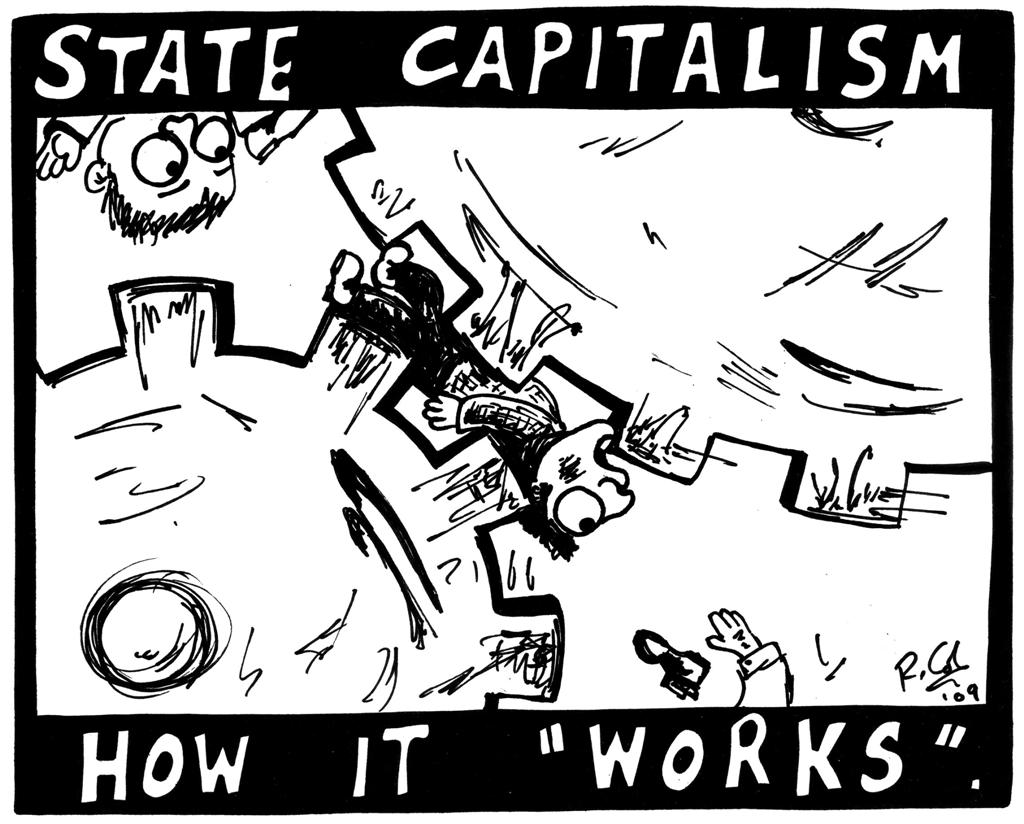
Nothing even approaching this level of government interference in the private sector has occurred since the emergency mobilization of the private sector for World War II. This government interference in private companies, which is a type of state-controlled capitalism, has until now always been anathema to Republicans and the business community. If any president prior to Trump had attempted any of this, Republicans, business executives, and the mainstream media would be screaming about it being socialism or communism. The actions by Trump are making the U.S. economy look like that of China, where the government owns a stake in companies or has considerable influence over their decision making. [2] [3] Or like Leninist capitalism where the Communist Party controlled the state’s ownership of businesses. [4]

This alignment of an authoritarian leader and a nominally capitalist economy is classic fascism. While Republicans and business executives are supportive or mute, the Wall Street Journal simply calls it inefficient. The business executives and other wealthy investors that facilitate and participate in Trump’s actions are the American oligarchy.

Examples of Trump’s actions include:

  • Allowed Nvidia and Advanced Micro Devices, makers of artificial intelligence (AI) computer chips, to export them to China on the condition that the companies pay the United States 15% of their profits. This poses risks to the U.S. AI industry and to U.S. national security (in part due to the chips’ use by the Chinese military). These payments are, for all intents and purposes, an export fee, which is unprecedented in U.S. history. Moreover, the Constitution explicitly bans export taxes (Article I, Section 9, Clause 5). [5]
  • Demanded that Intel’s CEO resign and then negotiated 10% government ownership of the company. This makes the U.S. government one of Intel’s largest shareholders. [6]
  • Proposed that the Defense Department take a 15% ownership stake in MP Materials, which mines minerals critical for chips and electronics.
  • Allowed Nippon Steel of Japan to take over U.S. Steel on condition that Nippon pay a “golden share” of the proceeds to the government and give Trump control over elements of corporate governance.
  • Reserved the right to personally direct some the $1.5 trillion in promised investments in the U.S. to be made by America’s trading partners as part of tariff negotiations.
  • Sued media corporations and negotiated approval of media corporation mergers to get money and influence over media content.

The government ownership in and influence over the private sector asserted by Trump has nothing to do with promoting the public interest, the well-being of American workers, or protecting national security. In fact, they undermine all these principles. They’re all about centralizing power and control in Trump’s hands as part of his efforts to undermine the rule of law and democracy. [7] Moreover, who holds the ownership stakes and who exercises the related rights is unclear.

Despite Trump’s bluster about being tough on China, his actions have been quite favorable to China. He has illegally extended the deadline for the sale of Chinese ownership of TikTok if it wants to do business in the U.S. He has shut down Radio Free Asia, which countered Chinese propaganda. He’s allowed the export of artificial intelligence computer chips to China, which was a key request from China in trade negotiations.

Please contact your members of Congress and ask them to assert their oversight of these deals Trump is making. Ask them to clarify who holds the ownership stakes, who is exercising ownership rights, and where the funds received are going. Ask them to ensure that the Trump administration’s economic policies and actions further the public interest, benefit workers, promote national security, and comport with the rule of law and democratic principles.

You can find contact information for your US Representative at  http://www.house.gov/representatives/find/ and for your US Senators at http://www.senate.gov/general/contact_information/senators_cfm.cfm.


[1]      Dayen, D., 8/11/25, “Tariffs to import and fees to export,” The American Prospect (https://prospect.org/blogs-and-newsletters/tap/2025-08-11-tariffs-to-import-fees-to-export-nvidia-chips-china/)

[2]      Reich, R., 8/12/25, “Trump’s ‘state capitalism’,” Blog post (https://robertreich.substack.com/p/trumps-state-capitalism)

[3]      Cox Richardson, H., 8/11/25, Letters from an American blog post, (https://heathercoxrichardson.substack.com/p/august-11-2025)

[4]      Meyerson, H., 8/18/25, “When l’etat c’est Trump, the U.S. goes in for state capitalism,” The American Prospect (https://prospect.org/economy/2025-08-18-when-letat-cest-trump-us-goes-in-for-state-capitalism/)

[5]      Dayen, D., 8/11/25, see above

[6]      Liedtke, M., & Kurtenbach, E., 8/20/25, “US vying to own a big stake in Intel,” The Boston Globe from the Associated Press

[7]      Reich, R., 8/12/25, see above

BEWARE! SCAMS ARE COMING YOUR WAY! PART 2

Consumers beware; you’ll need to up your vigilance to avoid scams. The Trump administration is weakening consumer protections. From the cryptocurrency industry to cyber security to Social Security and health care, weak oversight and regulation will lead to consumer rip-offs and outright fraud.

Consumers beware; scams of all sorts are coming your way. The Trump administration is weakening or eliminating agencies and regulations that protect consumers. From the cryptocurrency industry to cyber security to Social Security and health care, weak oversight and regulation will lead to consumer rip-offs and outright fraud. You will need to up your level of vigilance to avoid getting scammed.

(Note: If you find a post too long to read, please just skim the bolded portions. Thanks for reading my blog!)

(Note: Please follow me and get notices of my blog posts on Bluesky at: @jalippitt.bsky.social. Thanks!)

Consumers beware; scams of all sorts are coming your way. The Trump administration is weakening or eliminating agencies and regulations that protect consumers, so it’s an open field for unscrupulous behavior by businesses and fraudsters. From the cryptocurrency industry to cyber security to Social Security and health care, weak oversight and regulation will lead to consumer rip-offs and outright fraud. (See this previous post focused on financial and other corporate scamming.)

The cryptocurrency industry is trying to transform its image from that of a scandal-ridden and crime-enabling financial technology (aka fintech) experiment into that of a mainstream financial and commercial investment and transaction vehicle. Don’t let yourself be fooled. For example, Coinbase, founded in 2012 and now the largest U.S.-based cryptocurrency exchange as well as the world’s biggest bitcoin custodian, has had over 8,000 consumer complaints filed against it with the Consumer Financial Protection Bureau (CFPB). [1]

The crypto industry spent well over $100 million in the last elections, including donations to Trump-affiliated entities, to elect pro-crypto politicians and to instill fear into others who might oppose the industry. It has also spent millions on a lobbying campaign to build bipartisan support for the Republican-led pro-crypto bills and to obtain a favorable regulatory environment.

Despite the crypto industry’s record of fraud, facilitating criminal activity, and extreme volatility, the Trump administration, through an executive order, is allowing investments in it by retirement plans, corporations (including banks!), and the government itself. [2] Furthermore, the Trump administration has eliminated crypto crime units at the Securities and Exchange Commission (SEC), the Department of Justice (DOJ), and in other government agencies. It has ended numerous investigations and criminal prosecutions of crypto industry entities. These actions effectively facilitate money laundering and criminal activity. [3]

Three bills have been introduced in Congress ostensibly to regulate the industry but appear more focused on giving it legitimacy and a government seal of approval. One of the three bills, the so-called Genius Act has passed and become law. It established a regulatory framework for a piece of the crypto industry called stablecoins. This type of cryptocurrency is linked to the value of the U.S. dollar which is supposed to prevent the volatility that occurs with other cryptocurrencies. Most, but not all, Democrats opposed this bill due to concerns that it lacked strong provisions to prevent fraud and money laundering. Furthermore, it does nothing to stop President Trump, his family, and his associates from profiting from cryptocurrency activities that allow other people and entities to effectively put money in Trump’s and his affiliates’ pockets. [4]

One of the other bills, the so-called Clarity Act would create a broader crypto regulatory framework. The third bill would ban the Federal Reserve from creating its own cryptocurrency that would compete with private cryptocurrencies and presumably reduce the profitability of the private crypto industry. So, beware of anything crypto industry related that comes your way.

In a variety of other arenas, the Trump administration is also weakening consumer protections.

Having effectively eliminated the Consumer Financial Protection Bureau (CFPB), the Trump administration is now considering weakening the Consumer Product Safety Commission (CPSC) that protects consumers from dangerous non-financial products.

The Trump administration has dramatically weakened some of the federal government’s cyber security agencies. So, be ever more alert for cyber crime and cyber scams. It is taking FBI agents away from their specialties such as combating hackers (as well as terrorism, espionage, public corruption, white-collar crime, civil rights, child sex crime, etc.) to have them patrol the streets of D.C. where crime is at its lowest level in years. Moreover, a map of where FBI agents and troops have been deployed makes it very clear they are not really there to combat crime; they are there to be seen and to make a statement. [5]

The Trump administration is cutting staffing and services at the Social Security Administration, while having it send out misleading information. (See this previous post for more detail.) This will make it harder for seniors and others to receive the benefits they’re owed and to get accurate information. This will create fertile ground for scammers to step in. Be on your guard.

Similarly, cuts to the health care system and weakened oversight of privatized Medicare Advantage Plans will open the door to scammers. For example, 17% of Americans now report they are using buy now, pay later (BNPL) programs to pay for medical or dental care. [6] BNPL programs not infrequently involve terms and costs that are not well explained to consumers and, therefore, result in financial abuse.

Please contact your members of Congress and tell them you support strong regulation of the crypto industry to protect consumers and to prevent crime and money laundering. Ask them to oppose the two crypto industry bills as they are currently written. Ask them to stand up for strong consumer protections from the CFPB, CPSC, and cyber security agencies. Ask them to protect seniors and others from the undermining of Social Security and our health care system.

You can find contact information for your US Representative at http://www.house.gov/representatives/find/ and for your US Senators at http://www.senate.gov/general/contact_information/senators_cfm.cfm.

By the way, there is lots of good news. See Jess Craven’s latest good news post. It includes California Governor Newsom fighting fire with fire on the gerrymandering front, numerous judges’ decisions, protests all across the country, conservative economists opposing Trump’s nominee to run the Bureau of Labor Statistics, Ohio’s Sherrod Brown deciding to run for U.S. Senate again in 2026, and much more.


[1]      Silverman, J., 5/27/25, “Three coin monte,” The American Prospect (https://prospect.org/power/2025-05-27-three-coin-monte-crypto-regulation/)

[2]      Johnson, J., 8/7/25, “‘Disaster in the making’: Trump to open 401(k)s to crypto, private equity vultures,” Common Dreams (https://www.commondreams.org/news/trump-private-equity-401k)

[3]      Silverman, J., 5/27/25, see above

[4]      Gold, M., 7/18/25, “Here’s how Congress is wading into crypto regulation,” The Boston Globe from the New York Times

[5]      Cox Richardson, H., 8/19/25, “Letters from an American,” (https://heathercoxrichardson.substack.com/p/august-19-2025)

[6]      Corbett, J., 8/6/25, “‘Gouging’: US health insurance giants raked in over $71 billion in profits last year,” Common Dreams (https://www.commondreams.org/news/health-insurance-profits)

BEWARE! SCAMS ARE COMING YOUR WAY!

Consumers beware; scams are coming your way. The Trump administration is weakening consumer protections. From financial services to big tech a lack of oversight and regulation will lead to consumer rip-offs and outright fraud. You will need to up your level of vigilance to avoid getting scammed.
Top view of money banknote, toy padlock and square letters with text SCAM ALERT.

Consumers beware; scams of all sorts are coming your way. The Trump administration is weakening or eliminating agencies and regulations that protect consumers. From financial services to the big tech companies a lack of oversight and regulation will lead to consumer rip-offs and outright fraud. You will need to up your level of vigilance to avoid getting scammed.

(Note: If you find a post too long to read, please just skim the bolded portions. Thanks for reading my blog!)

(Note: Please follow me and get notices of my blog posts on Bluesky at: @jalippitt.bsky.social. Thanks!)

Consumers beware; scams of all sorts are coming your way. The Trump administration is weakening or eliminating agencies and regulations that protect consumers, so it’s an open field for unscrupulous behavior by businesses and fraudsters. From financial services (including student loans) to the big tech companies, a lack of oversight and regulation will lead to consumer rip-offs and outright fraud.

Perhaps the most blatant of the Trump administration’s anti-consumer actions is the virtual elimination of the Consumer Financial Protection Bureau (CFPB). In its 14 years of existence, the CFPB has required over $20 billion to be returned to consumers who were defrauded by financial businesses. Last year, for example, it sent $1.8 billion in checks to 4.3 million customers who had been defrauded by two credit repair services. [1] It has saved consumers billions more by regulating late fees on credit cards, overdraft fees on bank accounts, and much more. If it had been in existence before the 2008 financial collapse, it might well have prevented the collapse, and it would have saved many home owners their homes and others billions of dollars lost to mortgage fraud.

Not surprisingly, in the absence of CFPB enforcement, the number of consumer complaints has already exploded with 2.5 million complaints filed in the last six months. This is over ten times the number of complaints filed in a typical six-month period over the last 13 years. A major source of complaints is inaccurate data on consumers’ credit reports. Two weeks before Trump took office, the CFPB had sued Experian (one of the three big credit reporting agencies) for basically ignoring consumers’ complaints about inaccurate information. This lawsuit is going nowhere under the Trump administration. The Trump administration also voided a ruling that would have forced the Navy Federal Credit Union to return $80 million in fraudulent overdraft fees to customers who had been told they had sufficient funds to cover a withdrawal. This just one example of Trump administration actions to take millions of dollars promised to fraud victims and give it back to corporate scammers.

The Trump administration is attempting to dodge requirements that the CFPB make consumer complaints public so consumers can know which companies are bad actors. It has also stopped actions to curb excessive credit card late fees, to remove medical debt from credit reports, and to regulate digital payment businesses, payday lenders, and credit repair services. It has permanently dropped at least 22 enforcement actions against companies accused of billions of dollars of consumer financial fraud, including one against Zelle, the electronic payment platform that was infested with fraud shortly after being launched.

Medical credit cards and abuses of them are likely to increase dramatically with the CFPB out of the way. For example, in 2023, Synchrony Bank made $3.7 billion in interest and fees on its 11.7 million CareCredit cards (the most widely used medical credit card). These are offered to patients, sometimes ones in a crisis. They are often interest-free up-front but have a balloon interest amount due if not fully paid off in a set period. There are frequently junk fees associated with them and users frequently report that the terms and rules of the credit card weren’t clearly explained to them. [2]

The emasculation of the CFPB will eliminate oversight and accountability in the financial industry. This will make consumers vulnerable to the multitude of financial scams in the marketplace, which will now grow and proliferate. You will need to up your level of vigilance to avoid getting scammed.

Consumers will also be harmed by the far-reaching business deregulation and lack of enforcement of regulations and laws governing business behavior that the Trump administration is undertaking. As economists have noted for literally hundreds of years, bad money drives out good money, or, in other words, honest companies have a tough time competing against dishonest companies. Therefore, bad business behavior is likely to proliferate. [3]

Over 165 enforcement actions against businesses have been dropped or put on hold in the first six month of the Trump administration. Not coincidentally, roughly $50 million in donations to Trump’s inauguration and untold millions to Trump via other vehicles have come from companies subject to federal investigations, lawsuits, enforcement actions, or antitrust cases. Technology companies, particularly the big three: Meta (Facebook’s parent company), Apple, and Google, have benefited by spending relatively small amounts of money for them (a few million dollars) on political spending and lobbying to get favorable actions from the Trump administration. Of the 140 investigations and enforcement actions targeting 104 tech corporations when Trump took office, at least 50 have already been stopped. Bank of America, Capital One, Coinbase, DuPont, and JPMorgan donated to Trump’s inauguration and then federal enforcement actions against them were dropped. Intuit, which makes tax preparation software, gave to the inauguration and then the IRS discontinued its free, Direct File tax return program. Apple supported the inauguration and was then exempted from most tariffs. These companies are getting a great return on their “investments”. This pattern is evidence of a pay-to-play scheme that would be criminal bribery under any other president and administration. [4] [5]

The Trump administration is weakening or stating it won’t enforce laws banning U.S. companies from bribing foreign officials, prohibiting workplace discrimination, or regulating loan shark lending and its usurious interest rates. It is also making life harder and loans more expensive for student borrowers by making federal government student lending much less helpful and more costly. This will force many students needing to borrow funds for college into the hands of private lenders, some of whom are financial predators that the CFPB won’t be around to regulate or hold accountable. [6]

More in my next post on scams to be on the lookout for, including from the cryptocurrency industry.


[1]      Tkacik, M., & Baratta, J., 7/11/25, “Hardly workin’,” The American Prospect (https://prospect.org/economy/2025-07-11-hardly-workin-cfpb-doge-trump/)

[2]      Covert, B., 5/28/25, “Predatory lenders in the operating room,” The American Prospect (https://prospect.org/health/2025-05-28-predatory-lenders-operating-room-medical-credit-cards/)

[3]      Dayen, D., 5/27/25, “The golden age of scams,” The American Prospect (https://prospect.org/power/2025-05-27-golden-age-of-scams/)

[4]      Johnson, J., 8/14/25, “‘Corporate crime pays’ under Trump as his agencies drop enforcement against 165 companies,” Common Dreams (https://www.commondreams.org/news/corporate-crime-donald-trump)

[5]      Johnson, J., 4/22/25, “‘See how this works?’: Trump drops cases against corporations that funded his inauguration,” Common Dreams (https://www.commondreams.org/news/trump-corporations-inauguration)

[6]      Dayen, D, 5/27/25, “Borrowers besieged,” The American Prospect (https://prospect.org/education/2025-05-27-borrowers-besieged-student-debt/)

OUR CORRUPT CAMPAIGN FINANCING SYSTEM part 2

U.S. political campaigns are awash in money and it’s corrupting our government. The big spenders, wealthy individuals and corporations, are looking for something in return. They generally get rewarded with policies and actions that provide a high return on their investments.

(Note: If you find a post too long to read, please just skim the bolded portions. Thanks for reading my blog!)

My previous two posts have focused on how billionaires are buying our elected officials (here) and how super PACs (political action committees) are the vehicle they are using to do so (here). They also highlighted how big donors are using non-profit organizations that don’t have to report donors in order to hide their identities (i.e., “dark money”) and how super PACs are violating the law by coordinating with candidates’ campaigns. Unfortunately, the Federal Elections Commission (FEC) is failing to enforce campaign finance laws.

An example of how big money donors and our political parties are flouting campaign finance laws is the growing and now extensive use of joint fundraising committees. These joint fundraising committees allow big donors to skirt campaign contribution limits and write one huge check, typically for tens of thousands of dollars, for candidates’ campaign committees and political party PACs. The entities in the joint committee then supposedly split up the money so that no contribution limits are violated. Some of the joint fundraising committees directly pay for advertising but frame it as a fundraising solicitation to evade restrictions on their activities. These joint committees have also figured out how to game the system to get the lower advertising rates supposedly given only to candidates’ committees. (Note: Advertising rates for super PACs and other non-candidate entities can be up to 20 times higher than those for candidates’ committees.) [1]

These big donors are special interests, and they view their campaign spending as an investment. They expect a return on their investment, and generally they get paid back many, many times over. You may remember that in 2017 wealthy Republican donors were telling Trump and the Republicans that if they didn’t get a big tax cut their support of Republicans in the 2018 congressional elections would be curtailed. So, the Republicans in Congress and Trump, in December 2017, enacted the Tax Cuts and Jobs Act, which gave huge tax cuts to wealthy individuals and corporations.

As campaign spending is increasingly dominated by outside money, which is increasingly from super PACs and done with dark money, the result is a political environment of hidden influence by wealthy individuals and corporations. This undermines an essential principle of democracy: that voters deserve to know who is trying to influence their vote.

An example of huge spending by a special interest, using, of course, a super PAC, is the cryptocurrency industry. It was one of the largest and most successful special interest spenders in the 2024 elections. It spent roughly $245 million via a super PAC called Fairshake. The majority of its money went to Republicans. It won every one of the 49 races it spent money on except for Sen. Elizabeth Warren’s (D-MA) winning re-election campaign. However, none of Fairshake’s advertisements even mentioned cryptocurrency; it clearly wanted to influence elections without revealing its true interests.

Fairshake’s 48 victorious campaigns may understate its influence, as its spending in primaries instilled fear in numerous Democratic candidates who avoided criticizing the crypto-industry or stated support for it. Cryptocurrency industry donors were responsible for almost half of all corporate donations to all super PACs. Fairshake already has $78 million on hand for the 2026 congressional elections. Based on all of this, the crypto industry will almost certainly be rewarded with weak regulation by Congress and the Trump administration.

Another example of special interest spending with a very specific outcome in mind is the American Israel Affairs Committee’s super PAC (AIPAC). It spent roughly $100 million in the 2024 elections, primarily in primaries to beat Democratic candidates who weren’t unquestioning supporters of Israel in the face of the horrific Gaza War. It spent $14 million in one Democratic primary to beat incumbent Jamaal Bowman (D-NY), a record for outside spending in a House race. It also spent heavily in incumbent Cori Bush’s (D-MO) primary, which she ended up losing. The primary funders of AIPAC are Republican mega-donors, many of whom each gave hundreds of thousands of dollars to it. [2]

As another example, two multi-national, multi-hundred-billion-dollar investment management firms, Blackstone Group and Citadel, each gave $22 million to the Republican Senate Leadership super PAC for the 2022 congressional elections. They want, and so far have gotten, lax regulation of their financial activities and favorable tax treatment for their incomes. For example, the “carried interest” provision of U.S. tax laws allows the firms’ managers to treat their income as capital gains, which lets them pay an income tax rate on their huge incomes at less than half the rate they’d pay on regular income (i.e., non-capital gains income).

The fossil fuel industry is also reaping rewards for its spending of about $75 million in support of Trump’s campaign. Although Trump, in a public statement, told fossil fuel industry executives that if they invested $1 billion in his campaign that he would reward them, $75 million appear to have done the trick. Trump, in his first days in office, has signed executive orders, some of them likely written by fossil fuel industry lobbyists, revoking climate change reduction rules. These executive orders allow increased oil and gas drilling off the U.S. coast and on federal lands, allow the building of new liquified natural gas (LNG) export terminals, and withdraw the U.S. from international climate change reduction efforts. [3]

My next post will discuss some more general effects of all this special interest spending on election campaigns and what can be done about this obscene and corrupting spending.


[1]      Goldstein, L., 12/10/24, “The money game,” The American Prospect (The Money Game – The American Prospect)

[2]      Johnson, J., 8/28/24, “‘Very bad sign for democracy’: AIPAC has spent over $100 million on 2024 elections,” Common Dreams (‘Very Bad Sign for Democracy’: AIPAC Has Spent Over $100 Million on 2024 Elections | Common Dreams)

[3]      Johnson, J., 1/17/25, “Trump readies ‘day one climate destruction package’ after raking in big oil cash,” Common Dreams (Trump Readies ‘Day One Climate Destruction Package’ After Raking in Big Oil Cash | Common Dreams)

EXTREME CAPITALISM OF PRIVATE EQUITY FIRMS DOES GREAT HARM Part 2

Illustration of a vulture sitting on a falling graph. Concept for vulture capitalists, economic crisis, recession, bankruptcy and insolvency.

This post provides an overview of how the private equity financial model works. It includes two examples of its detrimental effects, one in the chemical industry and the other in communications services for the 500,000 deaf people in the U.S.

(Note: If you find my posts too long to read on occasion, please just skim the bolded portions. Thanks for reading my blog! Special Note: The new, more user-friendly website for my blog is here.)

My previous post provided a high-level summary of the harm being done by private equity (PE) firms. It then focused on the Stop Wall Street Looting Act in Congress as an important step to stop the harm being done to patients, consumers, employees, and communities by the PE financial model.

Here’s an overview of how the private equity financial model works. The PE firm, using mostly borrowed money, buys a company. The debt and interest of the borrowed money are then made the responsibility of (and often an overwhelming burden on) the purchased company. The PE owners also pay themselves exorbitant fees (usually for “management”) and pay large dividends to themselves and their other investors. They often sell the company’s assets, such as real estate, to raise money to pay for these payments or to make debt payments. Typically, the company’s real estate is leased back to it at an exorbitant cost.

All this forces the purchased company to engage in (often severe) cost-cutting to be able to make the payments on the debt, the lease, and to the PE owners and investors. This cost-cutting often involves major layoffs and cuts in compensation for employees. Abusive employment practices, union busting, and unsafe workplaces are not uncommon. The quality of the company’s products or services is often compromised to reduce costs. Despite all this cost cutting, the companies often go bankrupt, leaving employees without jobs and often without owed pay and benefits, including retirement benefits.

U.S. laws and policies aid and abet this process by granting tax and other benefits to elements of this model. PE firms are much more loosely regulated than publicly-owned companies or mutual funds that sell shares to the public. Given their private ownership, PE firms have basically no requirements for public disclosures or transparency. The Stop Wall Street Looting Act (see this previous post for an overview) would change this, regulating PE firms and holding them accountable.

Previous posts have reported on PE ownership and its effects in pet care, retail, and health care (here, here, here, and here). Here are two additional examples.

EXAMPLE #1: Centerbridge Partners, a PE firm, bought KIK Custom Products, the parent company of BioLab Inc., in 2015 for $1.6 billion. In late September, 2024, a BioLab chemical plant in Conyers, Georgia, had a massive explosion. Toxic clouds of smoke spread over the area and 17,000 residents had to be evacuated and another 90,000 were told to shelter-in-place. In 2020, an explosion at another BioLab plant in Georgia released a cloud of toxic chlorine gas and there was also a major fire at a plant in Louisiana. Under PE firm Centerbridge’s ownership, BioLab has a long history of explosions, fires, and workplace safety violations. [1]

Centerbridge and its investors have gotten at least $3.45 billion in dividends; a return of more than double their investment – in dividends alone. In the last four years, Centerbridge has added over $2.6 billion in debt to BioLab, primarily to pay for dividends paid to Centerbridge and its investors. In addition, in July, 2024, it sold off a separate subsidiary of KIK for $850 million, which was used to pay Centerbridge and its investors another large dividend and had the effect of increasing the debt load on BioLab. With interest rates rising, this significantly undermines BioLab’s financial stability and makes bankruptcy more likely.

If this most recent plant explosion pushes BioLab into bankruptcy, the company’s workers, including their pensions, as well as contractors and suppliers, will end up losing money that is owed to them. Furthermore, if BioLab goes bankrupt, anyone suing BioLab for personal or environmental harms from the toxic explosions will likely get nothing. It will be left up to the government and the taxpayers to pay for the harm and damage done, as well as the clean-up.

EXAMPLE #2: Two companies, Sorenson Communications and ZP Better Together, separately owned by PE firms, run the service that allows deaf people to communicate by phone using sign language via the Video Relay Service (VRS). The phone companies are required by the Americans with Disabilities Act to make the VRS available for free to the 500,000 deaf people in the U.S. A small fee on all phone calls pays for it and the funding is funneled through the Federal Communications Commission (FCC). The FCC pays a fixed rate per minute for the video calls. The VRS must be available 24 hours a day, seven days a week, and must answer 85% of calls within ten seconds.

The VRS companies were targeted for acquisition by the PE firms because of their steady cashflow with effectively guaranteed profits. [2] Furthermore, the two companies have pushed the FCC to increase reimbursement rates and, in 2023, it announced a new five-year deal with rate increases of 30% to 49%. The rate for the first million minutes of calls will now be $6.27, up from $3.92. After the first million minutes, the rate declines.

Sorenson’s annual revenue is projected to be $2.1 billion and ZP’s about $400 million. Nonetheless, the two PE-owned firms have presided over declining service quality and deteriorating working conditions for employees in their efforts to maximize profits. There have been layoffs, under staffing, and under-training of staff. For example, some staff are specially trained to handle difficult calls, such as notifying a deaf person of the death of a loved one. Some are specially trained to handle translation and communication of legal documents. However, because of staff and training shortages, interpreters are being asked to do work they are not trained for. Workers typically have quotas for the number of minutes per hour they must be on calls to get paid. In some call centers, quotas have been increased because of labor shortages.

The companies have engaged in unfair labor practices and have aggressively resisted efforts to unionize. Labor representatives report that the FCC has not responded to a request for a meeting to discuss working conditions for months, while FCC staff and Commission members have met with the companies’ executives 16 times in the last two years.

Most of the sign language interpreters are part-time employees, with lower pay and benefits than full-time employees, who are usually managers. Although the FCC said that pay for interpreters would increase 65% over five years due to the rate increase, interpreters haven’t received wage increases and therefore are pushing to unionize. Several months after the 2023 rate increase, ZP closed two call centers in Minnesota after workers tried to unionize. ZP also closed two centers in California after settling a case of wage theft and retaliation for $320,000.

Sorenson has laid off workers, including middle management, many of whom were deaf people who had started as interpreters and worked their way up. The middle managers are some of the few employees who are typically full-time workers with decent pay and benefits.

More examples of PE ownership and its detrimental effects, including the Steward Health Care fiasco, will be shared in future posts.

[1]      Tkacik, M., & Goldstein, L., 10/2/24, “A toxic explosion in private equity payouts,” The American Prospect (https://prospect.org/power/2024-10-02-conyers-biolab-explosion-private-equity/)

[2]      Goldstein, L., 9/30/24, “Private equity is taking your calls,” The American Prospect (https://prospect.org/power/2024-09-30-private-equity-is-taking-your-calls/)

EXTREME CAPITALISM OF PRIVATE EQUITY FIRMS DOES GREAT HARM Part 1

The extreme capitalism of private equity firms does great harm. These vulture capitalists use financial manipulation to extract big profits from companies without regard to their survival or the welfare of stakeholders. There’s a bill in Congress that will stop this.
Illustration of a vulture sitting on a falling graph. Concept for vulture capitalists, economic crisis, recession, bankruptcy and insolvency.

SUMMARY: The current brand of capitalism in the U.S. does lots of harm. Nowhere are the harms more evident than in the extreme capitalism of private equity (PE) firms. These vulture capitalists use financial manipulation to extract big profits from companies they buy without regard to the health or survival of the companies, or the welfare of their employees, customers, and communities. There’s a bill in Congress that will stop this vulture capitalism and all the damage it does.

(Note: If you find my posts too long to read on occasion, please just skim the bolded portions. Thanks for reading my blog! Special Note: The new, more user-friendly website for my blog is here.)

The current brand of capitalism in the U.S. does lots of harm. Even “routine” corporate activity results in lots of bad behavior, some of it illegal or corrupt, all of which harms employees, consumers, and the public. I’ve cited examples of this in many previous posts and, in my most recent post, I highlighted three examples and also shared why it’s important to be aware of this. The profit motive of capitalism and the greed of capitalists result in harmful business behaviors unless they’re well-regulated and the penalties and punishments for businesses and their executives are sufficient to truly discourage bad behavior or to put them out of business.

Nowhere are the harms of capitalism more evident than in the extreme capitalism of private equity (PE) firms. PE firms (i.e., “vulture capitalists”) use financial manipulation to extract profits from companies without regard to the health or survival of the companies, or the welfare of their employees, customers, and communities. Vulture capitalism fails to produce benefits for anyone other than the rich private equity financiers. They are not investing in the companies they buy; they are looking to maximize their short-term profits and have no qualms about the companies going bankrupt – in some cases that’s their plan. (See this previous post from 2018 describing the private equity business model and why it deserves to be called vulture capitalism.)

PE firms have purchased companies in many sectors of the economy from health care (over $500 billion between 2018 and 2023) to child care to pet care, from housing to private colleges, and from retail store chains to newspapers. Everywhere they’ve gone they’ve left destruction in their wake, including decimating local newspapers, bankrupting long-standing retail store chains, and causing deaths and injuries in health care.

In my next post, I’ll give a description of the PE business model and some specific recent examples of the harm it’s done, but, for now, here’s what can be done to stop this vulture capitalism. The Stop Wall Street Looting Act has been introduced in Congress by Senators Elizabeth Warren (D-MA), Tammy Baldwin (D-WI), Sherrod Brown (D-OH), (all three are up for re-election, by the way) and others, along with over half a dozen Representatives. First introduced in 2019, the Act would: [1]

  • Make the PE owners and investors responsible for the debts and liabilities of the companies they own rather than allowing them to continue to avoid responsibility and liability by claiming to be an independent entity.
  • Change bankruptcy laws so that when PE-owned companies go bankrupt (as they often do) workers’ pay and benefits, including pensions, would be given a higher priority, rather than being the last party to get paid if there’s any money left over (which there usually isn’t).
  • Ban practices that allow PE owners to extract short-term profits that undermine the financial viability of a purchased company. For example, if a PE-owned company files for bankruptcy, the PE owners and investors could be forced to pay back the fees, dividends, and other payments they had received over the last 3 – 5 years.
  • Prohibit PE-owned firms that receive federal or state funds (as all health care providers do and as 611 PE-owned companies that received $5.3 billion in Covid relief funds did) from acquiring other companies or making payments to the PE owners or investors for two years.
  • Ban PE-owned health care companies from receiving federal money from Medicare or Medicaid if they sell property to or receive property-based loans from a real estate investment trust (REIT). REIT transactions are a standard, financial manipulation practice for PE-owned hospitals and were a key factor in Steward Health’s rapid expansion and then bankruptcy.
  • Subject PE firms to greater oversight and disclosure requirements. Cerberus Capital Management, the PE firm behind the Steward health care bankruptcy and debacle, would not have been able to withhold financial information from health care oversight agencies and from Congress – as it continues to do today.

I urge you to contact your U.S. Representative and Senators to ask them to support the Stop Wall Street Looting Act. Private equity’s model of vulture capitalism needs to be reined in before more patients, customers, employees, and communities are harmed. You can find contact information for your US Representative at  http://www.house.gov/representatives/find/ and for your US Senators at http://www.senate.gov/general/contact_information/senators_cfm.cfm.

The PE industry and its allies will, of course, strenuously oppose this legislation, as they have since it was first introduced in Congress in 2019. For example, during the 2021-2022 election cycle, the PE industry donated almost $350 million to federal election candidates and committees.

If you need any convincing of the need to stop the vulture capitalism of the PE model of business financial manipulation, my next post will present some recent examples of PE ownership and the detrimental effects it’s had. It will also share an overview of the PE model.

[1]      Office of Senator Warren, 10/10/24, “Warren, lawmakers renew legislative push to stop private equity looting,” Press release (U.S. Senator Elizabeth Warren | Warren, Lawmakers Renew L…) and (Stop Wall Street Looting Act One Pager)

CORRUPT MANAGEMENT OF PRESCRIPTION DRUG INSURANCE

The Federal Trade Commission is suing the three dominant prescription drug insurance managers for practices that it alleges have spiked the price of insulin in the U.S. The suit claims these drug insurance managers have been “engaging in anticompetitive and unfair rebating practices that have artificially inflated the list price of insulin drugs and impaired patients’ access to lower” cost alternatives. Drug insurance management was originally a cost-control effort that morphed into a profit center by getting rebates (i.e., kickbacks) from drug makers.

(Note: If you find my posts too long to read on occasion, please just skim the bolded portions. Thanks for reading my blog! Special Note: The new, more user-friendly website for my blog is here.)

The Federal Trade Commission (FTC) is suing the three largest pharmacy benefit managers (PBMs) for practices that it alleges have spiked the price of insulin in the U.S. to over 12 times what it was 20 years ago. PBMs are middlemen that manage the costs of prescription drug coverage for health insurers. They determine which drugs an insurance plan will pay for, what the co-pay for patients will be, and how much pharmaceutical manufacturers will be paid for their drugs. [1]

The FTC is suing Caremark Rx, Express Scripts, and Optum Rx, which process 80% of all prescription drug purchases in the U.S., for “engaging in anticompetitive and unfair rebating practices that have artificially inflated the list price of insulin drugs and impaired patients’ access to lower” cost alternatives. Each of these PBMs has roughly $100 billion in annual revenue and is tied to a large insurance corporation: Caremark Rx to CVS, Express Scripts to Cigna, and Optum Rx to UnitedHealth.

The FTC’s suit does not come as a surprise. Last year, numerous local governments sued these three PBMs and the three large insulin manufacturers alleging they had conspired to increase the price of insulin. [2]

PBMs were originally created by insurance corporations to manage the growing costs of prescription drugs. The initial intent was to save insurance corporations and patients money by negotiating lower prices with the drug makers and incentivizing patients to use lower cost drugs, particularly generic drugs as opposed to brand name drugs. A key part of these efforts was the creation of lists of drugs the PBM and insurer would pay for along with a tiered set of co-pays for patients to incentivize the use of lower cost drugs. These lists are known as “formularies.” [3]

The PBMs discovered they could turn this cost-control effort into a profit center by getting rebates (i.e., kickbacks) from the pharmaceutical manufacturers by paying them well for their drugs and incentivizing patients to use those drugs.

This created all sorts of perverse incentives. The PBMs could increase their profits by steering patients to brand name drugs with higher prices and co-pays (as opposed to cheaper generic drugs) because the PBMs got bigger rebates on the higher priced drugs. The PBMs could also increase their profits and rebates by paying the drug makers inflated prices for their drugs, because that allowed the drug makers to give them bigger rebates (also sometimes referred to as discounts). However, this drove up the “list prices” of these drugs so that people without health insurance (or with health insurers other than those linked to these PBMs) paid more.

The FTC suit focuses on insulin, although the illegal practices it charges the PBMs with apply to all prescription drugs. In the case of insulin, the PBMs’ formularies (i.e., list of approved drugs) include only certain types or brands of insulin. These are typically NOT the lowest price insulin products but the ones that give the PBMs the highest rebates and profits. Their collusion with the insulin product makers to maximize their rebates and profits, drives up the price of these insulin products for all users. The FTC has warned drug manufacturers that their complicity in the PBMs’ practices raises serious concerns and that they may be named as defendants in future FTC actions.

As background, insulin was invented in the 1920s and the inventors refused to patent it to make it as readily and cheaply available as possible. Today, three pharmaceutical corporations control the market for insulin: Eli Lilly, Novo Nordisk, and Sanofi. They’ve used their market power to unjustifiably increase the price of insulin. For example, Eli Lilly’s leading insulin product, Humalog, costs 13 times more now, $274 a dose, than it did in 1999 when it was $21.

Two interesting notes: First, Express Scripts has sued the FTC for defamation over the findings of its study of the PBMs’ behaviors. These findings were a precursor to the FTC’s lawsuit. Second, the FTC is also looking at the PBMs’ practices that favor certain, often affiliated pharmacy chains (such as CVS in the case of Caremark) and harm other pharmacies, particularly independent (i.e., non-chain) pharmacies. These, probably illegal, practices reduce competition in the pharmacy business.

As noted, these practices of the PBMs and the pharmaceutical corporations are by no means limited to insulin. The City of Baltimore is suing drug maker Biogen alleging illegal collusion with the three big PBMs to block competition for its brand name multiple sclerosis (MS) drug, Tecfidera. Biogen has regularly increased the price of the drug from $52,500 for a year’s supply in 2013 to $90,000 in 2019, so the drug now provides almost half of Biogen’s revenue. [4] Biogen’s patent on the drug was expiring and it was desperate to maintain the revenue stream and its profits. The suit alleges that Biogen paid the three PBMs to structure their drug formularies to promote the use of its drug rather than lower-cost generic drugs. Biogen calls the payments “rebates” or “fees,” but, in reality, they are good, old-fashioned kickbacks.

Kentucky is suing Express Scripts alleging that it colluded with opioid makers to increase opioid sales through deceptive marketing and other strategies. The result was a deadly, on-going opioid addiction crisis that was linked to roughly 75,000 deaths nationwide in the last year. [5]

There are bills in Congress and in state legislatures that would tackle various elements of PBMs’ corrupt practices. I’ll keep you posted if any of the bills in Congress look like they may move forward. In the meantime, you might want to raise this issue with your state representative or senator, or your state’s public health agency, to learn if they are taking steps to stop the anti-competitive practices of PBMs.

[1]      Dayen, D., 9/20/24, “FTC sues PBMs for jacking up insulin prices,” The American Prospect (https://prospect.org/health/2024-09-20-ftc-sues-pbms-jacking-up-insulin-prices/)

[2]      Silverman, E. 9/26/24, “Baltimore sues Biogen, accusing it of blocking generic MS drugs,” The Boston Globe from Stat News

[3]      Editorial, 7/30/24, “Reining in pharmacy benefit managers,” The Boston Globe

[4]      Silverman, E. 9/26/24, see above

[5]      Schreiner, B., 9/28/24, “Kentucky sues Express Scripts,” The Boston Globe from the Associated Press

SHORT TAKES #14: MORE EXAMPLES OF CORPORATE BAD BEHAVIOR

Here are short takes on three important stories that have gotten little attention in the mainstream media. Each provides a quick summary of the story, a hint as to why it’s important, and a link to more information. They range from irresponsible and dangerous behavior by the owners and operators of a cargo ship to corrupt behavior by a student loan servicer to illegal behavior by Apple and Goggle in Europe.

STORY #1: The cargo ship that crashed into and collapsed the bridge in Baltimore (killing six people who were working on the bridge) has asked a court to limit its liability to $44 million! The U.S. Justice Department, the U.S. attorney in Maryland, the State of Maryland, the City of Baltimore, business owners in the area, and the families of those who died are all opposing this effort. More realistically and fairly, the liability for this incident could be billions of dollars. [1]

Justice Department lawyers have asserted in court documents that the owners and operators of the ship prioritized profits over safety and knowingly allowed a dangerous, unseaworthy ship to set sail. Their court filing identified mechanical problems on the ship and described the owners’ “Band-Aid approach” to fixing some of them. It described the crew as “ill-prepared” and the owners as “cutting corners in ways that risked lives and infrastructure so that they could save time and money.”

Due to the “negligence” and “egregious facts” of the case, the Justice Department is seeking $100 million in economic damages and unspecified punitive damages. The economic damages could escalate as the cost of rebuilding the bridge is factored in and, along with the claims of other entities, including the families of those who died, the liability is likely to be in the billions. Unfortunately, the litigation to settle all this will likely drag on for years.

The FBI has opened an investigation into whether the ship’s owners’ and crew’s actions, in allowing the ship to sail with known problems, rise to the level of a crime. No criminal charges have yet been filed.

STORY #2: Navient Corp. has been banned from servicing federal student loans and will pay $100 million to harmed borrowers, as well as a $20 million penalty. This settlement with the Consumer Financial Protection Bureau (CFPB) comes after an investigation found that Navient had denied borrowers access to more affordable, income-based repayment plans, while channeling them into more expensive (and profitable) repayment plans. [2]

Navient is a repeat offender. In 2022, it paid $1.85 billion and canceled 66,000 student loans in a settlement with 39 states over its use of predatory lending practices. It has failed to report borrower complaints as is required by the U.S. Department of Education and has ranked dead last in borrower satisfaction according to surveys by the department. It has made it difficult for students who attended fraudulent for-profit schools to get debt relief.

Navient still services non-federal student loans for more than 12 million borrowers totaling nearly $300 billion in debt. If you or someone you know has a loan serviced by Navient, keep a close eye on the payment plan and options.

STORY #3: The European Union’s top court has ruled that Apple must pay over $14 billion in back taxes to Ireland. It concluded that two Apple subsidiaries got illegal, selective tax breaks from Ireland between 1991 and 2014 and that these tax breaks were illegal state aid that harmed competition. Apple’s taxes in Ireland, the base of its European operations since 1980, have been as low as 0.005% of profits. Ireland hosts the headquarters of many multinational corporations because of its special tax breaks. [3]

The current system for taxing multinational corporations is complex and unfair. Coordination and reform of tax policies across countries is badly needed. The United Nations is working to establish a global tax standard that fairly taxes a multinational corporation’s economic activity and appropriately distributes taxes among the countries where the corporation does business.

The European Union court also ruled that Google had illegally used its search engine dominance to favor its own shopping service. Google was fined $2.65 billion.

[1]      Mettler, K., 9/19/24, “US: Ship that hit bridge deficient,” The Boston Globe from the Washington Post

[2]      Bloomberg, 9/13/24, “Navient banned from servicing federal student loans, to pay $120 million,” Business Talking Points, The Boston Globe

[3]      Carver, E., 9/10/24, “ ‘Long-overdue justice: EU court rules Ireland let Apple avoid $14.4 billion in taxes,” Common Dreams (https://www.commondreams.org/news/ireland-apple-tax)

SHORT TAKES ON IMPORTANT STORIES #3: CORPORATE GREED

Here are short takes on three important stories that have gotten little attention in the mainstream media. Each provides a quick summary of the story, a hint as to why it’s important, and a link to more information.

STORY #1: Corporate profits have skyrocketed. They were roughly $12 trillion per year in 2022 and 2023. This is up from about $8.5 trillion a year in 2019 and 2020; a 50% increase in just three years. [1] (The graph linked to in this footnote is worth a thousand words.) This in large part reflects the price gouging large corporations engaged in in the post-pandemic years, claiming it was inflation. Their ability to inflate their prices and profits is due to the presence of just a few large corporations with monopolistic power in many markets in the U.S. economy. It also reflects squeezing workers to keep their pay low. [2]

This trend of high marketplace concentration, monopolistic power, and growing profits for large corporations has been going on for 40 years largely because of the failure to enforce antitrust laws. Corporate profits were $2.2 trillion per year in 2000, $1.1 billion in 1990, and $0.8 billion in the early 1980s. In other words, they are now over five times what they were in 2000, over ten times what they were in 1990, and 15 times what they were in the early 1980s.

In the last 20 years, marketplace concentration has increased in three-quarters of the U.S. economy with fewer corporations controlling more of the market than ever before. The good news is that the Biden administration is reviving enforcement of antitrust laws. It’s tackling price fixing in the meat industry – where four corporations control roughly 70% of the market. It’s suing Amazon for its monopolistic practices. It’s blocked the merger of JetBlue and Spirit Airlines as well as other mergers that would have increased concentration and monopolistic power.

Notably, the Biden administration initiated the first major antitrust case in 25 years that targets monopoly power. It charges Google with monopolizing the search engine market. The U.S. Department of Justice has been joined by 50 states’ attorneys general in the case. As the trial began, Google asked to keep the proceedings and evidence confidential and the judge was quite compliant. Google typically claimed the information represented business secrets that would harm the company if made public. In particular, Google tried to keep secret the dollar figure central to the whole case: how much it paid smart phone and computer companies to make its search engine the default on their devices. Six weeks into the trial, media representatives and transparency advocates filed a motion challenging the unprecedented secrecy and obstruction of public access to the trial’s proceedings and evidence. The judge responded by making much more information publicly available, including the amount Google was paying to have its search engine be the default on a wide range of phone and computer products and, therefore, effectively the default search engine across most of the Internet. It was a stunning $26.3 billion in 2021 alone. [3]

STORY #2: Chief executive officers’ (CEO) compensation is exorbitant and does not reflect their skills, their productivity, or competition for good candidates for the CEO position. Rather, it reflects CEOs’ power over their Boards of Directors and the lack of any counter weight to such unwarranted influence. CEO compensation declined slightly in 2022 because of weak stock market performance, which reduced the value of stock-based compensation. However, over the last 45 years, CEOs’ compensation is up over 1,200% (adjusted for inflation) while a typical workers’ pay is up 15%. CEOs are now paid 344 times as much as a typical worker, up from 21 times worker pay in 1965. [4]

The most egregious example of exorbitant CEO pay is the 10-year compensation agreement for Elon Musk approved in 2018 by Tesla’s Board of Directors. It’s potentially worth $56 billion. A shareholder sued and a judge just ruled that this level of compensation was unfair to shareholders. Tesla’s Board has only eight members and many have close personal ties to Musk (such as his brother) and therefore don’t have the degree of independence required for a publicly traded company. The compensation package would have allowed Musk to buy 304 million shares of Tesla stock for about $23 each. Over the last 3 ½ years, the stock’s price on the market has always been over $100, hit a high of $400, and has generally been around $200 per share – far above the purchase price of just over $23 given to Musk. [5] [6]

STORY #3: Our tax system needs to require wealthy CEOs and other wealthy individuals to pay their fair share in taxes. To achieve this, fair taxes are needed on income, including capital gains (i.e., the profit from selling stock). Without a fair and well-enforced national tax system, the wealthy play games to avoid national and state taxes. Recently, Amazon founder Jeff Bezos announced that he’s moving his official residence from Washington state to Florida. (He just bought two mansions for almost $150 million on a literally gated island near Miami.) It appears that his motivation for the move was to avoid a new 7% capital gains tax that Washington state has enacted on the sales of stock worth over $250,000. Bezos has been selling about 50 million shares of Amazon stock each year generating roughly $8 billion a year in income that was previously untaxed in Washington. He will save roughly $600 million a year by moving his legal residence to Florida, which has no income tax and no tax on capital gains. Washington enacted its capital gains tax to make its tax system fairer. Prior to its enactment, Washington’s state tax system was rated as the most regressive in the country. With this new, fairer tax system in place, Florida is now the state in the country with the most regressive state tax system. [7]

[1]      Federal Reserve Economic Data, 12/21/23, “Corporate profits after tax,” St. Louis Federal Reserve Bank (https://fred.stlouisfed.org/series/CP)

[2]      Reich, R., 2/16/24, “Where are record corporate profits coming from? Your thinning wallets,” Reich’s daily blog (https://robertreich.substack.com/p/corporate-soaring-profits-are-from)

[3]      Goldstein, L., 11/28/23, “The secret trial,” The American Prospect (https://prospect.org/justice/2023-11-28-google-secret-trial/)

[4]      Bivens, J., & Kandra, J., 9/21/23, “CEO pay slightly declined in 2022,” Economic Policy Institute, (https://www.epi.org/publication/ceo-pay-in-2022/)

[5]      Chase, R., 1/31/24, “Elon Musk cannot keep Tesla pay package worth more than $55 billion, judge rules,” The Boston Globe from The Associated Press

[6]      Hals, T., 1/31/24, “Judge voids Elon Musk’s ‘unfathomable’ $56 billion Tesla pay package,” Reuters

[7]      Johnson, J., 2/13/24, “Tax-dodging Jeff Bezos to save $610 million with move to ‘Billionaire Bunker’ in Florida,” Common Dreams (https://www.commondreams.org/news/jeff-bezos-billionaire-bunker)

RESULTS OF FOR-PROFIT HEALTH CARE Part 2

Here are some current examples of the results of for-profit health care: lack of availability and use of generic drugs, huge bills for ambulance services, doctors unionizing, and illegal and unethical health care for prison inmates from a private equity-owned provider.

This is the eleventh post in a series on how the U.S. health care system is a high-cost, low-quality, profit-driven system. The tenth post provides some other examples of the results of for-profit health care and links to the previous posts. Those posts cover the negative effects of vertical integration and private equity-owned health care providers. They also describe illegal and unethical behavior by nursing home operators as well as anti-competitive and often illegal practices by drug companies. And one post highlights how doctors are pushing back against for-profit health care.

(Note: If you find my posts too long to read on occasion, please just skim the bolded portions. Thanks for reading my blog! Special Note: The new, more user-friendly website for my blog is here.)

Generic drugs that are just as effective as and cheaper than brand name drugs are sometimes unavailable in the U.S. or are underused because they don’t produce enough profit. For example, there’s a generic cold medicine, ambroxol, that’s been available in Europe since 1978. It’s cheap (a few euros), available over the counter, and Americans who have used it describe it as miraculous. However, no drugmaker has ever sought Food and Drug Administration (FDA) approval to sell it in the U.S. FDA approval is costly and time-consuming and the profits of a generic drug aren’t sufficient to warrant the expense, so it’s not available in the U.S. [1]

The Biden Administration should direct the FDA to establish a new, expedited approval process for drugs approved for sale in Europe. The European Medicines Agency, Europe’s equivalent of the FDA, has a proven track record as an effective drug regulator and the FDA could simply review its records on a drug and quickly approve the drug for use in the U.S.

Another example is anastrozole, a generic drug that works to prevent breast cancer in post-menopausal women with risk factors for breast cancer. Many women and even some doctors are unaware of this because, as a generic drug, it would not produce enough profit to warrant a marketing campaign by a drugmaker. A one-year supply costs only about $100. Anastrozole is FDA approved for treating breast cancer but not for preventing breast cancer. A definitive clinical trial showing its benefit in preventing breast cancer was completed in 2014 in the United Kingdom (UK). Because the UK has a single-payer health care system that is motivated to decrease costs as well as promote health, it promotes the use of anastrozole for preventing breast cancer, while no one is promoting that here in the U.S. [2]

On a different front, exorbitant bills for ambulance transportation are still widespread, despite the federal No Surprises Act passed in 2022. It eliminated surprise billing for most medical services but excluded ambulance services because of the complexities involved. An advisory committee charged with studying this issue recently recommended capping patients’ out-of-pocket costs at $100. At least ten states have banned surprise billing (aka balance billing) to patients of the difference between what a service provider charges and what the patient’s insurance will pay. In the absence of such a state law, patients are receiving ambulance bills that often are $1,000 and sometimes as high as $3,300. People who need an ambulance shouldn’t have second thoughts about calling one due to fear of an unaffordable bill. [3]

Doctors are pushing back against for-profit health care by unionizing (which was the topic of this previous post). The 145 doctors at Salem Hospital in Massachusetts have announced they are unionizing in order to improve patient care. Citing budget cuts, lack of sufficient beds, and decision-making without their input, they are joining Council 93 of the American Federation of State, County, and Municipal Employees (AFSCME), which represents roughly 3,000 doctors nationwide. Salem Hospital is part of the Mass General Brigham, Boston-based conglomerate, which employs about 7,500 doctors. Some of its nurses, medical residents and fellows, and other staff are already unionized. [4]

Another example of problems with private equity (PE) owned health care providers is Wellpath (owned by H.I.G. Capital). (See previous posts here and here for other examples.) Wellpath provides prison health care in 34 states for 300,000 patients, generating an estimated $2 billion in revenue. It is a defendant in over 1,000 lawsuits filed by prisoners, their families, and civil rights advocates. A survey of inmates it serves found that 80% reported delayed health care and 79% reported a medical condition that had been ignored. In its six years servicing 6,000 inmates in Massachusetts’s Department of Correction, it has been accused of chronic understaffing, denials of care, and failures to follow doctors’ treatment plans, as well as inappropriate treatment of inmates with mental health issues, including the inappropriate use of solitary confinement and chemical and physical restraints. In November 2020, an investigation by the Massachusetts U.S. Attorney and the U.S. Department of Justice’s Civil Rights Division found numerous problems and accused Wellpath of exposing inmates having a mental health crisis “to conditions that harm them or place them at serious risk of harm.” [5] [6]

I urge you to contact President Biden and your U.S. Representative and Senators to ask them to:

  • Implement an expedited FDA approval process for drugs approved in Europe,
  • Fund the FDA to promote generic drug use, and
  • Ban private equity firms from our healthcare system. Furthermore, ask them to regulate the private equity business generally to eliminate its harmful and unproductive extreme capitalism practices throughout our economy.

You can email President Biden at http://www.whitehouse.gov/contact/submit-questions-and-comments or you can call the White House comment line at 202-456-1111 or the switchboard at 202-456-1414. You can find contact information for your US Representative at  http://www.house.gov/representatives/find/ and for your US Senators at http://www.senate.gov/general/contact_information/senators_cfm.cfm.

[1]      Kuttner, R., 9/15/23, “How do you spell relief?” The American Prospect (https://prospect.org/blogs-and-newsletters/tap/2023-09-15-how-do-you-spell-relief/)

[2]      Kleiman, L., 12/27/23, “Cheap, effective treatments for cancer already exist, so why don’t we know about them?” The Boston Globe

[3]      Editorial Board, 11/20/23, “Ban expensive surprise bills for ambulance rides,” The Boston Globe

[4]      Johnston, K., 1/10/24, “Hospital doctors forming a union,” The Boston Globe

[5]      Piore, A., 1/3/24, “Company seeking new contract faces more scrutiny over prisoner treatment,” The Boston Globe

[6]      Editorial Board, 12/27/23, “Warren, Markey shine a much-needed light on prison health care,” The Boston Globe

SHORT TAKES ON IMPORTANT STORIES 2/1/24

These short takes highlight important stories that have gotten little attention in the mainstream media. They provide a quick summary of the story, a hint as to why it’s important, and a link to more information.

The U.S. economy is performing better than any other major economy in the world. Workers’ wages have grown 2.8% over the last four years after adjusting for inflation. The overall economy is 7% larger than before the pandemic and unemployment has been at record lows. Inflation is down to a benign 2% and consumer spending, which drives the U.S. economy, is growing. This isn’t just happenstance; it’s been fueled by pandemic relief measures and economy-stimulating legislation passed by Democrats in Congress and the Biden Administration. The success of these policies suggests that in future economic downturns, stimulative spending (i.e., fiscal policy) may well be more effective in reviving the economy than the Federal Reserve’s adjustment of interest rates (i.e., monetary policy). (Lynch, D. J., 1/28/24, “You don’t have to look far for the world’s best economic recovery because it’s happening here. What is going on in the US?” The Boston Globe from The Washington Post)

In February 2023, a train derailed in East Palestine, OH, and created a toxic nightmare. The railroads promised to operate more safely and Congress promised to pass legislation to prevent future accidents. However, derailments have increased and no legislation has been passed. Congressional legislation, the Railway Safety Act, has been opposed by lobbyists for the railroads. (Eavis, P., 1/28/24, “Since Ohio train derailment, accidents have gone up,” The Boston Globe from the New York Times)

The Consumer Financial Protection Bureau (CFPB) has proposed limiting the overdraft fees big banks can charge. The proposal, which will probably take a year or two to finalize and go into effect, would reduce the $35 overdraft fee that’s the current standard to between $3 and $14 or just enough to cover banks’ costs. The proposal would only apply to the 175 largest banks (out of about 9,000), but those banks collect about 2/3 of all overdraft fees. In 2022, consumers paid $7.7 billion in overdraft fees; the CFPB’s proposal would save bank customers about $3.5 billion a year. CFPB will be accepting public comments until April 1. (Crowley, S., 1/17/24, “Consumer bureau proposes overdraft fee limits for large banks,” The Boston Globe from the New York Times; The CFPB website: CFPB Proposes Rule to Close Bank Overdraft Loophole that Costs Americans Billions Each Year in Junk Fees)

Republicans in 15 states are refusing to provide federally-funded food to 8 million very low-income children this summer when they don’t get free meals at school. In 2022, roughly one out of every six households with children did not have enough food (17.3%). This was up almost 50% from 2021 due to the end of emergency food assistance, which was a response to the pandemic. The states refusing the federal funding are: Alabama, Alaska, Florida, Georgia, Idaho, Iowa, Louisiana, Mississippi, Nebraska, Oklahoma, South Carolina, South Dakota, Texas, Vermont, and Wyoming. (Gowen, A., 1/10/24, “Republican governors in 15 states reject summer food money for kids,” The Boston Globe from the Washington Post)

A record 20 million people have enrolled in health insurance under the Affordable Care Act (aka Obama Care) this year. This is up 25% over last year’s record of 16 million and is at least in part due to increased subsidies for health insurance’s costs. The need for and popularity of federally subsidized health insurance grows, despite Republican attempts to reduce the subsidies and statements denigrating the Affordable Care Act. (Weiland, N., 1/22/24, “20m signed up for Obamacare for the new year,” The Boston Globe from the New York Times; Weiland, N., 12/21/23, “Americans are signing up for Obamacare in record numbers,” The Boston Globe from the New York Times)

Intuit Inc., the maker of the Turbo Tax software for doing income tax returns, has lobbied aggressively against the IRS creating an easy, free, on-line system for Americans to file their income tax returns. It has claimed such a system would be too expensive and not a good use of taxpayers’ money. The IRS has estimated that it would cost between $64 and $249 million annually for it to offer a free E-filing system. Intuit got a federal research tax credit of $94 million in 2022, which would roughly pay for the cost of the free IRS filing system. (Business Talking Points, 1/4/24, “Lawmakers say break for Intuit could have financed free government tax filing program,” The Boston Globe from Bloomberg News; Senator E. Warren, 1/3/24, “Warren, Blumenthal, Sanders, Porter probe massive tax breaks received by Intuit while company fights free tax filing for millions of Americans”)