A SUCCESS FOR DEMOCRACY: PUBLIC CAMPAIGN FINANCING

The campaign finance system in the U.S. is corrupt. It allows wealthy individuals and corporations to effectively buy and bribe candidates. One of the signs of resurgent democracy is the passing of campaign finance reforms in many states and municipalities. One very effective way to democratize campaign financing is a public matching funds system that amplifies the campaign contributions, and therefore the voices and power, of everyday Americans. New York City’s public financing system is credited with allowing Zohran Mamdani to run a competitive race for Mayor.

(Note: If you find a post too long to read, please just skim the bolded portions. Thanks for reading my blog!)

(Note: Please follow me and get notices of my blog posts on Bluesky at: @jalippitt.bsky.social. Thanks!)

The campaign finance system in the U.S. is corrupt. It allows wealthy individuals and corporations to effectively buy and bribe candidates. This fosters oligarchy. However, as noted in this previous post, one sign of resurgent democracy is the passing of campaign finance reforms in many states and municipalities.

Making campaign financing more democratic is quite difficult, given that the Supreme Court has equated political spending with speech, including for corporations, and ruled that free speech rights, therefore, allow unlimited campaign spending by wealthy individuals and corporations.

However, there is one very effective way to democratize campaign financing and level the playing field between candidates with access to big sums of money and everyday people running for elected office: a public financing system. More than 14 states and 25 municipalities have enacted campaign finance reforms with some form of public financial support. The most effective of these systems gives a candidate the option of participating in a public matching funds system. If they do, it requires them to agree to restrictions on the size of donations and the use of their own funds. Without voluntary opting in, these restrictions would be prohibited by the Supreme Court’s rulings. [1] Public matching funds amplify the small campaign contributions, and therefore the voices and power, of everyday Americans. [2]

New York City’s public financing system, which has been in place since 1988, is credited with allowing Zohran Mamdani to run a competitive race for Mayor. He won the Democratic primary and is favored to win Tuesday’s final election. (He’s facing disgraced former New York Governor, Andrew Cuomo, whom he beat in the primary. Cuomo, a lifelong Democratic, is running in the final election as an independent with backing from the oligarchy, including President Trump.)

Whether Mamdani wins the final election or not, this is a huge win for democracy. (See this previous post for more detail on public financing systems and their benefits for democracy.) It shows that a public financing system like New York City’s allows a serious candidate, but one who lacks access to big money, to run a competitive campaign against candidates with the backing of the big money oligarchs. It allows candidates to run and win without big money from private donors who want policy favors.

In New York City’s public financing system, small donations of up to $250 from constituents (i.e., residents of the City) are matched by public funds 8 to 1. Therefore, a $50 contribution is worth $450 to the candidate and a $250 contribution is worth $2,250. Mamdani raised over $4 million from over 40,000 contributors, making his average contribution amount under $100. He received over $13 million in public matching funds for his qualifying, private contributions.

Without these public matching funds, Mamdani probably would not have had the resources necessary to effectively reach out to enough New Yorkers to be competitive against the oligarch-funded Cuomo. As Mamdani said, “it allows … the amplification of the voice of ordinary New Yorkers, as opposed to the billionaires who have grown used to buying our elections.” [3]

The public financing of campaigns is not a new idea. It was first proposed by Teddy Roosevelt in 1907 as part of his effort to rein in the Robber Barons and their monopolistic trusts of the Gilded Age, as well as to rein in the political corruption they fostered. In 1974, after the Watergate scandal that led to the resignation of President Nixon, a public financing system was created for presidential campaigns. The Senate passed legislation creating a public financing system for congressional elections, but it was not passed by the Democratic-controlled House. In the 1990s, after the savings and loan crisis and scandals, Congress passed public financing for congressional elections, but Republican President George H. W. Bush vetoed it. Democratic President Clinton promoted public financing legislation, but Republicans blocked it with a filibuster. Some presidential candidates opted out of the presidential public financing system because they found its spending limits constraining and too low. As the cost and spending of presidential campaigns escalated, the public financing system failed to keep up. In 2008, candidate Barack Obama opted out of the system, which was essentially its death knell.

Public campaign financing systems at the state and local levels will hopefully gain enough support so that eventually such a system will again be proposed for our national elections. Without public financing, many candidates face a wrenching choice: run a race standing up for everyday people and challenging the oligarchs but that fails to be competitive due to a lack of resources, or sell out to the big donors who are looking for policies to be shaped to their benefit. In the current big donor dominated campaign finance system, multiple studies and many, many anecdotes show that broadly popular policies don’t get enacted because policies are consistently formulated to benefit the wealthy and their companies.


[1]      Brennan Center for Justice, retrieved from the Internet on 10/17/25, “Reform money in politics,” (https://www.brennancenter.org/issues/reform-money-politics)

[2]      Sirota, D., 10/22/25, “The real lesson from Zohran Mamdani’s ascent,” The Nation (https://thenationmagazine.substack.com/p/the-real-lesson-from-zohran-mamdanis)

[3]      Sirota, D., 10/22/25, see above

MUSK AND TRUMP ARE ENGAGED IN CORRUPT SELF-ENRICHMENT

Musk and Trump are corruptly lining their own pockets by ending or weakening investigations, enforcement, and regulation of Musk’s companies, as well as providing them with new government contracts. They’re also endangering workers, the public, and our national security.

Musk and Trump are corruptly lining their own pockets by ending or weakening investigations, enforcement, and regulation of Musk’s companies, as well as providing them with new government contracts. They’re also endangering workers, the public, and our national security.

(Note: If you find a post too long to read, please just skim the bolded portions. Thanks for reading my blog!)

My previous post provided an overview of the 32 (or more) ongoing investigations of Elon Musk’s six companies when Trump was sworn into office. It also noted that Musk has obtained much of his enormous wealth through government subsidies and contracts – over $38 billion in the last 20 years. In 2023, Space X and Tesla got almost $3 billion from 100 contracts with 17 federal agencies. [1] These include substantial contracts with the Department of Defense (DOD). Space X has a multi-billion-dollar contract to build a classified spy satellite network for the DOD. It also has contracts for communication services through Space X’s subsidiary, Starlink.

Needless to say, Musk’s role with the so-called Department of Government Efficiency (DOGE) presents huge conflicts of interest that are illegal. He would be swiftly barred from this work and/or prosecuted under any president other than Trump. Instead, Trump and Musk are systematically undermining the agencies that regulate businesses, including Musk’s, to keep workers, consumers, and the public safe. This deregulation results in windfall profits for Musk, Trump, members of Trump’s cabinet, and other wealthy business executives and investors. This is outright oligarchic corruption with wealthy business people funneling government money and benefits to themselves and their cronies.

Musk is lining his own pockets as a government contractor and businessman in two main ways:

  • Dismantling or emasculating agencies that regulate his business activities, often ending on-going investigations and enforcement actions, and
  • Having the Trump administration award his companies billions of dollars in new contracts, while continuing to pay billions of dollars to his companies under existing contracts.

Actions by Musk, DOGE, and Trump to block or weaken regulation, investigations, and sanctions of Musk’s companies include:

  • Firing members of the National Labor Relations Board, the Equal Opportunity Employment Commission, and others at the Department of Labor in order to hobble their 24 investigations into violations of workers’ rights at Musk’s companies.
  • Cutting staff at the National Highway Traffic Safety Administration that was investigating fatal crashes of Tesla vehicles and had ordered recalls of hundreds of thousands of Tesla vehicles due to safety issues.
  • Emasculating the Consumer Financial Protection Bureau (CFPB) that
    • Was reviewing over 300 complaints about Tesla’s financing entity, and
    • Would have oversight of the digital payment service Musk wants to add to his social media platform, X.
  • Slashing the workforce at the Federal Aviation Administration (FAA) that is suing Space X over worker safety and investigating it for violations related to its rocket launches.
  • Firing workers at the Food and Drug Administration (FDA) that was investigating Musk’s Neuralink company for violations of the Animal Welfare Act.
  • Eliminating USAID that was reviewing its contract with Space X subsidiary, Starlink, for communication services in Ukraine.
  • Firing over a dozen Inspectors General, which has reduced oversight of government contractors, among other negative effects. The firings of Inspectors General at the Defense Department most likely disrupted or ended an investigation into Space X’s contracts.
  • Presumably ending the three DOD investigations of Musk’s and Space X’s repeated failures to file mandatory national security reports of contacts and involvement with foreign entities. This is one small effect of Trump’s politicization of the DOD, e.g., his appointments of political loyalists such as Hegseth as Secretary of Defense and Caine as Chairman of the Joint Chiefs of Staff.

Musk and Space X have significant contacts and engagement with Chinese leaders and investors. This is one reason that their failure to make required national security reports is a matter of serious concern. Space X has sizeable investments from Chinese investors, but because of its contracts with the DOD, Space X does not want its investments from Chinese investors to be public knowledge. Therefore, it actively works to make sure those investments are laundered through intermediate entities in the Cayman Islands and elsewhere, which keeps investors anonymous. [2]

Roughly half of Musk’s Tesla vehicles are built in China and China is Tesla’s largest market. Tesla’s largest factory is in Shanghai and its construction received a $2.8 billion investment, major tax breaks, and special permissions from the Chinese government. Musk regularly meets with Chinese government and Communist Party officials due to his multiple business interests, current and future, in China.

Needless to say, Musk is considered a significant national security risk by DOD and intelligence officials and experts. Nonetheless, Musk had scheduled a private meeting with Secretary of Defense Hegseth and others for a briefing on top secret U.S. preparations for conflict with China. The briefing was apparently scrapped after knowledge of it became public. [3]

Notwithstanding all the above, the Trump administration has awarded or announced plans to award (it’s sometimes hard to tell the difference due to Trump’s and Musk’s frequent distortions of facts) Musk’s companies multiple new contracts. The FAA recently announced its intention to engage Space X subsidiary Starlink in a $2 billion contract to upgrade air traffic control systems. There were plans for the State Department to order $400 million worth of armored Teslas. The contract was backdated to make it look like it was awarded before Trump took office. The contract is apparently now on hold.

It’s abundantly clear that Musk, Trump, and their cronies are lining their pockets at taxpayers’ expense and at significant risk to the public. I urge you to contact your US Representative and Senators and ask them to call out and take whatever actions they can to stop the corrupt self-enrichment of Musk and Trump. You can find contact information for your US Representative at  http://www.house.gov/representatives/find/ and for your US Senators at http://www.senate.gov/general/contact_information/senators_cfm.cfm.


[1]      Elordi, M., 10/21/24, “Elon Musk’s companies have faced at least 20 federal probes,” Daily Wire (https://www.dailywire.com/news/elon-musks-companies-have-faced-at-least-20-federal-probes-report)

[2]      Kaplan, J., & Elliott, J., 3/26/25, “How Elon Musk’s Space X secretly allows investments from China,” ProPublica (https://www.propublica.org/article/elon-musk-spacex-allows-china-investment-cayman-islands-secrecy)

[3]      Reich, R., 3/21/25, “Is the Muskrat working for China?” Robert Reich blog (https://robertreich.substack.com/p/is-the-muskrat-working-for-china )

MUSK AND DOGE ARE ALL ABOUT CORRUPT SELF-ENRICHMENT

Musk, DOGE, and Trump do not care about efficiency & reducing waste. They’re not targeting for-profit contractors, which is where the bulk of fraud & waste occurs. They’re focused on ending investigations & enforcement actions against Musk’s companies, letting Musk corruptly line his own pockets.

Musk, his Department of Government Efficiency (DOGE), and Trump do not care about efficiency and reducing government waste. They’re not targeting for-profit government contractors, which is where the bulk of fraud and waste occurs. Instead, they’re focused on ending investigations of and enforcement actions against Musk’s companies, and providing them with new government contracts. Musk is corruptly lining his own pockets.

(Note: If you find a post too long to read, please just skim the bolded portions. Thanks for reading my blog!)

I’m sure I don’t need to tell you that Elon Musk’s Department of Government Efficiency (DOGE) is not focused on efficiency and reducing government waste. DOGE’s haphazard actions of laying off workers and dismantling government programs, processes, and agencies that Musk and Trump don’t like are actually decreasing efficiency. (See previous posts here and here for more detail.) Musk and Trump are focused on lining their own pockets, i.e., on corrupt self-enrichment.

Contrary to Musk’s and Trump’s claims that the government workforce is bloated, the federal government had fewer employees before Trump took office (3 million) than at its peak in 1990 (3.1 million), despite significant growth in the responsibilities of the government. Federal government employees were 4.3% of the U.S. workforce in 1960; they’re just 1.9% of the workforce today. In general, government agencies are understaffed, due to budgetary restrictions.

If Musk, Trump, and DOGE were serious about increasing government efficiency, they would be targeting for-profit government contractors – like Musk’s companies. Before looking specifically at Musk’s companies, overall, the major sources of waste, fraud, and abuse in government spending are contractors for military hardware and services, and insurance companies that are contractors providing Medicare coverage through so-called Medicare Advantage programs. It’s estimated that 40% of the people working for the federal government are contractors and not employees. For example, in 2019, in Iraq and Afghanistan, there were 50% more U.S. contractors than U.S. soldiers.

Between 2013 and 2023, spending on government contractors grew by nearly 63%. This reflects the mistaken belief by many that private, for-profit contractors are more efficient than government employees. A 2011 study found that contractors are overpaid in comparison to government workers and that when waste and fraud are identified in government programs it is often for-profit contractors that are the culprits. A 1994 Defense Department Inspector General’s report had similar findings.

For-profit contractors are seeking to maximize profit. They do this by maximizing their prices and minimizing their costs, which generally means minimizing the quality of services and products delivered. Contractors are exempt from transparency and accountability laws that cover government programs, making waste, fraud, and abuse hard to identify, eliminate, and punish. Contractors also violate the law with shocking regularity and repetitiveness. Defense contractor RTX (formerly Raytheon) averages over five sanctions per year for illegal activities. Insurance companies operating Medicare Advantage programs regularly and repetitively engage in fraudulent billing of the government. (See this previous post for more detail.)

To feather their own nests, government contractors spend millions lobbying the government and send employees through the revolving door to work in government roles often overseeing their contracts or work. In 2024, the ten largest federal government contractors spent $71 million lobbying the hand that feeds them. They also spent $8.5 million in the 2023-24 election cycle on contributions to federal candidates’ campaigns, although this is technically illegal. They circumvent laws banning contractors contributing to campaigns by setting up supposedly independent political action committees (PACs).

Musk is lining his own pockets as a government contractor and businessman in two main ways:

  • Dismantling or emasculating agencies that regulate his business activities, often ending on-going investigations and enforcement actions, and
  • Having the Trump administration award his companies billions of dollars in new contracts, while continuing to pay billions of dollars under existing contracts.

Musk has obtained much of his enormous wealth through government subsidies and contracts. His companies have received over $38 billion in government funding over the last 20 years. Currently, among other things, Musk’s Space X company is receiving billions of dollars a year from NASA for rocket launches and from the Department of Defense (DOD) for satellite launches and Starlink communications services. Musk’s Tesla vehicle company got significant funding from the Department of Energy for its development of electric cars. (Note: This support was called wasteful by Republican presidential candidate Mitt Romney.) [1] In 2023, Space X and Tesla got almost $3 billion from 100 contracts with 17 federal agencies. [2]

When Trump was sworn into office, Musk’s six companies were the subject of more than 32 ongoing investigations by at least 11 federal agencies. The agencies conducting these enforcement actions are being emasculated by Musk, DOGE, and Trump. Therefore, these investigations and potential penalties from them are now likely to be ended. This means Musk’s companies are now worth far more than before because they are no longer threatened with government penalties or constraints on their operations. As their major shareholder, Musk is a huge winner. [3]

The enforcement actions against Musk and his companies included: [4]

  • A Securities and Exchange Commission lawsuit accusing Musk and his companies of violating federal securities laws.
  • A lawsuit by the Federal Aviation Administration accusing him and his rocket company, Space X, of violating worker safety.
  • 24 separate investigations by the National Labor Relations Board into violations of workers’ rights.
  • Over a dozen investigations of Tesla and Space X for unfair labor practices, safety violations, and workplace discrimination by various agencies of the Department of Labor.
  • Several open investigations by the National Highway Traffic Safety Administration into safety issues with Tesla vehicles.
  • An investigation by the Federal Aviation Administration (FAA), which had fined Space X for previous violations, for issues with its rocket launches, including post-launch explosions that had interrupted air traffic and spread debris and toxic pollution in the atmosphere.
  • At least three investigations by the DOD of Musk and Space X for repeatedly failing to meet reporting requirements aimed at protecting national security, including reporting information on Musk’s meeting with foreign leaders. This non-compliance with national security protocols has led to investigations by the DOD Inspector General (now fired), by the Air Force, and by the Under Secretary of Defense for Intelligence and Security.

My next post will discuss actions by Musk, DOGE, and Trump to block regulation, investigations, and sanctions of Musk companies; Musk’s and Space X’s China connections; and new government contracts for Musk’s companies.


[1]      Heinz, B., 4/1/25, “Rule by contractor: DOGE is not about waste and efficiency – it’s about privatization,” The American Prospect (https://prospect.org/power/2025-04-03-rule-by-contractor-doge-privatization/)

[2]      Elordi, M., 10/21/24, “Elon Musk’s companies have faced at least 20 federal probes,” Daily Wire (https://www.dailywire.com/news/elon-musks-companies-have-faced-at-least-20-federal-probes-report)

[3]      Reich, R., 2/11/25, “Fraud and Musk,” Robert Reich blog (https://robertreich.substack.com/p/fraud)

[4]      House Committee on the Judiciary, 2/13/25, “Fact Sheet: Trump administration, DOGE punish agencies investigating Elon Musk’s companies,” (https://democrats-judiciary.house.gov/uploadedfiles/2025.02.13_fact_sheet_re_musk_investigations.pdf

ARE TARIFFS AND NO TAX ON TIPS GOOD POLICIES?

Trump’s proposal to eliminate taxes on tips sounds good but analysis shows it’s bad policy. Tariffs can be used effectively, but Trump’s tariff actions are already hurting our economy and will raise prices. They’re also ripe for political corruption.

Trump’s proposal to eliminate taxes on tips sounds good but careful analysis shows it would benefit few workers, be unfair, create perverse incentives, and open a door for tax avoidance. On the other hand, tariffs can be used effectively, but Trump’s on-again-off-again, high, broad-based tariffs are already hurting our economy and will raise prices for consumers and businesses. They are also ripe for political corruption.

(Note: If you find a post too long to read, please just skim the bolded portions. Thanks for reading my blog!)

Let’s take a step back from the dramatic and illegal actions of the Trump administration for a moment and take a look at their policy proposals on tariffs and eliminating taxes on tip income.

Trump has proposed eliminating income tax on tips, which sounds like a good policy that would help low-income workers. However, when carefully analyzed, it’s clearly a bad idea. First, it’s one more complexity in our tax code, unfairly treating some low-income workers and one type of income differently than others. It also creates a perverse incentive to create tip income, even the conversion of regular income to tip income. This is a new avenue for tax avoidance that some employers and business people would take advantage of. [1]

Second, eliminating tax on tips would help very few workers. Workers who earn less than $25 per hour and are in traditionally tipped jobs are only 2.5% of the overall workforce, which is about 4.3 million workers. However, 37% of tipped workers earn so little that they already don’t pay federal income tax. So, fewer than 2.5 million workers would benefit from eliminating tax on tips. Moreover, some low-income tipped workers would lose their eligibility for tax credits such as the Earned Income Tax Credit and the Child Tax Credit.

It’s unfair to give this benefit to low-wage tipped workers but no similar benefit to low-wage workers who don’t get tips, such as fast-food workers, teachers’ aides, retail cashiers, and bank tellers, for example. The biggest beneficiaries of eliminating taxes on tips would be servers in high-end, expensive restaurants who are already making a decent living.

Third, it undermines efforts to increase wages for all low-wage workers. Some employers might see this tax cut as a justification for not increasing workers’ wages. So, in effect, part of the benefit of this tax cut would go to employers rather than employees. It undermines efforts to raise the federal tipped worker minimum wage of only $2.13 per hour (set in 1993), as well as efforts to raise the regular federal minimum wage of $7.25 (set in 2009).

Fourth, it would incentivize increasing the number of tipped jobs because it would allow employers to pay $2.13 an hour rather than $7.25. Furthermore, tipping might proliferate to many services that currently aren’t tipped. Businesses might add an automatic “tip” to bills or classify a portion of their fees as “tips.” The use of “tipping” to dodge taxes could spread to a wide range of services such as car repair and servicing, appliance installation, child care, and even dental and legal services. [2]

An expansion of low wage tipped jobs is clearly not in workers’ economic interests and, furthermore, tipped work is rife with wage theft, worker mistreatment and abuse, and discrimination (including by tippers).

Turning to tariffs, Trump declared a fake economic emergency that gives him the power to unilaterally impose tariffs. Putting aside the disruptive aspects of threatening or implementing tariffs and then stepping back from them, let’s examine the role and impact of tariffs.

Tariffs can be used effectively to achieve important goals of economic and trade policy. They are most effective when they are narrowly targeted at well-defined goals as part of a larger, clearly established policy strategy. The three main goals of tariffs are: [3]

  • Protecting domestic production of specific products for reasons of national security, resilience of key supply chains, or other clearly justified purposes,
  • Protecting U.S. workers from unfair competition from specific other countries, and
  • Protecting domestic climate change and environmental policies from specific other countries with weaker policies.

High, broad-based tariffs harm the U.S. economy in multiple ways, and they do not reduce the U.S. trade deficit. They raise prices of imported goods for consumers and for businesses who use inputs that are imported. Furthermore, other countries are very likely to implement retaliatory tariffs or restrictions on the importation of U.S. products. For example, when Trump imposed tariffs on China in his first term, China retaliated with tariffs on U.S. agricultural products and a ban on the purchase of Boeing airplanes. The loss of the Chinese market had such a profound impact on U.S. farmers and ranchers that the Trump administration authorized $61 billion in emergency relief for them. This ate up (no pun intended) roughly all the tariff revenue generated by the Trump tariffs. Boeing lost the 25% of its sales that had been in China, and this strengthened the Chinese competitor to Boeing and increased its sales.

High, broad-based tariffs facilitate political corruption. They typically allow importers to petition for reductions of or exclusions from the tariffs. This favors politically connected or favored companies. The first Trump administration granted more than 100,000 exclusions or reductions to tariffs through a process that the Government Accountability Office (GAO) and the Commerce Department’s Inspector General found lacked transparency and made inconsistent and apparently arbitrary decisions. Further analysis found that tariff reductions were used to reward political supporters and contributors, while punishing political opponents. [4]

[1]      Cooper, D., & Mast, N., 2/6/25, “‘No tax on tips’ will harm more workers than it helps,” Economic Policy Institute (https://www.epi.org/blog/no-tax-on-tips-will-harm-more-workers-than-it-helps-proposals-in-congress-and-now-20-states-could-encourage-harmful-employer-practices-and-lead-to-tip-requests-in-virtually-every-co/)

[2]      Cooper, D., & Mast, N., 2/6/25, see above.

[3]      Hersh, A. S., & Bivens, J., 2/10/25, “Tariffs – Everything you need to know but were afraid to ask,” Economic Policy Institute (https://www.epi.org/publication/tariffs-everything-you-need-to-know-but-were-afraid-to-ask/)

[4]      Hersh, A. S., & Bivens, J., 2/10/25, see above.

OUR CORRUPT CAMPAIGN FINANCING SYSTEM

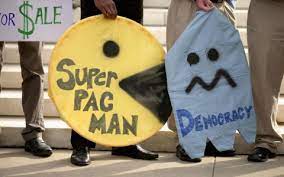
U.S. political campaigns are awash in money with increasing portions of it coming from super PACs and “dark money” non-profits. The unlimited political spending by super PACs, allowed by the Supreme Court’s Citizens United decision, is not independent of candidates’ campaigns nor are its donors fully disclosed. These were the Supreme Court’s stated requirements to ensure that candidates weren’t corrupted by the unlimited spending. Knowledgeable observers knew these requirements and the avoidance of corruption were a joke from day one.

(Note: If you find a post too long to read, please just skim the bolded portions. Thanks for reading my blog!)

Sixteen billion dollars were spent on the 2024 U.S. federal election campaigns. (See this previous post for more details.) Three types of spending occur in our federal elections:

  • Candidates’ political committees
  • Political action committees (PACs)
  • Super PACs

Candidates’ committees can accept up to $3,300 from an individual per election. (A primary and general election count as two elections.) A candidate’s committee can receive up to $5,000 per election from a PAC or party committee. A candidate’s committee may not accept any money from a super PAC. (Note: All money spent on a campaign that is not spent by a candidate’s committee is referred to as “outside money.”) [1]

PACs can accept contributions from individuals (not organizations) of up to $5,000 per year. PACs can contribute up to $5,000 per election to a candidate’s committee and up to $15,000 per election to a political party committee.

Super PACs (which came into existence after the Supreme Court’s 2010 Citizens United decision) can accept contributions of unlimited size from any entity, i.e., an individual or an organization, including a corporation or other business entity. They are not allowed to contribute to candidates’ committees or to political party committees. Their expenditures are supposed to be independent of candidates and parties. This requirement for independence was central to the Supreme Court’s Citizens United decision. The five justices supporting the unlimited contributions and spending wrote in their decision that disclosed, independent spending could not corrupt candidates or our government. Therefore, allowing unlimited, independent spending in campaigns, including by corporations, was constitutionally protected free speech.

To maintain independence, super PACs are prohibited (supposedly) from coordinating with candidates’ campaigns. However, this independence began eroding the day after the Court’s decision. That erosion grew dramatically in 2024. Knowledgeable observers knew from day one that this assertion of independence and lack of corruptive influence was a smoke screen for the justices who wanted to allow wealthy individuals and corporations to dominate our elections and government. The Federal Election Commission (FEC) has not enforced the law on independence. It has never fined or otherwise penalized a super PAC, even when coordination was blatant, as knowledgeable observers knew it wouldn’t.

For example, campaigns put “red boxes” in the media sections of their websites with messaging and targeting information. The super PACs use this information to ensure their messaging and targeting is aligned with the candidate’s campaign strategy. [2]

One of the most blatant violations of super PAC independence in 2024, was that super PACs actually ran extensive door knocking and other voter outreach efforts. Elon Musk’s super PAC’s activities in Pennsylvania were the most notable example. This kind of voter outreach requires sophisticated voter lists and street maps that candidates’ campaigns typically have and that PACs typically don’t have. Moreover, a failure to coordinate such activities with campaigns would create substantial redundancy and inefficiency. Nonetheless, an FEC ruling in 2024 essentially legalized such activities.

Furthermore, wealthy donors have found a way to avoid disclosure of their identities by funneling their money through non-profit 501(c)(4) organizations. (See this previous post for more details on 501(c)(4)s.) This “dark money,” as it is referred to, was about half of the $4.5 billion in outside spending in the 2024 federal elections.

My next post will present more examples of the corruption of the campaign finance system, discuss the effects of all this special interest spending, and give some options for what can be done about this obscene spending on our elections.


[1]      Ghosh, S., 9/15/22, “PACs, super PACs and more: Your guide to key election spending vehicles,” Campaign Legal Center (PACs, Super PACs and More: Your Guide to Key Election Spending Vehicles | Campaign Legal Center)

[2]      Goldstein, L., 12/10/24, “The money game,” The American Prospect (The Money Game – The American Prospect)