SUMMARY: Billionaires are already spending record amounts of money on 2026 election campaigns. Most of this money flows through Political Action Committees (PACs) and goes to Republicans. The Democratic National Committee (DNC) and state Democratic committees should ban PAC money from their primary elections because it distorts election results, perverts governments’ policies, and drowns out the voices of working people.
(Note: If you find a post too long to read, please just skim the bolded portions. Thanks for reading my blog!)
(Note: Please follow me and get notices of my blog posts on Bluesky at: @jalippitt.bsky.social. Thanks!)
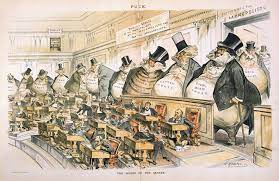
One of the problems with great economic inequality in a democracy is that the wealthy will find a way to buy policy decisions and enforcement that favor them. It can be through outright bribes. Or it can be more subtle. Our campaign finance system effectively lets the wealthy buy candidates. First, candidates without access to wealthy people’s money generally don’t even bother to run because they don’t have a chance. Second, during the campaign, wealthy donors fund and support candidates who will do their bidding once elected. Once in office, those elected want to get re-elected, so they curry favor with wealthy donors by supporting policies donors favor to ensure their funding for re-election campaigns.
Although U.S. campaign finance laws limit the amount an individual can give directly to a candidate or a political party, the Supreme Court’s 2010 Citizens United decision allows unlimited spending by super Political Action Committees (PACs). PAC spending is supposed to be independent of the candidate being supported, but the rules on independence are ignored and unenforced.
Therefore, much of the billionaires’ money flows through PACs. Nine of the eleven richest PACs fund Republican campaigns. Trump’s MAGA Inc. PAC leads the way with $89 million from billionaires. Musk’s America PAC is second at $45 million. The Senate and House PACs for Republicans have received a combined $66 million while those for Democrats have received $37 million. The other five richest PACs all fund Republicans and have between $15 and $10 million.
Billionaires are willing to spend lots of money on campaigns (or bribes) because the return on their investment is huge. A few million dollars can buy them tax cuts worth billions as the Republicans 2017 tax cut bill and the 2025 so-called One Big Beautiful Bill did. The wealthy’s campaign spending also buys them deregulation or contracts for their businesses that are worth billions. In the 2024 federal elections, billionaires accounted for almost 20% of all campaign spending. [1]
Grassroots organizing that gets lots of people to vote and educates them to distrust the advertising they see and hear from wealth-backed candidates can beat billionaires’ money, but it takes lots of work. Public matching funds for small donations to campaigns coupled with links to limits on donation size also make a huge difference as Mayor Mamdani’s campaign in New York City demonstrated. (See this previous post for more information.) Democracy is NOT a spectator sport. It takes work, participation, and voters who are paying attention and not believing the lies of wealth-backed candidates like Trump.
American billionaires are already spending big on the 2026 elections. As of March 1, the 50 highest spending billionaire families had already spent over $400 million on 2026 election campaigns. At this rate they will exceed the record for a non-presidential election and spend over $1 billion by election day. Not surprisingly, 80% of this money is going to Republican candidates or groups because Republicans have been the ones at the forefront of pushing policies that favor the wealthy. This is obscene and undemocratic. This is why we have an oligarchy running our government. [2]
Twelve of the top thirteen billionaire families have given money exclusively to Republicans. The Musk family leads the way at $71 million followed by the Yass family at $55 million and the Brockman family at $25 million. The next ten families have given between $10 million and $16 million each with the one Democratic donor at $13 million.
This is why we must change our tax laws to reduce the wealth of billionaires. (See this previous post for specifics.) They are so rich that they can afford to spend essentially unlimited amounts of money to corrupt our democracy to serve their interests, i.e., to make it an oligarchy. High levels of wealth lead inexorably to concentrated political power. [3] As Supreme Court Justice Louis Brandeis wrote almost 100 years ago, “We may have democracy, or we may have wealth concentrated in the hands of a few, but we can’t have both.”
Please contact your U.S. Representative and Senators to ask them to support a fairer tax system that taxes wealth and transfers of it. [4]
In addition to the billionaires, special interest groups are also already spending big money on the 2026 elections. Some of these special interest PACs split their money between Republicans and Democrats because they want to buy influence with both parties. A current example is the crypto industry. Its primary PAC, called Fairshake, has already raised $133 million. The vast majority of this comes from two billionaire-backed companies, Ripple and Coinbase. The crypto industry also spent heavily in the 2024 elections and some of the corrupt influence its spending bought is readily apparent. The Trump administration dropped thirteen charges for security law violations against Binance, the largest cryptocurrency exchange and pardoned its billionaire founder. The crypto industry has been pushing Congress, successfully so far, to leave the crypto industry largely unregulated and the beneficiary of tax loopholes.
Billionaires and special interest PACs spend money in Democratic primaries, often to defeat candidates who strongly oppose their policy interests and sometimes to support candidates who support their interests. The crypto industry has done this frequently, as have the AI industry and pro-Israel interests.
This is why my previous post called for the Democratic National Committee (DNC) and state Democratic committees to ban super PAC and dark money (i.e., money where the true donor is unidentified) from their primary elections. A coalition of four Democratic Senators (Merkley [D-OR], Warren [D-MA], Welch [D-VT], and Van Hollen [D-MD]) and Independent Sanders (VT) are pushing Democrats and the DNC to ban money from billionaire- and corporate-backed PACs from Democratic primary elections. They noted in a letter to the DNC that unlimited PAC spending will “distort our elections and drown out the voices of working people.” [5]
For lots of good news, see Jess Craven’s Chop Wood Carry Water blog’s most recent good news Sunday post here.
[1] Johnson, J., 3/25/26, “‘Modern-day royalty’: 50 billionaire families have already pumped over $430 million into midterms,” Common Dreams (https://www.commondreams.org/news/billionaire-spending-2026-midterms)
[2] Americans for Tax Fairness, 3/25/26, “No Kings – No billionaire kingmakers either,” (https://americansfortaxfairness.org/billionaire-kingmakers/)
[3] Bivens, J., 11/17/25, “Raising taxes on the ultrarich,” Economic Policy Institute (https://www.epi.org/publication/raising-taxes-on-the-ultrarich-a-necessary-first-step-to-restore-faith-in-american-democracy-and-the-public-sector/)
[4] You can find contact information for your US Representative at http://www.house.gov/representatives/find/ and for your US Senators at http://www.senate.gov/general/contact_information/senators_cfm.cfm.
[5] Prager, S., 4/27/26, “Bernie Sanders lead Senators in demand to end super PACs in Democratic primaries,” Common Dreams (https://www.commondreams.org/news/sanders-dnc-dark-money)