THE AFFORDABILITY CRISIS Part 4

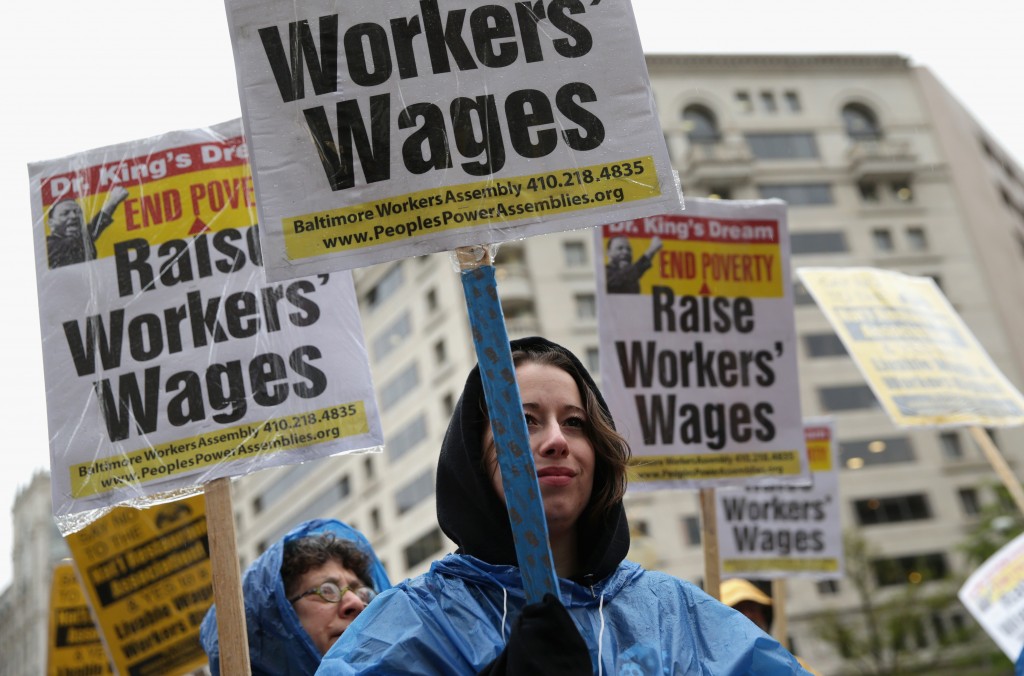
The U.S. affordability crisis is multifaceted and has been growing for 45 years, caused by low pay and high prices. Many factors have been depressing workers’ pay including the failure to raise the minimum wage, the weakening of unions, globalization, gig work, and reduced competition for workers.

The U.S. affordability crisis is multifaceted and has been growing for 45 years, caused by low pay and high prices. Many factors have been depressing workers’ pay including the failure to raise the minimum wage, the weakening of unions, globalization, gig work, and reduced competition for workers.

(Note: If you find a post too long to read, please just skim the bolded portions. Thanks for reading my blog!)

(Note: Please follow me and get notices of my blog posts on Bluesky at: @jalippitt.bsky.social. Thanks!)

The U.S. affordability crisis is multifaceted and caused by low pay and high prices. (Previous posts have discussed the reasons for high prices.) This post will discuss the factors leading to low pay.

Over the last 45 years, workers’ pay has barely kept up with the increase in prices (i.e., inflation). And the pay increases there have been, have gone disproportionately to high earners. A study by the Economic Policy Institute found that between 1979 and 2019 the annual wages (adjusted for inflation) of the lowest-income 90% of workers increased by 26%, while the wages of those in the top 1% rose by 160%. The next richest 4% of workers saw their wages increase by 75%. CEOs now make about 300 times what their typical employee makes, while in 1960s they only made 20 times as much as the typical worker.

Good, middle-class blue- and white-collar jobs have been lost to globalization, while the compensation for the remaining jobs has declined due to the purposeful undermining of unions and global pay competition. The result is a crushing affordability crisis for many current and formerly middle-class households, as well as for lower income households.

According to a Brookings Institute analysis, 43% of American families can’t afford to pay for housing, food, health care, child care, and transportation. This figure is 59% for Black families and 66% for Latino families. The shift in income from workers to executives and investors has been dramatic: in 1947 workers received 70% of total national income, while today they get only 59%. Unlike the previous 35 years, after 1980, workers did not receive wage increases that were in line with their increases in productivity: from 1979 to 2025 workers’ productivity increased by 87% but their compensation only increased 33%. According to a Rand Corporation analysis, in 1975, the 90% of workers at the bottom of the income spectrum received 67% of national income, while in 2019 (the latest data it had) they received just 47% of national income. This highlights again the skewing of income to the top 10%. It calculated that if, in 2023, the 90% of workers with the lowest incomes had received 67% of national income (as they did in 1975), they would have earned an additional $4 trillion or, on average, each worker would have made $28,000 more than they did. Over the period from 1975 to 2023, if these workers had received 67% of national income, they would, in aggregate, have received $79 trillion more in income. [1]

There are many factors that have been depressing workers’ pay. They include:

  • Failure to raise the minimum wage. The federal minimum wage of $7.25 an hour is only 29% of a typical worker’s wage today; in 1968, it was 53% of the typical wage. If the minimum wage had been raised at the same pace as productivity growth since the late 1960s, it would be over $24 an hour today.
  • Dramatic weakening of unions by the emasculation of pro-union government policies and of the enforcement of labor laws, as well as by the monopolistic power of huge employers. These have resulted in a huge shift in power from workers to employers over the last 45 years. Union membership has declined from roughly a third of workers in the 1950s to under one-tenth of workers today and only one-sixteenth of private sector workers.
  • Globalization, which shipped jobs overseas and put downward pressure on the pay for the remaining jobs.
  • Gig work and the misclassification of workers as contractors and not employees, which reduces wages, removes the protections for employees that are in labor laws, and typically means they get no benefits (e.g., health insurance, sick or vacation time, and retirement benefits). A 2021 study estimated that nine million American workers, from Amazon and FedEx delivery personnel to Uber and Lyft drivers, earn between 15% and 30% less than they would as employees.

    The gig work-based companies, using AI with vast amounts of personal data and tremendous computer processing power, can tweak the pay of gig workers instantaneously so each worker gets the minimum pay for which they’re willing to do a job. For example, Uber pays drivers based on their past behavior. If a driver is hungry for work, perhaps because they badly need the income, and therefore always grabs the first job that is offered, Uber will pay them less because it knows they’ll take the job. On the other hand, Uber will offer more to a driver that waits for a better paying option.
  • Reduced competition for workers among employers due to fewer, very large employers and the widespread use of non-compete clauses in workers’ contracts (which prevent workers from moving to similar work for another company, down to and including other franchisees of the same fast-food chain). The Federal Trade Commission under President Biden banned non-compete agreements but the Trump administration undid this.

Capitalism in the U.S. is out of control. Competition has been stymied and monopolistic power is widespread. This has happened because of the failure to enforce antitrust laws for 45 years (except for four years under President Biden).This means the invisible hand of a market economy and the economic “rules” of supply and demand do not work to give fair compensation to workers. The rules of the economic game have been rigged to favor large employers. One indicator that clearly confirms this is that corporate profits are at very high levels in terms of percentage of revenue. In 1980, 80% of corporate income was paid to workers; in 2025, that percentage was under 72% with the difference largely going to profits.

Regulators have been compromised (aka captured) by the large employers through the political influence garnered by campaign spending and lobbying, as well as the revolving door of personnel between government regulatory positions and private industry jobs. As a result, many aspects of corporate behavior have undergone deregulation, which allows companies to increase profits by, for example, blocking increases in the minimum wage, shipping jobs overseas, gig work, breaking existing unions, blocking union organizing, failing to negotiate in good faith with unions, and frequently preventing new unions from ever getting a contract. In 2018, 63% of new unions, each of which had been voted for by a majority of workers, failed to get their employer to agree to a contract within a year. Amazon workers at a New York City warehouse voted decisively for a union in April 2022, but as of December 2025, Amazon had refused to even begin contract negotiations with them. This reflects a lack of effective labor laws and a lack of enforcement of them.

My next post will discuss steps to take to tackle the affordability crisis.


[1]      Meyerson, H., 12/3/25, “The $79 trillion heist,” The American Prospect (https://prospect.org/2025/12/03/79-trillion-heist-worker-pay/)

MUSK AND TRUMP ARE ENGAGED IN CORRUPT SELF-ENRICHMENT

Musk and Trump are corruptly lining their own pockets by ending or weakening investigations, enforcement, and regulation of Musk’s companies, as well as providing them with new government contracts. They’re also endangering workers, the public, and our national security.

Musk and Trump are corruptly lining their own pockets by ending or weakening investigations, enforcement, and regulation of Musk’s companies, as well as providing them with new government contracts. They’re also endangering workers, the public, and our national security.

(Note: If you find a post too long to read, please just skim the bolded portions. Thanks for reading my blog!)

My previous post provided an overview of the 32 (or more) ongoing investigations of Elon Musk’s six companies when Trump was sworn into office. It also noted that Musk has obtained much of his enormous wealth through government subsidies and contracts – over $38 billion in the last 20 years. In 2023, Space X and Tesla got almost $3 billion from 100 contracts with 17 federal agencies. [1] These include substantial contracts with the Department of Defense (DOD). Space X has a multi-billion-dollar contract to build a classified spy satellite network for the DOD. It also has contracts for communication services through Space X’s subsidiary, Starlink.

Needless to say, Musk’s role with the so-called Department of Government Efficiency (DOGE) presents huge conflicts of interest that are illegal. He would be swiftly barred from this work and/or prosecuted under any president other than Trump. Instead, Trump and Musk are systematically undermining the agencies that regulate businesses, including Musk’s, to keep workers, consumers, and the public safe. This deregulation results in windfall profits for Musk, Trump, members of Trump’s cabinet, and other wealthy business executives and investors. This is outright oligarchic corruption with wealthy business people funneling government money and benefits to themselves and their cronies.

Musk is lining his own pockets as a government contractor and businessman in two main ways:

  • Dismantling or emasculating agencies that regulate his business activities, often ending on-going investigations and enforcement actions, and
  • Having the Trump administration award his companies billions of dollars in new contracts, while continuing to pay billions of dollars to his companies under existing contracts.

Actions by Musk, DOGE, and Trump to block or weaken regulation, investigations, and sanctions of Musk’s companies include:

  • Firing members of the National Labor Relations Board, the Equal Opportunity Employment Commission, and others at the Department of Labor in order to hobble their 24 investigations into violations of workers’ rights at Musk’s companies.
  • Cutting staff at the National Highway Traffic Safety Administration that was investigating fatal crashes of Tesla vehicles and had ordered recalls of hundreds of thousands of Tesla vehicles due to safety issues.
  • Emasculating the Consumer Financial Protection Bureau (CFPB) that
    • Was reviewing over 300 complaints about Tesla’s financing entity, and
    • Would have oversight of the digital payment service Musk wants to add to his social media platform, X.
  • Slashing the workforce at the Federal Aviation Administration (FAA) that is suing Space X over worker safety and investigating it for violations related to its rocket launches.
  • Firing workers at the Food and Drug Administration (FDA) that was investigating Musk’s Neuralink company for violations of the Animal Welfare Act.
  • Eliminating USAID that was reviewing its contract with Space X subsidiary, Starlink, for communication services in Ukraine.
  • Firing over a dozen Inspectors General, which has reduced oversight of government contractors, among other negative effects. The firings of Inspectors General at the Defense Department most likely disrupted or ended an investigation into Space X’s contracts.
  • Presumably ending the three DOD investigations of Musk’s and Space X’s repeated failures to file mandatory national security reports of contacts and involvement with foreign entities. This is one small effect of Trump’s politicization of the DOD, e.g., his appointments of political loyalists such as Hegseth as Secretary of Defense and Caine as Chairman of the Joint Chiefs of Staff.

Musk and Space X have significant contacts and engagement with Chinese leaders and investors. This is one reason that their failure to make required national security reports is a matter of serious concern. Space X has sizeable investments from Chinese investors, but because of its contracts with the DOD, Space X does not want its investments from Chinese investors to be public knowledge. Therefore, it actively works to make sure those investments are laundered through intermediate entities in the Cayman Islands and elsewhere, which keeps investors anonymous. [2]

Roughly half of Musk’s Tesla vehicles are built in China and China is Tesla’s largest market. Tesla’s largest factory is in Shanghai and its construction received a $2.8 billion investment, major tax breaks, and special permissions from the Chinese government. Musk regularly meets with Chinese government and Communist Party officials due to his multiple business interests, current and future, in China.

Needless to say, Musk is considered a significant national security risk by DOD and intelligence officials and experts. Nonetheless, Musk had scheduled a private meeting with Secretary of Defense Hegseth and others for a briefing on top secret U.S. preparations for conflict with China. The briefing was apparently scrapped after knowledge of it became public. [3]

Notwithstanding all the above, the Trump administration has awarded or announced plans to award (it’s sometimes hard to tell the difference due to Trump’s and Musk’s frequent distortions of facts) Musk’s companies multiple new contracts. The FAA recently announced its intention to engage Space X subsidiary Starlink in a $2 billion contract to upgrade air traffic control systems. There were plans for the State Department to order $400 million worth of armored Teslas. The contract was backdated to make it look like it was awarded before Trump took office. The contract is apparently now on hold.

It’s abundantly clear that Musk, Trump, and their cronies are lining their pockets at taxpayers’ expense and at significant risk to the public. I urge you to contact your US Representative and Senators and ask them to call out and take whatever actions they can to stop the corrupt self-enrichment of Musk and Trump. You can find contact information for your US Representative at  http://www.house.gov/representatives/find/ and for your US Senators at http://www.senate.gov/general/contact_information/senators_cfm.cfm.


[1]      Elordi, M., 10/21/24, “Elon Musk’s companies have faced at least 20 federal probes,” Daily Wire (https://www.dailywire.com/news/elon-musks-companies-have-faced-at-least-20-federal-probes-report)

[2]      Kaplan, J., & Elliott, J., 3/26/25, “How Elon Musk’s Space X secretly allows investments from China,” ProPublica (https://www.propublica.org/article/elon-musk-spacex-allows-china-investment-cayman-islands-secrecy)

[3]      Reich, R., 3/21/25, “Is the Muskrat working for China?” Robert Reich blog (https://robertreich.substack.com/p/is-the-muskrat-working-for-china )