
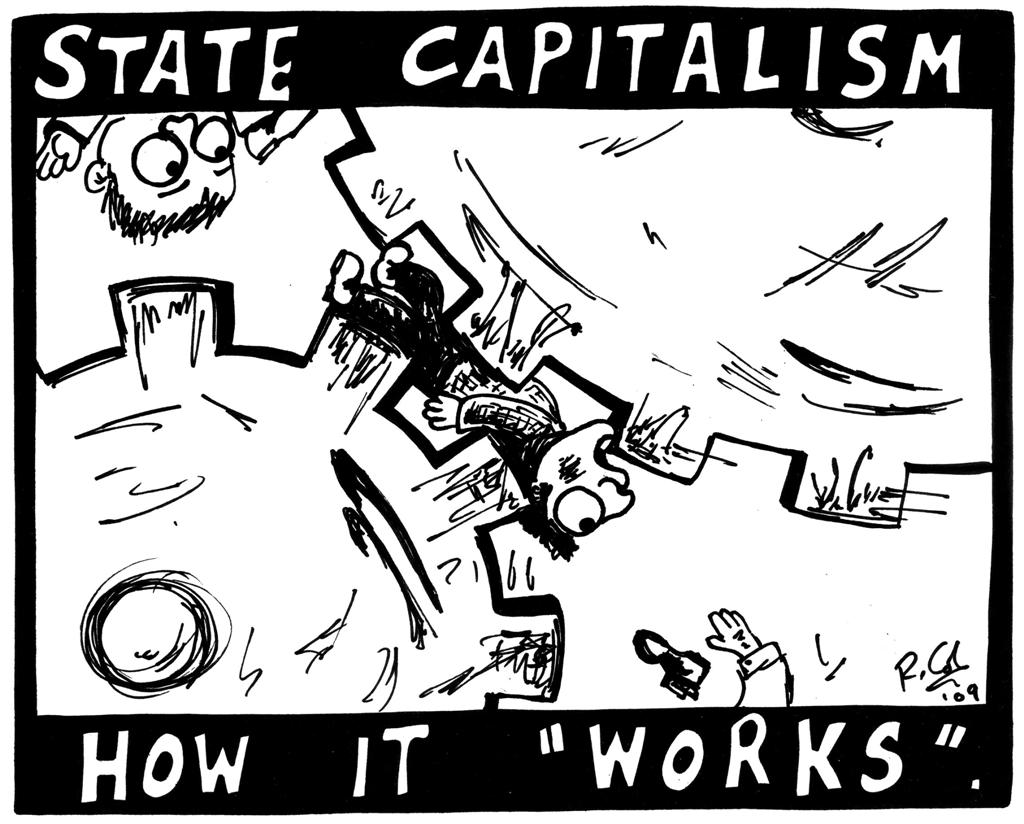
President Trump is perverting capitalism and the free market by asserting unprecedented influence over the private sector. His actions are not a coherent economic policy and make the U.S. economy look like China’s. They’re all about centralizing power and control, while undermining the rule of law and democracy. This is what fascism and oligarchy look like.
(Note: If you find a post too long to read, please just skim the bolded portions. Thanks for reading my blog!)
(Note: Please follow me and get notices of my blog posts on Bluesky at: @jalippitt.bsky.social. Thanks!)
President Trump is perverting capitalism and the free market by asserting unprecedented personal influence over and taking government ownership in private sector companies. His actions do not reflect a coherent economic policy. It is the power grabbing of a tyrant and bully who wants to control others and wants them to be subservient. Trump is using largely illegal financial (e.g., import tariffs and export fees), regulatory, and court-based actions to do this. He wants to influence the decisions of other countries and American businesses, including media corporations, financial institutions, law firms, and universities. He wants countries and companies to come to him begging for exemptions from his actions and threats. [1] This is, of course, a breeding ground for corruption and bribery.
Nothing even approaching this level of government interference in the private sector has occurred since the emergency mobilization of the private sector for World War II. This government interference in private companies, which is a type of state-controlled capitalism, has until now always been anathema to Republicans and the business community. If any president prior to Trump had attempted any of this, Republicans, business executives, and the mainstream media would be screaming about it being socialism or communism. The actions by Trump are making the U.S. economy look like that of China, where the government owns a stake in companies or has considerable influence over their decision making. [2] [3] Or like Leninist capitalism where the Communist Party controlled the state’s ownership of businesses. [4]
This alignment of an authoritarian leader and a nominally capitalist economy is classic fascism. While Republicans and business executives are supportive or mute, the Wall Street Journal simply calls it inefficient. The business executives and other wealthy investors that facilitate and participate in Trump’s actions are the American oligarchy.
Examples of Trump’s actions include:
- Allowed Nvidia and Advanced Micro Devices, makers of artificial intelligence (AI) computer chips, to export them to China on the condition that the companies pay the United States 15% of their profits. This poses risks to the U.S. AI industry and to U.S. national security (in part due to the chips’ use by the Chinese military). These payments are, for all intents and purposes, an export fee, which is unprecedented in U.S. history. Moreover, the Constitution explicitly bans export taxes (Article I, Section 9, Clause 5). [5]
- Demanded that Intel’s CEO resign and then negotiated 10% government ownership of the company. This makes the U.S. government one of Intel’s largest shareholders. [6]
- Proposed that the Defense Department take a 15% ownership stake in MP Materials, which mines minerals critical for chips and electronics.
- Allowed Nippon Steel of Japan to take over U.S. Steel on condition that Nippon pay a “golden share” of the proceeds to the government and give Trump control over elements of corporate governance.
- Reserved the right to personally direct some the $1.5 trillion in promised investments in the U.S. to be made by America’s trading partners as part of tariff negotiations.
- Sued media corporations and negotiated approval of media corporation mergers to get money and influence over media content.
The government ownership in and influence over the private sector asserted by Trump has nothing to do with promoting the public interest, the well-being of American workers, or protecting national security. In fact, they undermine all these principles. They’re all about centralizing power and control in Trump’s hands as part of his efforts to undermine the rule of law and democracy. [7] Moreover, who holds the ownership stakes and who exercises the related rights is unclear.
Despite Trump’s bluster about being tough on China, his actions have been quite favorable to China. He has illegally extended the deadline for the sale of Chinese ownership of TikTok if it wants to do business in the U.S. He has shut down Radio Free Asia, which countered Chinese propaganda. He’s allowed the export of artificial intelligence computer chips to China, which was a key request from China in trade negotiations.
Please contact your members of Congress and ask them to assert their oversight of these deals Trump is making. Ask them to clarify who holds the ownership stakes, who is exercising ownership rights, and where the funds received are going. Ask them to ensure that the Trump administration’s economic policies and actions further the public interest, benefit workers, promote national security, and comport with the rule of law and democratic principles.
You can find contact information for your US Representative at http://www.house.gov/representatives/find/ and for your US Senators at http://www.senate.gov/general/contact_information/senators_cfm.cfm.
[1] Dayen, D., 8/11/25, “Tariffs to import and fees to export,” The American Prospect (https://prospect.org/blogs-and-newsletters/tap/2025-08-11-tariffs-to-import-fees-to-export-nvidia-chips-china/)
[2] Reich, R., 8/12/25, “Trump’s ‘state capitalism’,” Blog post (https://robertreich.substack.com/p/trumps-state-capitalism)
[3] Cox Richardson, H., 8/11/25, Letters from an American blog post, (https://heathercoxrichardson.substack.com/p/august-11-2025)
[4] Meyerson, H., 8/18/25, “When l’etat c’est Trump, the U.S. goes in for state capitalism,” The American Prospect (https://prospect.org/economy/2025-08-18-when-letat-cest-trump-us-goes-in-for-state-capitalism/)
[5] Dayen, D., 8/11/25, see above
[6] Liedtke, M., & Kurtenbach, E., 8/20/25, “US vying to own a big stake in Intel,” The Boston Globe from the Associated Press
[7] Reich, R., 8/12/25, see above
 Lippitt's Policy and Politics Blog