2025 was a horrible year for American democracy. However, many good things did happen; here are some of them. Let’s keep up the activism and resistance in 2026. And let’s get out to vote and get everyone we know out to vote. That will make it a much better year than 2025 was. Happy New Year!
(Note: If you find a post too long to read, please just skim the bolded portions. Thanks for reading my blog!)
(Note: Please follow me and get notices of my blog posts on Bluesky at:@jalippitt.bsky.social. Thanks!)
2025 was a horrible year for American democracy. However, there were glimmers of hope and many good things did happen. Let’s start 2026 by looking at some of the good things that happened in 2025.
Many increases in the minimum wage, put in place in 2025 or earlier, will go into effect in 2026. On January 1, 19 states will increase their minimum wage, on average from $13.90 to $14.57. (Note: The federal minimum wage is $7.25.) Over eight million workers will benefit. Three more states and D.C. will increase their minimum wage later in 2026. Furthermore, roughly 50 counties and municipalities will increase their minimum wage in 2026. [1]
Bob Reich presents his 2025 top ten biggest wins in domestic politics in a 3.5-minute video from Inequality Media. They include the growing pushback and protests against Trump and his administration from the public at the No Kings rallies and through other actions. He notes Democratic election wins for Governor in New Jersey and Virginia, for Mayor in Miami, New York, and Seattle, and for supreme court seats in Pennsylvania and Wisconsin, among others. He highlights positive actions by voters and legislators in several states in support of school meals and universal child care, in opposition to huge data centers and consumer price manipulation, and in blocking junk fees and private equity firms’ ownership of health care providers. He also celebrates the resurgence of unions and worker solidarity, including the strike by Starbucks workers.
Medea Benjamin at Common Dreams identifies “10 good things that happened in 2025”in the arena of justice and peace here in the U.S. and abroad. They include the growing protests against ICE and support for immigrants, which have led to the release of a number of ICE detainees. The growing resistance to war andthe use of the military by theTrump administration also make the list, along with the growing opposition to the horrors of the ongoing war on the Palestinians.
Jess Craven, in her Chop Wood, Carry Water blog, posts good news at a very granular level every Sunday. In addition to touching on many of the topics mentioned above, her 12/28 edition also highlighted the Supreme Court ruling disallowing the Trump administration’s deploying of the National Guard in Chicago, the growing resistance to ICE, and increasing opposition to the Trump administration’s military actions. She also notes the freeing of Abrego Garcia from ICE detention and Arizona’s elimination hundreds of millions of dollars of medical debt for its residents. And much more. In her 12/21 edition, she highlighted the growing production of clean energy (despite the Trump administration’s opposition), resignations at the Heritage Foundation (the source of Project 2025), the success of a discharge petition in the U.S. House requiring a vote on extending the Affordable Care Act subsidies, a judge blocking the corrupt sale of a private equity-owned nursing home chain (to escape liability for patient negligence claims), and a judge’s nullification of the Trump administration’s termination of some federal employees. And much, much more.
Let’s keep up the activism and resistance in 2026! And let’s get out to vote and get everyone we know out to vote. That will make it a much better year than 2025 was. I’m raring to go and I hope you are too!
U.S. political campaigns are awash in money. American oligarchs are buying our elected officials, thereby corrupting all facets of government.We must reform campaign financing to preserve our democracy. Matching small campaign contributions with public funds in a system that restricts the size and source of campaign contributions is the most effective answer to big money in our elections, particularly within the context of current Supreme Court rulings.
(Note: If you find a post too long to read, please just skim the bolded portions. Thanks for reading my blog!)
My previous three posts have focused on how a miniscule group of billionaires (aka the American oligarchs) are buying our elected officials (here), using super PACs to do so (here) and expecting a return on their “investments,” all of which corrupt our government (here). They also highlighted how big donors are using non-profit organizations that don’t have to report donors to hide their identities and how super PACs are violating the law by coordinating with candidates’ campaigns. Unfortunately, the Federal Elections Commission (FEC) is failing to enforce campaign finance laws. Meanwhile, Congress has failed to act, although bills to reform campaign financing have been on the table. [1]
In the 2024 election campaigns, donors who spent at least $5 million spent more than twice as much as they had in the 2020 presidential election cycle. About 44% ($480 million) of all the money spent on Trump’s campaign came from just ten individual donors. The wealthy individuals spending tens and hundreds of millions of dollars on campaigns are motivated by greed (they expect a return on investment for their spending), as well as a desire for power and influence. Elon Musk (Tesla, X, Space X, Starlink, etc.) is the most visible of these oligarchs. He appears to be motivated primarily by a desire for power and influence. Jeff Bezos (Amazon and the Washington Post) and Mark Zuckerberg (Meta, Facebook, and Instagram) appear to be motivated primarily by greed and fear that Trump would retaliate and hurt their businesses if they didn’t support him. Peter Thiel (vulture capitalist and sponsor of J. D. Vance) appears to be motivated primarily by a desire for power and influence. Trump and J. D. Vance appear to be motivated primarily by a desire for power, although wealth may be a close second.
This huge spending on campaigns corrupts who runs for elected offices, who wins, what issues governments address, what policy alternatives are considered and adopted, and how laws are implemented and enforced (or not). The oligarchs’ spending buys access to elected and regulatory officials. It allows them to influence policies such as regulations and tax laws, as well as enforcement of them. [2]
More and more of the money spent on congressional races is coming from out-of-state donors, highlighting that big spenders are looking for a return on their investments, not just supporting their local congressional candidates. It also means that our elected officials are more likely to be responsive to wealthy special interests than to the constituents who actually live in their congressional districts.
The huge amount of money in supposedly democratic, one person one vote, elections is obscene. The buying of our elected officials by wealthy interests is corrupting all facets of our governments.To preserve democracy, we must reform campaign financing laws and push back against the power and influence of the oligarchs.
Supreme Court Justice Louis Brandeis faced these issues roughly a century ago. As a lawyer, often doing pro bono work in the public interest, he successfully challenged the powerful railroad, street car, electricity, and banking companies, as well as their wealthy owners.
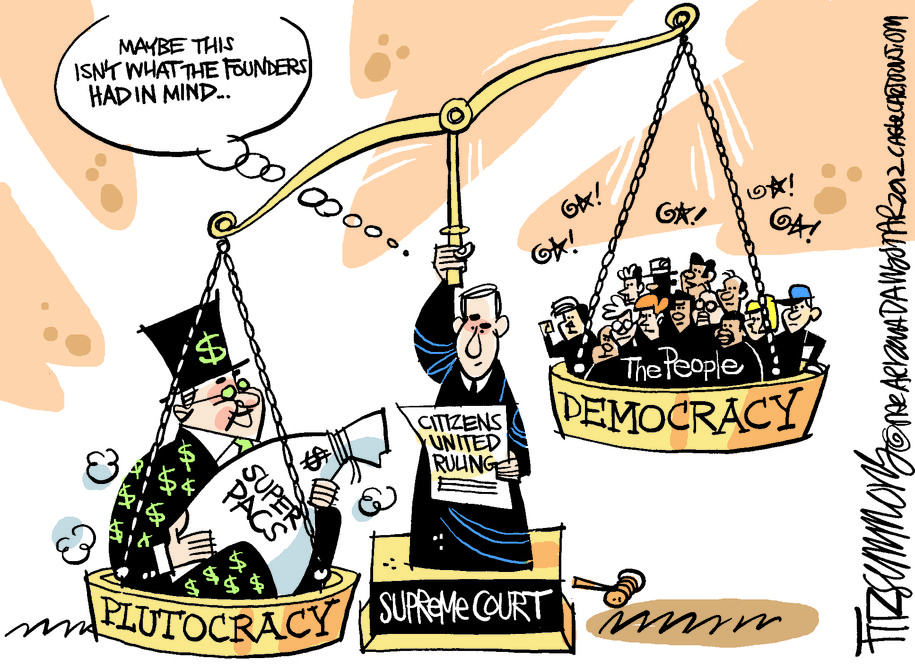
The current situationmakes clear how right Brandeis, a fervent supporter of democracy, was when he wrote almost 100 years ago, “We must make our choice. We may have democracy, or we may have wealth concentrated in the hands of a few, but we can’t have both.” How true those words ring today. [3]
An ancillary effect of the incredible cost of election campaigns is that elected officials must spend substantial time fundraising from the day they get elected. This diverts time, energy, and attention from policy making and legislating, as well as from interacting with constituents.
Before Republicans took control of the House in 2022, The Freedom to Vote Act (S.2747) was developed and introduced in the Senate to address the issues of big money and dark money in our elections. It included most of the key provisions of the For the People Act and the Democracy Is Strengthened by Casting Light on Spending in Elections (DISCLOSE) Act, which had previously been passed by Democrats in the House. Unfortunately, Republicans in the Senate blocked these bills and there is no hope for such reforms at the national level with Republicans fully in control now. (For more details see this previous post.)
The Freedom to Vote Act included provisions that would have: [4]
Reformed the campaign finance system by
a) requiring enhanced disclosure of all major donors by any entity spending more than $10,000,
b) ensuring super PACs are truly independent of candidates, and
c) strengthening enforcement of campaign finance laws.
Created a system for matching small donations with public funds in U.S. House campaigns that states and candidates could opt into. It would have matched each dollar of small donations with $6 of public funds in exchange for limiting the size of donations. This would eliminate the need for candidates to rely on large donations from wealthy special interests with their corrupting influence.
Given the control of the federal government by Republicans, oligarchs, and the six corrupt Supreme Court justices, people working to limit the influence of wealthy interests in our elections will need to focus at the state and local levels for now. State and local governments can enact laws implementing all of the provisions for the Freedom to Vote Act above: enhanced disclosure and transparency for campaign spending, requirements that super PAC and other outside spending is truly independent of candidates’ campaigns, public matching funds for small contributions to campaigns, and strict enforcement of campaign financing laws. [5]
Matching small campaign contributions with public funds in a system that restricts the size and source of campaign contributions is the most effective answer to big money in our elections, particularly within the context of current Supreme Court rulings. Such systems have been in place in multiple states for some time and in New York State starting in 2024. A number of municipalities also have such systems, including a very successful one in New York City since 1988. (See this previous post for more details.)
Given that the state and national parties set the rules for their primaries, they could address campaign finance reform. They could, for example, ban super PAC money and dark money in party primaries, as well as require strict disclosure of donors. So far, the Democratic National Committee has refused to consider such campaign finance rules, despite a push from some internal groups to do so. Apparently, it is still too wedded to big donors to be willing to work for government of, by, and for the people, as opposed to wealthy special interests.
I encourage you to contact your local and state elected officials, as well as state and national party officials, to ask them to enact campaign finance reforms. The corrupting influence of big money in our elections must be reversed if the U.S. is to be a democracy where all voters have a fair, if not equal, voice in our government. Money should not drown out the voices of citizens, and even candidates, in our elections. And voters have a right to know who is spending money to try to influence their vote. Justice Brandeis summed it all up by saying, “The end for which we must strive is the attainment of rule by the people” as opposed to rule by the oligarchs who are buying our elected officials and government.
U.S. political campaigns are awash in money and it’s corrupting our government. The big spenders, wealthy individuals and corporations, are looking for something in return. They generally get rewarded with policies and actions that provide a high return on their investments.
(Note: If you find a post too long to read, please just skim the bolded portions. Thanks for reading my blog!)
My previous two posts have focused on how billionaires are buying our elected officials (here) and how super PACs (political action committees) are the vehicle they are using to do so (here). They also highlighted how big donors are using non-profit organizations that don’t have to report donors in order to hide their identities (i.e., “dark money”) and how super PACs are violating the law by coordinating with candidates’ campaigns. Unfortunately, the Federal Elections Commission (FEC) is failing to enforce campaign finance laws.
An example of how big money donors and our political parties are flouting campaign finance lawsis the growing and now extensive use of joint fundraising committees. These joint fundraising committees allow big donors to skirt campaign contribution limits and write one huge check, typically for tens of thousands of dollars, for candidates’ campaign committees and political party PACs. The entities in the joint committee then supposedly split up the money so that no contribution limits are violated. Some of the joint fundraising committees directly pay for advertising but frame it as a fundraising solicitation to evade restrictions on their activities. These joint committees have also figured out how to game the system to get the lower advertising rates supposedly given only to candidates’ committees. (Note: Advertising rates for super PACs and other non-candidate entities can be up to 20 times higher than those for candidates’ committees.) [1]
These big donors are special interests, and they view their campaign spending as an investment. They expect a return on their investment, and generally they get paid back many, many times over. You may remember that in 2017 wealthy Republican donors were telling Trump and the Republicans that if they didn’t get a big tax cut their support of Republicans in the 2018 congressional elections would be curtailed. So, the Republicans in Congress and Trump, in December 2017, enacted the Tax Cuts and Jobs Act, which gave huge tax cuts to wealthy individuals and corporations.
As campaign spending is increasingly dominated by outside money, which is increasingly from super PACs and done with dark money, the result is a political environment of hidden influence by wealthy individuals and corporations. This undermines an essential principle of democracy: that voters deserve to know who is trying to influence their vote.
An example of huge spending by a special interest, using, of course, a super PAC, is the cryptocurrency industry. It was one of the largest and most successful special interest spenders in the 2024 elections. It spent roughly $245 million via a super PAC called Fairshake. The majority of its money went to Republicans. It won every one of the 49 races it spent money on except for Sen. Elizabeth Warren’s (D-MA) winning re-election campaign. However, none of Fairshake’s advertisements even mentioned cryptocurrency; it clearly wanted to influence elections without revealing its true interests.
Fairshake’s 48 victorious campaigns may understate its influence, as its spending in primaries instilled fear in numerous Democratic candidates who avoided criticizing the crypto-industry or stated support for it. Cryptocurrency industry donors were responsible for almost half of all corporate donations to all super PACs. Fairshake already has $78 million on hand for the 2026 congressional elections. Based on all of this, the crypto industry will almost certainly be rewarded with weak regulation by Congress and the Trump administration.
Another example of special interest spending with a very specific outcome in mind is the American Israel Affairs Committee’s super PAC (AIPAC). It spent roughly $100 million in the 2024 elections, primarily in primaries to beat Democratic candidates who weren’t unquestioning supporters of Israel in the face of the horrific Gaza War. It spent $14 million in one Democratic primary to beat incumbent Jamaal Bowman (D-NY), a record for outside spending in a House race. It also spent heavily in incumbent Cori Bush’s (D-MO) primary, which she ended up losing. The primary funders of AIPAC are Republican mega-donors, many of whom each gave hundreds of thousands of dollars to it. [2]
As another example, two multi-national, multi-hundred-billion-dollar investment management firms, Blackstone Group and Citadel, each gave $22 million to the Republican Senate Leadership super PAC for the 2022 congressional elections. They want, and so far have gotten, lax regulation of their financial activities and favorable tax treatment for their incomes. For example, the “carried interest” provision of U.S. tax laws allows the firms’ managers to treat their income as capital gains, which lets them pay an income tax rate on their huge incomes at less than half the rate they’d pay on regular income (i.e., non-capital gains income).
The fossil fuel industry is also reaping rewards for its spending of about $75 million in support of Trump’s campaign. Although Trump, in a public statement, told fossil fuel industry executives that if they invested $1 billion in his campaign that he would reward them, $75 million appear to have done the trick. Trump, in his first days in office, has signed executive orders, some of them likely written by fossil fuel industry lobbyists, revoking climate change reduction rules. These executive orders allow increased oil and gas drilling off the U.S. coast and on federal lands, allow the building of new liquified natural gas (LNG) export terminals, and withdraw the U.S. from international climate change reduction efforts. [3]
My next post will discuss some more general effects of all this special interest spending on election campaigns and what can be done about this obscene and corrupting spending.
U.S. elections are awash in money and billionaires are the dominant spenders. Wealthy interests have been allowed by the Supreme Court to engage in unlimited political spending, and they have found ways to avoid disclosing that they are the sources of the funding. Democrats made a huge political mistake years ago in not regulating campaign spending.
(Note: If you find my posts too long to read on occasion, please just skim the bolded portions. Thanks for reading my blog! Special Note: The new, more user-friendly website for my blog is here.)
Elections in the U.S. are awash in money. The Supreme Court’s 2010 Citizens United decision (and related ones) allowed unlimited spending by wealthy individuals and corporations. Supposedly, the donors and spending would be disclosed, as well as independent of candidates’ campaigns. This would, according to the supportive Supreme Court justices, ensure that there was no corruption. Most observers knew from day one that the independence of such spending and the prevention of corruption were not realistic. Time has proven this sentiment to be correct.
Wealthy interests have found or manufactured loopholes to get around disclosure and independence requirements. Furthermore, the lack of enforcement from the Federal Elections Commission (FEC) and the Internal Revenue Service (IRS) has eviscerated disclosure and independence laws.
Sixteen billion dollars were spent on the 2024 federal elections for president and Congress. Roughly $5.5 billion was spent on the presidential race and over $10 billion on congressional races. The record of over $18 billion from 2020 still stands. However, both the 2024 and 2020 amounts are roughly double what was spent in prior presidential election years before wealthy interests had figured out how to fully take advantage of the Citizens United decision. [1]
To win a seat in the U.S. House now costs on average about $3 million and about $30 million for a seat in the Senate. Incumbents win well over 90% of the time. Business interests’ campaign spending on behalf of incumbents is roughly 50 times what they spend for challengers. Business interests spend about 16 times what labor interests spend, despite the fact that labor represents millions of every day workers (and to some extent all workers) while business interests represent lifeless but immortal legal entities (e.g., corporations) and the self-interest of a small number of wealthy executives and investors.
Campaign donations by small donors ($200 or less) are overwhelmed in most races by big donors. Of the 535 members of Congress, only 16 got over 50% of their donations from small donors. Over 40%, 230 of them, got less than 5% (1/20th) of their donations from small donors. Over 80%, 432 of them, got less than 20% (one fifth) of their donations from small donors.
The dominant campaign spenders today are the billionaires. Just 150 billionaire families spent $2 billion on federal elections in 2024. More than one-sixth (over 16%) of spending in the presidential race came from billionaires. Over 70% of billionaires’ money went to Republicans. Although determining exact figures is probably impossible, Elon Musk spent roughly $250 million in support of Trump’s campaign and additional tens of millions supporting other Republicans. Timothy Mellon spent $197 million on Republican campaigns. In the list of the top ten campaign spenders, only two supported Democrats, Michael Bloomberg and Dustin Moskovitz (Facebook co-founder). Their combined spending of less than $100 million pales in comparison to the money spent by wealthy individuals supporting Republicans. [2]
Much of this spending, including Musk’s $250 million, is spent through super PACs. Super PACs can accept unlimited contributions, but they must be reported to the FEC. However, wealthy donors who want to hide their identities have found a way to avoid this disclosure. A non-profit organization is created under section 501(c)(4) of the IRS code, which does not have to disclose donors. However, it can make unlimited contributions to super PACs, as well as engage in lobbying or issue advocacy for the public good (independent of candidates’ campaigns of course). Political activity is not supposed to be their primary activity, but IRS enforcement of this has been largely non-existent. Therefore, wealthy interests and super PACs are using 501(c)(4)s extensively. Most super PACs have an affiliated 501(c)(4) organization to facilitate secrecy for any donors who would like it. Hence, money flowing through 501(c)(4)s is referred to as “dark money.”
In the 2024 election cycle, about half of the $4.5 billion in election spending outside of candidates’ own campaigns was so-called “dark money,” i.e., funneled through 501(c)(4)s to hide the identity of the donors.
Democrats have historically raised more money for campaigns than Republicans, including through super PACs and dark money. It is projected that Democratic candidates got more dark money funding in the 2024 elections than Republicans. In 2020, Democratic candidates got about $500 million of dark money while Republicans got about $200 million.
Republicans have now caught up and, by aggressively innovating, ignoring the law, and pressuring the FEC and IRS to be lax in their enforcement activities, are poised to take the lead in campaign fundraising. With the majority of wealthy interests favoring Republicans, along with laws that allow unlimited spending, Republicans and the overwhelming wealth of their supporters are likely to be more dominant and powerful than ever in the coming years.
To reap big contributions from wealthy individuals and corporations, Democrats have catered to the wishes of these interests to the detriment of workers and everyday Americans. This has undermined Democrats’ electoral success. As the Democratic National Committee (DNC) selects new officers, it has tried to keep its membership list secret. Apparently, this was to limit grassroots advocacy and to hide the number of big money people on the list. In addition, the dominant funders of the DNC are corporations and venture capital companies. [3] This underscores the DNC’s focus on big money as opposed to workers and everyday Americans. [4] This is a major reason the Democrats did not perform better in the recent elections.
Democrats made a huge political mistake in not reforming campaign finance laws when they had chances to do so years ago. Democratic party leaders were too enamored with big contributions from the wealthy to see the writing on the wall over the long-term. President Clinton was a primary culprit in this big mistake.
Future posts will go into more detail on how our campaign finance system has become so corrupted, what the effects of this are, and what can be done about it.