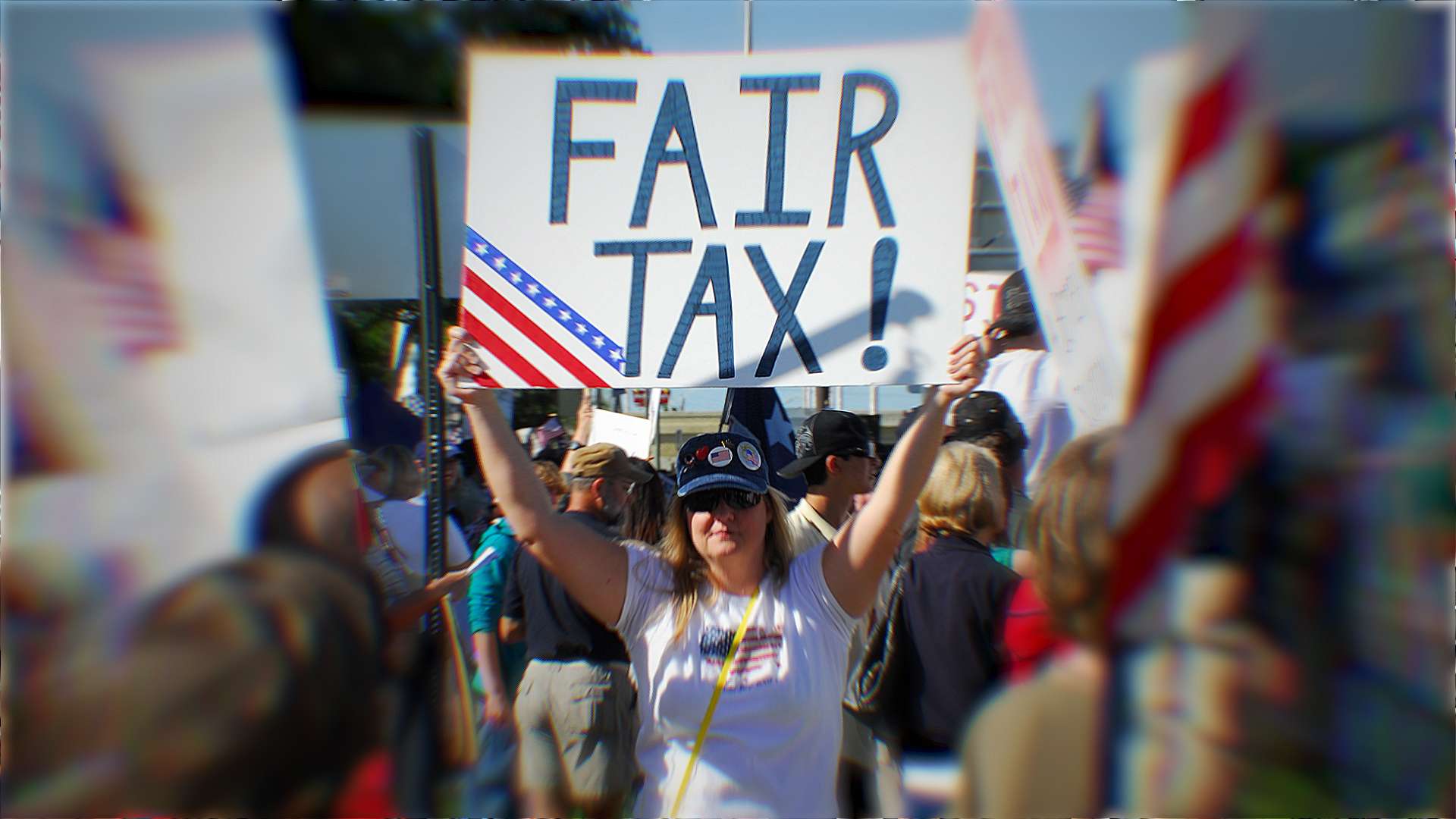
FAIR TAXATION IS ESSENTIAL FOR DEMOCRACY Part 3

Democracy requires fair taxation. The current U.S. tax system is unfair. Given the huge inequalities in wealth, wealth and transfers of it need to be taxed directly. Wealth taxes are essential to re-establishing a fair tax system and reducing economic inequality.

Democracy requires fair taxation. The current U.S. tax system is unfair. Given the huge inequalities in wealth, wealth and transfers of it need to be taxed directly. Wealth taxes are essential to re-establishing a fair tax system and reducing economic inequality.

(Note: If you find a post too long to read, please just skim the bolded portions. Thanks for reading my blog!)

(Note: Please follow me and get notices of my blog posts on Bluesky at: @jalippitt.bsky.social. Thanks!)

Democracy requires fair taxation. The current U.S. tax system is unfair. My previous post focused on increasing the progressivity of individual and business income tax rates as one essential piece of re-establishing a fair tax system and reducing economic inequality. This post focuses on taxing wealth.

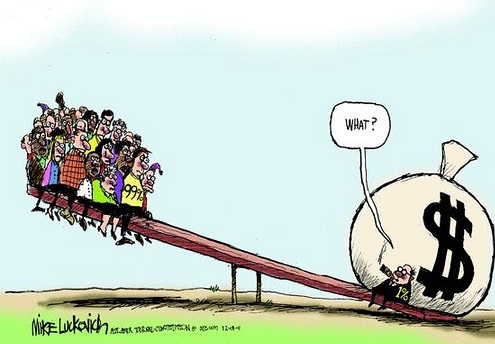
Wealth inequality has grown even more dramatically than income inequality. U.S. billionaires’ wealth has doubled since 2019. [1] Wealth inequality is so great that the only way to reduce it is to tax wealth and transfers of it directly. To re-establish a fair tax system and reduce economic inequality, we must: [2]

  • Tax existing wealth to slow and ultimately reverse the huge growth in wealth inequality and because the wealthy can (and do) maintain their extravagant lifestyles without having income. They borrow money and use their wealth as collateral for the loans. Therefore, they pay little or no income tax.
  • Tax increases in wealth even if assets aren’t sold. These increases in wealth are effectively income even when not sold.
  • Tax the intergenerational transfer of wealth because otherwise America will have a perpetual class of reigning, oligarchic families.
  • Give the Internal Revenue Service (IRS) the resources to enforce U.S. tax laws and dramatically reduce the hundreds of billions of dollars a year of tax dodging by wealthy individuals and businesses, i.e., not paying the taxes they legally owe.

A wealth tax makes sense and is fair because, among other reasons, the main source of wealth for the middle class – their home – has a wealth tax on it, i.e., the property tax. Therefore, taxing other forms of wealth that the wealthy own is fair and reasonable. There are many proposals on the table to tax wealth at the state and local levels, [3] as well as at the federal level. At the federal level, the Billionaires Income Tax Act would tax the increase in value of assets (e.g., stocks) even if they aren’t sold. There are also two different wealth tax proposals, one from Senator Warren (D-MA) and Representative Jayapal (D-WA), the Ultra-Millionaire Tax Act, and another from Senator Sanders (I-VT) and Representative Khanna (D-CA), the Make Billionaires Pay Their Fair Share Act. There is also the Working Americans’ Tax Cut Act that would shift some of the income tax burden from low- and moderate-income households to those with incomes of over $1 million.

In California, a one-time 5% wealth tax on billionaires is being proposed. Bob Reich explains why this makes sense in this 3-minute video. California’s 200 billionaires would pay $100 million a year for the next 5 years. This would allow the state government to provide health and food assistance benefits to millions of residents who would otherwise lose them due to federal funding cuts.

Current federal laws allow wealthy parents to pass their wealth on to their children with little or no tax being paid, including on assets that have increased in value while the parents owned them. At least 90 billionaires died over the last ten years and left their beneficiaries a total of $455 billion. Roughly $250 billion of that was increases in the value of assets during the time the deceased person held them (e.g., stock in a corporation). There was no capital gains tax paid on that $250 billion because current laws allow it to be transferred at its current value; this is the so-called “stepped up basis” tax loophole. This loophole should be repealed.

The estate tax has been cut in recent years and should be increased to decrease economic inequality, increase fairness, and curb the perpetuation of an oligarchic class in American society. The For the 99.5% Act proposed by Senator Sanders (I-VT) and Representative Gomez (D-CA) would reduce the size of an estate that is exempt from taxation from $30 million per couple to $7 million. It would also apply progressive tax rates based on the size of an estate (as opposed to the current flat rate of 40%). [4]

The IRS has been attacked and vilified by Republicans and the oligarchs for decades, presumably because they and their supporters don’t want to pay taxes, including by dodging taxes they owe. They’ve cut its funding and therefore its staffing, particularly for enforcement, leaving hundreds of billions of dollars owed by wealthy individuals and companies uncollected each year. President Biden and Democrats in Congress provided $80 billion in additional funding to the IRS to address understaffing and weak enforcement. For every dollar spent auditing the wealthy, the government recovered $26.

As soon as the Republicans and Trump returned to power, they began cutting tens of billions from the IRS’s funding and reducing its staffing. In 2025, about 22,000 employees left the IRS, about one-quarter of its workforce. Seven former IRS Commissioners, going back to President Reagan, co-wrote an opinion piece in the New York Times in February criticizing the cuts to funding and staffing at the IRS. [5] The IRS workers’ union, the National Treasury Employees Union, pushed back against some of the Trump administration’s cuts. So, in February 2026, the Trump administration terminated the union’s collective bargaining agreement.

To better serve taxpayers, the IRS introduced Direct File in 2024, which enabled many taxpayers to file simplified income tax returns for free – saving taxpayers an estimated $23 billion a year in tax preparation costs. Nearly 300,000 taxpayers used it in 2025. However, tax preparation and software companies have long opposed it because it reduces the demand for their services. So, the Trump administration has terminated it. In addition to its lobbying, the tax preparation industry’s opposition included, for example, Intuit, the parent company of Turbo Tax, donating $1 million to Trump.

I encourage you to contact your state and local elected officials, as well as your U.S. Representative and Senators, to ask them to support a fairer tax system that taxes wealth and transfers of it. Also ask your members of Congress to support funding for the IRS so it can enforce our tax laws. You can find contact information for your US Representative at http://www.house.gov/representatives/find/ and for your US Senators at http://www.senate.gov/general/contact_information/senators_cfm.cfm.
For lots of good news, see Jess Craven’s Chop Wood Carry Water blog’s most recent good news Sunday post here.


[1]      Collins, C., 4/5/26, “Tax the rich across the land!” Common Dreams (https://www.commondreams.org/opinion/how-to-tax-the-rich)

[2]      See this previous post on reducing economic inequality, which includes information on tax reforms proposed by the Economic Policy Institute and in the Money Agenda proposed by a group called Patriotic Millionaires.

[3]      Meyerson, H., 3/12/26, “Democrats get serious about taxing the rich,” The American Prospect (https://prospect.org/2026/03/12/democrats-get-serious-taxing-rich/)

[4]      Conley, J., 12/13/24, “Why can’t we fund universal public goods? Blame the tax-dodging billionaire nepo babies,” Common Dreams (https://www.commondreams.org/news/what-billionaires-avoid-taxes)

[5]      Sorapuru, J. E. J., 4/8/26, “Smaller IRS still pressured by Trump,” The Boston Globe

FAIR TAXATION IS ESSENTIAL FOR DEMOCRACY Part 2

Democracy requires fair taxation. The current U.S. tax system is unfair. Increased progressivity of individual and business income tax rates, especially on income from wealth (versus work), is one essential piece of re-establishing a fair tax system and reducing economic inequality.

(Note: If you find a post too long to read, please just skim the bolded portions. Thanks for reading my blog!)

(Note: Please follow me and get notices of my blog posts on Bluesky at: @jalippitt.bsky.social. Thanks!)

The American democracy described in the Declaration of Independence and further detailed in the  preamble to the Constitution requires fair taxation linked to meaningful representation to produce a government of, by, and for the people. (See this previous post for more detail.)

Fair taxation requires individuals and businesses to pay their fair share. The current U.S. tax system is unfair based on common sense,an historical perspective, and the current experiences of everyday Americans. It has allowed wealth and income inequality to grow dramatically in the last 45 years, both among individuals and among businesses. To re-establish a fair tax system and reduce economic inequality, the U.S. must: [1]

  • Increase the progressivity of individual and business income tax rates, especially on income from wealth (versus work), such as interest, dividends, and capital gains on the sale of assets that have appreciated (i.e., increased in value).
  • Tax increases in wealth even if assets are not sold. These increases in wealth are effectively income even when the assets are not sold.
  • Tax existing wealth to slow or reverse the huge growth in wealth inequality and because the wealthy can (and do) maintain their extravagant lifestyles without having income by borrowing money and using their wealth as collateral for the loans. U.S. billionaires’ wealth has doubled since 2019 and in 2024 alone, the 19 richest billionaires added one trillion dollars to their wealth, an average of over $50 billion each. [2]
  • Tax intergenerational transfers of wealth because otherwise America will have a class of reigning, perpetual oligarch families.
  • Close loopholes in tax laws to prevent tax avoidance by wealthy individuals and corporations.
  • Establish an international tax system to prevent tax avoidance by wealthy individuals and corporations through the shifting of wealth and income streams to low-tax countries. [3] [4]
  • Give the Internal Revenue Service (IRS) the resources to enforce U.S. tax laws and dramatically reduce the hundreds of billions of dollars a year of tax dodging by wealthy individuals and businesses when they do not pay the taxes they legally owe.

Progressive income tax rates are fair (i.e., percentage tax rates that increase with increases in income) because the value of $1,000 of additional income to a millionaire is far less than it is to someone with a $50,000 or $100,000 income. Or from the perspective of taxes, a tax of $100 (10%) on that $1,000 of additional income has much less impact on the millionaire than the lower income individual.

What tax rates are fair across the income range is, of course, a matter of judgment. However, for a starting point, a relatively small increase in the top marginal personal income tax rate (i.e., the tax rate on the last dollar of income) back to its pre-2017 level (i.e., from 37% to 39.6%) would generate revenue of over $30 billion a year for the government to use to deliver public goods that people need or want. (Note: In 1980, the top rate was 70% and it was over 90% in the 1950s and the wealthy and the economy, nonetheless, did quite well.)

Returning the tax rate on large corporations to 35% (where it was before the 2017 Republican Tax Cut Act reduced it to 21%) would make sense, be fair, and generate over $250 billion a year in revenue for the government.

I encourage you to contact your state and local elected officials, as well as your U.S. Representative and Senators, and ask them to support enacting a fairer tax system with progressive income tax rates for wealthy individuals and businesses. You can find contact information for your US Representative at http://www.house.gov/representatives/find/ and for your US Senators at http://www.senate.gov/general/contact_information/senators_cfm.cfm.
For lots of good news, see Jess Craven’s Chop Wood Carry Water blog’s most recent good news Sunday post here.

My next post will discuss taxing wealth and the intergenerational transfer of it. It will also discuss the IRS and its role in enforcing a fair tax system.


[1]      See this previous post on reducing economic inequality, which includes information on tax reforms proposed by the Economic Policy Institute and in the Money Agenda of a group called Patriotic Millionaires.

[2]      Collins, C., 4/5/26, “Tax the rich across the land!” Common Dreams (https://www.commondreams.org/opinion/how-to-tax-the-rich)

[3]      Johnson, J., 11/19/24, “Tax dodging by super-rich, big corporations costs nations half a trillion per year: Study,” Common Dreams (https://www.commondreams.org/news/global-tax-dodging)

[4]      Conley, J., 11/19/24, “G20 leaders reach ‘landmark commitment’ for global tax on ultrarich,” Common Dreams (https://www.commondreams.org/news/global-wealth-tax-2669945403)

FAIR TAXATION IS ESSENTIAL FOR DEMOCRACY

Democracy requires a government that fosters people’s freedom. Its resources must come from fair taxation. Oligarchs cut taxes and undermine democracy to consolidate their power. Economic inequality has bred discontent and distrust of government and democracy, an opening for authoritarianism.

Democracy requires a government that fosters people’s freedom based on their experiencing safety, economic security, liberty, and happiness. To do these things, it must have the resources that come from taxation. The taxes must be perceived as fair and government perceived as reasonably efficient at fulfilling its role. High and growing economic inequality has bred discontent and distrust of government – and of democracy. This has opened the door for demagogues and acceptance of authoritarianism.

(Note: If you find a post too long to read, please just skim the bolded portions. Thanks for reading my blog!)

(Note: Please follow me and get notices of my blog posts on Bluesky at: @jalippitt.bsky.social. Thanks!)

The American democracy, as announced in the Declaration of Independence, would ensure the right of the people to “Life, Liberty and the pursuit of Happiness.” The government it envisioned would “effect their Safety and Happiness.” The preamble to the Constitution expands on these principles and states that “We the People [are forming a government to] establish Justice, insure domestic Tranquility, provide for the common defence, promote the general Welfare, and secure the Blessings of Liberty.”

For a government to do these things, it must have the necessary resources. Taxes are what provide government with its resources to honor these principles and achieve these goals. They are the life blood of a democratic government of, by, and for the people. As Deval Patrick, former Governor of Massachusetts put it, “Taxes are the dues we pay to live in a civilized society.”

Historian Heather Cox Richardson had a 42-minute conversation with Dr. Vanessa Williamson of the Brookings Institution about the relationship between taxes and democracy, based on Williamson’s 2025 book, The Price of Democracy: The Revolutionary Power of Taxation in American History. I strongly encourage you to listen to all or part of it, however, I’ll share a summary of and commentary on this conversation here. (Williamson gives a 1-minute summary of the relationship between taxes and democracy at the Patriotic Millionaires conference Money. Message. Millionaires.)

American history indicates that the people are willing to pay taxes if they are perceived to be fair and the government is fostering their freedom based on their experiencing safety, economic security (aka general welfare), liberty (aka justice under the rule of law), and happiness.

The public wants government to do and provide things often referred to as public goods that include schools, roads, law and order, clean air and water, national parks, and a safety net for when things in life go wrong. These things allow people the freedom to pursue their dreams and achieve their goals. The effectiveness of governments and, therefore, their support by the people, comes from their ability to act and get things done. Revenues from taxes are, of course, essential to giving governments the capacity and power to act and deliver these public goods.

It’s important that taxes be perceived as fair and government perceived as reasonably efficient at fulfilling its role. That way the people feel they’re getting a fair return on their investment. The American Revolution occurred, in part, because of taxation without representation and the perception that the government wasn’t delivering what the people wanted. However, the Boston Tea Party was actually a protest over the King giving the East India Tea Company, a huge corporation in its day, a monopoly on the sale of tea in the colonies.

Paying taxes means that taxpayers have a personal stake in their government (aka skin in the game) and, therefore, in participating in democracy, in elections, and with their representatives in government. It’s everyone’s civic duty to make their contribution to democracy by paying their fair share of taxes and being engaged to have their say in the governing process. When governments are capable of and accountable for acting in the interests of the people (aka for the public good), this reinforces democracy and the connection between taxation and representation.

In the 1980s, the Republicans, President Reagan, and the American oligarchy (although we didn’t call them that at the time) promoted efforts to undermine the relationship among taxation, representation, and democracy. They pushed the notion that government wasn’t efficient, that taxes were bad, and that they could cut taxes and still deliver the public goods that people wanted. Basically, they promised a free lunch. They claimed their tax cuts, which disproportionately benefited wealthy individuals and corporations, would “trickle down” to everyone because the economy would boom. Actual experience, with multiple tax cuts over the last 45 years, has definitively shown that this does not happen. The results of their individual and corporate tax cuts have been sharply growing economic inequality and huge, monopolistic corporations.

High and growing economic inequality, along with the loss of economic security and upward mobility for working Americans, has bred discontent and distrust of government – and of democracy. This has opened the door for demagogues and acceptance of authoritarianism.

Throughout American history, oligarchs, from southern plantation owners to the robber barons to today’s corporate executives and investors (including private equity financiers), have worked to cut taxes and undermine a fair tax system. Not only does this make them wealthier, but it also undermines the power of government and democracy to stand up for the people and constrain the oligarchs’ power. If the government can’t and doesn’t deliver the public goods the public wants, the people won’t support it. Oligarchs want to shrink government, make it ineffective, and as one of them said, make it small enough to drown in a bathtub by starving it of the tax revenue it needs to get things done for the people. This undermines support for the government and faith in democracy, creating a reinforcing destructive cycle for government of, by, and for the people while cementing the oligarchs’ power.

Oligarchs want their power to be uncontested and unconstrained. They don’t want to be subject to government regulations or even the rule of law. They want to undermine the voice and representation of the people, as well as their faith in government and democracy. In addition to undermining a fair tax system, they use their wealth to effectively buy politicians and government policies. And they work to undermine voting and faith in elections.

My next post will discuss what a fair tax system would look like and what it will take to get there.

For lots of good news, see Jess Craven’s Chop Wood Carry Water blog’s most recent good news Sunday post here.