
The huge, billionaire-owned news and media companies are not providing voters with the balanced, factual information needed for a well-functioning democracy. I urge you to abandon these biased, corporate news sources, or, at the least, complement them with independent, typically viewer / reader supported, non-profit sources, such as those listed below.
(Note: If you find a post too long to read, please just skim the bolded portions. Thanks for reading my blog!)
(Note: Please follow me and get notices of my blog posts on Bluesky at: @jalippitt.bsky.social. Thanks!)
The huge, billionaire-owned news and media companies are not providing voters with the balanced, factual information they need to maintain a well-functioning democracy. In particular, they are not reporting on Trump, his administration, and his allies in a way that provides accurate, important information and context. In large part this reflects the bias of their owners toward conservative or right-wing, capitalist points of view. Can you imagine their reporting if President Biden had fallen asleep in cabinet meetings? Or had had an MRI and wouldn’t reveal what was scanned or why? Or once misspoke or blatantly lied as Trump does multiple times in every speech he gives?
My previous post identified seven ways to compensate for or correct this bias in the mainstream media, two that are things we can do as individuals, while the other five require institutional action.
The first individual step, which we all can and should take, is to patronize independent, reader / viewer funded news media. Your time spent reading / viewing them, your subscriptions to them, and, if you can, your financial support of them boosts their viability. Furthermore, share their content; comment on and like their reporting.
There’s so much information and so many sources of it that it’s overwhelming. Skimming is definitely required; only read, watch, or listen to pieces that particularly interest you or that are truly important. Keep in mind that a lot of the “news” from Trump and his administration is insignificant; it’s meant to divert attention and to confuse and overwhelm the media and all of us.
Here are some suggestions. First, do pay attention to (i.e., skim and read selectively) your local and state news. They are important and the foundation of democracy and grassroots activism.
- Pick a local news source or two in your community to follow (assuming they exist).
- Pick a state or regional news source or two to follow. For me, that’s the Boston Globe.
For national political news, analysis, and commentary (which is my focus), pick a couple of sources to follow (i.e., skim and read / watch selectively) from the options below or others. For visual news and information, here are three recommendations:
- Watch or listen to your local PBS TV and/or radio station.
- Watch the short videos (typically 4 – 6 minutes) from Robert Raich at Inequality Media. They are informative, yet entertaining and easy to understand, They cover current news and explanations of how our economy and democracy work or should work.
- Watch or listen to Democracy NOW! programming on your TV, radio, computer, or other device. It airs an hour long current international news program recorded each weekday at 8 a.m. Eastern Time. It is available on the Internet, via its website, and on more than 1,400 radio and television stations. It combines worldwide news, investigative journalism, and progressive political commentary.
If you like text (to read or skim) here are some recommendations:
- Robert Hubbell publishes a daily online newsletter, Today’s Edition Newsletter, that covers current political news, providing analysis and commentary, particularly from a legal perspective. He is upbeat and optimistic. He includes specific opportunities to take grassroots action to fight for our democracy. You can also listen to the newsletter as a podcast.
- Heather Cox Richardson publishes a daily online newsletter, Letters from an American, that covers current political events and provides analysis and context, and often a historical perspective.
- Common Dreams distributes daily or weekly emails with summaries of and links to its relatively short articles covering current political news that is often underreported by the mainstream media.
- Robert Reich publishes a daily online newsletter that provides analysis of and commentary on current political events and policies. He identifies policies that have led to our current situation and ones that would remedy it.
- Mother Jones provides broad reporting, including progressive political commentary and investigative journalism. It’s available in print (every two months), online, and via videos, e-newsletters, and podcasts.
- The Nation covers politics and culture with a progressive bent both online and in print (monthly). It has a variety of focused email newsletters one can sign up for as well as podcasts.
- The American Prospect magazine (every 2 months) and website is the best and most comprehensive source for progressive policy analysis and proposals, in my humble opinion. It also has a variety of e-newsletters one can sign up for.
- ProPublica does incredible and impactful investigative journalism with great depth and breadth, including national, regional, and local investigations. Its products are available online. It has e-newsletters one can sign up for. It also maintains a searchable database of the annual returns filed by non-profit organizations.
- Chop Wood, Carry Water, Jess Craven’s daily blog on politics, includes messages to deliver to your members of Congress. She posts every Sunday a good news post that’s a very welcome source of hope and encouragement in these dark times.
Other sources that I use on occasion include the Economic Policy Institute, the Center on Budget and Policy Priorities, the Brennan Center for Justice, Open Secrets (on money in elections), The Guardian (which includes international news), and The Atlantic. A longer list by topic is available here from Project Censored. (Note: Project Censored’s primary goal is to highlight stories un- or under-reported by the mainstream media, i.e., effectively censored by them.)
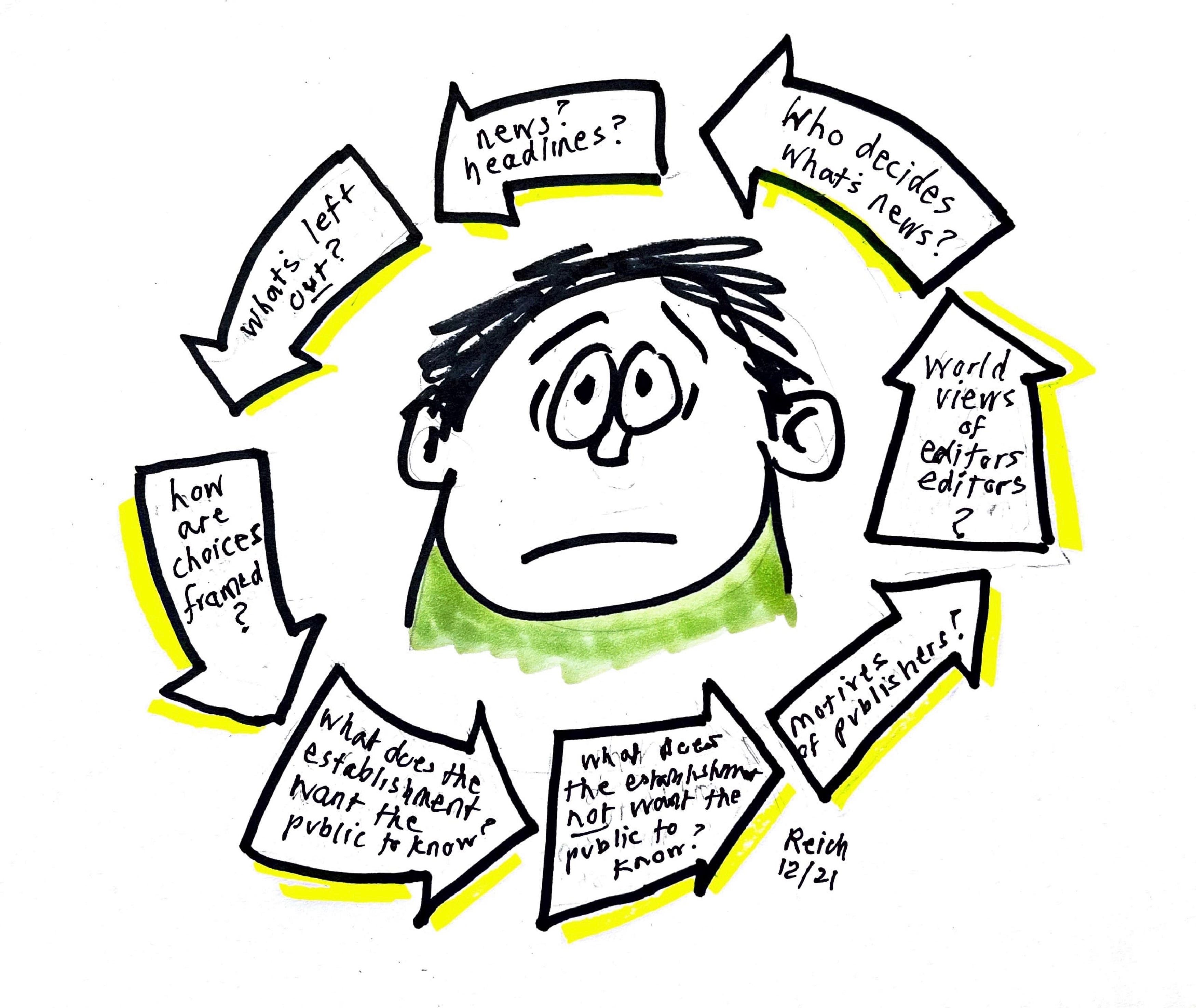
Huge billionaire-owned news and media companies are dangerous, harmful, and biased. They control and skew the information we receive and not infrequently deliver disinformation. They are not providing voters with the balanced, factual information they need to maintain a well-functioning democracy.
I urge you to abandon the biased, corporate news sources, or, at the least, complement them with independent, typically viewer / reader supported, non-profit sources. There are plenty of options for good news and information that better serve voters in a democracy.
 Lippitt's Policy and Politics Blog