
The U.S. affordability crisis is multifaceted and has been growing for 45 years, caused by low pay and high prices. There are many strategies for tackling the affordability crisis, some are presented below. However, many (most?) of the Trump administration’s policies are exacerbating the crisis. Therefore, one longer-term strategy for tackling affordability would be to participate in a No Kings rally (pro-democracy and anti-Trump) on Sat., March 28. Find an event near you here.
(Note: If you find a post too long to read, please just skim the bolded portions. Thanks for reading my blog!)
(Note: Please follow me and get notices of my blog posts on Bluesky at: @jalippitt.bsky.social. Thanks!)
The U.S. affordability crisis is multifaceted and caused by low pay and high prices. (Previous posts have discussed the factors leading to low pay and the reasons for high prices.) This post will discuss short-term strategies for increasing low pay. Many of these strategies would benefit from or require changes in federal laws or enforcement to be most effective. This probably won’t happen until Democrats take control of Congress and the presidency.
Here are some short-term strategies for increasing low pay that can be undertaken at the state and local levels now. [1] Every politician, at every level, local, state, and federal, who’s serious about addressing the affordability crisis should embrace these strategies. The first five should be core policies of the Democratic Party and every Democrat.
- Reduce wage theft. Every year, over $15 billion is stolen from U.S. workers by employers who don’t pay the minimum wage, don’t pay required overtime pay, or don’t pay for all hours worked, as well as by ones who steal workers’ tips or don’t give workers their final paycheck. States can reduce wage theft through better enforcement of existing laws and strengthening laws, including by increasing penalties for violations. [2]
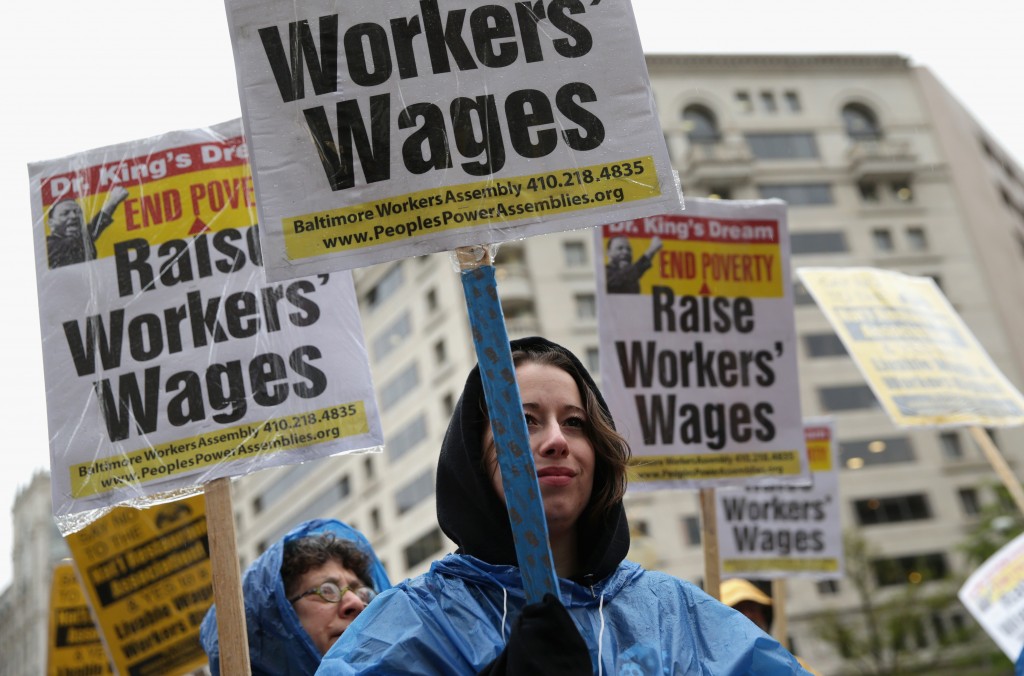
- Raise the minimum wage. The federal minimum wage is only $7.25 an hour. If it had kept pace with workers’ increased productivity since the late 1960s, it would be over $24 an hour. The highest minimum wage in the U.S. is in Tukwila, WA, where it is $20.29. In D.C., it’s $17, while in Washington State it’s $16.28, $16 in California and $15 in Massachusetts. State and local governments can and should increase their minimum wages now.
- Enact family friendly policies. Subsidies for child care are provided by the federal government and several states but typically fall well short of making child care affordable for many low- and moderate-income families. Some states and Mamdani in New York City are working to make child care free or at least affordable for all families. These policies have substantial economic benefits as they allow parents to remain in the workforce.
Paid family leave for the birth of a child exists in thirteen states and D.C., although not at the federal level. The U.S. is one of less than half a dozen countries in the world – and the only wealthy one – that does not have paid family leave.
Many wealthy countries provide a family allowance (i.e., cash benefits) for each child in a family. Proposals have been put forward in the U.S. for a $5,000 per year per child allowance. This could be achieved by increasing the child tax credit and making it fully refundable (i.e., a family who owes less in taxes than the amount of the credit would get a cash payment).
- Strengthen unions and union organizing. Labor laws and enforcement of them need to be changed to make it easier to form a union and to require employers to sign a contract with unionized workers within a set time limit (e.g., 90 days) or to go to compulsory arbitration. Penalties on employers for violations of labor laws must be swift and significant. Much of this needs to happen at the federal level but states can act too. There’s strong support for unions among the public; they receive 70% approval ratings in polls.
- Reform our tax systems. This is something that needs to happen at the federal level, but also at the state and local levels. Income taxes on wealthy individuals and businesses, particularly multi-national corporations, need to be increased. They have been declining for decades and dramatically so in President Trump’s two terms. Incomes should be taxed in a progressive manner (i.e., higher tax rates for higher incomes). Furthermore, there is no reason income made through gains on the sale of assets (i.e., capital gains) should be taxed at a lower rate than income earned from work, as is the case today. This is a tax break for the wealthy that was probably never fair and is inexcusable given the current economic inequalities and the affordability crisis for low- and middle-income households.
Wealth (not just income) needs to be taxed, including increases in wealth, which are functionally income even if assets are not sold. Inheritances and transfers of appreciated assets (which currently avoid any tax on their increased value) should be taxed. The most common form of middle-class wealth – a home – has what is effectively a wealth tax – the property tax. So, it only seems fair that other forms of wealth, held primarily by the wealthy, should also have a wealth tax.
Corporate income tax rates should be restored to pre-Trump levels at a minimum, and additional steps should be taken to counter multi-national entities’ sheltering of income offshore in low-tax jurisdictions. Stock buybacks should be banned as they were prior to 1980 as illegal manipulation of a stock’s price.
State and local governments can and should reform their tax laws now. For example, California is considering a wealth tax. In NYC, Mayor Mamdani has proposed a 2% surtax on individuals with incomes over $1 million and an increase in corporate income taxes. Massachusetts voters passed a 4% surtax on income over $1 million in 2022. It’s generating over $2 billion a year for education and transportation spending and, contrary to the scare tactics of opponents, millionaires are NOT moving out of the state. Nonetheless, the 5% of households with the highest incomes still pay a lower percentage of income in all state and local taxes in MA than the other 95% of households – 8% versus 10%.
- Ban non-compete and mandatory arbitration clauses in employment contracts so workers aren’t prevented from moving to better paying jobs and/or jobs they would prefer. This can be done at the state and local levels, as well as at the national level.
- Clarify the standard for who is considered an employee and increase penalties for misclassifying and mistreating workers as contractors rather than employees. This can be done at the state and local levels, as well as at the national level.
I encourage you to contact your state and local elected officials to ask them to increase the low pay of many workers by reducing wage theft, increasing the minimum wage, supporting unions, making the tax system fairer, and enacting or enhancing child care subsidies and paid family leave.
For lots of good news, see Jess Craven’s Chop Wood Carry Water blog’s most recent good news Sunday post here.
My next post will discuss additional strategies for tackling the affordability crisis.
[1] Meyerson, H., 12/3/25, “The $79 trillion heist,” The American Prospect (https://prospect.org/2025/12/03/79-trillion-heist-worker-pay/)
[2] National Institute for Workers’ Rights, retrieved from the Internet on 3/7/26, “Wage theft: Employers stealing workers’ wages,” (https://niwr.org/state-policy-clearinghouse/spc-wage-theft/)


 Lippitt's Policy and Politics Blog