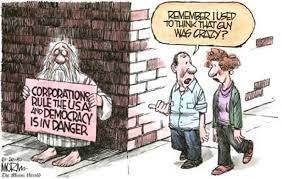
CORPORATE AMERICA IS WRECKING CAPITALISM

SUMMARY: The Trump regime has cut a corrupt deal with corporate America, which most of the corporate elites have readily gone along with despite its corruption and undermining of democracy. This is what oligarchy and fascism are all about. Everyday citizens pay financially and with their freedom as these corrupt government and business people get richer and richer, as well as more and more powerful. Recently, Gerard Baker, editor-at-large (and former editor-in-chief) of The Wall Street Journal wrote two columns that make a powerful statement about the damage America’s corporate elites and their style of capitalism have done.

(Note: If you find a post too long to read, please just skim the bolded portions. Thanks for reading my blog!)

(Note: Please follow me and see my blog posts on Bluesky at: @jalippitt.bsky.social. Thanks!)

The Trump regime has cut a corrupt deal with corporate America, which the corporate elites have all too readily been happy to accept. It is based on greed and corruption by both these parties: the government will let the corporations and their executives do whatever they want to grow their profits and wealth as long as they pay homage to Trump and his regime verbally and financially. That everyday Americans will suffer from unaffordable costs of daily living and from poor pay and working conditions does not concern either of these parties.

What’s surprising is that so few members of the corporate elite have been willing to call out the corruption and the undermining of democracy. A group calling themselves Patriotic Millionaires has been highlighting the harm of the high and growing levels of economic inequality for some time. They have been promoting policy solutions through changes in tax and employee pay laws. Patriotic Millionaires has proposed “The Money Agenda,” a set of policies that would reduce economic inequality and “permanently stabilize the economic lives of working people, stimulate wide-spread economic growth, and ensure prosperity and stability.” (See this previous post for more details.)

Recently, Gerard Baker, editor-at-large (and former editor-in-chief) of The Wall Street Journal (WSJ) wrote two columns that make a powerful statement about what America’s corporate elites and their current style of capitalism have done wrong. I don’t imagine that I have to tell you that the WSJ and Baker previously have been stanch proponents and, when necessary, defenders of American capitalism. Baker’s recent columns in the WSJ (paywall) are titled How to Cure What Ails American Capitalism (8/17/26) and Socialism Is the Wrong Answer, but the Questions Are Real (8/10/26). Robert Reich provides a nice summary of Baker’s points in this blog post.

Baker writes that, “The widespread popular dissatisfaction with the working of modern American capitalism may be the product of some real, objective problems in the way American capitalism is working.” The problems he notes include the high level of economic inequality, the unaffordability of daily life for many, and the corruption and lack of accountability of the political and corporate elites. He points out that this is harming social solidarity and leading to demands for a radical replacement of American capitalism.

Baker further writes that, “Most of the causes of America’s economic dysfunction are the result of a capitalism that has mutated into a system run by and for large corporate interests.” The dysfunction he highlights includes oligopoly-level concentration in almost every business sector; regulation, legislation, and policy that benefit big companies; and a privatized healthcare system that operates to generate profits for providers, insurers, and pharmaceutical companies while producing poor outcomes for patients and very high costs. He states that the overall result is a concentration of “market, economic and political power by a business-political class that promotes its own well-being at the expense of competition, the market and ultimately the people.”

The fact that this is coming from a career-long proponent and advocate for American capitalism is striking and underscores how poorly capitalism is working. It also highlights how shocking it is that other supposed leaders in corporate America aren’t standing up both to call this out and to support remedies – not to mention speaking out against the corruption and undermining of democracy.

The current Trump regime and its allies among the corporate elite are what oligarchy and fascism are all about. There’s a corrupt deal among government and business people that “I’ll scratch your back if you scratch mine.” Everyday citizens pay financially and with their freedom as these corrupt government and business people get richer and richer, as well as more and more powerful.

Some of the remedies are clear but obviously require a seismic change in our elected officials:

  • Strong enforcement of antitrust laws (as the Biden administration started to do for the first time in 40 years). American capitalism has gone so far down the road of eliminating actual market place competition by allowing monopolies and oligopolies that remediation will requiring breaking up some (if not many) of the huge corporations that have been created.
  • Strong worker protection laws and agencies, including support for unions and unionization.
  • Strong consumer protection laws and agencies for all consumer goods and services, especially financial services.
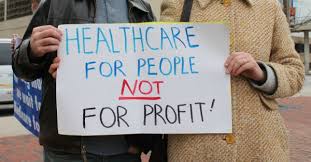
  • A total revamping of our health care system to remove the corrupting profit motive that puts profits before patients. A single payer Medicare for All system is the remedy, like what every other peer country has.
  • Dramatic reform of the American campaign finance system to prevent wealthy individuals and corporations from effectively buying elected officials and policies. Matching public funds for small campaign contributions from people within a candidate’s district, tied to strict limits on other campaign funding, are the most immediate solution in the context of the Citizens United and related Supreme Court decisions. New York City and State and numerous other jurisdictions have such systems in place and they’ve produced very positive results. (See previous posts here and here for more information.)

For lots of good news see Jess Craven’s Chop Wood Carry Water blog’s most recent good news Sunday post here.

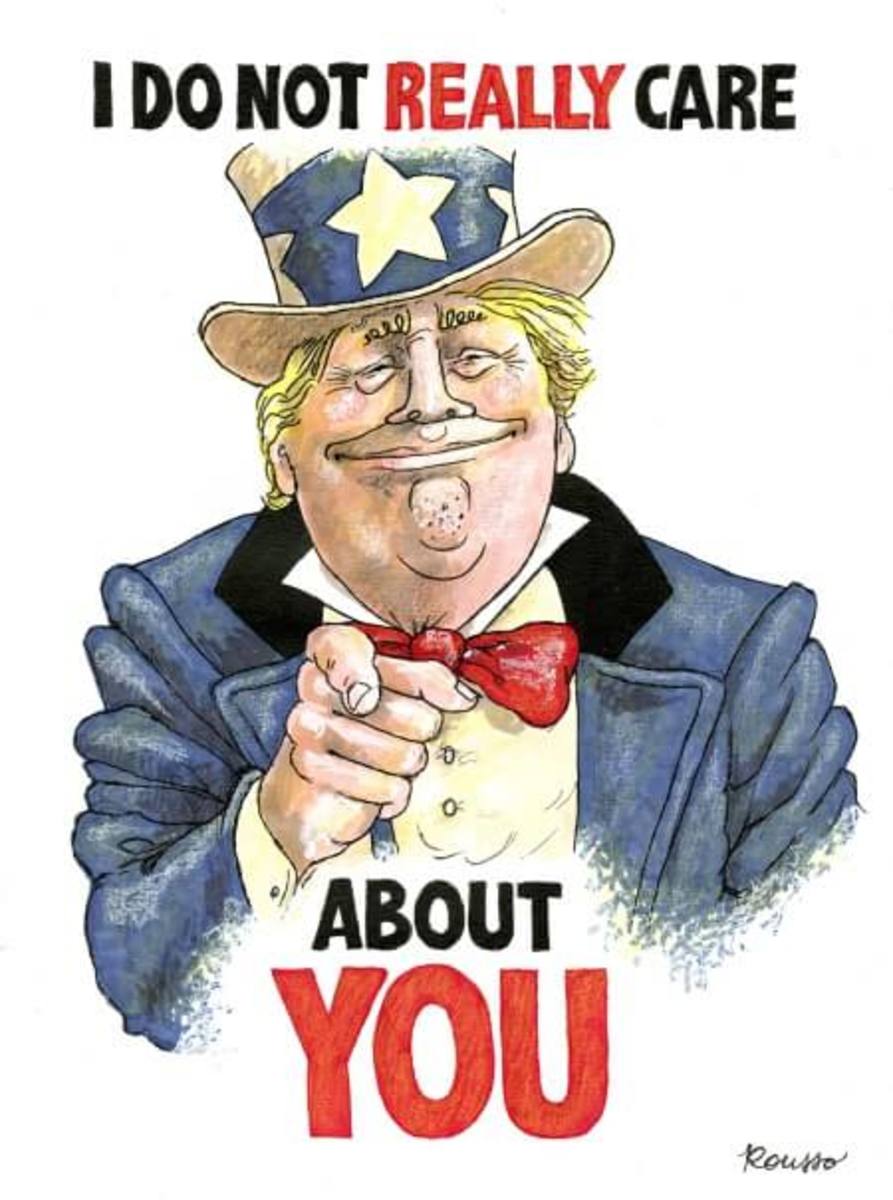
TRUMP AND HIS REGIME DON’T CARE ABOUT YOU

SUMMARY: President Trump and his regime don’t care about you and aren’t protecting your health, safety, or financial security. Here are some examples of actions they have taken that put you at risk.

(Note: If you find a post too long to read, please just skim the bolded portions. Thanks for reading my blog!)

(Note: Please follow me and see my blog posts on Bluesky at: @jalippitt.bsky.social. Thanks!)

Trump and his regime don’t care about you, your health or safety, or protecting you from financial fraud and crime. They demonstrate this in many ways. Here are some examples.

The Trump regime is NOT protecting you from financial fraud and abuse. Since its first days in office, it’s been weakening the Consumer Financial Protection Bureau (CFPB). Most recently, the Trump-controlled CFPB announced it would no longer make consumer complaints public. Failure to make complaints public will protect financial companies from scrutiny and transparency, hiding corporate misconduct from the public. It removes the incentive companies have to avoid, fix, and respond to problems that comes with public awareness and publicity. Furthermore, the CFPB recently purged its backlog of complaints and canceled a policy requiring refunds to consumers who had been overcharged. [1]

Consumer complaints filed with the CFPB have doubled in 2025 to 6.6 million (from 3.2 million in 2024). Since 2011, the CFPB has received and made public more than seventeen million complaints. Nearly six million consumers have received some form of relief in response to their CFPB complaints over its 16 years of operation. The CFPB has gotten consumers over $20 billion in compensation based on complaints involving loans, bank accounts, credit reports, and other financial matters.

The Trump regime is also NOT protecting us from drug and human trafficking as well as financial fraud because it has stopped blocking the money laundering necessary for these criminal enterprises. It has terminated the shell company [2] registry of the Financial Crimes Enforcement Network (FinCEN) in the Treasury Department. Congress created the registry in 2021 through the Corporate Transparency Act (CTA). It was a response to the reporting of investigative journalists who documented that between 1999 and 2017 U.S. banks had processed more than $2 trillion in potentially laundered money for criminals using shell companies and operating out of Russia, China, Iran, and Syria. At the time, Senator Rubio, now Trump’s Secretary of State, called the CTA “the most significant anti-corruption and money laundering law in decades.” [3]

To combat this extensive money laundering, the CTA requires every individual owning at least 25% of a shell company to register their legal name, date of birth, and residential street address; and provide an image of an official identification document with a unique identifying number. The Trump regime has now (probably illegally) stopped enforcing this law. [4] The termination of the shell company registry also facilitates oligarchs’ ability to hide their money and avoid taxes. Trump’s Treasury Department also destroyed the registry’s data that had been previously collected.

Law enforcement, national security experts, and small business owners are alarmed. Senator Elizabeth Warren (D-MA) has called this lack of enforcement of the CTA “a gift to cartels, criminals, and U.S. adversaries.” [5]

On a different front, Trump’s Justice Department has reduced or stopped investigations and prosecutions of crimes like tax evasion, drug trafficking, and sex trafficking. The number of personnel assigned to these crimes has declined because of staffing shortages, funding cuts, and the reassignment of agents to immigration enforcement. [6]

The Trump regime is also NOT protecting your health. Measles in the U.S. is at levels not seen in many years and children have died from it. Nonetheless, Trump issued an executive order demanding states revise their recommendations for childhood vaccinations in ways that will reduce vaccinations for measles, as well as for mumps and rubella. Although the executive order does not change the Centers for Disease Control and Prevention’s recommendations or insurance coverage, it will increase confusion over and distrust of vaccinations that Trump’s Secretary of Health and Human Services Kennedy has been fomenting. This will result in more diseases, disabilities, and deaths. [7]

Foodborne illnesses in the U.S. are at very high levels. This year’s 10,500 cases to-date are almost ten times the annual rates in 2021 – 2025. A major contributor is the Trump regime’s cuts of more than 40% to food safety detection systems, including reduced funding for federal agencies to conduct food inspections and for grants to state and local health departments that track outbreaks. [8]

To add insult to injury, the Trump regime is also reducing access to health insurance and raising its cost for millions of Americans. In late June 2026, its own Department of Health and Human Services reported that at least five million people lost public health insurance in the first six months of the year, a drop of about 13%. For those remaining on public plans, premiums have spiked, more than doubling for some, while deductibles have increased by about $1,000 a person for many as they chose cheaper policies. [9]

The Trump regime announced in June plans to cancel 53 of 66 active grants from the Teen Pregnancy Prevention (TPP) program. TPP was created by bipartisan legislation in 2009 and has been credited with contributing to reducing the unwanted teen pregnancy rate by 65%. The Trump regime wants to end the comprehensive sex education of TPP programs and focus on abstinence promotion, despite evidence that abstinence only sex education is ineffective. A federal judge recently paused the regime’s attempt to put limits on the TPP grants’ sex education programs. [10]

Other examples of Trump regime actions that may hurt you:

  • Canceled the rule requiring airlines to compensate you for canceled flights (after United and Delta donated a million dollars to Trump).
  • Ended the IRS’s free tax return filing program (after the TurboTax tax return prepration software’s parent company gave a million dollars to Trump).
  • Weakened gun laws including restrictions that have been in place since 1934 on sawed-off (and therefore easily concealed) shotguns and silencers.
  • Promote cryptocurrency. But that’s a whole other story.

For lots of good news see Jess Craven’s Chop Wood Carry Water blog’s most recent good news Sunday post here.


[1]      Conley, J., 8/14/26, “In gift to abusive Wall Street firms, Trump CFPB moves to suppress consumer complaints,” Common Dreams (https://www.commondreams.org/news/cfpb-complaint-database)

[2]      Shell companies are legal entities that don’t have any physical presence or operations but are used for moving money and processing financial transactions.

[3]      Baratta, J., 8/14/26, “Trump makes crime legal,” The American Prospect (https://prospect.org/2026/08/14/trump-makes-crime-legal-corporate-transparency-act-treasury/)

[4]      Cox Richardson, H., 8/15/26, “Letters from an American blog,” (https://heathercoxrichardson.substack.com/p/august-15-2026)

[5]      Baratta, J., 8/14/26, see above

[6]      Cox Richardson, H., 8/13/26, “Letters from an American blog,” (https://heathercoxrichardson.substack.com/p/august-13-2026)

[7]      Cox Richardson, H., 8/13/26, see above

[8]      Cox Richardson, H., 8/20/26, “Letters from an American blog,” (https://heathercoxrichardson.substack.com/p/august-20-2026)

[9]      Cox Richardson, H., 8/20/26, see above

[10]     Conley, J., 8/19/26, “Federal judge blocks Trump and RFK effort to get more teens pregnant,” Common Dreams (https://www.commondreams.org/news/teen-pregnancy-programs)

PROGRESSIVES ARE WINNING ELECTIONS BY FOCUSING ON AFFORDABILITY, FAIRNESS, AND CORRUPTION

SUMMARY: Strong progressive election results are continuing. Voters are making it clear that their top issues are the unaffordability of daily life, corruption in our politics, fairness in our economy, and strong, effective opposition to the Trump regime.

(Note: If you find a post too long to read, please just skim the bolded portions. Thanks for reading my blog!)

(Note: Please follow me and see my blog posts on Bluesky at: @jalippitt.bsky.social. Thanks!)

Strong progressive election results are continuing. My earlier post noted wins by progressives in June and early July elections, and my hope that national Democrats were hearing the voters’ clear message. Many still seem too entrenched with big-money backers to hear the grassroots voices. Voters are signaling that everyday unaffordability, as well as corruption in politics and the economy, are the issues that matter most to them.

In the past two weeks, elections were held in Alabama, Connecticut, Michigan, Minnesota, Missouri, South Carolina, Vermont, and Wisconsin. Progressives won repeatedly, including in Minnesota’s U.S. Senate race, and even democratic socialists won, although the democratic socialist in Wisconsin’s governor race lost narrowly.

Incumbent House Democrats’ losses to more progressive primary challengers suggest that Democratic voters want representatives who will more aggressively confront the affordability crisis, demand fairness, and take on the Trump regime’s corruption and bad policies on the economy, the war, ICE, the climate crisis, and protections for individual rights and the rule of law. [1]

While attention was focused on Democratic primaries, Republican primaries also produced notable results. Several Trump-endorsed candidates have lost, including Mike Lindell (the MyPillow guy) in Minnesota’s governor’s race, as well as Amir Hassan in Michigan and Andy Ogles in Tennessee in U.S. House races. In South Carolina’s U.S. Senate race, Darline Graham was pushed into a runoff despite Trump’s endorsement. [2]

In Missouri, voters strongly rejected two Republican ballot initiatives. One would have eliminated the state income tax and replaced it with a higher sales tax (defeated 83% – 17%), even though supporters outspent opponents by more than two to one (with many proponent groups keeping their donors’ identities secret). This and other election results may indicate that the era of tax cuts as the supposed path to economic growth and jobs may be ending. [3] Missouri voters also rejected (80% – 20%) a GOP-backed effort to make it harder to pass initiative petitions. Both ballot questions passed in all eight Missouri congressional districts. [4]

These candidates and issues are winning, even when being outspent, because voters are no longer being fooled by messaging from a corrupt campaign financing system, including candidates’ disingenuous economic promises (e.g., tax cuts whose benefits will trickle down) that have resulted in economic inequality and the unaffordability of everyday life.

What unites these candidates is a shared focus: improving everyday life and making society fairer. They call out the greed and power of the American oligarchy and their control of the economy and policymaking. They make the case that for our private enterprise system to survive government must put a stop to huge monopolistic companies and dramatic wealth and income inequality. They argue that regulation and fair taxes are needed to curb monopolies and stop price-gouging (including by major food and gas and oil companies). They call for an end to private for-profit control of essential public services, such as healthcare, education, mail delivery, utilities, and transportation. [5]

For lots of good news see Jess Craven’s Chop Wood Carry Water blog’s most recent good news Sunday post here.


[1]      Hubbell, R. B., 8/6/26, “The polls were wrong in Michigan – by a mile! Why that matters,” Today’s Edition Newsletter (https://roberthubbell.substack.com/p/the-polls-were-wrong-in-michiganby)

[2]      Hubbell, R. B., 8/13/26, “Don’t underestimate the ability of Democratic voters to get it right,” Today’s Edition Newsletter (https://roberthubbell.substack.com/p/dont-underestimate-the-ability-of)

[3]      Cox Richardson, H., 8/5/26, “Letters from an American blog,” (https://heathercoxrichardson.substack.com/p/august-5-2026)

[4]      Hubbell, R. B., 8/5/26, “The misleading narrative of Democratic disunity,” Today’s Edition Newsletter (https://roberthubbell.substack.com/p/the-misleading-narrative-of-democratic)

[5]      Cox Richardson, H., 6/26/26, “Letters from an American blog,” (https://heathercoxrichardson.substack.com/p/june-26-2026)

ARE THE NATIONAL DEMOCRATS LISTENING?

SUMMARY: I hope the national Democrats are listening. The grassroots are yelling and voting based on the unaffordability of daily life and the corruption in our politics and economy. In recent elections across the country, progressive, grassroots candidates are beating incumbents and winning even in conservative, Republican districts. Many of these candidates are young, female, multicultural, and/or new to politics.

(Personal note: I didn’t post the last two weeks because of the combination of a scramble to get signatures to put a question on the November ballot and a ten-day visit by an out-of-town grandson.)

(Note: If you find a post too long to read, please just skim the bolded portions. Thanks for reading my blog!)

(Note: Please follow me on Bluesky at: @jalippitt.bsky.social. Thanks!)

I hope the national Democrats are listening. The people and the voters are sending a loud, clear message. I worry that many of the Democrats in Washington are too entrenched with the oligarchs who spend big money to support their campaigns to hear the grassroots voices. The grassroots are yelling and voting based on the unaffordability of daily life and the corruption in our politics and economy.

In recent elections across the country, from Maine to Florida, from New York to Ohio to Colorado and Montana, from Arizona to California to Washington State, progressive, grassroots candidates are winning. They are beating incumbents and winning even in conservative, Republican districts. [1]

These candidates are winning by calling out monopolistic, corporate America, by attacking the political corruption of big money, and by addressing the everyday problems of ordinary Americans. [2] They are advocating for:

  • Guaranteeing health care for everyone
  • Making housing and child care more affordable
  • Increasing the minimum wage and easing the path to union membership
  • Reforming the corrupt campaign finance system
  • Requiring that wealthy individuals and corporations pay their fair share in taxes
  • Addressing climate change
  • Ensuring AI benefits all of us and not just the oligarchs
  • Ending wars and bloated military spending

The majority of the American people support these policies in poll after poll – and now in election after election. The public is sick and tired of status quo politics and corrupt campaign finance and economic systems that benefit only the rich and powerful.

Many of these winning candidates are young, female, multicultural, and/or new to politics. Some of them are Democrats and some are Democratic Socialists – not that many voters know what that means or care. What unites these candidates is that they are committed to making people’s everyday lives better and our society fairer. They are calling out the greed of the American oligarchy and their control of our economy and policy making. They make the case that our private enterprise system cannot survive unless the government ends huge monopolistic companies and dramatic wealth and income inequality through regulation and taxation. They call for an end to monopolistic price gouging like that of the food and gas and oil companies. They oppose private for-profit ownership of societal functions that people need to survive and that should serve the public good, such as health care, education, mail delivery, utilities, detention facilities, and roads, bridges, and public transportation. [3]

Ironically, Republicans supported many of these policies from the 1950s through the 1970s – ones they are now calling dangerous socialism or communism (without knowing or caring what those terms really mean). (More on the meaning of these terms in a future post.)

In 1969, Republican President Richard Nixon proposed the Family Assistance Plan, which would have provided a universal basic income to all families, effectively ending poverty. But it didn’t get enacted. In 1971, Congress passed legislation creating a universal, federally subsidized child care system that President Nixon was about to sign until pressured by right-wing political forces to veto it. In 1974, Nixon proposed universal health care with cost controls and financial assistance for those who couldn’t afford insurance. This also didn’t get enacted.

Back in the 1950s, Republicans and President Eisenhower supported workers, unions, and increasing the minimum wage; the expansion of social security and unemployment insurance; as well as improved housing and health care. The Republican Party platform called for equal pay for equal work and the elimination of discrimination in employment. [4]

It’s amazing to review how American politics and policies have changed over the last 75 years. What were centrist policies, supported by Republicans, in the 1950s through 1970s, are now called far left, socialist (or even communist) policies.

For lots of good news see Jess Craven’s Chop Wood Carry Water blog’s most recent good news Sunday posts here, here, and here.


[1]      Sanders, B., 7/1/26. “Last night in Colorado,” (https://www.facebook.com/reel/1517611133169096)

[2]      Reich, R., 7/6/26, “Why is he using the communist trump card,” Blog post (https://robertreich.substack.com/p/trumps-communist-trump-card)

[3]      Cox Richardson, H., 6/26/26, “Letters from an American blog (https://heathercoxrichardson.substack.com/p/june-26-2026)

[4]      Cox Richardson, H., 6/26/26, see above

AI NEEDS STRONG REGULATION

Artificial intelligence (AI) needs strong regulation because its effects are far-reaching and powerful. U.S. Representative Khanna states that a robust federal agency is needed to regulate AI and has put forth seven principles for a new social compact to address the issues of AI and inequality.

SUMMARY: Artificial intelligence (AI) needs strong regulation because its effects are far-reaching and powerful. U.S. Representative Khanna states that a robust federal agency is needed to regulate AI and has put forth seven principles for a new social compact to address the issues of AI and inequality.

(Note: If you find a post too long to read, please just skim the bolded portions. Thanks for reading my blog!)

(Note: Please follow me and get notices of my blog posts on Bluesky at: @jalippitt.bsky.social. Thanks!)

My previous post provided an overview of the need for strong regulation of Big Tech companies and focused on artificial intelligence (AI). It also shared an innovative proposal from U.S. Senator Sanders to regulate the AI industry through public ownership of 50% of the big AI companies. This post will go into more depth on the need to regulate AI and principles for ensuring that AI produces public benefits rather than solely private wealth.

AI needs strong regulation because its effects are far-reaching and powerful. AI is having dramatic impacts on the news we get, the entertainment we enjoy, and the social media we consume. It’s affecting our jobs, sometimes to the point of getting laid off and replaced by AI. It’s having negative effects on education and mental health. Its data centers are affecting local communities and increasing costs for electricity and water, as well as having serious negative environmental impacts. The paper-wealth AI is generating is skewing our society and politics, while also creating a financial bubble that could burst with serious negative effects on financial markets and our economy. Some of AI’s worst aspects may be in its use by the military and its ability to generate pornographic images.

A key ingredient of AI’s implementation has been the combination of huge databases (including our personal information) and massive computing power. In many cases, it isn’t the algorithms and their “intelligence” that are new, but simply AI’s use of them with huge databases and computing power. In many ways, this is a brute force approach that is reflected in the industry’s need for huge data centers using massive amounts of electrical power to operate and of water for cooling.

The result is an amazing ability to manipulate us, for example, our shopping and our addiction to social media. It also gives the AI and related companies or governments, incredible power to surveil us – to know where we are and what we’re doing. Make no mistake, we and our data are the product, and we are very much for sale.

If AI were being implemented with the best of intentions, as a beneficial innovation, the amount of misinformation would be declining and not growing; faked images, text, and speech would be detected and not disseminated; and inflammatory rhetoric and hateful content would be identified and blocked. AI certainly has the capability to do these things if they were the goals of its creators and implementers. However, the industry’s goals are clearly to maximize profits and wealth. Many experts who are deeply involved with and knowledgeable about AI are sounding warnings about possible catastrophic results. [1]

To counter the growing public unease with AI, the AI companies and their incredibly wealthy founders and investors are spending tens and sometimes hundreds of millions of dollars on election campaigns and lobbying. As a result, there often is support for the industry among policymakers. The Trump regime is promoting the U.S.’s AI world leadership as a national security priority. Trump issued an executive order directing his Attorney General to sue states that try to regulate AI. His key policy makers for AI have substantial conflicts of interest through investments in AI companies. [2] There have been significant government investments in AI for its initial development and its deployment. There are government subsidies at the federal, state, and local levels for the construction of AI’s data centers, for the chips needed for AI computing, and even for the exports of AI companies. There’s a $1 billion federal government loan for the restarting of the Three Mile Island nuclear power plant to provide electricity for a data center. This is oligarchic crony capitalism at work.

U.S. Representative Ro Khanna (D-CA) states that a robust federal agency is needed to regulate AI and has put forth seven principles for a new social compact to address the issues of AI and inequality, which AI will exacerbate if not well regulated. Here are his principles: [3]

  • Ensure AI augments human capabilities and doesn’t just eliminate jobs.
  • Require that workers benefit from AI-driven productivity gains through higher wages, profit sharing, and a shorter work week. Americans should also get paid for the data they generate that AI uses.
  • Fix our tax system that currently subsidizes robots with accelerated depreciation and disadvantages human workers via payroll taxes.
  • Provide AI-displaced workers jobs in public service, as FDR did during the Great Depression.
  • Require data centers to serve the communities that host them, from supporting schools and libraries, to supporting local businesses, to avoiding increases in electricity and water costs, as well as negative environmental impacts.
  • Require social media platforms to stop AI algorithms from spreading hate and other harmful content. Require them to support interoperability so users are not trapped by monopolistic control but can switch and connect across platforms.
  • Regulate AI with a robust federal agency so it’s used to enhance humanity and not harm it.

For lots of good news see Jess Craven’s Chop Wood Carry Water blog’s most recent good news Sunday post here.


[1]      Khanna, R., 4/8/26, “AI for the people,” The Nation (https://www.thenation.com/article/society/ro-khanna-ai-democracy-blueprint/)

[2]      Glickman, S., Kak, A., & Myers West, S., 4/8/26, “The great AI grift,” The Nation (https://www.thenation.com/article/economy/ai-crony-capitalism-grift/)

[3]      Khanna, R., 4/8/26, see above

BIG TECH NEEDS STRONG REGULATION

Big Tech needs strong regulation due to its potential for great benefit and great harm, especially artificial intelligence (AI). An innovative regulation of AI would be to have the government seize 50% of AI companies’ stock, putting the shares in a sovereign wealth fund to benefit all Americans.

SUMMARY: The Big Tech companies need strong regulation because of their potential for great benefits but also great harm. This is especially true for the artificial intelligence (AI) industry. An innovative approach to regulation of AI is to have the federal government seize 50% of AI companies’ stock with the shares put in a sovereign wealth fund to benefit all Americans.

(Note: If you find a post too long to read, please just skim the bolded portions. Thanks for reading my blog!)

(Note: Please follow me and get notices of my blog posts on Bluesky at: @jalippitt.bsky.social. Thanks!)

The Big Tech companies need strong regulation. There are various definitions of Big Tech, but I include all the technology companies that have a significant influence on people’s daily lives – on the information they get, the ads they see, the virtual interactions they have, the online shopping they do, and the entertainment they enjoy. This includes the big social media platforms, online services providers (including app stores and search engines), and artificial intelligence (AI) companies. All of them have a degree of monopolistic control in their markets through a combination of high market share and features that make it difficult for their customers to switch to a different company.

This post focuses on the big AI companies, which are:

  • Meta: owner of Llama AI (as well as Facebook, Instagram, and WhatsApp)
  • Alphabet: owner of Gemini AI (as well as YouTube and Google)
  • Microsoft: owner of Copilot AI (as well as LinkedIn and a dominant seller of computer software and services)
  • OpenAI owner of ChatGPT (OpenAI is 27% owned by Microsoft)
  • Anthropic AI owner of Claude
  • xAI owner of Grok (xAI is part of SpaceX, owned by Elon Musk along with X, formerly Twitter)

AI presents the possibility of great benefits to society but also the potential for great harm. It has also made a small number of individuals and their companies extremely wealthy. Previous posts (here and here) have discussed how such highly concentrated wealth is a threat to democracy, if not actually incompatible with it.

Strong federal regulation of AI is essential because AI presents serious threats to individuals’ well-being, national security, and jobs. It is changing how people get, process, and use information and misinformation. Its use in military applications is dangerous and potentially catastrophic. The bubble that AI is creating in our financial markets could well lead to a major economic crash if it bursts in dramatic fashion. AI’s chatbots are harming children and adults. Education is being transformed at all levels. Making sure AI-related changes are beneficial for students presents challenges. AI-generated sex abuse and pornographic images may well be the worst of what AI has delivered to-date. [1]

AI’s intelligence is built on the accumulation of human knowledge, products, and experiences, including publications, music, and art that is fed to it to train it. Typically, the authors and creators of this material have not been asked for permission to use their products nor were they compensated. And they are typically not compensated nor even acknowledged when AI shares the information and art they have produced through hard work, time, effort, and cost. This is plagiarism.

Regulation should require that creators of material used to train and inform AI, and then shared by it, should be compensated both when their material is fed in and when it is shared as part of outputs. Furthermore, creators should be acknowledged when their material is shared, just as sources must be cited in academic publications, books’ footnotes, adaptations of music, use of people’s voices, publications of photographs, and other situations.

Regulations should ban and establish liability for spreading misinformation, harmful content, and altered or faked images, speech, or writing. Regulations should require companies to disclose data about their AI models: how they are trained, how they are tested, how they are used, and the effects they have, such as discriminatory hiring decisions and harms to mental health.

Regulation has been slow in coming especially given the exploding reach and impact of AI. Although strong national regulations and standards are needed – and would make sense in creating one set of regulations and standards for companies to comply with – Congress is largely gridlocked and the Trump regime is sympathetic to and supportive of the AI oligarchs and their companies. [2]

Some states have and are attempting to regulate AI. However, it is a new and multi-headed monster that moves and shape-shifts quickly, making it hard to regulate effectively. Therefore, these states’ efforts are sorely needed and should be encouraged and supported. Given the federal government’s gridlock, the last thing Congress should do is preempt state regulation, as current federal legislation proposes. The federal government should set a minimum floor for regulations and standards, and welcome states raising the bar higher to protect their residents. [3]

An innovative approach to federal regulation of AI is being proposed by Senator Sanders (I-VT): have the federal government seize 50% of AI companies’ stock. This would give the federal government power through its ownership share and resultant representation on the companies’ Boards of Directors. The government could block decisions and practices that harm Americans and America, while pushing for actions that would be beneficial. This would give the public, through our government, a say in determining the development and use of AI in the future.

The government’s shares of the AI companies would be put in a sovereign wealth fund that would benefit the American people. Alaska created such a fund from its oil extraction revenue that pays an annual dividend to all Alaskans. Norway created a similar fund from oil drilling off its coast. Middle Eastern countries have sovereign wealth funds based on their fossil fuel wealth. [4]

As Senator Sanders points out, AI tools were built using the collective knowledge and products of human intelligence, therefore, their use should benefit all of humanity. He notes that the idea of public ownership of AI is not his original idea. It has been proposed by independent scholars and even some in the AI industry. Sam Altman, CEO of OpenAI, has spoken in support of a public wealth fund based on ownership in AI companies to give the public a stake in AI-driven economic growth. Anthropic’s CEO Amodei similarly proposed a sovereign wealth fund with investments in AI companies. Sanders proposes that the proceeds from the wealth fund could provide direct payments to the American people (as Alaska’s does) and could support the federal government’s safety net, providing a decent and dignified standard of living for everyone. [5]

For lots of good news see Jess Craven’s Chop Wood Carry Water blog’s most recent good news Sunday post here.


[1]      Trahan, L., 6/12/26, “Why Congress must lead on AI standards,” The Boston Globe

[2]      Levy, M., 6/15/26, “Trump tried to block AI rules; states forge ahead,” The Boston Globe from the Associated Press

[3]      Carson, B., 6/12/26, “Congress shouldn’t freeze state AI safeguards.” The Boston Globe

[4]      Fayyad, A., 6/14/26, “Should the government own AI companies?” The Boston Globe

[5]      Sanders, B., 6/1/26, “The public should own half of the big A.I. companies,” (https://www.sanders.senate.gov/op-eds/the-public-should-own-half-of-the-big-a-i-companies/ ) an Op Ed in the New York Times