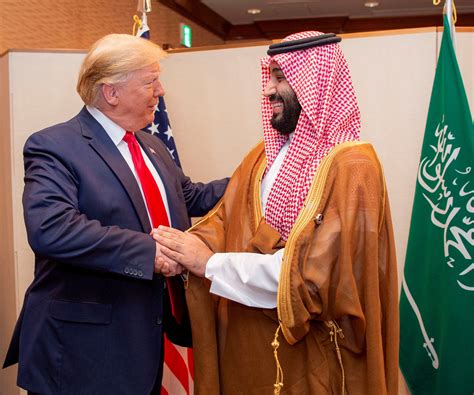
THE TRUMP FAMILY’S SAUDI ARABIAN CONNECTIONS Part 1

SUMMARY: The Trump administration’s recent deal to support Saudi Arabia’s development of a nuclear energy program represents a major shift in U.S. policy and risks accelerating the nuclear arms race in the Middle East and globally. It is in stark contrast with Trump’s position on neighboring Iran’s nuclear energy program. It has again put a spotlight on the Trump family’s relationship with Saudi Arabia and its ruler Mohammed bin Salman (MBS). This friendly relationship highlights the hypocrisy of Trump’s and other Republicans anti-Muslim rhetoric and policies.

(Note: If you find a post too long to read, please just skim the bolded portions. Thanks for reading my blog!)

(Note: Please follow me and get notices of my blog posts on Bluesky at: @jalippitt.bsky.social. Thanks!)

The Trump administration’s recent deal to support Saudi Arabia’s development of a nuclear energy program has again put a spotlight on the Trump family’s friendly relationship with Saudi Arabia and its ruler Mohammed bin Salman (MBS). President Trump, son Eric, and son-in-law Jared Kushner have conflicts of interest, present national security risks, and face ethical dilemmas in their relationship with MBS and Saudi Arabia.

It’s important to give this relationship some context. Saudi Arabia is an autocratic, Islamic country that uses Sharia law for parts of its society and places severe restrictions on women. MBS is also widely believed to have ordered the murder of Jamal Khashoggi, the Washington Post columnist. Saudi Arabians were the planners and most of those who executed the 9/11/2001 terrorist attack on the U.S.

Trump’s friendly relationship with MBS and Saudi Arabia highlight the hypocrisy of his anti-Muslim rhetoric and policies. The silence of other Republicans in the face of this nuclear technology deal, sales of military hardware, and other dealings with Saudi Arabia highlight their hypocrisy in their vilification of Muslims and vocal opposition to supposed efforts to implement Sharia law in the U.S.

This most recent example of the cozy relationship between Trump and MBS is an unprecedented, 30-year agreement to support Saudi Arabia’s development of nuclear energy and related technology. The deal gives a monopoly worth billions of dollars to U.S. companies, benefiting Westinghouse in particular (which was bailed out by Trump after it filed for bankruptcy in 2017). Notably, the deal does NOT include monitoring and inspections by the International Atomic Energy Agency to ensure that nuclear fuel isn’t enriched into weapons grade material, despite MBS’s statement that if Iran builds a nuclear weapon, Saudi Arabia will too. The agreement must be approved by Congress, although a veto-proof two-thirds majority in both the House and Seante would be required to reject it, which is unlikely.

The deal’s transfer of nuclear technology presents a clear risk of nuclear weapons proliferation and a stark contrast with Trump’s position on neighboring Iran’s nuclear energy program, which Trump has gone to war to destroy. Saudi Arabia and Iran are long time Middle East rivals, and this deal will strengthen Iran’s claim that it should have nuclear technology. The agreement, whose text has not been made publicly available, is being described differently by different parties (which is not unusual with Trump’s deals) and may allow Saudi Arabia to build and operate its own uranium enrichment facilities. Such facilities, which Iran has, can enrich nuclear power fuel to make weapons grade nuclear material. [1] Note: A day after the Saudi Arabia nuclear deal was signed, President Trump apparently added a new condition: that Saudi Arabia normalize diplomatic relations with Israel. Saudi Arabia has clearly stated in the past that it would not do so without a path to a Palestinian state, something Israel has rejected. [2]

Providing nuclear technology to Saudi Arabia is a major shift in U.S. policy, a reversal of 50 years of U.S. nuclear nonproliferation efforts, and risks accelerating the nuclear arms race in the Middle East and globally. Other U.S. allies are likely to ask for similar arrangements, in particular the ability to enrich nuclear fuel on-site, which the U.S. has prohibited for decades. It also opens the door for China and Russia to share nuclear technology with their allies because the U.S. has done so. [3]

Back in 2016, Trump’s campaign rhetoric included support for building nuclear power plants in Saudi Arabia. At that time, son-in-law Kushner and others formed a company to engage in such a project. During Trump’s first term as president, White House ethics and national security officials warned that selling nuclear technology to Saudi Arabia might violate the Atomic Energy Act and that it presented national security risks. [4]

My next posts will review U.S. sales of military equipment and artificial intelligence (AI) technology to Saudi Arabia. They will also describe the real estate and financial deals between Trump family members and Saudi Arabia.

For lots of good news see Jess Craven’s Chop Wood Carry Water blog’s most recent good news Sunday posts here.


[1]      Hjelmgaard, K., 7/23/26, “Saudi Arabia gets nuclear deal. Iran gets bombed. What’s in the pact?” USA Today (https://www.usatoday.com/story/news/world/2026/07/23/us-saudi-nuclear-deal-iran-raises-regional-arms-race-fears/91020032007/)

[2]      Sanger, D. E., & Demirjian, K., 7/24/26, “Trump makes Saudi-Israel ties a must for nuclear deal,” The Boston Globe from the New York Times

[3]      Schwartz, F., Wu, J., & Ewing, G. R., 7/22/26, “Trump’s Saudi nuclear deal risks igniting a Middle East arms races, lawmakers warn,” Politico (https://www.politico.com/news/2026/07/22/saudi-nuclear-pact-fears-regional-enrichment-01009142)

[4]      Cox Richardson, H., 7/22/26, Letters from an American blog (https://heathercoxrichardson.substack.com/p/july-22-2026))


Is Trump the Real Communist in American Politics?

SUMMARY: Trump is the only politician calling for and taking government control of private companies and resources. At his direction, the government has taken stakes in at least nine companies. On the other hand, democratic socialists in the U.S. today are in the mainstream of our history, not outliers, let alone communists.

(Note: If you find a post too long to read, please just skim the bolded portions. Thanks for reading my blog!)

(Note: Please follow me and get notices of my blog posts on Bluesky at: @jalippitt.bsky.social. Thanks!)

Despite Trump and the Republicans calling Democrats communists, – especially the progressive ones and the ones who identify as democratic socialists – Trump is the actual communist. Really. [1] Let’s review definitions of socialism and communism, and then look at Trump’s actions.

Democratic socialism was eloquently defined by Senator Bernie Sanders in the fall of 2015 when he was running for president. You can watch and listen to his two-minute definition here. (My post about Sanders’ speech with more detail is here.)

His definition builds on President Franklin D. Roosevelt’s (FDR) proposed economic bill of rights and notes that true individual freedom cannot exist without economic security. Democratic socialism includes:

  • Decent jobs at decent pay with time off and the ability to retire with dignity;
  • The ability to have adequate food, clothing, health care, and housing;
  • A right to a good education; and
  • The opportunity for small businesses, including farmers, to operate without domination by large corporations.

Sanders noted that Martin Luther King, in 1968, echoed FDR’s call for economic rights and stated that the US provides “socialism for the rich and rugged individualism for the poor.” By the way, while “socialism” may be a politically negative label to older Americans, 67% of young Americans have a positive or neutral association with the word “socialism” compared to 40% who are positive or neutral about “capitalism.”

Historian Heather Cox Richardson states that the democratic socialists in the U.S. today are in the mainstream of our history. Their policy proposals echo the 1860s, when the Republicans established public colleges; the 1900s, when Theodore Roosevelt called for public health insurance; the 1930s with FDR’s New Deal and proposed economic bill of rights; Eisenhower Republicans of the 1950s; and Republican President Nixon in the late 1960s and 1970s. (See my previous post for more details.)

Cox Richardson notes that today’s American democratic socialists are not communists or even hardcore socialists. [2] Communists and some hardcore socialists advocate for eliminating all private property. Today’s American democratic socialists call for a robust system of private ownership and enterprise, alongside government control of essential societal functions required for people to survive and for the economy to work for the good of everyone. (See my previous post for more details.)

Communism calls for government or communal ownership of all resources as well as all means of production, meaning the state, rather than private individuals or corporations, owns factories, farms, mines, etc. None of the Democratic or Democratic Socialist candidates is proposing anything akin to this.

The only politician calling for state takeover of private industries and resources is Trump. At his direction, the government has taken stakes in at least nine companies at a cost of at least $10 billion in taxpayer money. These companies are in the steel, minerals, nuclear energy, and semiconductor industries. [3] Trump claims he’s done this for national security reasons, but increasing his power, control, wealth, and influence seem to be the real reasons. Notably, the arrangements his regime has made leave power and control, as well as money, in his hands, not under the control of some group or entity that is committed to the public good. Trump has used tariffs (and exemptions from them), regulatory actions (e.g., approval or denial of mergers and acquisitions), and trumped-up lawsuits (no pun intended) to coerce business leaders into complying with his requests for control of their businesses.

For example, in August 2025, the Trump administration converted $9 billion in federal grants to Intel into a 10% ownership share in the company. The grants were made under President Biden’s 2022 CHIPS and Science Act to boost domestic semiconductor manufacturing and research. The U.S. government is now Intel’s biggest shareholder. Intel had been struggling financially and this, along with other actions by Trump requiring other companies to buy Intel products or invest in it, bailed Intel out. (Imagine what Trump and Republicans would have said if the Obama administration had converted its bailouts of Wall Street and automakers in the 2008 Great Recession into government ownership of those companies!)

Apple got an exemption from Trump’s 100% tariffs on semiconductor imports (essential to iPhones and many other Apple products) by promising to buy Intel chips and collaborate with it.

Nvidia got Trump’s approval to sell its artificial intelligence (AI) chips to China (which he had said and others believe is a national security risk). Nvidia agreed to give 25% of the profits from Nvidia’s China sales to the government and to invest $5 billion in Intel.

The U.S. government has also become the largest shareholder in MP Materials, the only rare earth mining company in the country, after a $400 million investment of taxpayers’ money.

When the Japanese company, Nippon Steel, acquired U.S. Steel in 2025, Trump conditioned government approval on his receiving a “golden share” in U.S. Steel. This golden share allows him to veto key business decisions including decisions on changing U.S. Steel’s name, moving its headquarters out of Pittsburgh, or closing production facilities. [4]

These actions are not capitalism. Establishing government control over private companies is nationalized socialism or communism. Nothing at all close to this has happened in U.S. history except during the true national emergency of World War II. This is oligarchic communism in that it’s making Trump and wealthy executives and investors in these companies even richer. And it’s concentrating ever more power over a broader range of the U.S. economy and society in Trump’s hands. That’s authoritarianism.

For lots of good news see Jess Craven’s Chop Wood Carry Water blog’s most recent good news Sunday posts here.


[1]      Sonnenfeld, J.A., Pepper, J., Mulcahy, A., George, B., and Tyson, L.D., 8/21/25, “MAGA’s march toward a command economy,” Yale Insights (https://insights.som.yale.edu/insights/magas-march-toward-command-economy)

[2]      Cox Richardson, H., 7/5/26, Letters from an American blog (https://heathercoxrichardson.substack.com/p/july-5-2026)

[3]      Cox Richardson, H., 6/26/26, Letters from an American blog (https://heathercoxrichardson.substack.com/p/june-26-2026)

[4]      Kimball, S., 11/24/25, “Trump appoints two Commerce officials to oversee U.S. Steel under ‘golden share’ agreement,” CNBC (https://www.cnbc.com/2025/11/24/trump-us-steel-nippon-golden-share.html)

ARE THE NATIONAL DEMOCRATS LISTENING?

SUMMARY: I hope the national Democrats are listening. The grassroots are yelling and voting based on the unaffordability of daily life and the corruption in our politics and economy. In recent elections across the country, progressive, grassroots candidates are beating incumbents and winning even in conservative, Republican districts. Many of these candidates are young, female, multicultural, and/or new to politics.

(Personal note: I didn’t post the last two weeks because of the combination of a scramble to get signatures to put a question on the November ballot and a ten-day visit by an out-of-town grandson.)

(Note: If you find a post too long to read, please just skim the bolded portions. Thanks for reading my blog!)

(Note: Please follow me on Bluesky at: @jalippitt.bsky.social. Thanks!)

I hope the national Democrats are listening. The people and the voters are sending a loud, clear message. I worry that many of the Democrats in Washington are too entrenched with the oligarchs who spend big money to support their campaigns to hear the grassroots voices. The grassroots are yelling and voting based on the unaffordability of daily life and the corruption in our politics and economy.

In recent elections across the country, from Maine to Florida, from New York to Ohio to Colorado and Montana, from Arizona to California to Washington State, progressive, grassroots candidates are winning. They are beating incumbents and winning even in conservative, Republican districts. [1]

These candidates are winning by calling out monopolistic, corporate America, by attacking the political corruption of big money, and by addressing the everyday problems of ordinary Americans. [2] They are advocating for:

  • Guaranteeing health care for everyone
  • Making housing and child care more affordable
  • Increasing the minimum wage and easing the path to union membership
  • Reforming the corrupt campaign finance system
  • Requiring that wealthy individuals and corporations pay their fair share in taxes
  • Addressing climate change
  • Ensuring AI benefits all of us and not just the oligarchs
  • Ending wars and bloated military spending

The majority of the American people support these policies in poll after poll – and now in election after election. The public is sick and tired of status quo politics and corrupt campaign finance and economic systems that benefit only the rich and powerful.

Many of these winning candidates are young, female, multicultural, and/or new to politics. Some of them are Democrats and some are Democratic Socialists – not that many voters know what that means or care. What unites these candidates is that they are committed to making people’s everyday lives better and our society fairer. They are calling out the greed of the American oligarchy and their control of our economy and policy making. They make the case that our private enterprise system cannot survive unless the government ends huge monopolistic companies and dramatic wealth and income inequality through regulation and taxation. They call for an end to monopolistic price gouging like that of the food and gas and oil companies. They oppose private for-profit ownership of societal functions that people need to survive and that should serve the public good, such as health care, education, mail delivery, utilities, detention facilities, and roads, bridges, and public transportation. [3]

Ironically, Republicans supported many of these policies from the 1950s through the 1970s – ones they are now calling dangerous socialism or communism (without knowing or caring what those terms really mean). (More on the meaning of these terms in a future post.)

In 1969, Republican President Richard Nixon proposed the Family Assistance Plan, which would have provided a universal basic income to all families, effectively ending poverty. But it didn’t get enacted. In 1971, Congress passed legislation creating a universal, federally subsidized child care system that President Nixon was about to sign until pressured by right-wing political forces to veto it. In 1974, Nixon proposed universal health care with cost controls and financial assistance for those who couldn’t afford insurance. This also didn’t get enacted.

Back in the 1950s, Republicans and President Eisenhower supported workers, unions, and increasing the minimum wage; the expansion of social security and unemployment insurance; as well as improved housing and health care. The Republican Party platform called for equal pay for equal work and the elimination of discrimination in employment. [4]

It’s amazing to review how American politics and policies have changed over the last 75 years. What were centrist policies, supported by Republicans, in the 1950s through 1970s, are now called far left, socialist (or even communist) policies.

For lots of good news see Jess Craven’s Chop Wood Carry Water blog’s most recent good news Sunday posts here, here, and here.


[1]      Sanders, B., 7/1/26. “Last night in Colorado,” (https://www.facebook.com/reel/1517611133169096)

[2]      Reich, R., 7/6/26, “Why is he using the communist trump card,” Blog post (https://robertreich.substack.com/p/trumps-communist-trump-card)

[3]      Cox Richardson, H., 6/26/26, “Letters from an American blog (https://heathercoxrichardson.substack.com/p/june-26-2026)

[4]      Cox Richardson, H., 6/26/26, see above