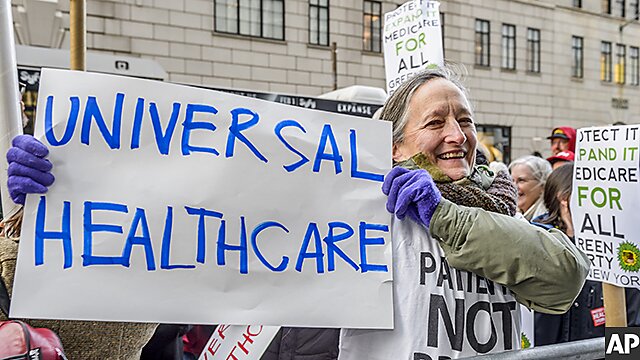
UNIVERSAL HEALTH CARE SAVES LOTS OF LIVES AND MONEY

SUMMARY: A universal, single-payer U.S. health care system could save over 100,000 lives and $1 trillion every year. However, because capitalism has corrupted our health care system, which now puts profits before patients, the potential benefits, both in quality and in savings, won’t occur unless the corporate giants in the system are broken up or strongly regulated. Six corporations dominate Big Medicine with over $2 trillion in revenue and $34 billion in profits in 2025.

(Note: If you find a post too long to read, please just skim the bolded portions. Thanks for reading my blog!)

(Note: Please follow me and see my blog posts on Bluesky at: @jalippitt.bsky.social. Thanks!)

A reformed U.S. health care system providing universal coverage could save over 100,000 lives and $1 trillion every year according to a study from the Yale School of Public Health. A universal U.S. public health insurance program, such as Medicare for All, would save over $1 trillion a year even after including roughly $300 billion for the additional care received by currently uninsured or underinsured people. [1]

The five major sources of savings are:

  • Reduced administrative overhead. At least 15% of U.S. health care spending, about $800 billion annually, is administrative waste. Peer countries and Medicare spend 1% to 4% on administration.
  • Lowered drug costs due to regulation and negotiation of drug prices.
  • Reduced fraudulent billing from for-profit entities working to maximize profits.
  • Fewer emergency room visits and hospitalizations due to earlier and less expensive treatment of medical conditions.
  • Standardized and capped prices for health care services.

Universal health insurance would, of course, undo the coverage cuts and other health policy changes implemented by the Trump administration since 2025. This alone would prevent about 51,300 deaths a year. Universal comprehensive and affordable health coverage would benefit the over 45 million adults who are underinsured – where deductibles and co-pays make needed care unaffordable. This would save another 29,600 lives a year. Finally, universal health insurance would, of course, insure the uninsured saving an estimated 33,300 additional lives. So, in total over 114,000 deaths per year would be averted.

The Yale study builds on and confirms estimates in a less comprehensive 2020 study that concluded that a single-payer, universal health care system in the U.S. would save at least 68,000 lives and $450 billion a year. [2]

However, capitalism has corrupted the U.S. health care system. The pursuit of profits has become the priority, rather than care for patients. Costs are high and growing fast, while outcomes are poor. (See this previous post for more details.) Big corporations (aka Big Medicine) dominate health insurance, drug manufacturing, hospitals, and doctors’ practices. Middlemen skim off profits at many points in the system. Private equity firms (vulture capitalists) pocket profits at the expense of patients, doctors, and others. Practitioners are burned out and leaving clinical practices in record numbers leading to shortages of doctors in primary care and many specialties, especially mental health. [3]

Therefore, a universal, single-payer, Medicare-for-All type system won’t achieve all its potential benefits, both in quality and in savings, unless the corporate giants in the health care system are broken up or strongly regulated. [4]

Six corporations dominate Big Medicine: huge insurer / provider conglomerates UnitedHealth, CVS, and Cigna, along with mega-wholesalers McKesson, Cencora, and Cardinal Health. They are six of the fifteen largest corporations in the U.S. They have been built by mergers and acquisitions over the last 16 years; only one of them was among the fifteen largest corporations in 2010. They had over $2 trillion in revenue and $34 billion in profits in 2025. For example, McKesson, Cencora, and Cardinal Health are the three largest wholesale drug distributors, controlling 98% of the market, giving them, as middlemen, monopolistic leverage over drug manufacturers, providers, and consumers. (See this previous post for more on corporate consolidation and concentration in health care.)

Big Medicine now employs 80% of doctors. This exemplifies the major changes in our health care system since the early 1980s when 80% of doctors owned their own private practices. Big Medicine (as with big retailers and big tech) also pushes manufacturing  of drugs and medical supplies to low-cost sources overseas. This makes supply chains brittle and results in shortages if there’s any disruption.

For patients, Big Medicine means unaffordable coverage, doctor shortages and long wait times, longer trips to doctors and hospitals, administrative barriers to care and payments, worse health, and medical debt for 40% of American adults. For doctors and other practitioners, it means decreased pay and benefits, increased pressure to produce billings, decreased time with patients, delayed payments for services, and worsening working conditions. Big Medicine has pushed both patients and practitioners into frustration and anger, and, as a result, only 28% of patients trust the health care system and practitioners are leaving the field at unprecedented rates.

For lots of good news see Jess Craven’s Chop Wood Carry Water blog’s most recent good news Sunday post here.


[1]      Kristoffersen, M., 8/13/26, “Universal health coverage could save $1 trillion and 114,000 lives every year, Yale study projects,” Yale School of Public Health (https://ysph.yale.edu/news-article/universal-health-coverage-could-save-one-trillion-dollars-and-114000-lives-every-year/)

[2]      Galvani, A. P., et al., 2/15/20, “Improving the prognosis of health care in the USA,” The Lancet (https://www.thelancet.com/journals/lancet/article/PIIS0140-6736(19)33019-3/abstract)

[3]      Freer, E., & Harper, M., August 2026, “Break up Big Medicine: A health care agenda to restore power to patients and practitioners and save families $6,000 a year,” American Economic Liberties Project (https://www.economicliberties.us/wp-content/uploads/2026/08/AELPHealthcareAgenda.pdf)

[4]      Dayen, D., 8/27/26, “Health care reform needs more than universal coverage,” The American Prospect (https://prospect.org/2026/08/27/health-care-reform-universal-coverage-medicare-for-all/)

WHAT DEMOCRATS NEED TO DO Part 2

Democrats need to be more dramatic, effective, and consistent in opposing Trump, his nominees, and the congressional Republicans’ agenda. They need to step up their resistance while promoting and committing to enact policies that would support everyday Americans.

Democrats need to be more dramatic, effective, and consistent in opposing Trump, his nominees, and the congressional Republicans’ agenda. They need to step up their resistance while promoting and committing to enact policies that would support everyday Americans.

(Note: If you find this post too long to read, please just skim the bolded portions. Thanks for reading my blog!)

(Note: Correction. In my previous post asking you to contact your U.S. Representative and ask them to oppose elements of the proposed Republican budget, I wrote that the proposed cuts to Medicaid were “$700 – $800 million.” As many of you know, that should have been $700 – $800 BILLION.)

This previous post made the case that Democrats need to be more dramatic, effective, and consistent in opposing Trump, his nominees, and the congressional Republicans’ agenda. It identified policies that Democrats should be promoting for our economy and the economic well-being of all Americans. This current post focuses on policies in the social services arena, including health care reforms, drug price reductions, enhancements to Medicare, and ensuring long-term funding for Social Security.

Here are some specific policies Democrats ought to be promoting and committing to enact in the social services arena when they are back in power:

  • Ending wasteful and dangerous privatization of health care. Here are two examples;
    • Private equity firms should be banned from the health care industry. The example of Steward Health alone should be enough to seal this case, but there are plenty of other examples as well. (See this previous post for more information.)
    • End the Medicare Advantage program, which privatizes Medicare and results in huge, often fraudulent, wasteful costs to the Medicare program. For example, in 2024, illegal overbilling by Medicare Advantage providers (i.e., big insurance corporations) was estimated to be $83 billion. Medicare Advantage is estimated to cost Medicare $140 billion more per year than if all individuals were on traditional Medicare. [1] (See this previous post for more details.)
  • Strong regulation of drug prices. President Biden took some initial steps to regulate and reduce drug prices, but President Trump is undoing them. In 2022, U.S. drug prices were two and three-quarters times (178% more than) prices in 33 other industrialized countries. This means that our federal, state, and local governments (i.e., taxpayers) and all of us pay over $200 billion a year extra, which fuels exceptionally high profits for drug makers (when compared to other sectors of our economy). [2] (See this previous post for more details.)
  • Enhance Medicare. If the Medicare Advantage program was eliminated and Medicare was allowed to negotiate prices for all drugs (see the above two bullet points), the savings would be sufficient to pay for the addition of dental, hearing, and vision benefits to Medicare, as well as to cap out-of-pocket spending by Medicare enrollees.
  • Ensure Social Security funding for the rest of this century. Currently, workers pay taxes into Social Security only on the first $176,100 they earn in a year. This means that someone making a million dollars stops paying into Social Security after February 15 and someone making ten million dollars stops paying into Social Security after the first week of January. Simply eliminating this cap would increase Social Security’s revenue by roughly $100 billion per year. This would provide about 75% of the funding needed to allow Social Security to pay out its full planned benefits for the rest of the century. The rest could be raised by taxing investment income, estates, and gifts or a variety of other strategies. [3]
    • NOTE: The Medicare and Social Security Fair Share Act in Congress would require taxpayers with over $400,000 in income in a year to pay a bit more into Medicare and Social Security. This would fully fund planned Medicare and Social Security benefits for at least the next 75 years. [4]

There are plenty of other policies that Democrats should be advancing to demonstrate that they would better serve and support workers and everyday Americans than Trump and the Republicans. Examples include housing; early education and child care; supporting workers and their unions; effective regulation of businesses for worker, consumer, and public safety; and strong enforcement of antitrust laws including the breaking up of monopolistic companies.

If any of your members of Congress are Democrats, I urge you to contact them and ask them to step up their resistance while promoting and committing to enact policies that would support everyday Americans. You can find contact information for your US Representative at  http://www.house.gov/representatives/find/ and for your US Senators at http://www.senate.gov/general/contact_information/senators_cfm.cfm.


[1]      Dayen, D., 1/27/25, “We found the $2 trillion,” The American Prospect (https://prospect.org/economy/2025-01-27-we-found-the-2-trillion-elon-musk-doge/)

[2]      Dayen, D., 1/27/25, see above.

[3]      Dayen, D., 1/27/25, see above.

[4]      Conley, J., 5/9/25, “Democrats’ bill would extend Social Security and Medicare solvency ‘as far as the eye can see’,” Common Dreams (https://www.commondreams.org/news/social-security-medicare-2671925476)