
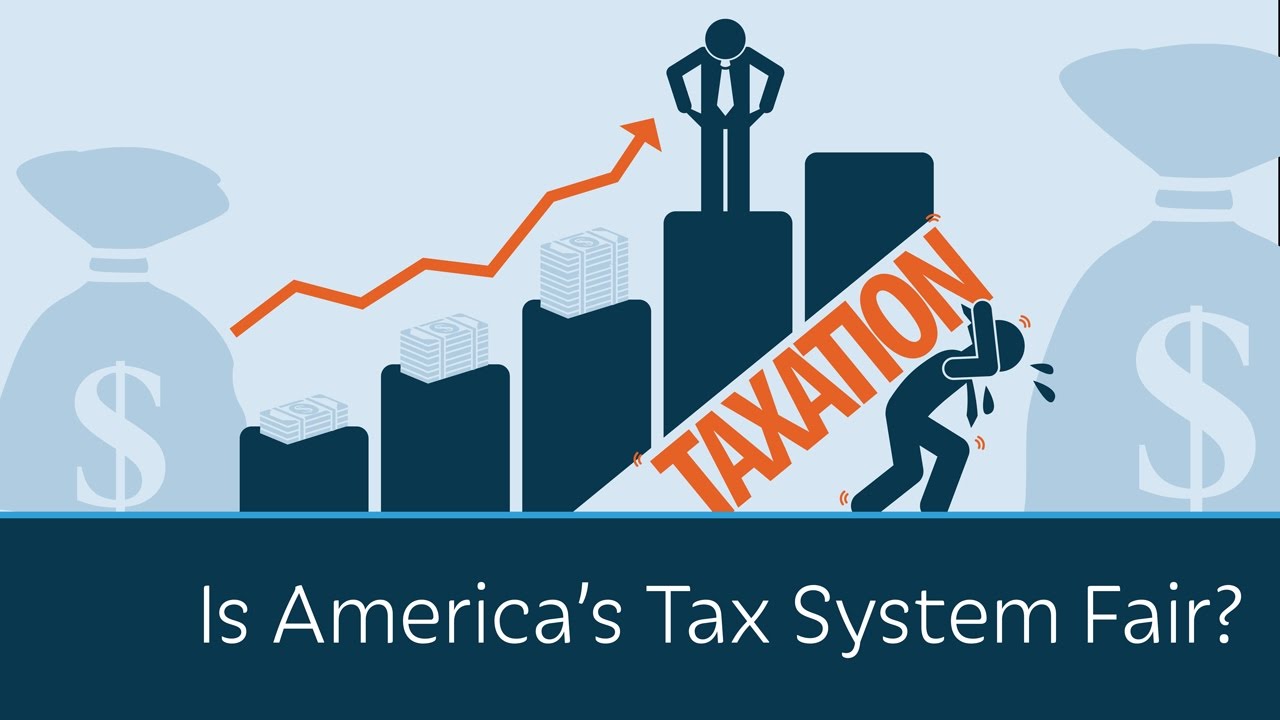
Democracy requires fair taxation. The current U.S. tax system is unfair. Increased progressivity of individual and business income tax rates, especially on income from wealth (versus work), is one essential piece of re-establishing a fair tax system and reducing economic inequality.
(Note: If you find a post too long to read, please just skim the bolded portions. Thanks for reading my blog!)
(Note: Please follow me and get notices of my blog posts on Bluesky at: @jalippitt.bsky.social. Thanks!)
The American democracy described in the Declaration of Independence and further detailed in the preamble to the Constitution requires fair taxation linked to meaningful representation to produce a government of, by, and for the people. (See this previous post for more detail.)
Fair taxation requires individuals and businesses to pay their fair share. The current U.S. tax system is unfair based on common sense,an historical perspective, and the current experiences of everyday Americans. It has allowed wealth and income inequality to grow dramatically in the last 45 years, both among individuals and among businesses. To re-establish a fair tax system and reduce economic inequality, the U.S. must: [1]
- Increase the progressivity of individual and business income tax rates, especially on income from wealth (versus work), such as interest, dividends, and capital gains on the sale of assets that have appreciated (i.e., increased in value).
- Tax increases in wealth even if assets are not sold. These increases in wealth are effectively income even when the assets are not sold.
- Tax existing wealth to slow or reverse the huge growth in wealth inequality and because the wealthy can (and do) maintain their extravagant lifestyles without having income by borrowing money and using their wealth as collateral for the loans. U.S. billionaires’ wealth has doubled since 2019 and in 2024 alone, the 19 richest billionaires added one trillion dollars to their wealth, an average of over $50 billion each. [2]
- Tax intergenerational transfers of wealth because otherwise America will have a class of reigning, perpetual oligarch families.
- Close loopholes in tax laws to prevent tax avoidance by wealthy individuals and corporations.
- Establish an international tax system to prevent tax avoidance by wealthy individuals and corporations through the shifting of wealth and income streams to low-tax countries. [3] [4]
- Give the Internal Revenue Service (IRS) the resources to enforce U.S. tax laws and dramatically reduce the hundreds of billions of dollars a year of tax dodging by wealthy individuals and businesses when they do not pay the taxes they legally owe.
Progressive income tax rates are fair (i.e., percentage tax rates that increase with increases in income) because the value of $1,000 of additional income to a millionaire is far less than it is to someone with a $50,000 or $100,000 income. Or from the perspective of taxes, a tax of $100 (10%) on that $1,000 of additional income has much less impact on the millionaire than the lower income individual.
What tax rates are fair across the income range is, of course, a matter of judgment. However, for a starting point, a relatively small increase in the top marginal personal income tax rate (i.e., the tax rate on the last dollar of income) back to its pre-2017 level (i.e., from 37% to 39.6%) would generate revenue of over $30 billion a year for the government to use to deliver public goods that people need or want. (Note: In 1980, the top rate was 70% and it was over 90% in the 1950s and the wealthy and the economy, nonetheless, did quite well.)
Returning the tax rate on large corporations to 35% (where it was before the 2017 Republican Tax Cut Act reduced it to 21%) would make sense, be fair, and generate over $250 billion a year in revenue for the government.
I encourage you to contact your state and local elected officials, as well as your U.S. Representative and Senators, and ask them to support enacting a fairer tax system with progressive income tax rates for wealthy individuals and businesses. You can find contact information for your US Representative at http://www.house.gov/representatives/find/ and for your US Senators at http://www.senate.gov/general/contact_information/senators_cfm.cfm.
For lots of good news, see Jess Craven’s Chop Wood Carry Water blog’s most recent good news Sunday post here.
My next post will discuss taxing wealth and the intergenerational transfer of it. It will also discuss the IRS and its role in enforcing a fair tax system.
[1] See this previous post on reducing economic inequality, which includes information on tax reforms proposed by the Economic Policy Institute and in the Money Agenda of a group called Patriotic Millionaires.
[2] Collins, C., 4/5/26, “Tax the rich across the land!” Common Dreams (https://www.commondreams.org/opinion/how-to-tax-the-rich)
[3] Johnson, J., 11/19/24, “Tax dodging by super-rich, big corporations costs nations half a trillion per year: Study,” Common Dreams (https://www.commondreams.org/news/global-tax-dodging)
[4] Conley, J., 11/19/24, “G20 leaders reach ‘landmark commitment’ for global tax on ultrarich,” Common Dreams (https://www.commondreams.org/news/global-wealth-tax-2669945403)
 Lippitt's Policy and Politics Blog