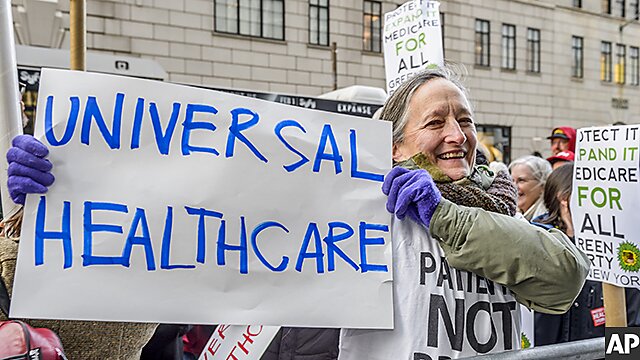
UNIVERSAL HEALTH CARE SAVES LOTS OF LIVES AND MONEY

SUMMARY: A universal, single-payer U.S. health care system could save over 100,000 lives and $1 trillion every year. However, because capitalism has corrupted our health care system, which now puts profits before patients, the potential benefits, both in quality and in savings, won’t occur unless the corporate giants in the system are broken up or strongly regulated. Six corporations dominate Big Medicine with over $2 trillion in revenue and $34 billion in profits in 2025.

(Note: If you find a post too long to read, please just skim the bolded portions. Thanks for reading my blog!)

(Note: Please follow me and see my blog posts on Bluesky at: @jalippitt.bsky.social. Thanks!)

A reformed U.S. health care system providing universal coverage could save over 100,000 lives and $1 trillion every year according to a study from the Yale School of Public Health. A universal U.S. public health insurance program, such as Medicare for All, would save over $1 trillion a year even after including roughly $300 billion for the additional care received by currently uninsured or underinsured people. [1]

The five major sources of savings are:

  • Reduced administrative overhead. At least 15% of U.S. health care spending, about $800 billion annually, is administrative waste. Peer countries and Medicare spend 1% to 4% on administration.
  • Lowered drug costs due to regulation and negotiation of drug prices.
  • Reduced fraudulent billing from for-profit entities working to maximize profits.
  • Fewer emergency room visits and hospitalizations due to earlier and less expensive treatment of medical conditions.
  • Standardized and capped prices for health care services.

Universal health insurance would, of course, undo the coverage cuts and other health policy changes implemented by the Trump administration since 2025. This alone would prevent about 51,300 deaths a year. Universal comprehensive and affordable health coverage would benefit the over 45 million adults who are underinsured – where deductibles and co-pays make needed care unaffordable. This would save another 29,600 lives a year. Finally, universal health insurance would, of course, insure the uninsured saving an estimated 33,300 additional lives. So, in total over 114,000 deaths per year would be averted.

The Yale study builds on and confirms estimates in a less comprehensive 2020 study that concluded that a single-payer, universal health care system in the U.S. would save at least 68,000 lives and $450 billion a year. [2]

However, capitalism has corrupted the U.S. health care system. The pursuit of profits has become the priority, rather than care for patients. Costs are high and growing fast, while outcomes are poor. (See this previous post for more details.) Big corporations (aka Big Medicine) dominate health insurance, drug manufacturing, hospitals, and doctors’ practices. Middlemen skim off profits at many points in the system. Private equity firms (vulture capitalists) pocket profits at the expense of patients, doctors, and others. Practitioners are burned out and leaving clinical practices in record numbers leading to shortages of doctors in primary care and many specialties, especially mental health. [3]

Therefore, a universal, single-payer, Medicare-for-All type system won’t achieve all its potential benefits, both in quality and in savings, unless the corporate giants in the health care system are broken up or strongly regulated. [4]

Six corporations dominate Big Medicine: huge insurer / provider conglomerates UnitedHealth, CVS, and Cigna, along with mega-wholesalers McKesson, Cencora, and Cardinal Health. They are six of the fifteen largest corporations in the U.S. They have been built by mergers and acquisitions over the last 16 years; only one of them was among the fifteen largest corporations in 2010. They had over $2 trillion in revenue and $34 billion in profits in 2025. For example, McKesson, Cencora, and Cardinal Health are the three largest wholesale drug distributors, controlling 98% of the market, giving them, as middlemen, monopolistic leverage over drug manufacturers, providers, and consumers. (See this previous post for more on corporate consolidation and concentration in health care.)

Big Medicine now employs 80% of doctors. This exemplifies the major changes in our health care system since the early 1980s when 80% of doctors owned their own private practices. Big Medicine (as with big retailers and big tech) also pushes manufacturing  of drugs and medical supplies to low-cost sources overseas. This makes supply chains brittle and results in shortages if there’s any disruption.

For patients, Big Medicine means unaffordable coverage, doctor shortages and long wait times, longer trips to doctors and hospitals, administrative barriers to care and payments, worse health, and medical debt for 40% of American adults. For doctors and other practitioners, it means decreased pay and benefits, increased pressure to produce billings, decreased time with patients, delayed payments for services, and worsening working conditions. Big Medicine has pushed both patients and practitioners into frustration and anger, and, as a result, only 28% of patients trust the health care system and practitioners are leaving the field at unprecedented rates.

For lots of good news see Jess Craven’s Chop Wood Carry Water blog’s most recent good news Sunday post here.


[1]      Kristoffersen, M., 8/13/26, “Universal health coverage could save $1 trillion and 114,000 lives every year, Yale study projects,” Yale School of Public Health (https://ysph.yale.edu/news-article/universal-health-coverage-could-save-one-trillion-dollars-and-114000-lives-every-year/)

[2]      Galvani, A. P., et al., 2/15/20, “Improving the prognosis of health care in the USA,” The Lancet (https://www.thelancet.com/journals/lancet/article/PIIS0140-6736(19)33019-3/abstract)

[3]      Freer, E., & Harper, M., August 2026, “Break up Big Medicine: A health care agenda to restore power to patients and practitioners and save families $6,000 a year,” American Economic Liberties Project (https://www.economicliberties.us/wp-content/uploads/2026/08/AELPHealthcareAgenda.pdf)

[4]      Dayen, D., 8/27/26, “Health care reform needs more than universal coverage,” The American Prospect (https://prospect.org/2026/08/27/health-care-reform-universal-coverage-medicare-for-all/)
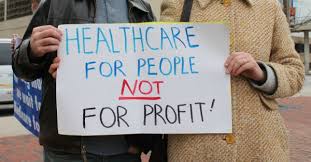
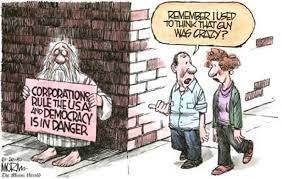
CAPITALISM HAS CORRUPTED HEALTH CARE

Capitalism and its pursuit of profits have corrupted our health care system, resulting in the most expensive system in the world, but one that delivers poor outcomes. Three elements have driven this corruption: corporate consolidation, private equity, and privatization.

SUMMARY: Capitalism and its pursuit of profits have corrupted our health care system. Oligarchs have been allowed to reap huge rewards resulting in the most expensive health care system in the world but one that delivers poor outcomes. Three essential elements that have driven this corruption are corporate consolidation, private equity, and privatization. Some remedies are clear but require dramatic changes in our federal elected officials.

(Note: If you find a post too long to read, please just skim the bolded portions. Thanks for reading my blog!)

(Note: Please follow me and see my blog posts on Bluesky at: @jalippitt.bsky.social. Thanks!)

Capitalism has corrupted our health care system. My previous two posts described more generally 1) how corporate America’s current brand of capitalism is corrupt and undermines democracy, while abetting oligarchy and fascism; and 2) how large, profitable corporations avoid paying taxes while paying their employees so little they have to rely on government assistance to survive.

The U.S. health care system does not provide high-quality health care and is not accessible and affordable because it has been corrupted by the pursuit of profits. As a result, Americans have the worst health outcomes among peer countries. Moreover, they face high costs for insurance and care, resulting in huge amounts of medical debt and many bankruptcies. Individual health care providers are burned out and have low morale because their managers are focused on maximizing profit.

The U.S. health care system has been corrupted by the “free market” revolution that began in the 1970s, took off under President Reagan in the 1980s, and has dominated the U.S. economic system ever since. This laissez-faire, deregulated, no-holds-barred brand of capitalism has been championed by wealthy “conservatives” and Republicans, and abetted by some Democrats. It has been dubbed neo-liberalism. It is a turbocharged version of capitalism that promotes deregulation of business and privatization of public goods and services. [1]

Oligarchs have been allowed to reap huge rewards from our health care system through financial manipulation, mergers and acquisitions, and what amounts to bribery of elected officials. The result has been huge mega-hospitals and vertically integrated insurers / providers, along with pharmaceutical giants and a mind-boggling number of middlemen. All these entities are focused on squeezing as much profit as possible out of the health care system, while patient outcomes and the well-being of individual providers are sacrificed.

The result is the most expensive health care system in the world but one that delivers poor outcomes.

There are three essential elements that have driven this corruption of our health care system: [2]

  • Corporate consolidation: Deregulation and lack of antitrust enforcement over the last 40 years have led to huge health care corporations that have monopolistic power, which allows them to maximize profits at the expense of patients and individual providers. Almost every component of our health care system is rated as “highly concentrated.” [3] For example, 90% of dialysis is performed by just two companies, while 90% of hospital markets, 74% of health insurance markets, and 65% of specialized physician services are rated as highly concentrated.
  • Private equity: Private equity firms (which I referred to as vulture capitalists [see background here]) invaded health care starting in the 2000s. In the decade from 2010 to 2020, private equity firms spent $750 billion buying health care entities. While these purchases have produced big returns for the private equity financiers, the results for patients have been higher prices, poorer quality, and less access due to the closing of facilities, while doctors and other personnel are disempowered and discouraged. (This is consistent with the standard practice of private equity firms in all sectors of our economy. See more here.)

    Steward Health is perhaps the poster child for private equity’s harmful impact on health care. Among other negative outcomes, it delivered poor care as it cut corners to maximize profits. By filing for bankruptcy, patient malpractice awards (among other debts) won’t be paid or will be paid with pennies on the dollar, while executives and private equity owners walked away with fortunes.
  • Privatization: Privatization and profits are the hallmarks of our neoliberal health care system. Notably, Medicare, which provides health insurance coverage for 65 million seniors and people with disabilities, is being increasingly privatized to the detriment of taxpayers and patients. A growing portion of Medicare enrollees are being seduced by slick advertising and short-term benefits to sign up for privatized Medicare Advantage plans, which now have 55% of the population.

    The only long-term advantage of the plans is to the profits of private insurers, such as the giants UnitedHealthcare and Humana, which between them have 46% of all Medicare Advantage enrollees. Recently, these two corporations announced plans to boost their profits by dropping some “under-performing” markets and kicking more than a million seniors off their insurance plans.

    Medicare Advantage (MA) plans cost the government over $500 billion a year and more per person than non-privatized, traditional Medicare, despite serving a healthier population. MA companies are notorious for denying payments for necessary care and for overbilling the government. Nonetheless, the Trump administration recently approved a substantial increase in payments to MA plans. [4]

Not surprisingly, another result of this corruption of our health care system has been that trust in the system has dropped dramatically from 79% in 1975 to 28% in 2026. [5]

Some of the remedies for our health care system’s dysfunction are clear but obviously would require dramatic changes in our federal elected officials:

  • Strong enforcement of antitrust laws (as the Biden administration started to do for the first time in 40 years). The high concentration in many parts of the health care system will require breaking up some of the huge, monopolistic corporations that have been created.
  • Banning private equity ownership from our health care system.
  • Regulating drug prices, as they are in every other peer country.
  • Implementing a single-payer, Medicare for All type system, like those in every other peer country.
  • Establishment of a new patient bill of rights.

For lots of good news see Jess Craven’s Chop Wood Carry Water blog’s most recent good news Sunday post here.


[1]      McDonough, J. E., 8/30/26, “The little-understood roots of the American health care catastrophe,” The Boston Globe

[2]      McDonough, J. E., 8/30/26, see above

[3]      Highly concentrated is defined in the merger guidelines of the Federal Trade Commission. More on its application to health care is in this American Medical Association publication: https://www.ama-assn.org/health-care-advocacy/access-care/95-us-health-insurance-markets-are-highly-concentrated

[4]      Johnson, J., 9/10/26, “To boost profits, Medicare Advantage giants move to kick over a million seniors off their plans,” Common Dreams (https://www.commondreams.org/news/medicare-advantage-benefit-cuts)

[5]      McDonough, J. E., 8/30/26, see above

CORPORATE AMERICA IS WRECKING CAPITALISM

SUMMARY: The Trump regime has cut a corrupt deal with corporate America, which most of the corporate elites have readily gone along with despite its corruption and undermining of democracy. This is what oligarchy and fascism are all about. Everyday citizens pay financially and with their freedom as these corrupt government and business people get richer and richer, as well as more and more powerful. Recently, Gerard Baker, editor-at-large (and former editor-in-chief) of The Wall Street Journal wrote two columns that make a powerful statement about the damage America’s corporate elites and their style of capitalism have done.

(Note: If you find a post too long to read, please just skim the bolded portions. Thanks for reading my blog!)

(Note: Please follow me and see my blog posts on Bluesky at: @jalippitt.bsky.social. Thanks!)

The Trump regime has cut a corrupt deal with corporate America, which the corporate elites have all too readily been happy to accept. It is based on greed and corruption by both these parties: the government will let the corporations and their executives do whatever they want to grow their profits and wealth as long as they pay homage to Trump and his regime verbally and financially. That everyday Americans will suffer from unaffordable costs of daily living and from poor pay and working conditions does not concern either of these parties.

What’s surprising is that so few members of the corporate elite have been willing to call out the corruption and the undermining of democracy. A group calling themselves Patriotic Millionaires has been highlighting the harm of the high and growing levels of economic inequality for some time. They have been promoting policy solutions through changes in tax and employee pay laws. Patriotic Millionaires has proposed “The Money Agenda,” a set of policies that would reduce economic inequality and “permanently stabilize the economic lives of working people, stimulate wide-spread economic growth, and ensure prosperity and stability.” (See this previous post for more details.)

Recently, Gerard Baker, editor-at-large (and former editor-in-chief) of The Wall Street Journal (WSJ) wrote two columns that make a powerful statement about what America’s corporate elites and their current style of capitalism have done wrong. I don’t imagine that I have to tell you that the WSJ and Baker previously have been stanch proponents and, when necessary, defenders of American capitalism. Baker’s recent columns in the WSJ (paywall) are titled How to Cure What Ails American Capitalism (8/17/26) and Socialism Is the Wrong Answer, but the Questions Are Real (8/10/26). Robert Reich provides a nice summary of Baker’s points in this blog post.

Baker writes that, “The widespread popular dissatisfaction with the working of modern American capitalism may be the product of some real, objective problems in the way American capitalism is working.” The problems he notes include the high level of economic inequality, the unaffordability of daily life for many, and the corruption and lack of accountability of the political and corporate elites. He points out that this is harming social solidarity and leading to demands for a radical replacement of American capitalism.

Baker further writes that, “Most of the causes of America’s economic dysfunction are the result of a capitalism that has mutated into a system run by and for large corporate interests.” The dysfunction he highlights includes oligopoly-level concentration in almost every business sector; regulation, legislation, and policy that benefit big companies; and a privatized healthcare system that operates to generate profits for providers, insurers, and pharmaceutical companies while producing poor outcomes for patients and very high costs. He states that the overall result is a concentration of “market, economic and political power by a business-political class that promotes its own well-being at the expense of competition, the market and ultimately the people.”

The fact that this is coming from a career-long proponent and advocate for American capitalism is striking and underscores how poorly capitalism is working. It also highlights how shocking it is that other supposed leaders in corporate America aren’t standing up both to call this out and to support remedies – not to mention speaking out against the corruption and undermining of democracy.

The current Trump regime and its allies among the corporate elite are what oligarchy and fascism are all about. There’s a corrupt deal among government and business people that “I’ll scratch your back if you scratch mine.” Everyday citizens pay financially and with their freedom as these corrupt government and business people get richer and richer, as well as more and more powerful.

Some of the remedies are clear but obviously require a seismic change in our elected officials:

  • Strong enforcement of antitrust laws (as the Biden administration started to do for the first time in 40 years). American capitalism has gone so far down the road of eliminating actual market place competition by allowing monopolies and oligopolies that remediation will requiring breaking up some (if not many) of the huge corporations that have been created.
  • Strong worker protection laws and agencies, including support for unions and unionization.
  • Strong consumer protection laws and agencies for all consumer goods and services, especially financial services.
  • A total revamping of our health care system to remove the corrupting profit motive that puts profits before patients. A single payer Medicare for All system is the remedy, like what every other peer country has.
  • Dramatic reform of the American campaign finance system to prevent wealthy individuals and corporations from effectively buying elected officials and policies. Matching public funds for small campaign contributions from people within a candidate’s district, tied to strict limits on other campaign funding, are the most immediate solution in the context of the Citizens United and related Supreme Court decisions. New York City and State and numerous other jurisdictions have such systems in place and they’ve produced very positive results. (See previous posts here and here for more information.)

For lots of good news see Jess Craven’s Chop Wood Carry Water blog’s most recent good news Sunday post here.