THE ESCALATING CORRUPTION IN OUR ELECTIONS

The corruption of Trump and his cronies is omnipresent. The November elections are an opportunity for election and campaign contribution corruption. Trump is using government money in efforts to buy votes, while big campaign contributors get tangible benefits from the Trump administration.

SUMMARY: The corruption of Trump and his cronies is omnipresent. The upcoming November elections have become another opportunity for both new and old types of election and campaign contribution corruption. Trump has made multiple promises to give – and in some cases has delivered – government money directly to voters in both explicit and implicit efforts to buy votes. The linkages between campaign contributions and tangible benefits from the Trump administration are more numerous and blatant than in the past. Just 172 billionaires have spent $1.7 billion on the 2026 elections already.

(Note: If you find a post too long to read, please just skim the bolded portions. Thanks for reading my blog!)

(Note: Please follow me and see my blog posts on Bluesky at: @jalippitt.bsky.social. Thanks!)

The corruption of Trump and his cronies is omnipresent and is happening through many different avenues. The upcoming November elections have become another opportunity for both new and old types of election and campaign contribution corruption.

In a new form of election corruption, Trump has made multiple promises to give – and in some cases has delivered – government money directly to voters in both explicit and implicit efforts to buy votes. He’s doing this far more brazenly and blatantly than any other politician I can think of in at least the last 50 years. Here are the most notable examples: [1]

  • In October, sent $90 to over 20 million seniors enrolled in Medicare. To pay for this, the Trump administration is diverting money from the $2 billion Medicare Improvement Fund, which is supposed to be used to improve Medicare services. The Trump administration’s rationale for making these payments is that “the best way to improve Medicare is to put healthcare dollars back where they belong – in the hands of our Medicare beneficiaries – and make coverage more affordable.”
  • In September, sent $500 to roughly 1 million Americans who were supposedly overcharged when they purchased health care under the Affordable Care Act during the Biden administration. (Note: Trump and Congressional Republicans terminated the subsidies for purchasing health care under the Affordable Care Act that the Biden administration had put in place. This led to health insurance costs increasing dramatically for millions of people and millions dropped their health insurance as a result.)
  • Will give $1,000 to all children born from 1/1/25 – 12/31/28 (i.e., during Trump’s second term) whose families open “Trump Accounts” on their behalf. These tax-free accounts, which others can add to, have also been called “money account for growth and advancement” or MAGA accounts. Wealthy individuals have pledged to help fund these accounts, which appears to be a blatant effort to curry favor with Trump. I received an email from the Social Security Administration on October 21 promoting the “Trump Accounts” and stating that they are available to nearly 70 million American children. (Note: These accounts were created by the July 2025 Big Beautiful Budget Bill that also cut food assistance, health care subsidies, and other spending that supported children and their families.)
  • In September, Trump announced that every American citizen would receive $5,000 if Republicans retained control of the U.S. House and Senate.

With an eye on the November 2026 mid-term elections, Republicans in Congress and Trump scheduled implementation of many of the spending cuts in the July 2025 Big Beautiful Budget Bill to occur after the election. In addition to the above payoffs, Trump has said on more than one occasion that Americans would receive a tariff dividend of at least $2,000 sometime in 2026. This appears unlikely to happen.

The more traditional corruption of campaign contributions and spending – traditional since the Supreme Court in 2010 allowed unlimited spending by wealthy individuals and corporations – has grown in size and explicitness. Perhaps most notable and explicit has been Elon Musk’s spending of at least $276 million in an effort to keep Republicans in control of Congress. (This is as of early October. Newer reports put it at $445 million.) Musk’s money comes from his ownership in a number of companies including Tesla and SpaceX. The value of his companies and his wealth is based on tens of billions of dollars of government contracts and subsidies. [2] (Note: As you probably remember, Musk spent at least $250 million to help Trump get elected in 2024 and was rewarded with effectively a co-presidency role and leadership of DOGE for several months, as well as with government contracts worth billions.)

Linkages between campaign contributions and tangible benefits from the Trump administration are more numerous and blatant than in the past. The Center for American Progress has tracked the contributions to MAGA Inc., Trump’s main political action committee (PAC), and the benefits donors have received. Overall, MAGA Inc. has raised over $400 million in contributions of over $100,000. Just 108 donors contributed 79% of this total (an average of $3 million each) and each one received a tangible benefit from Trump or the government. Here are some highlights:

  • 65 donors of roughly $97 million benefited from regulatory actions affecting the companies in which they work or invest.
  • 20 donors who along with friends and relatives contributed $88 million received appointments to government agency and advisory board positions; sometimes ones that had influence over the industries in which they work or invest.
  • 7 donors of $79 million had investigations or enforcement actions terminated or reversed.
  • 6 donors of $42 million received government contracts worth at least $11 billion.
  • 2 donors who contributed $4.5 million were connected to presidential pardons.

An analysis of the industries that are contributing – and looking for favorable actions from the government – finds the following:

  • Crypto companies and executives contributed $88 million
  • AI and data center builders contributed $37 million
  • Fossil fuel companies and executives contributed $30 million
  • Nursing home companies and executives contributed $10 million
  • Health insurance and benefits companies contributed $6 million

This is just for MAGA Inc. So, both in terms of campaign spending and the corruption of Trump and his administration, this is just a tip of an iceberg. As of early October, the 15 billionaires spending the most on the 2026 elections have contributed roughly $1 billion (about $67 million each on average). The next 157 biggest billionaire spenders have spent a total of approximately $700 million. Over half of MAGA Inc.’s money is coming from these 172 billionaires. [3] These numbers have grown by hundreds of millions of dollars since this analysis was done and will continue to grow until election day.

For lots of good news see Jess Craven’s Chop Wood Carry Water blog’s most recent good news Sunday post here.


[1]      Metzger, B., Edmonds, L., & Hennessey, G., 10/1/26, “Here’s all the free money Trump’s talked about giving Americans during his second term – and where it all stands,” Business Insider (https://www.businessinsider.com/trump-checks-free-money-status-doge-tariff-rebate-warrior-dividend-2025-12)

[2]      Cox Richardson, H., 10/21/26, “”Letters from an American blog,” (https://heathercoxrichardson.substack.com/p/october-21-2026)

[3]      Johnson, J., 10/7/26, “172 billionaire families have spent record $1.7 billion on 2026 midterms so far: Analysis,” Common Dreams (https://www.commondreams.org/news/billionaire-family-spending-2026)

HOW THE RICH BENEFIT FROM THE RECORD HIGH FEDERAL DEBT

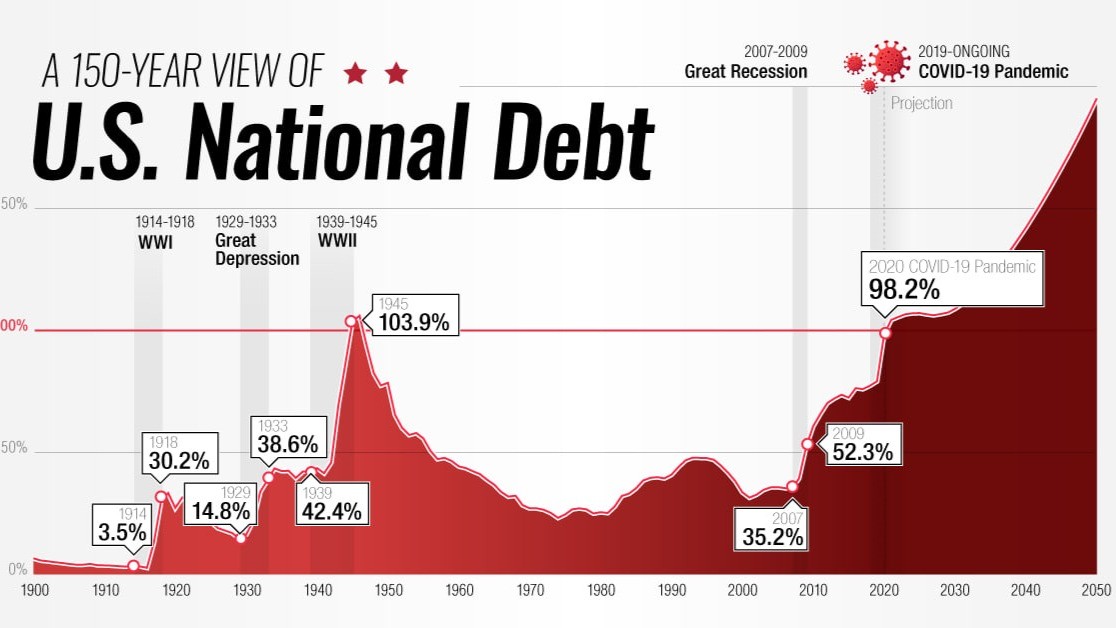
The federal debt was $1 trillion in 1980 and now is $40 trillion due to Republican tax cuts and increased military spending. Wealthy individuals and corporations pay less in taxes and get lots of interest from government bonds. The rest of us are hurt by high inflation and interest rates.

SUMMARY: The federal debt has grown from $1 trillion in 1980 to a record $40 trillion today. President Trump has added $12 trillion to the debt. The causes of the dramatic growth of the debt are quite clear: Republican tax cuts and increased military spending. Wealthy individuals and corporations benefit by paying less in taxes and collecting over $360 billion a year from interest on government bonds. High government debt hurts average Americans by increasing inflation and the interest rates they pay on all types of debt. This all leads to high and growing economic inequality.

(Note: If you find a post too long to read, please just skim the bolded portions. Thanks for reading my blog!)

(Note: Please follow me and see my blog posts on Bluesky at: @jalippitt.bsky.social. Thanks!)

The federal debt has grown from $1 trillion in 1980 to a record $40 trillion today. President Trump has added $12 trillion to the debt in six years as President (despite his promises to reduce it); that’s almost a third of the debt that’s accumulated over the last 45 years. And it’s now growing at a rate of about $2 trillion a year. The debt has grown very fast in recent months, in part because Trump’s tariffs were declared illegal and had to be refunded. [1]

The causes of the dramatic growth of the debt over the last 45 years are quite clear:

  • Republican tax cuts under Presidents Reagan, G. W. Bush, and Trump that primarily benefit wealthy individuals and corporations,
  • Increased military spending including the costs of wars, primarily fueled by Republican Presidents, and
  • At a less dramatic level, one-time emergency spending in response to the Covid pandemic and the economic crash of 2008.

The G.W. Bush and Trump tax cuts gave the richest 20% of Americans 65% of the benefits, while the top 1% got 22% of the benefits. It’s estimated that these tax cuts’ reductions of the federal government’s revenue have added about $11 trillion to the debt since 2001.

Wealthy individuals and corporations benefit from this in two ways. They are:

  • Paying less in taxes, and
  • Collecting a big share of the $1 trillion a year in interest the government is paying for the money borrowed to cover the debt.

Wealthy individuals and corporations used to help fund the government by paying more in taxes. However, top income tax rates for wealthy individuals have fallen from 91% in the 1950s to 37% today. Corporate tax rates have fallen from 50% to 21%. Today, the 400 richest Americans pay an average effective tax rate of only 24%, including federal, state, local, and corporate taxes. Many of them have years where they pay no federal income taxes, including Donald Trump and Jeff Bezos. [2]

This loss of government revenue means the government spends more than it takes in. Therefore, it must borrow money to cover the difference. So, wealthy individuals and corporations now fund government spending by loaning it money (by buying government bonds) and then collecting interest on those bonds.

The federal government is now paying $1 trillion a year in interest on the $40 trillion debt that is covered by selling government bonds to investors. While 30% of the bonds are owned by foreign investors and governments, 70% are owned by domestic investors. These investors include individuals, mutual funds, pension funds, and companies such as banks and insurance companies. The richest Americans own a disproportionate share of financial investments, with the richest 1% of Americans owning 36% of all financial assets. Therefore, a reasonable estimate is that at least 36% of the $1 trillion the government pays in interest, $360 billion a year, is paid to the richest Americans. [3]

The $1 trillion in annual interest payments are $1 trillion that the government doesn’t have to spend on other programs and services. This amount is roughly equal to what is spent on Medicare in a year or what is in the annual Defense Department budget.

Government borrowing of large amounts of money increases interest rates. The rapid current borrowing has pushed the interest rate the government has to pay to get investors to buy its mainstay 30-year Treasury bonds to 5.5%, the highest level in 25 years. As a result, interest rates Americans pay on mortgages, credit card debt, car loans and leases, and student debt are all increasing. The cost of borrowing money for businesses is also increasing. This all increases the rate of inflation. [4]

So, while wealthy individuals and corporations are pocketing billions of dollars due to lower tax rates, they are also collecting billions in interest on their investments in government bonds. Meanwhile, average Americans are paying more on any kind of debt they have, are facing inflation in the prices of the goods and services they need, and are getting less support from the federal government because of reduced spending due to less revenue and more that has to be spent on paying interest on the debt. All of this leads to very high and growing economic inequality in the U.S. (See this previous post for more details.)

For lots of good news see Jess Craven’s Chop Wood Carry Water blog’s most recent good news Sunday post here.


[1]      Johnson, J., 8/20/26, “Economists blame $40 trillion debt milestone on two things: GOP ineptitude and tax cuts for the rich,” Common Dreams (https://www.commondreams.org/news/economists-trump-40-trillion-debt)

[2]      Reich, R., 8/20/26, “Who’s raking it in as the national debt explodes?” Robert Reich blog post (https://robertreich.substack.com/p/who-gets-paid-as-our-national-debt)

[3]      Reich, R., 8/20/26, see above

[4]      Kuttner, R., 8/19/26. “How the cost of money spikes inflation,” The American Prospect (https://prospect.org/2026/08/19/how-cost-of-money-spikes-inflation/)

RESIST GOVERNMENT USE OF ID.me FOR IDENTITY VERIFICATION

xr:d:DAFZCzzlxfU:13,j:46031831340,t:23012914

SUMMARY: Our governments should not be requiring us to provide personal identity information to a private, for-profit company in order to access government programs and information. Yet, that’s what’s happening. It’s a dangerous example of privatization that is redundant and costs taxpayers money, and, in this case, their privacy. I urge you to boycott this if you can and to contact your elected officials to protest. Furthermore, the U.S. needs to better regulate the collection and use of our personal data by the private sector, as Europe has done since 2018.

(Note: If you find a post too long to read, please just skim the bolded portions. Thanks for reading my blog!)

(Note: Please follow me and see my blog posts on Bluesky at: @jalippitt.bsky.social. Thanks!)

Providing citizens access to government agencies and information is an essential government function. Verifying people’s identity for such access shouldn’t be contracted out to a for-profit company. Yet, that’s what the federal government is doing.

Since 2016, some federal agencies have contracted out identity verification for access to their programs and databases to ID.me. ID.me is a hundred-million-dollar, for-profit company. Recently, Medicare and the U.S. Treasury have been added to the list of ID.me users that includes the IRS, Social Security, and Veterans Affairs (which requires it to access family members’ old military records that are public information). As-of 10/29/26, the U.S. Treasury Department will require use of ID.me to access account information. ID.me has contracts for identity verification with 20 federal agencies, as well as at least 50 state agencies, notably those providing unemployment benefits. [1]

ID.me requires you to provide your date of birth, Social Security number, a photograph of your driver’s license or passport, and a picture of your face taken with your cellphone. This puts a biometric facial recognition image in the hands of a private company with little oversight or control over how it uses the data. ID.me also provides identity verification services to dozens of private companies, including Apple, Amazon, Bank of America, Ford, and JPMorgan Chase. ID.me claims it doesn’t sell data and that it makes its money by charging fees for its services, but I find it hard to believe that it isn’t finding ways to monetize the data it holds on hundreds of millions of Americans.

I urge you to resist by refusing to use ID.me if you can. I also urge you to contact your U.S. Representative and Senators to ask them to block the use of ID.me (or at least the expansion of its use). (You can find contact information for your US Representative at  http://www.house.gov/representatives/find/ and for your US Senators at http://www.senate.gov/general/contact_information/senators_cfm.cfm.)

If a login ID and password, along with verification by email, text, or phone message, is secure enough for our access to our bank and other financial accounts, it’s good enough for access to Medicare, Social Security, and other federal data and programs. Furthermore, you can apply for and collect Social Security benefits without going through ID.me and you can sign up for Medicare without it. So, why should it be required to access one’s information at Social Security, Medicare, or the U.S. Treasury? There has been no demonstrated need for this additional security.

Moreover, the U.S. government has its own very similar enhanced security program called Login.gov. So, ID.me is redundant. (Note: I don’t even want to use Login.gov as it puts a biometric facial recognition image in the hands of the Trump regime and I don’t trust how it might use such data.)

ID.me has persuaded government agencies to use its ID verification services through aggressive lobbying and marketing. For its unnecessary services, ID.me has, to date, billed the government (i.e., taxpayers) over $1 billion! ID.me is worse than unnecessary and redundant, it’s another example of privatization taking (stealing?) money from taxpayers. Moreover, once in place, it’s very hard to terminate its use and, eventually, the government may just give in and drop its own capability to perform identity verification. This would mean the end of the historically relatively easy and secure access of citizens to government agencies and programs without giving sensitive personal data to a private entity.

It’s bad enough that for-profit businesses are capturing our personal identity information whenever we interact with them directly. They capitalize on it by using it to tailor their marketing and pricing (aka surveillance pricing; see more here). They also make money by selling our data or sharing it with others. They capture our data through preferred customer and frequent flyer programs, through our activity on social media platforms, through product warranty and purchase registrations, etc.

There should be better government regulation of personal data collection and use by the private sector. For example, regulations should require disclosure of when and what personal data companies are capturing, and how they’re using it. We should have better options for opting out of personal data collection and use, and the ability to require companies to delete our data. Europe has done a much better job than the U.S. of regulating personal data collection and use through its 2018 General Data Protection Regulation (GDPR). It protects individuals when their data is captured and used by private and public entities. There’s a nice overview of it here and more on its legal background here.

What for-profit companies are doing when we interact with them is egregious, but the public sector – our government – should not be abetting the capture, use, and abuse of our personal data by requiring us to provide personal identity information to a for-profit company in order to access government programs and data. However, this is what’s happening with governments’ use of ID.me for login identity verification.

I urge you to contact your U.S. Representative and Senators and ask them to oppose the use of ID.me by the federal government. (See above for links to find contact information for your US Representative and Senators.) You can also contact state officials – your Governor and legislators – and ask them to oppose the use of ID.me at the state level.

For lots of good news see Jess Craven’s Chop Wood Carry Water blog’s most recent good news Sunday post here.


[1]      Kuttner, R., 10/6/26, “Identity crisis,” The American Prospect (https://prospect.org/2026/10/06/identity-crisis-federal-government-access-id-me/)

ENDING SURPRISE HEALTH CARE BILLING COSTS LOTS OF MONEY

The 2020 No Surprises Act set up an arbitration process so patients didn’t get huge surprise medical bills. The result was profits for corporate capitalists and huge health care costs and waste. Patients pay for this through increased premiums with no improvements in health care quality or outcomes.

SUMMARY: The federal No Surprises Act was passed in 2020 and set up an arbitration process where insurance companies and providers would negotiate the payment for out-of-network charges so patients didn’t get huge surprise bills. What happened is a classic example of how for-profit corporate capitalism creates huge costs and waste in our health care system. Ultimately, patients are paying for all of this through increased premiums, while the cost of our health care system spirals upward with no improvements in quality or outcomes.

(Note: If you find a post too long to read, please just skim the bolded portions. Thanks for reading my blog!)

(Note: Please follow me and see my blog posts on Bluesky at: @jalippitt.bsky.social. Thanks!)

You probably remember the surprise health care billing problem that made headlines in 2019 and 2020 where patients were getting huge bills for “out-of-network” medical services over which they had no control, such as in the emergency room or for anesthesia or radiology. As a remedy, the federal No Surprises Act was passed in 2020 and set up an arbitration process where insurance companies and providers would negotiate the payment for out-of-network charges, so patients didn’t get huge surprise bills.

Although the Act did succeed in keeping patients from getting surprise bills, what happened is a classic example of 1) how for-profit corporate capitalism dominates and has corrupted our health care system, and 2) how the lack of a single payer system wastes time and money. With a single payer system, the surprise billing problem would never have happened in the first place because there would be no such thing as “out-of-network.”

The arbitration system created to “solve” the surprise bill problem has become another layer of bureaucratic waste. It has created two new sets of middlemen, arbitrators and consultants, who manipulate the system to maximize their own profits on the backs of our already expensive health care system. [1]

The arbitration system primarily has huge insurance companies on one side who want to pay less for medical services. On the other side, in many cases, are private equity-owned medical staffing companies trying to maximize billings and profits. The No Surprises Act instituted an arbitration system using an independent dispute resolution process (IDR).

The in-network rate for medical services is supposed to be used as a guideline for determining payments, but it is not a mandated standard. Policy makers estimated there would be 20,000 arbitration cases a year nationally, based on experience with a similar system that mandated in-network rates as the standard.

However, in 2025 there were 2.2 million arbitration cases and payments were triple those of the previous year. Providers won roughly 85% of the cases and some outrageous payments were made. For example, there were 25 payments for over $10 million each for procedures that had an in-network cost of $100 to $2,000.

One of the new middlemen, the arbitrators get a flat fee per case and took in $1.3 billion. Given their flat rate, they have a perverse incentive to want to stimulate more cases as the only way to increase their revenue. The way to incentivize more cases is to make high payment awards that create an incentive for providers to file more cases. These high payments establish precedents that are cited in subsequent cases, so the payment awards just spiral upward. By the way, five of the certified arbitrators have private equity backers.

The other new middlemen are consultants to providers and their private equity owners. One of these consultant companies, HaloMD, filed 20% of all the arbitration cases and earned over $1 billion in fees in 2025. These consultants, of course, have an incentive to maximize the payment awards and they brag about getting eight to thirteen times the typical in-network payment rate for their clients.

The insurers are fighting back in unusual ways. Across the 2.2 million cases in 2025, in roughly one million cases they simply gave up and defaulted to the providers’ requests. In another 380,000 cases, they offered to pay $1 or less. Clearly, they are not participating in the arbitration system in good faith. It appears their strategy is to fight in court to get cases thrown out en masse rather than having to fight case by case – although the No Surprises Act bans judicial review of individual billing disputes. Or their strategy may be to have the arbitration system spiral so far out of control that the insurers can argue in court that the whole system should be thrown out. A piece of the court-based strategy may be to delay payments. In some cases, providers are reporting that insurers are simply refusing to pay. A trade association for emergency medical services providers has reported that about 60% of awards were not paid within the 30-day period mandated by the No Surprises Act.

Ultimately, patients are paying for all of this – the outrageous payments for the services and the billions of dollars of administrative overhead costs. Individual patients aren’t getting huge surprise bills, rather we are all paying through increased premiums for our health insurance. And the cost of our health care system spirals upward with no improvements in quality or outcomes – just more capitalists making more money. (See this previous post for a more general overview of how capitalism has corrupted our health care system. See this previous post for how a universal, single-payer health care system would save lots of money and lives.)

For lots of good news see Jess Craven’s Chop Wood Carry Water blog’s most recent good news Sunday post here.


[1]      Dayen, D., 8/13/26, “Congress face-plants on surprise health care bills,” The American Prospect (https://prospect.org/2026/08/13/congress-trump-no-surprises-act-health-care-bills-insurance/)