
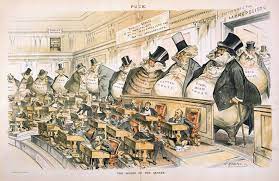
SUMMARY: Eighty-eight large corporations with over $105 billion in profits paid no federal income tax in 2025. Moreover, they got almost $5 billion in tax rebates! Many large and profitable companies also pay their employees so little that they rely on government-subsidized Medicaid for health insurance and the Supplemental Nutrition Assistance Program (SNAP) for food. The hundreds of billions of dollars in taxes dodged each year, as well as the cost of government benefits for employees, contribute significantly to the annual federal budget deficit.
(Note: If you find a post too long to read, please just skim the bolded portions. Thanks for reading my blog!)
(Note: Please follow me and see my blog posts on Bluesky at: @jalippitt.bsky.social. Thanks!)
At least 88 large, profitable corporations paid no federal income tax in 2025. Corporate tax dodging has increased in recent years in large part because of the two tax cut laws enacted by Trump and congressional Republicans: the so-called One Big Beautiful Bill in 2025 and the Tax Cuts and Jobs Act in late 2017.
These 88 corporations had over $105 billion in profits, paid no income tax, and got almost $5 billion in tax rebates! Given the federal corporate income tax rate of 21%, they dodged $27 billion in taxes. Based on the 35% income tax rate in place before the two tax cut laws, these corporations had their taxes cut by $41 billion in 2025 alone. [1]
Note that this analysis includes only corporations that have filed their 2025 tax returns and are one of the 500 largest U.S. corporations. It does not include thousands of other corporations or any privately owned companies.
Here are some of the most profitable and well-known corporations that paid no 2025 federal income tax and their 2025 profits:
- Walt Disney $8.3 billion in profits
- Cheniere Energy $7.0 billion in profits
- CVS Health $6.6 billion in profits
- Tesla $5.7 billion in profits
- Citigroup $4.5 billion in profits
- United Airlines $4.3 billion in profits
- Amer. Elec. Power $3.7 billion in profits
- PG&E $2.5 billion in profits
- 3M $1.8 billion in profits
- Coinbase (crypto) $1.6 billion in profits
- Palantir Tech. $1.6 billion in profits
- PayPal Holdings $1.4 billion in profits
- Biogen $1.2 billion in profits
- Yum! Brands $1.0 billion in profits (KFC, Taco Bell, Pizza Hut, etc.)
State corporate income taxes are typically based on federal income tax laws. As a result, these 88 corporations that paid no federal income tax also paid very little state income tax; their effective state tax rate was only 1.4%.
One of the main ways corporations reduce their federal income taxes is through special tax breaks written into federal laws. These include:
- Accelerated depreciation, which allows corporations to reduce taxes by the full amount of infrastructure expenditures in one year even if the infrastructure will last for many years. This tax break has been used to spur recovery from recessions in the past but is now a permanent part of tax law due to the two tax cut laws identified above.
- Research and development tax credits.
- Tax deductions for stock options given to employees.
In 2025, corporations have so far reported taking $204 billion in federal income tax breaks. This represents a huge giveaway of 18% of total corporate income taxes paid to the federal government, which were about $1,130 billion in 2025 and were paid by hundreds of thousands of corporations. [2]
Six corporations claimed $83 billion of these tax breaks (41%). These are record-breaking amounts.
- Microsoft $19 billion
- Alphabet (Google’s parent) $18 billion
- Amazon $17 billion
- Meta (Facebook, Instagram) $14 billion
- JPMorgan Chase $ 8 billion
- Nvidia (chip maker) $ 7 billion
These corporations do not need tax breaks because they are struggling; they collectively have roughly $500 billion in cash on hand. Previously, the largest one-year tax break claim had been $5 billion by JPMorgan Chase in 2024.
Meanwhile, many large and profitable companies pay employees so little that they must rely on government assistance to survive. The Government Accountability Office (GAO) recently analyzed data from eleven states on Americans who use government-subsidized Medicaid for health insurance (about 28 million adults) and/or the Supplemental Nutrition Assistance Program (SNAP) for food (about 20 million adults). Roughly half of them worked at least part-time in 2024 and of these, two-thirds worked full-time. Most of them worked for private employers in transportation, food, or retail sales jobs. Of the approximately 150 employers across the eleven states studied that had employees enrolled in Medicaid or SNAP, seventeen were among the 50 largest corporations in the country by number of employees. The following companies were among the 25 employers with the greatest number of employees using Medicaid and/or SNAP in multiple states: Walmart, Amazon, McDonald’s, FedEx, Home Depot, Lowe’s, Target, Walgreens, and CVS. [3]
The hundreds of billions of dollars in taxes dodged each year, as well as the cost of government benefits for employees, mean that large, profitable corporations contribute significantly to the annual federal budget deficit and to the growing cumulative federal debt that just hit $40 trillion. The wealth of these corporations and their executives and shareholders gives them substantial political and economic power, which they have been wielding in their self-interest and to the detriment of all of the rest of us.
For lots of good news see Jess Craven’s Chop Wood Carry Water blog’s most recent good news Sunday post here.
[1] Gardner, M., & Marasini, S., 4/14/26, “At least 88 profitable U.S. corporations paid zero federal income tax in 2025,” ITEP (https://itep.org/88-profitable-corporations-paid-zero-income-tax-in-2025/)
[2] Buttikofer, S., & Gardner, M., 8/14/26, “Six companies reaped $83 billion in federal tax breaks in 2025,” ITEP (https://itep.org/six-companies-83-billion-in-federal-tax-breaks/)
[3] U.S. Government Accountability Office, 6/22/26, “Federal social safety net programs: Millions of workers, including many employed by large employers, continue to rely on Medicaid and SNAP,” (https://www.gao.gov/products/gao-26-108703)

