FIXING OUR CORRUPT ELECTIONS

SUMMARY: U.S. elections have been corrupted by big money and partisan interests. The 2026 congressional elections were the most expensive ever with $12 billion in campaign spending. One piece of good news is that this growing torrent of money appears to have been less effective in 2026. Despite the many good signs from the November elections, there are multiple issues with our election system that need fixing, including campaign finance, voting suppression, gerrymandering, and the Electoral College.

(Note: If you find a post too long to read, please just skim the bolded portions. Thanks for reading my blog!)

(Note: Please follow me and see my blog posts on Bluesky at: @jalippitt.bsky.social. Thanks!)

(Note: For lots of good news see Jess Craven’s Chop Wood Carry Water blog’s most recent Sunday post here.)

U.S. elections have been corrupted by big money and partisan interests. For example, the 2026 congressional elections were the most expensive ever with $12 billion in campaign spending. Over the past 20 years, the House or Senate candidate with the most money has won between 71% and 98% of the time. (For more detail on the election-related corruption of big donors and the Trump administration, see this previous post.)

Candidates’ campaign committees spent about $3.7 billion on the 2026 elections despite the limit on individuals’ contributions of $7,000 per election cycle. Democrats’ committees outspent Republican ones $2.2 billion to $1.4 billion, due to a far greater number of donors. [1] This was most notable in Senate races. In Texas, Democrat Talarico’s committee spent $136 million while Republican Paxton’s committee spent $18 million, a ratio of 7.5 to one. In Ohio, Democrat Brown outspent Republican Husted $64 million to $16 million, a ratio of four to one. The ratio was roughly three to one in Georgia, New Hampshire, and North Carolina. [2]

Republicans had an advantage in spending outside of candidates’ committees (aka outside spending), largely by super PACs, which is projected to be $4 billion with final reporting not due until January. Republican PACs outspent Democratic ones by about $2 billion to $1.7 billion. At least $1.5 billion of this will be “dark money” where the actual donor is unknown. Due to the Supreme Court’s decisions in Citizens United and other cases, wealthy individuals and corporations can make unlimited contributions to super PACs, which are supposedly independent of candidates’ campaigns. The remaining $4 billion in spending came from the political parties and independent groups.

It now costs at least $5 million to be a competitive U.S. Senate candidate and at least $500,000 to be a competitive U.S. House candidate. Spending by all candidates on the ballot averages about $100 million in a Senate race and $8 million in a House race.

One piece of good news is that this growing torrent of money appears to have been less effective in 2026 than in previous years. Although a final analysis is not yet available, there are multiple examples from primary and final elections where candidates that were vastly outspent won or lost narrowly. This may mean that voters are paying more attention; that they are becoming more skeptical of or savvier at seeing through misleading advertising. (Ads are where most of the millions of dollars are spent.) It may be a saturation effect with diminishing returns for additional spending and ads, or even a negative return as voters are turned off by the deluge of often repetitive ads. It may also be the result of very effective grassroots campaigning and all the individual outreach to voters. Probably, it’s a combination of these.

Despite the many good signs from the November elections, there are multiple issues with our election system that need fixing, including:

  • Decreasing the amount and impact of campaign spending by wealthy individuals and corporations by:
    • Immediately, implementing voluntary public matching funds campaign financing systems at the federal, state, and local levels. These systems use public funding to match small campaign contributions (e.g., under $250) from constituents (i.e., individuals living in the district). Candidates who opt into the matching funds system are then subject to financing limits that would otherwise be illegal under the Supreme Court’s decisions. More than 14 states and 25 municipalities have enacted some form of public financial support for campaigns. New York City and New York State both have very effective public matching funds systems that democratize campaign financing and level the playing field between candidates with access to wealthy donors and everyday people running for elected office. [3] (See this previous post for more details.)
    • Banning corporate spending in campaigns by eliminating their power to do so in their state charters. Montana and Hawaii have recently done this.
    • Increasing donor disclosure requirements so that the true source of campaign spending is known. This would eliminate “dark money” where the true donor is hidden by laundering the money through a shell corporation or an opaque non-profit.
    • Ultimately, reversing the Supreme Court’s Citizens United and related decisions that have equated political spending with speech, including for corporations, and ruled that free-speech rights, therefore, allow unlimited campaign spending by wealthy individuals and corporations.
  • Stopping voting suppression by establishing national standards for voting access and an enforceable right to vote.
  • Ending gerrymandering by establishing national standards for the drawing of district boundaries and possibly other steps such as multi-member districts with representation apportioned based on fairness standards.
  • Enacting ranked choice voting so the winning candidate must have been voted for on a majority of the ballots cast.
  • Redesigning the Electoral College process so the President will be the winner of the popular vote. The most likely way to make this happen is to get enough states (i.e., those representing a majority of the Electoral College vote) to adopt the National Popular Vote Interstate Compact. This commits them to directing their Electors to vote for the winner of the popular vote regardless of the results in their state.

I will delve into some of these fixes in more detail in subsequent posts. If there are ones you’re particularly interested in or have questions about, please put that in a comment.


[1]      Glavin, B. et al., 10/30/26, “OpenSecrets predicts record $12 billion in midterm election spending,” OpenSecrets (https://www.opensecrets.org/news/2026/10/opensecrets-predicts-record-12-billion-in-midterm-election-spending/)

[2]      Vandewalker, I., 11/13/26, “In top Senate races, parties spend to a tie,” Brennan Center for Justice (https://www.brennancenter.org/our-work/analysis-opinion/top-senate-races-parties-spend-tie)

[3]      Paez, M., & Vandewalker, I., 6/29/23, “Small donor public financing explained,” Brennan Center for Justice (https://www.brennancenter.org/our-work/research-reports/small-donor-public-financing-explained)
WHAT DEMOCRATS MUST DO – NOW!

Democrats won the election and need to fulfill voters’ expectations. They must increase the minimum wage, provide a rebate for energy costs, and repeal cuts to the safety net. If Trump and Republicans refuse, make these issues in the 2028 election. Investigations and impeachments need to begin too.

SUMMARY: Democrats won resoundingly in last week’s elections and now they need to fulfill voters’ expectations. Democrats must quickly and concretely address the affordability crisis, for example, by increasing the minimum wage, providing a rebate for high energy costs through a windfall profits tax on the big oil companies, and repealing the cuts to the Affordable Care Act, Medicaid, and SNAP. If Trump vetoes these bills and congressional Republicans refuse to override his veto, hang these issues around their necks in the 2028 elections. Democrats should also immediately begin investigations, impeachments, and prosecutions of the corruption and lawlessness of the Trump regime.

(Note: If you find a post too long to read, please just skim the bolded portions. Thanks for reading my blog!)

(Note: Please follow me and see my blog posts on Bluesky at: @jalippitt.bsky.social. Thanks!)

(Note: For lots of good news see Jess Craven’s Chop Wood Carry Water blog’s most recent Sunday post here.)

Democrats won resoundingly in last week’s elections, but I don’t think most voters were voting for the Democratic brand. They were voting against the Trump regime and perhaps against the Republican brand. They were voting against the high cost of everyday necessities and the corruption of the Trump regime. They were voting against Republicans who have failed to oppose – and often abetted – the Trump regime’s corruption and unaffordability agenda.

Now, Democrats need to fulfill voters’ expectations. They need to concretely address the unaffordability of daily life. They need to tackle the corruption and lawlessness of the Trump regime. They need to do both things immediately when they take control of Congress on January 3, 2027.

Democrats must quickly and concretely address the affordability crisis. There are many ways to do this. Here are my suggestions:

  • Day one, increase the federal minimum wage from $7.25 to $17 over 4 years by passing the Raise the Wage Act. A case can be made for increasing it to $20 or even $25. The federal minimum wage hasn’t increased since 2009 and now has its lowest value since 1950. It’s the minimum wage in 20 states where there are roughly 55 million workers, which is about a third of the workforce. [1]
  • Day two, enact a windfall profits tax on the big oil companies and use the revenue to give a rebate to every American household to offset the increased cost of gas, diesel, and home heating oil. The big global fossil fuel companies are reporting skyrocketing profits, doubling from a year ago. Third quarter profits were $17.5 billion at ExxonMobil, $10.8 billion at Shell, and $10.4 billion at Chevron. Over the last six months, 50 large U.S. oil and gas companies had aggregate profits of $130 billion. [2]
  • Day three, repeal the cuts to the Affordable Care Act (ACA) subsidies and the other cuts to the ACA, Medicaid, and SNAP (aka food stamps). Many of these cuts are from the so-called One Big Beautiful Bill passed in July 2025 but that are going into effect now, purposefully scheduled to happen after the election.
  • Day four, repeal the tax cuts from 2017 and 2025 (in the so-called One Big Beautiful Bill) and enact a wealth tax.

If Trump vetoes these bills and congressional Republicans refuse to override his veto, hang these issues around their necks in the 2028 elections.

There are numerous other policy issues that need urgent attention from voting rights to climate change and clean energy to reforming ICE and immigration to strengthening Medicare and Social Security to reforming campaign finance, regulating AI, reducing military spending, and reducing the cost of the everyday needs of Americans, including food, housing, child care, education, and health care. Supporting workers and unionization should be an important overarching focus. And, of course, Democrats should quickly and forcefully work to end the wars in the Middle East.

Democrats should also immediately begin investigations, impeachments, and prosecutions (as well as other punishments) of the corruption and lawlessness of the Trump regime. There must be accountability for illegal actions. Accountability is fundamental to maintaining the rule of law and democracy. [3] Past failures to hold senior politicians and business executives accountable have paved the way for the blatant corruption of the Trump regime. These past failures to hold senior officials accountable include:

  • President Nixon after Watergate,
  • The perpetrators of the Iran-Contra scandal under President Reagan,
  • The perpetrators of torture and other misdeeds of the Iraq War under President G. W. Bush,
  • The Wall St. executives responsible for the 2008 financial collapse (by the Obama administration), and
  • Executives responsible for health care scandals (e.g., Purdue Pharma and Steward Health Care).

Democrats must end the justice system’s hands-off treatment of elites and prosecute senior politicians and corporate executives for illegal acts from which they have all too often walked away scot-free.

Congressional Democrats must be ready, willing, and able to take on these tasks and to take on the oligarchs loudly and unequivocally.

I urge you to contact your U.S. Representative and Senators who will be serving in the new Congress, both Democrats and Republicans, to ask them to support these actions. Even Republicans should listen to the voices of the voters, who spoke loudly and clearly last week saying they want a change in the behavior and policies of elected and appointed government officials.

You can find contact information for your current U.S. Representative at http://www.house.gov/representatives/find/ and for your current U.S. Senators at http://www.senate.gov/general/contact_information/senators_cfm.cfm. NOTE: If you have a newly elected member of Congress, you may have to contact them at their campaign website or personally until they are sworn in as a member of Congress.


[1]      Zipperer, B., 5/21/26, “Setting high standards for a federal minimum wage,” Economic Policy Institute (https://www.epi.org/publication/setting-high-standards-for-a-federal-minimum-wage-raising-the-wage-to-two-thirds-of-the-national-median-wage-would-lift-pay-for-nearly-40-million-workers/)

[2]      Corbett, J., 10/30/26, “As big oil reports billions in Q3 profits, climate groups say tax them to ‘protect communities’,” Common Dreams (https://www.commondreams.org/news/big-oil-profits-2026)

[3]      Cox Richardson, H., 11/8/26, “”Letters from an American blog,” (https://heathercoxrichardson.substack.com/p/november-8-2026) She traces the lack of accountability for politicians all the way back to the post-Civil War period.

WHY GOVERNMENT FUNCTIONS SHOULD BE DE-PRIVATIZED

Privatization of government functions gives a private entity control of a public good or service and is often inefficient and risky. The real goal is often to give businesses profits. Democrats need to reverse privatization. DOD contracts for mission critical capabilities need to be de-privatized.

SUMMARY: Privatization of government functions means giving a private entity control of or power over a public good or service. Privatization is often inefficient and can have safety and national security risks. The real goal of many privatization efforts is to give private businesses an opportunity to make profits. Democrats need to reverse decades of privatization to better serve the public. The companies the Department of Defense has contracted with to provide mission critical capabilities need to be nationalized, most notably Elon Musk’s SpaceX.

(Note: If you find a post too long to read, please just skim the bolded portions. Thanks for reading my blog!)

(Note: Please follow me and see my blog posts on Bluesky at: @jalippitt.bsky.social. Thanks!)

(Note: For lots of good news see Jess Craven’s Chop Wood Carry Water blog’s most recent Sunday post here.)

Privatization of government functions or “outsourcing” means more than just contracting for a prison or selling off a municipal water system. It means giving a private entity control of or power over a public good or service – essential things we depend on including public health, clean air and water, safe food, good education, transportation, health care, utilities, and safety.

Privatization is often inefficient (i.e., costs more and/or delivers lower quality goods or services than public provision) and can have safety and national security risks. (See this previous post for more information.) Privatization tends to be inefficient because it adds a layer of management and profits onto public functions. Any cost savings typically come from paying workers less. Public transparency and control over the delivery of services are typically lost and, in addition, government can lose its capacity to deliver basic services. [1] Private, for-profit companies tend to cut corners and purposely avoid expensive to serve individuals to maximize profits, compromising quality and fairness.

The real goal of many privatization efforts is not greater efficiency but a desire of politicians to give private businesses an opportunity to make profits. Some politicians may believe that privatization will produce efficiencies despite significant evidence to the contrary. However, some politicians may be looking to curry favor with private companies and their executives who can give them campaign contributions.

Some examples of failed or unwarranted privatization (in addition to ones in this previous post) include:

  • Privatization of prisons and detention facilities (see posts here and here for more information)
  • Use of ID.me for logging in to government agencies and information (see this post for more information)
  • Use of CLEAR for expedited security clearance at airports. (TSA PreCheck is the public alternative which costs less than one-tenth as much.)
  • Vouchers for K-12 education in private schools. (They divert money from public schools and typically subsidize well-off parents who are already sending their children to private schools.)
  • Privatization of Medicare through so-called Medicare Advantage plans. (Public Medicare is much more efficient than the privatized plans (i.e., lower cost per patient and better outcomes). Medicare would save about $100 billion a year if these private plans were eliminated. See more information here, here, and here.)

Contracts, vouchers, and just allowing the private sector to provide a service (e.g., rail and bus transportation, electricity, and Internet and phone service) are not the only ways to privatize government functions. For example, federal policies have hamstrung the U.S. Postal Service, including prohibiting it from providing some services, to allow private companies to provide a significant portion of package delivery services. The Department of Defense and other government agencies have been taking ownership shares in private companies, such as strategic minerals, chip making, and small defense manufacturing companies. [2] (For detailed information about privatization and its many variants see In the Public Interest.) [3] (For more information on how the Trump administration has been taking ownership interests in private companies and exerting control over private companies in other ways see this previous post.)

It’s usually more efficient and almost always fairer to have government provide the public goods and services that meet essential public needs (e.g., education, health care, water, sewer, waste removal, electricity, communications, transportation, public safety, and defense). Decades of privatization need to be reversed to better serve the public.

When Democrats take control of Congress in January, they should immediately take steps to slow privatization with a goal of halting additional privatization in the short-term. Over the longer term, they should de-privatize important public functions, such as the provision of Medicare and eventually all of health care.

There are situations where the ownership of private companies should be taken over by the government, i.e., they should be nationalized. The clearest examples are companies the Department of Defense has contracted with to provide mission critical capabilities. Specifically, it has contracted critical satellite-based communications and intelligence capabilities to SpaceX, including use of its Starlink and Starshield communications systems. It is not wise or safe to have these capabilities in private hands, let alone the hands of Elon Musk, the owner of SpaceX. He is a significant national security risk given his business interests, contacts, and engagement with Chinese leaders and investors. [4] Ownership of SpaceX needs to be taken over by the federal government. [5] (See this previous post for more information on Musk, SpaceX, and the national security risks they represent.)


[1]      Kuttner, R., 10/13/26, “Time to de-privatize,” The American Prospect (https://prospect.org/2026/10/13/time-to-de-privatize-federal-government/)

[2]      Groz, Z., 10/22/26, “As lawmakers scrutinize Pentagon equity deals, Pentagon keeps making them,” The American Prospect (https://prospect.org/2026/10/22/as-lawmakers-scrutinize-pentagon-equity-deals-pentagon-keeps-making-them/)

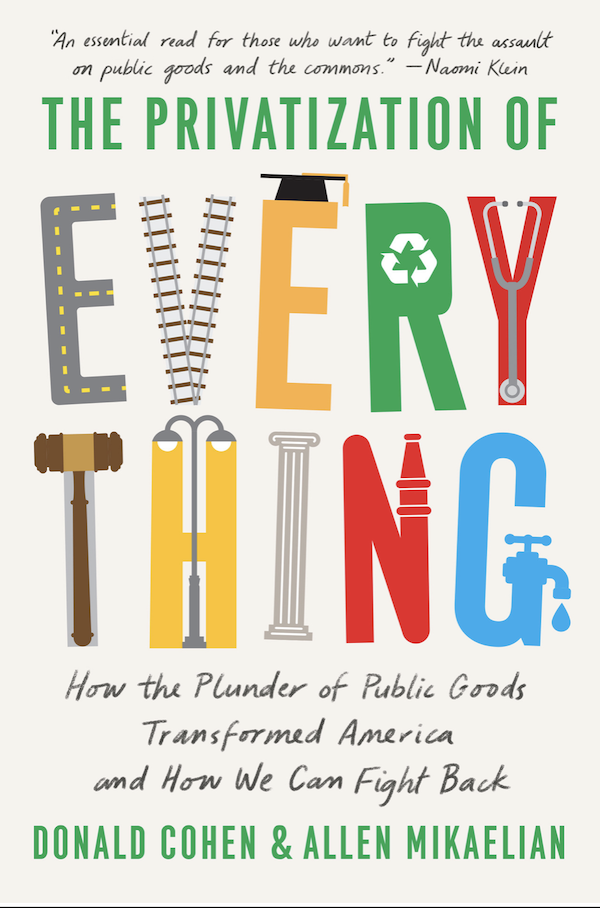
[3]      See also Cohen, D., & Potter, C., 1/7/22, “Why privatization is worse than you know,” Public Seminar (https://publicseminar.org/essays/why-privatization-is-worse-than-you-know/), which, among other things, references the book, The Privatization of Everything, by Cohen and Mikaelian.

[4]      Kaplan, J., & Elliott, J., 3/26/25, “How Elon Musk’s Space X secretly allows investments from China,” ProPublica (https://www.propublica.org/article/elon-musk-spacex-allows-china-investment-cayman-islands-secrecy)

[5]      Myerson, H., 10/22/26, “SpaceX is a de facto government agency. It should be nationalized.” The American Prospect (https://prospect.org/2026/10/22/spacex-government-agency-nationalized-elon-musk-russia-ukraine-starlink/)