HOW THE RICH BENEFIT FROM THE RECORD HIGH FEDERAL DEBT

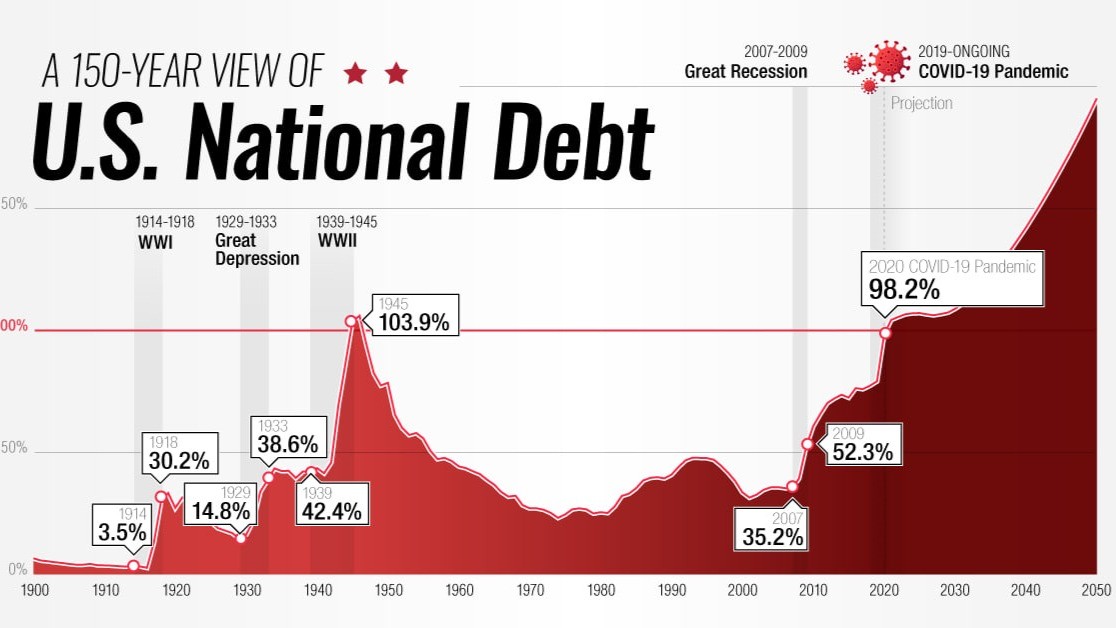
The federal debt was $1 trillion in 1980 and now is $40 trillion due to Republican tax cuts and increased military spending. Wealthy individuals and corporations pay less in taxes and get lots of interest from government bonds. The rest of us are hurt by high inflation and interest rates.

SUMMARY: The federal debt has grown from $1 trillion in 1980 to a record $40 trillion today. President Trump has added $12 trillion to the debt. The causes of the dramatic growth of the debt are quite clear: Republican tax cuts and increased military spending. Wealthy individuals and corporations benefit by paying less in taxes and collecting over $360 billion a year from interest on government bonds. High government debt hurts average Americans by increasing inflation and the interest rates they pay on all types of debt. This all leads to high and growing economic inequality.

(Note: If you find a post too long to read, please just skim the bolded portions. Thanks for reading my blog!)

(Note: Please follow me and see my blog posts on Bluesky at: @jalippitt.bsky.social. Thanks!)

The federal debt has grown from $1 trillion in 1980 to a record $40 trillion today. President Trump has added $12 trillion to the debt in six years as President (despite his promises to reduce it); that’s almost a third of the debt that’s accumulated over the last 45 years. And it’s now growing at a rate of about $2 trillion a year. The debt has grown very fast in recent months, in part because Trump’s tariffs were declared illegal and had to be refunded. [1]

The causes of the dramatic growth of the debt over the last 45 years are quite clear:

  • Republican tax cuts under Presidents Reagan, G. W. Bush, and Trump that primarily benefit wealthy individuals and corporations,
  • Increased military spending including the costs of wars, primarily fueled by Republican Presidents, and
  • At a less dramatic level, one-time emergency spending in response to the Covid pandemic and the economic crash of 2008.

The G.W. Bush and Trump tax cuts gave the richest 20% of Americans 65% of the benefits, while the top 1% got 22% of the benefits. It’s estimated that these tax cuts’ reductions of the federal government’s revenue have added about $11 trillion to the debt since 2001.

Wealthy individuals and corporations benefit from this in two ways. They are:

  • Paying less in taxes, and
  • Collecting a big share of the $1 trillion a year in interest the government is paying for the money borrowed to cover the debt.

Wealthy individuals and corporations used to help fund the government by paying more in taxes. However, top income tax rates for wealthy individuals have fallen from 91% in the 1950s to 37% today. Corporate tax rates have fallen from 50% to 21%. Today, the 400 richest Americans pay an average effective tax rate of only 24%, including federal, state, local, and corporate taxes. Many of them have years where they pay no federal income taxes, including Donald Trump and Jeff Bezos. [2]

This loss of government revenue means the government spends more than it takes in. Therefore, it must borrow money to cover the difference. So, wealthy individuals and corporations now fund government spending by loaning it money (by buying government bonds) and then collecting interest on those bonds.

The federal government is now paying $1 trillion a year in interest on the $40 trillion debt that is covered by selling government bonds to investors. While 30% of the bonds are owned by foreign investors and governments, 70% are owned by domestic investors. These investors include individuals, mutual funds, pension funds, and companies such as banks and insurance companies. The richest Americans own a disproportionate share of financial investments, with the richest 1% of Americans owning 36% of all financial assets. Therefore, a reasonable estimate is that at least 36% of the $1 trillion the government pays in interest, $360 billion a year, is paid to the richest Americans. [3]

The $1 trillion in annual interest payments are $1 trillion that the government doesn’t have to spend on other programs and services. This amount is roughly equal to what is spent on Medicare in a year or what is in the annual Defense Department budget.

Government borrowing of large amounts of money increases interest rates. The rapid current borrowing has pushed the interest rate the government has to pay to get investors to buy its mainstay 30-year Treasury bonds to 5.5%, the highest level in 25 years. As a result, interest rates Americans pay on mortgages, credit card debt, car loans and leases, and student debt are all increasing. The cost of borrowing money for businesses is also increasing. This all increases the rate of inflation. [4]

So, while wealthy individuals and corporations are pocketing billions of dollars due to lower tax rates, they are also collecting billions in interest on their investments in government bonds. Meanwhile, average Americans are paying more on any kind of debt they have, are facing inflation in the prices of the goods and services they need, and are getting less support from the federal government because of reduced spending due to less revenue and more that has to be spent on paying interest on the debt. All of this leads to very high and growing economic inequality in the U.S. (See this previous post for more details.)

For lots of good news see Jess Craven’s Chop Wood Carry Water blog’s most recent good news Sunday post here.


[1]      Johnson, J., 8/20/26, “Economists blame $40 trillion debt milestone on two things: GOP ineptitude and tax cuts for the rich,” Common Dreams (https://www.commondreams.org/news/economists-trump-40-trillion-debt)

[2]      Reich, R., 8/20/26, “Who’s raking it in as the national debt explodes?” Robert Reich blog post (https://robertreich.substack.com/p/who-gets-paid-as-our-national-debt)

[3]      Reich, R., 8/20/26, see above

[4]      Kuttner, R., 8/19/26. “How the cost of money spikes inflation,” The American Prospect (https://prospect.org/2026/08/19/how-cost-of-money-spikes-inflation/)
THE TRUMP FAMILY’S SAUDI ARABIAN CONNECTIONS Part 2

Trump’s friendly relationship with Saudi Arabia and its ruler is evident in his administration’s sales to them of military equipment and artificial intelligence (AI) technology, and his visits to Saudi Arabia. Trump’s extravagant military spending and sales have been called the “Bloody New Deal.”

SUMMARY: Trump’s (and his family’s) friendly relationship with Saudi Arabia and its ruler Mohammed bin Salman (MBS) is evident in his administration’s huge sales to Saudi Arabia of military equipment and artificial intelligence (AI) technology. Other signs of the close relationship are that the first foreign visits of each Trump presidential term have been to Saudi Arabia and that MBS was given the royal treatment on his visit to the White House. Trump’s extravagant military spending and sales have been called the “Bloody New Deal.”

(Note: If you find a post too long to read, please just skim the bolded portions. Thanks for reading my blog!)

(Note: Please follow me and get notices of my blog posts on Bluesky at: @jalippitt.bsky.social. Thanks!)

One example of Trump’s friendly relationship with Saudi Arabia and its leader Mohammed bin Salman (MBS) is his administration’s huge sales of military equipment and of artificial intelligence (AI) technology to Saudi Arabia. (See more below.) Another example of the close relationship is Trump’s recent deal to provide nuclear technology to Saudi Arabia described in my previous post. Trump, and his family, have maintained and built this friendly relationship despite Saudi Arabia being an autocratic, Islamic country whose leader, MBS, is widely believed to have ordered the murder of Jamal Khashoggi, the Washington Post columnist, and whose members were the planners and most of those who executed the 9/11/2001 terrorist attack on the U.S.

Evidence of Trump’s close relationship with the Saudis was made clear in that his first foreign visit of his first term was to Saudi Arabia, not a geographically close ally as is traditional. In May 2017, Trump and Jared Kushner met with Saudi King Salman, then Saudi defense minister MBS, and other Saudi leaders. Trump signed a $110 billion arms deal (growing to $350 billion over ten years) with Saudi Arabia, representing a substantial expansion of the U.S. – Saudi relationship.

Later in 2017, Trump’s son-in-law, Jared Kushner, went to Saudi Arabi for a private meeting with MBS, who had just become the Crown Prince and was taking control of the Saudi government. From late 2017 through January 2019, MBS undertook a purge and shakedown of the Saudi government, ruling royalty, and wealthy Saudi businessmen under a claim of ending corruption. Roughly 500 people were detained: some were beaten and tortured, at least 17 required hospitalization, and some ended up in prison. Assets of up to $800 billion were surrendered or seized. Trump indicated his support for MBS and lack of concern about the purge, shakedown, and their victims. (On June 30, 2026, PBS’s Frontline program aired a 90-minute report, The Crown Prince and the President, which documents many examples of the Trump family’s close relationship with MBS. It’s available on multiple streaming services.)

In 2019, President Trump vetoed multiple efforts to block U.S. military assistance to Saudi Arabia for its war on Yemen and the Houthis, despite strong evidence of significant civilian casualties.

In May 2025, President Trump’s first major international trip of his second term was to Saudi Arabia. The four-day visit focused primarily on securing business deals and investments. He met with Crown Prince MBS and King Salman and participated in a Saudi-U.S. Investment Forum.

In November 2025, MBS visited the White House, receiving the lavish treatment usually reserved for a head of state. (Note: MBS is the Crown Prince not the King, although he is effectively ruling Saudi Arabia. This was his first visit to the U.S. since the murder of Khashoggi in 2018.) The Trump administration approved the sale of an estimated $1 billion worth of advance artificial intelligence (AI) chips – up to 35,000 of them – to Saudi Arabia. This was a major reversal of U.S. policy which had previously restricted export sales of these chips to protect U.S. technology and national security. In particular, there is concern that this AI technology would be obtained by China due to Saudi Arabia’s existing economic and technological cooperation with China. Saudi Arabia’s state-backed AI company has signed contracts with nearly a dozen U.S. firms for AI technology and data centers in Saudi Arabia. [1] During this visit, MBS announced that Saudi Arabia would be investing up to $1 trillion in U.S. investment firms and infrastructure projects.

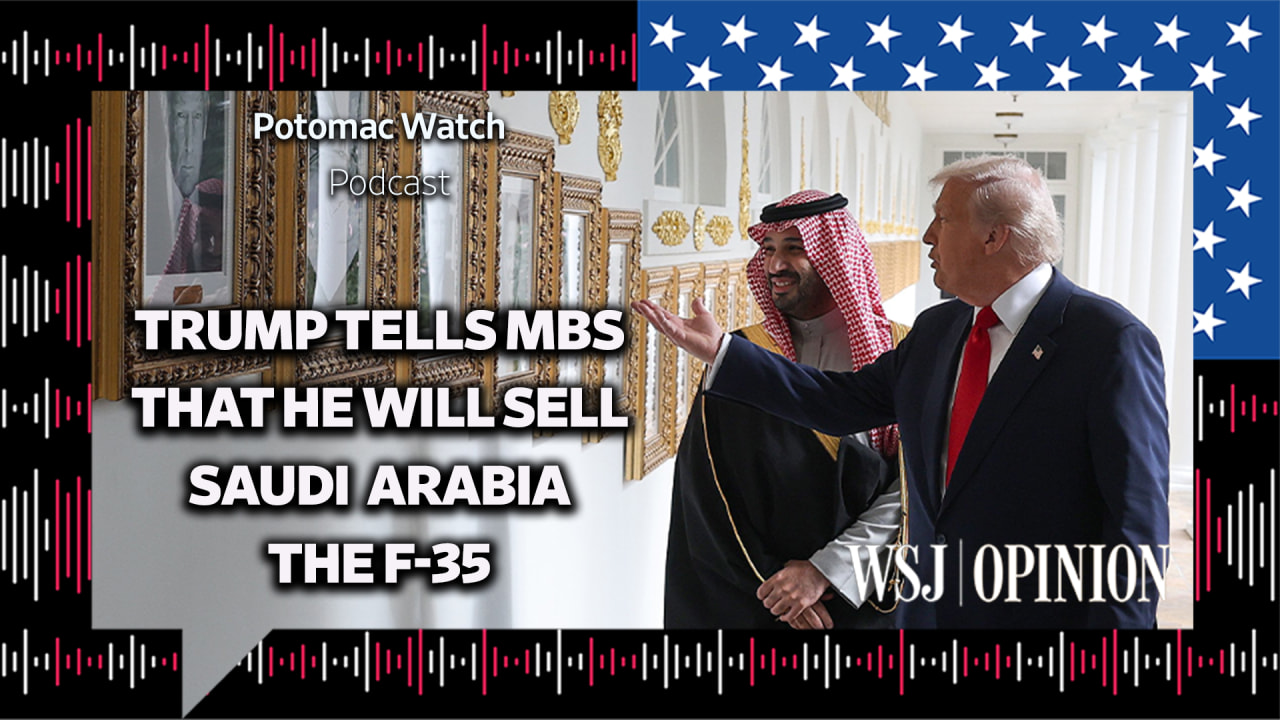
In March 2026, the Trump administration approved a $142 billion sale of military equipment and support to Saudi Arabia. This included 48 of the U.S.’s most advanced stealth fighter jets, the F-35. This represents a significant shift in U.S. arms export policy as only Israel had previously been able to obtain these fighter jets. This has raised national security concerns due to the sensitive technology in these jets, in particular because of Saudi Arabia’s connections with China. [2]

In July 2026, the Trump administration approved $2 billion in sales of Advanced Precision Kill Weapon Systems to Saudi Arabia, including 20,000 missiles.

Saudi Arabia is the largest purchaser of U.S. military equipment and second only to Israel in the technology and sophistication of the weapons systems it buys. The sale of these advanced weapons systems to Saudi Arabia is undoubtedly making Israel uncomfortable.

The hundreds of billions of dollars in military sales to the Saudis, the tens of billions of dollars in ordnance being used in the Iran War, and Trump’s request for a $1.5 trillion defense budget and an $80 billion supplemental appropriation for the Iran War are making the defense industry very happy. This unprecedented funding of the military-industrial complex has been called the “Bloody New Deal.” [3]

My next post will review the real estate and financial deals between Trump family members and Saudi Arabia.

For lots of good news see Jess Craven’s Chop Wood Carry Water blog’s most recent good news Sunday posts here.


[1]      Graham, E., 11/20/25, “U.S. greenlights AI chip exports to Gulf tech giants after Saudi Crown Prince’s Wahington visit,” CNBC (https://www.cnbc.com/2025/11/20/us-approves-ai-chip-exports-to-gulf-after-saudi-crown-prince-visit.html)

[2]      Kumar, A., 3/30/26, “U.S. approves F-35 stealth fighter jet sale to Saudi Arabia under strategic defense deal,” The Defense News (https://www.thedefensenews.com/US-Approves-F-35-Stealth-Fighter-Jet-Sale-to-Saudi-Arabia-Under-Strategic-Defense-Deal/)

[3]      Manning, S., 3/23/26, “Trump’s proposed military spending would be a ‘Bloody New Deal’,” Union of Concerned Scientists (https://blog.ucs.org/sean-manning/trumps-proposed-military-spending-would-be-a-bloody-new-deal/)