WHY GOVERNMENT FUNCTIONS SHOULD BE DE-PRIVATIZED

Privatization of government functions gives a private entity control of a public good or service and is often inefficient and risky. The real goal is often to give businesses profits. Democrats need to reverse privatization. DOD contracts for mission critical capabilities need to be de-privatized.

SUMMARY: Privatization of government functions means giving a private entity control of or power over a public good or service. Privatization is often inefficient and can have safety and national security risks. The real goal of many privatization efforts is to give private businesses an opportunity to make profits. Democrats need to reverse decades of privatization to better serve the public. The companies the Department of Defense has contracted with to provide mission critical capabilities need to be nationalized, most notably Elon Musk’s SpaceX.

(Note: If you find a post too long to read, please just skim the bolded portions. Thanks for reading my blog!)

(Note: Please follow me and see my blog posts on Bluesky at: @jalippitt.bsky.social. Thanks!)

(Note: For lots of good news see Jess Craven’s Chop Wood Carry Water blog’s most recent Sunday post here.)

Privatization of government functions or “outsourcing” means more than just contracting for a prison or selling off a municipal water system. It means giving a private entity control of or power over a public good or service – essential things we depend on including public health, clean air and water, safe food, good education, transportation, health care, utilities, and safety.

Privatization is often inefficient (i.e., costs more and/or delivers lower quality goods or services than public provision) and can have safety and national security risks. (See this previous post for more information.) Privatization tends to be inefficient because it adds a layer of management and profits onto public functions. Any cost savings typically come from paying workers less. Public transparency and control over the delivery of services are typically lost and, in addition, government can lose its capacity to deliver basic services. [1] Private, for-profit companies tend to cut corners and purposely avoid expensive to serve individuals to maximize profits, compromising quality and fairness.

The real goal of many privatization efforts is not greater efficiency but a desire of politicians to give private businesses an opportunity to make profits. Some politicians may believe that privatization will produce efficiencies despite significant evidence to the contrary. However, some politicians may be looking to curry favor with private companies and their executives who can give them campaign contributions.

Some examples of failed or unwarranted privatization (in addition to ones in this previous post) include:

  • Privatization of prisons and detention facilities (see posts here and here for more information)
  • Use of ID.me for logging in to government agencies and information (see this post for more information)
  • Use of CLEAR for expedited security clearance at airports. (TSA PreCheck is the public alternative which costs less than one-tenth as much.)
  • Vouchers for K-12 education in private schools. (They divert money from public schools and typically subsidize well-off parents who are already sending their children to private schools.)
  • Privatization of Medicare through so-called Medicare Advantage plans. (Public Medicare is much more efficient than the privatized plans (i.e., lower cost per patient and better outcomes). Medicare would save about $100 billion a year if these private plans were eliminated. See more information here, here, and here.)

Contracts, vouchers, and just allowing the private sector to provide a service (e.g., rail and bus transportation, electricity, and Internet and phone service) are not the only ways to privatize government functions. For example, federal policies have hamstrung the U.S. Postal Service, including prohibiting it from providing some services, to allow private companies to provide a significant portion of package delivery services. The Department of Defense and other government agencies have been taking ownership shares in private companies, such as strategic minerals, chip making, and small defense manufacturing companies. [2] (For detailed information about privatization and its many variants see In the Public Interest.) [3] (For more information on how the Trump administration has been taking ownership interests in private companies and exerting control over private companies in other ways see this previous post.)

It’s usually more efficient and almost always fairer to have government provide the public goods and services that meet essential public needs (e.g., education, health care, water, sewer, waste removal, electricity, communications, transportation, public safety, and defense). Decades of privatization need to be reversed to better serve the public.

When Democrats take control of Congress in January, they should immediately take steps to slow privatization with a goal of halting additional privatization in the short-term. Over the longer term, they should de-privatize important public functions, such as the provision of Medicare and eventually all of health care.

There are situations where the ownership of private companies should be taken over by the government, i.e., they should be nationalized. The clearest examples are companies the Department of Defense has contracted with to provide mission critical capabilities. Specifically, it has contracted critical satellite-based communications and intelligence capabilities to SpaceX, including use of its Starlink and Starshield communications systems. It is not wise or safe to have these capabilities in private hands, let alone the hands of Elon Musk, the owner of SpaceX. He is a significant national security risk given his business interests, contacts, and engagement with Chinese leaders and investors. [4] Ownership of SpaceX needs to be taken over by the federal government. [5] (See this previous post for more information on Musk, SpaceX, and the national security risks they represent.)


[1]      Kuttner, R., 10/13/26, “Time to de-privatize,” The American Prospect (https://prospect.org/2026/10/13/time-to-de-privatize-federal-government/)

[2]      Groz, Z., 10/22/26, “As lawmakers scrutinize Pentagon equity deals, Pentagon keeps making them,” The American Prospect (https://prospect.org/2026/10/22/as-lawmakers-scrutinize-pentagon-equity-deals-pentagon-keeps-making-them/)

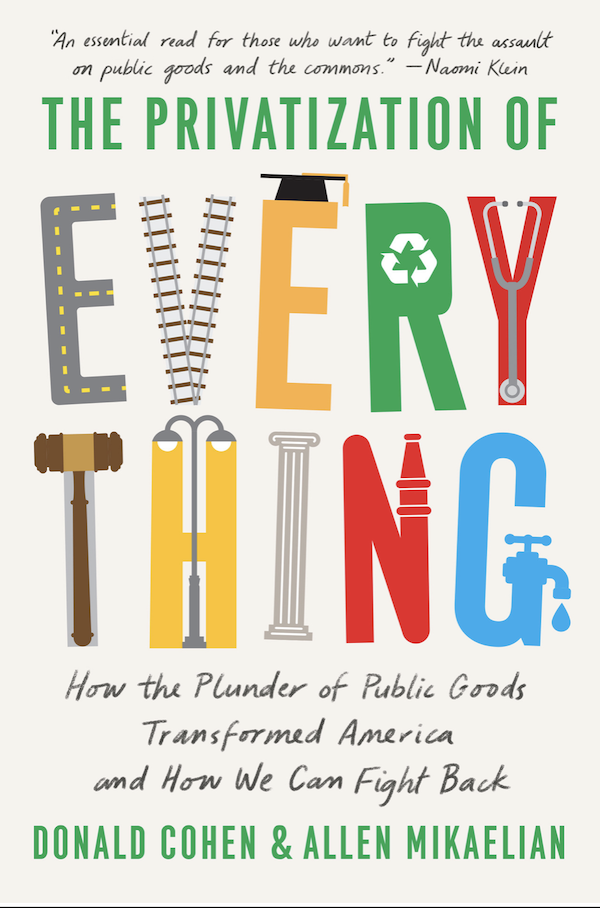
[3]      See also Cohen, D., & Potter, C., 1/7/22, “Why privatization is worse than you know,” Public Seminar (https://publicseminar.org/essays/why-privatization-is-worse-than-you-know/), which, among other things, references the book, The Privatization of Everything, by Cohen and Mikaelian.

[4]      Kaplan, J., & Elliott, J., 3/26/25, “How Elon Musk’s Space X secretly allows investments from China,” ProPublica (https://www.propublica.org/article/elon-musk-spacex-allows-china-investment-cayman-islands-secrecy)

[5]      Myerson, H., 10/22/26, “SpaceX is a de facto government agency. It should be nationalized.” The American Prospect (https://prospect.org/2026/10/22/spacex-government-agency-nationalized-elon-musk-russia-ukraine-starlink/)

THE AFFORDABILITY CRISIS Part 2

Cost of Living Crisis theme done in a Posterised style. Inflation – Economics, cost, shopping basket, supermarket

The affordability crisis (aka cost of living crisis) in the U.S. is multifaceted and has been growing for 45 years, due to low pay and high prices. There are many factors pushing up prices well beyond normal inflation, including profit-taking middlemen and privatization of public goods and services.

(Note: If you find a post too long to read, please just skim the bolded portions. Thanks for reading my blog!)

(Note: Please follow me and get notices of my blog posts on Bluesky at: @jalippitt.bsky.social. Thanks!)

My previous post presented an overview of the affordability crisis (aka cost of living crisis) in the U.S., its 45 year history, and began a discussion of why prices are so high. It covered:

  • Monopolistic price gouging,
  • Tariffs, and
  • Personalized (aka surveillance) pricing driven by artificial intelligence (AI).

This post will discuss:

  • Profit-taking by middlemen (aka intermediaries) from ticket sellers to drug benefit managers that increases costs for consumers, often unjustifiably and even illegally.
  • Privatization and the fraud that often accompanies it leave consumers and taxpayers with higher costs and often degraded quality.

Middlemen, also referred to as intermediaries, are entities that operate between consumers and the producers of goods or services. Ostensibly, they make the market operate more efficiently by linking consumers and producers, while making transactions easier and smoother. However, given their need to make a profit, they often end up more focused on profit-making than helping markets operate efficiently. They add a layer of costs to consumers’ purchases, pushing up prices. [1]

Pharmacy Benefit Managers (PBMs) are a classic example of  middlemen. The original intent was to reduce drug costs, saving insurers and consumers money, but that has morphed into rapacious profit making by manipulating the market and increasing drug costs for consumers. PBMs manage drug benefits for insurance companies and largely determine which drugs are available to insurees and how much they will pay for them. There are three huge, monopolistic PBMs that manage the great majority of drug benefits for private insurers, which is a $600 billion global market. They have found that they can be very profitable by negotiating kickbacks from drug manufacturers (that may be half the cost of a drug) for the drugs they include in an insurer’s formulary, i.e., the list of insured drugs and how much consumers must pay for them. They also sign contracts with pharmacies that tend to reward the big chains and make it very hard for independent pharmacies to exist. It’s estimated that 42 cents of every dollar paid for prescription drugs now goes to a PBM. Meanwhile, the PBM industry spends over $10 million a year lobbying the federal government to block regulation. [2]

As with the PBMs, other monopolistic middlemen often find ways to manipulate the market to make big profits by not only increasing prices for consumers but also lowering the prices they pay to producers. Amazon, once it gained monopolistic control of various e-commerce sectors, has shown itself to be a master at squeezing producers to minimize costs, while also figuring out ways to maximize its revenue from consumers.

Live Nation (parent company of Ticket Master) is another example of a monopolistic middleman. It dominates ticket sales for entertainment events and jacks up prices and adds junk fees to boost its profits. It has increased its monopolistic power by also managing thousands of performers and purchasing many entertainment venues. [3]

Middlemen, from Wall St. asset managers and stock traders to real estate agents, eBay, and the apps that deliver food to your door, add their costs and profits to transactions, thereby increasing prices for consumers. Some have been found to engage in illegal or at least unethical ways to increase their profits.

Meat packers are middlemen that buy meat from ranchers and farmers, process it, and sell it to consumer outlets, e.g., supermarkets. There are four giant meat packers that engage in monopolistic practices, both in the buying and the selling of meat. This, and illegal collusion, has led them to be very profitable as prices for consumers have increased dramatically while the prices they pay to meat producers have fallen. In October 2025, the meatpackers settled two separate price-fixing lawsuits for almost $300 million for illegally jacking up the prices of beef and pork.

As with middlemen, the privatization of goods and services typically delivered by government is presented as a way to make markets more efficient. There are many examples such as privatization of Medicare, roads and bridges with private tolls, and electricity, water, and sewer systems operated by private entities. Often, the profit motive leads to increased costs for consumers and decreased quality of the goods or services delivered.

For example, the federal government has allowed the privatization of the delivery of Medicare health care services to seniors through what are called Medicare Advantage plans. They are run by private insurers and are very profitable because they make it hard to get some health care services (especially expensive ones) and because they cheat the federal government. They cost more than traditional, publicly provided Medicare and deliver worse outcomes. It is estimated that Medicare would save at least $75 billion a year by eliminating Medicare Advantage plans. Because taxpayers pay for Medicare, they are driving up the taxes we all pay for Medicare’s health care. [4] (See this previous post for more detail on the Medicare Advantage rip off.)

Another example is Connecticut’s largest water system, which serves over 200,000 homes and businesses, and is privately owned by Eversource, the large New England utility corporation. It’s asking for a 42% rate increase ($88 million a year) or to allow it to be sold for $2.4 billion to a nonprofit, quasi-public entity. Many experts believe such a sale would lead to higher costs for consumers and weaker regulation. [5] This highlights the complexity and risk of having a public good such as water in private hands.

My next post will discuss the premiumization of markets, meaning that products and prices target consumers with high incomes, and factors that are keeping wages low.


[1]      Curry Wimbish, W., 12/5/25, “Meet the connectors,” The American Prospect (https://prospect.org/2025/12/05/meet-the-connectors-middlemen/)

[2]      Curry Wimbish, W., 12/5/25, see above

[3]      Dayen, D., 4/30/24, “Live Nation strikes up the band in Washington,” The American Prospect (https://prospect.org/2024/04/30/2024-04-30-live-nation-strikes-up-band-washington/)

[4]      Johnson, J., 1/28/26, “A $1.2 trillion ‘rip off’: Report spotlights massive scale of Medicare Advantage fraud,” Common Dreams (https://www.commondreams.org/news/medicare-advantage-fraud)

[5]      Associated Press, 12/18/25, “Connecticut’s largest water company seeking 42% rate increase,” The Boston Globe, Business Talking Points

FIXES FOR HUGE, BILLIONAIRE-OWNED NEWS AND MEDIA COMPANIES

Huge news and media companies are dangerous and harmful. They control the information and disinformation we receive. They are not providing voters with the information they need to maintain a well-functioning democracy. Here are steps to rein in and compensate for their dangers and harm.

Huge news and media companies owned by billionaires are dangerous and harmful. They control the information and disinformation we receive. They are not providing voters with the complete, balanced, factual information they need to maintain a well-functioning democracy. Therefore, we need, individually and through government policy, to take steps, such as those below, to rein in and compensate for their dangers and harm.

(Note: If you find a post too long to read, please just skim the bolded portions. Thanks for reading my blog!)

(Note: Please follow me and get notices of my blog posts on Bluesky at: @jalippitt.bsky.social. Thanks!)

My previous post focused on the dangers of huge, for-profit, billionaire-owned news and media companies in the TV, radio, print, and social media markets. It noted how their profit motive drives divisive content and a focus on culture war issues. And how this skews our politics and the focus of politicians and the public, while it undermines democracy.

This post focuses on how we can respond to this corruption of our news and media both personally and through government and institutional actions, including the following: [1] [2]

  1. Most immediately, patronize independent, reader / viewer funded news media. In particular, support local media, including local Public Broadcast System (PBS) radio and TV, as well as local print and on-line news sources. Your time spent reading / viewing and subscriptions to these outlets and, if you can, your financial support boosts their viability. Share their content; comment on and like their reporting. (Here’s a link to a previous post that identifies eight sources of news and analysis that I recommend. Much longer lists by topic are available here from Project Censored. Note: Project Censored’s primary goal is to highlight stories un- or under-reported by the mainstream media, i.e., effectively censored by them.)
  2. Enhance media literacy for ourselves, our families, friends, and colleagues. Build critical thinking skills so we and everyone we know can distinguish truth from misinformation, disinformation, lies, and fiction, i.e., real news from fake news. Encourage schools and adult learning programs to include courses on critical thinking and media literacy. More information is available from PBS here.
  3. Expect and, where possible, require news and media companies to clearly and fully disclose conflicts of interest and biases. When they don’t, call them out with comments, posts, letters to the editor, etc. Media watchdogs and professional associations should lead the way on this. Ultimately, ownership of news and media companies by individuals and entities with other business interests should be banned. This would prevent many conflicts of interest and biases. It would also insulate the news and media companies from being manipulated by government officials or others through leverage via other business interests. For example, Jeff Bezos owns The Washington Post and also Amazon, which has significant government contracts and is affected by many government labor regulations. Similarly, Elon Musk owns X and has many interests via government contracts and regulations on his other companies. Therefore, they are both susceptible to manipulation by President Trump.
  4. Viewers’ and readers’ personal information should be protected (e.g., ban its collection) and it should be illegal to use it to tailor individual’s news feeds. Personal information is currently used to feed audiences one-sided and slanted information, including disinformation, to spark their emotions and therefore their engagement. This is divisive for society and undermines democracy by failing to provide voters with complete, balanced, factual information.
  5. Regulate social media with a combination of Federal Communications Commission (FCC) standards and public utility regulations. These would require them to serve the public interest and to stop harming children. They should be liable for failures to moderate content for accuracy, to prevent hate speech and other inflammatory messages (e.g., calls for violence), and to prevent harm.
  6. Reinstate rules on fairness and accuracy in broadcast media that the FCC repealed in the 1980s. Require that news divisions operate independently of executives, advertising, and shareholders, as they did prior to the 1980s. The relicensing of TV and radio stations for their use of the public airwaves should enforce these standards and serious fines should be levied for violations of them.
  7. Use antitrust laws and anti-monopoly regulations to stop any further consolidation in the news and media industry. Ultimately, the huge conglomerates should be broken up. The FCC should change its rules and lower the number of news and media outlets any one entity is allowed to own in local, regional, and national markets.

Huge news and media companies are dangerous and harmful. They control the information and disinformation we receive. Their billionaire owners have biases, including politically. They are not providing voters with the complete, balanced, factual information they need to maintain a well-functioning democracy.

This situation is not inevitable. Personal and institutional actions, including public policies of governments, can change it. Steps, such as those above, need to be taken to rein in and compensate for the dangers and harms of huge news and media companies with billionaire owners.


[1]      Reich, R., 11/26/25, “The billionaires destroying our media system and what to do about it,” Common Dreams (https://www.commondreams.org/opinion/billionaire-ownership-media)

[2]      Reich, R., 12/2/25, “The monetization of rage,” (https://robertreich.substack.com/p/the-monetization-of-rage)